

Kelly Marsh
Student-Faculty Research Is Going Strong at Vassar
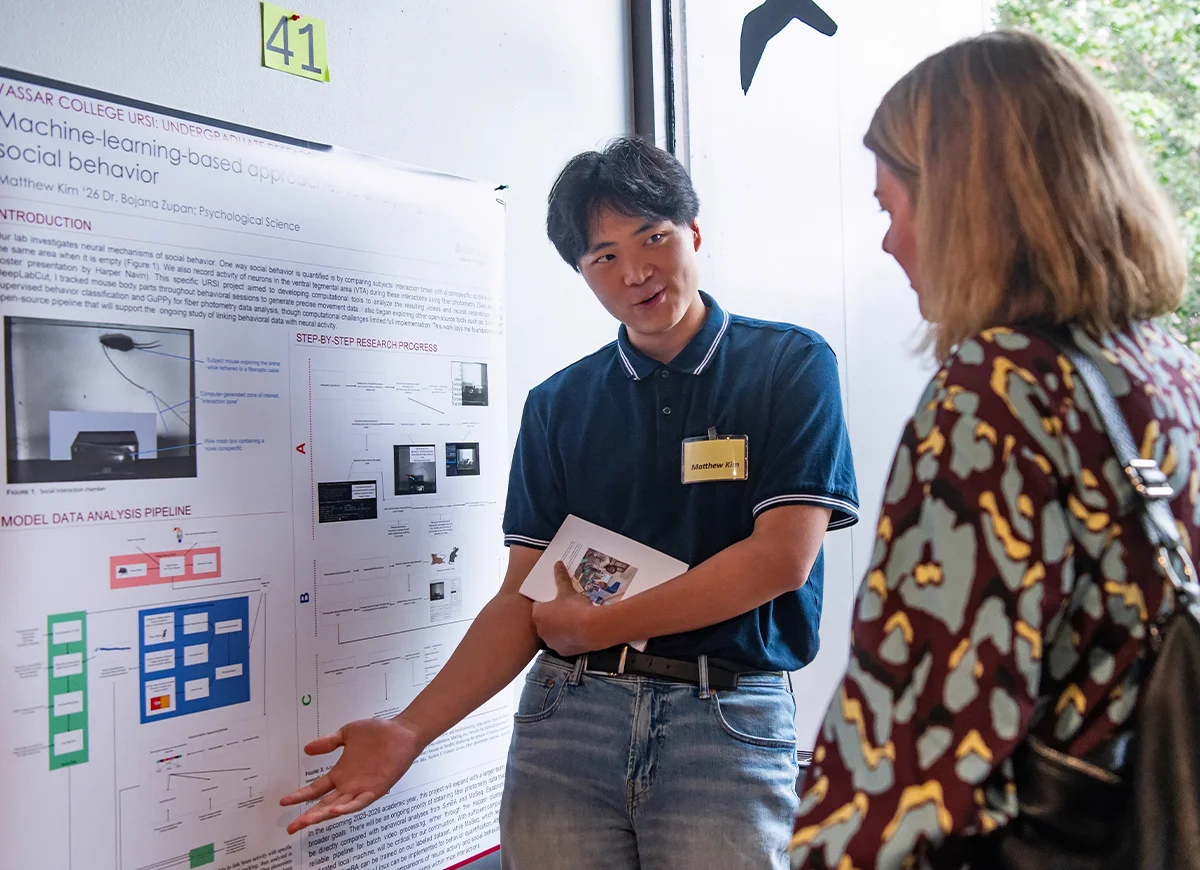
“What we do at Vassar that very few places do is to provide hands-on opportunities for actually touching the data as an undergraduate,” said Abigail Baird ’91, Professor of Psychological Science on the Arnhold Family Chair, herself a former URSI student researcher who went on to earn a PhD at Harvard. “The irony is that a small liberal arts college continues to provide top-tier training and is preparing students to be in the laboratory at a time when so many larger research institutions have been forced to reduce or eliminate student positions.”
Vassar programs remain strong because they are supported by a host of private foundations, endowments from alums, faculty grants, and other independent donations. Read on for a sampling of the projects.
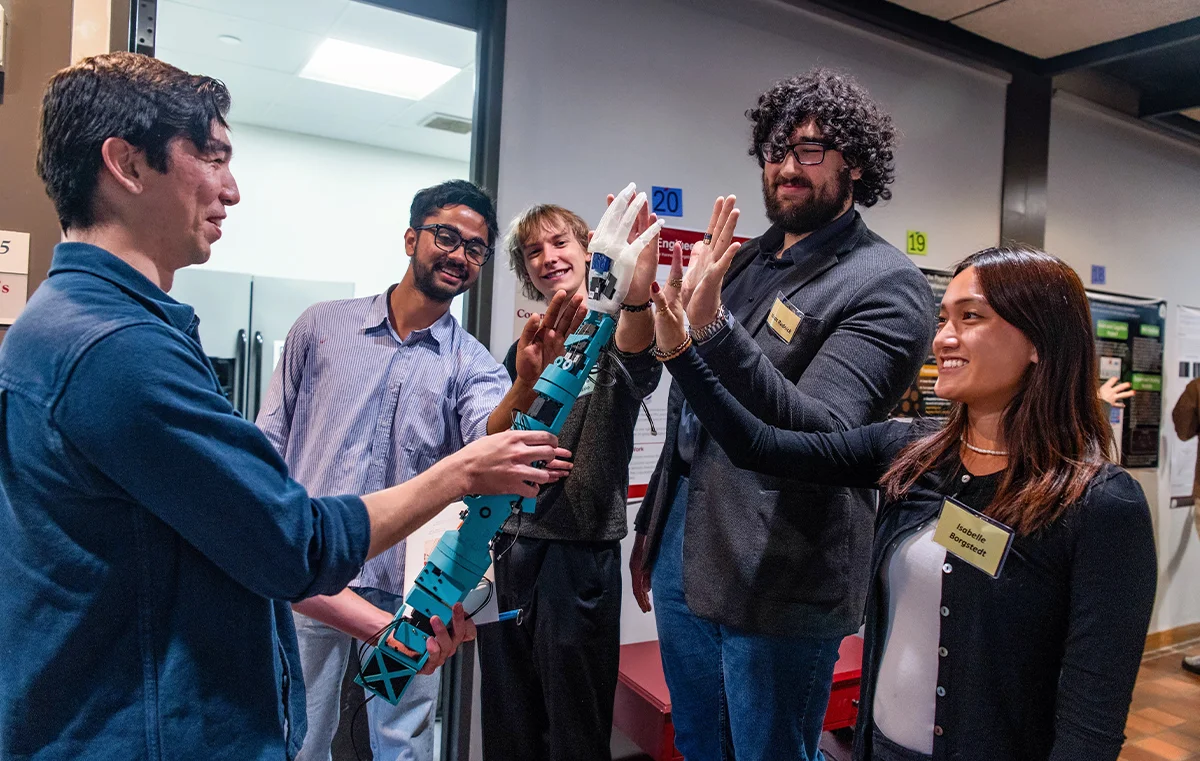
A Robot High-Five
Kelly Marsh
The Oviedo Project: Translating a 500-Year-Old Text About Life in the Americas
La Natural Hystoria de las Indias describes the lives of the colonized people, flora, and fauna of the region. It had never been fully translated into English until Paravisini-Gebert undertook the project in collaboration with Michael Aronna, Associate Professor of Hispanic Studies. “It’s been a challenging project because we are really working with three languages—16th-century Spanish, modern Spanish, and modern English,” said Lilli Palmer ’27, the Ford Scholar who took part in the project this year. The first volume of the translated text will be published later this year—in time to commemorate the 500th anniversary of the completion of Oviedo’s work in 1526.
Assessing Moose Presence and Status in a New Hampshire Forest
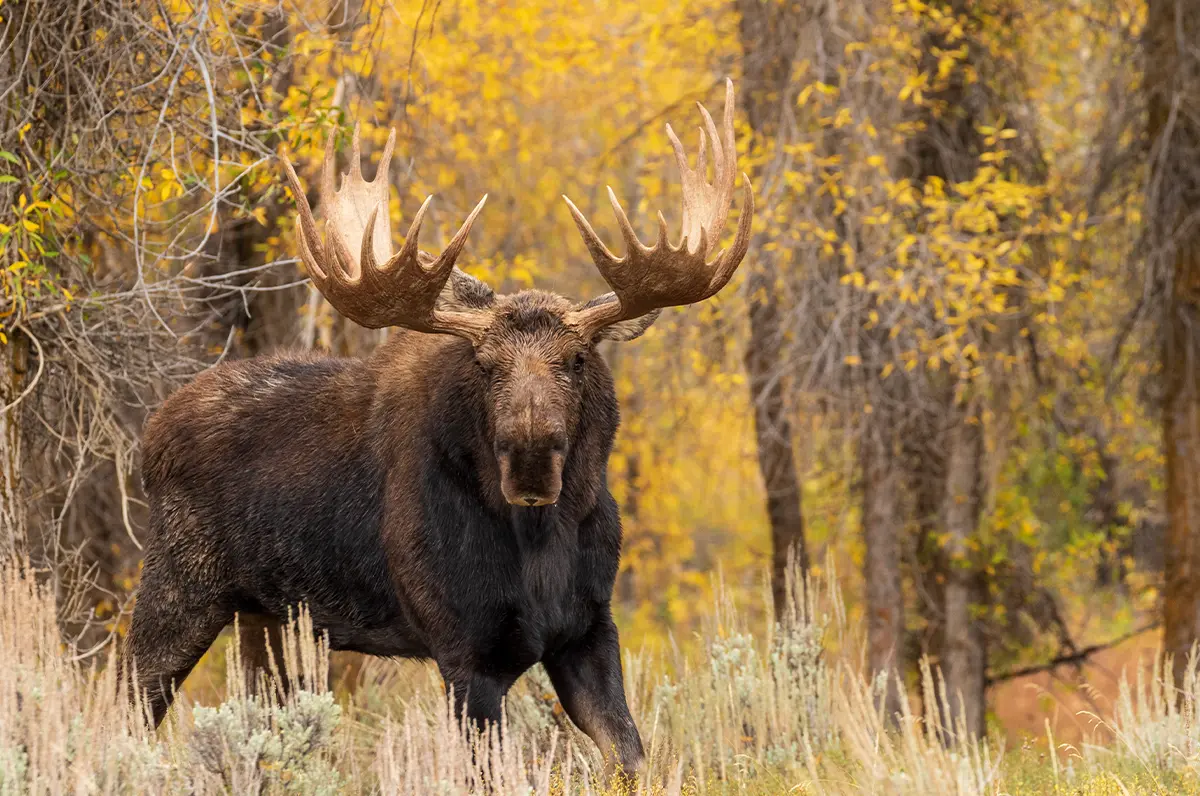
URSI student Otis Wildman ’26 and Associate Professor of Biology Lynn Christenson spent the summer evaluating how climate change is affecting the moose population at the Hubbard Brook Experimental Forest, a 7,800-acre northern hardwood forest located in the White Mountains of New Hampshire. On the trip, they monitored cameras that captured the movements of moose and other wildlife. When he returned to Vassar, Wildman used specially designed software to map and analyze the data. “My experience was really useful and let me gain some insight from professionals in the field,” he said.
Natureguy / Adobe Stock
Monitoring Water Quality in the Hudson River and Its Tributaries
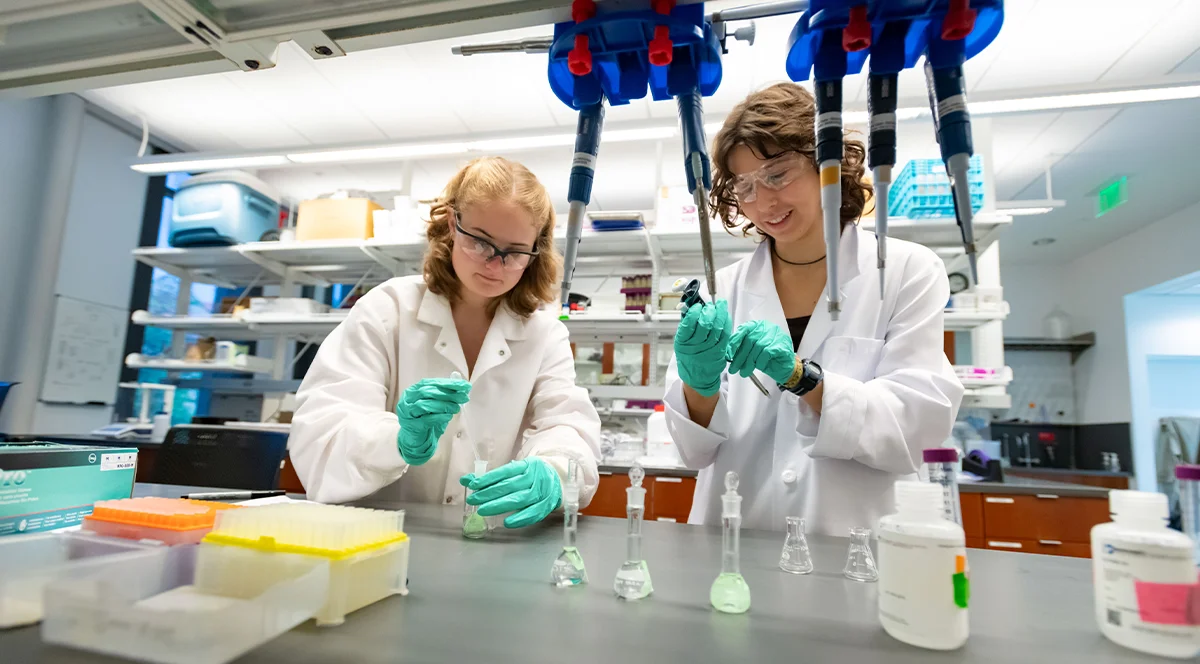
The students analyzed water samples they collected in a lab back at the College, assessing the prevalence of phosphates, which can serve as key indicators of the river’s health. “Phosphates are present in rocks and plants in the water,” Oteiza explained. Too much can indicate the presence of sewage and other pollutants in the river, while too little can also signal other threats to the river’s ecology. The research showed that the levels have not changed significantly since a previous study was conducted about 30 years ago. “I really enjoyed getting out in the community and meeting people who live along the river who are affected by its ecology,” she said. “This summer’s experience was a combination of scientific research and community interaction.”
Faculty mentors for the project were Assistant Professor of Earth Science and Environmental Studies Deon Knights and Associate Professor of Biology Justin Touchon. Both said they had been impressed with their students’ independence in completing the project. “The students were pretty autonomous, and we gathered a lot of good data,” Knights said.
Mitigating Prejudice Development
As an example, team member Asiyah Abbas ’27 said, “All U.S presidents have been men and none have been women. So why is that? Most of it’s because of voter bias and a lot of barriers for women to get into fields like politics. But a child would immediately jump to inborn qualities [of women] and think that this discrepancy is fair, which it obviously is not,” Abbas said.
With the help of a cartoon game-based experiment designed by Peretz-Lange, the students met with hundreds of 5- to 10-year-olds in person and over Zoom to understand their reasoning about fairness. No matter how the research turns out, Peretz-Lange said, the mixed group of student-scientists are already changing the face of the profession for children, who often see science as a male profession—that can discourage girls from wanting to pursue science.
The Costs and Benefits of Empathy
“Basically, we asked ourselves: What psychological resources or strategies can people turn to that would allow them to be more compassionate, especially when they are dealing with many stressors or challenges in their lives?” They asked their URSI students to take that concept and run with it.
Madeline Busam ’26 became intrigued by “self-concept clarity”—the extent to which an individual’s beliefs about themself are clearly and confidently defined. With her professors’ help, Busam designed a survey to measure self-concept clarity and its potential correlation with compassion burnout, recruiting about 300 adult participants through the data site prolific.com.
“We’ve definitely found some stuff that correlates with what I have predicted: That having a higher level of self-concept clarity is going to lead to greater well-being and less compassion fatigue,” said Busam. Baird said she and Morrow will continue to work with Busam, who is one of at least two students in this group likely to be able to publish their studies. “She’s going to see it all the way through with not one but two professors supporting her as an undergraduate, and that’s a wonderfully unusual setup,” Baird said.
“It’s been very helpful and eye-opening for what I want to do after Vassar,” said Busam, who is considering pursuing psychological science in grad school. “I think I’ve been able to get a lot of skills out of it that I wouldn’t have gotten at a big school where your professor might not even know your name. Being able to work on this small a scale, one-on-one, has been really amazing.”
Karl Rabe
Analyzing NBA Player Contracts
Koppolu, who will continue analyzing the actual outcomes of the players’ gambles during the academic year, said collaborating on a single project with a faculty mentor was an enlightening experience. “It was like I was at one end of a maze and he was at the other, and while he tried to guide me, I had to make a lot of decisions on my own because he couldn’t see what I was seeing.”
Said Ge, “This was truly a collaborative effort, and [Koppolu’s] liberal arts training helped him deal with the challenges he faced independently and iron out most issues himself.” These are abilities that will serve Koppolu well in his post-Vassar life, his mentor predicted.