

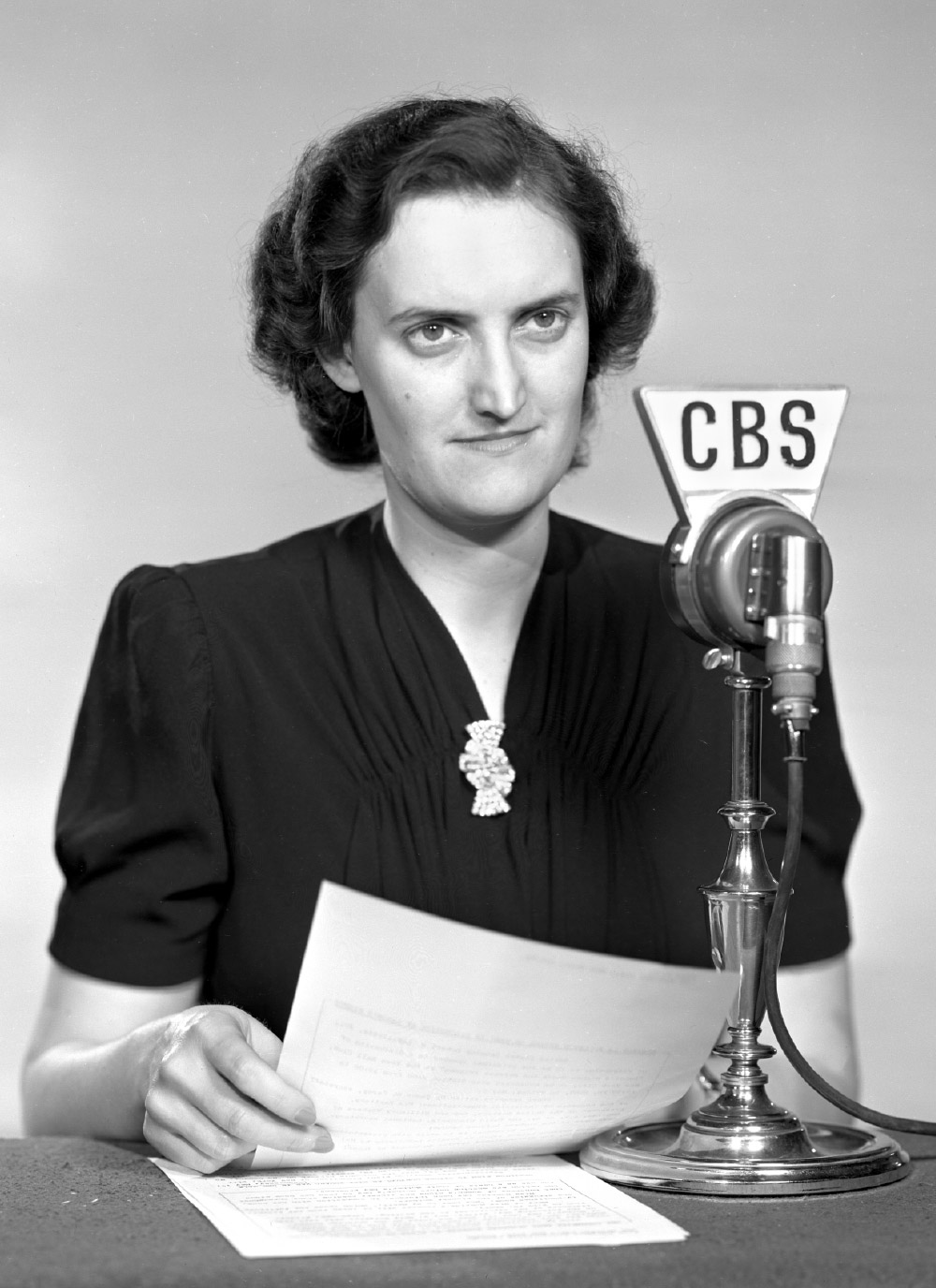
The “Murrow Boy” Who Went to Vassar!
Breckinridge fled to Britain and began documenting that island nation as it braced itself for WWII. In a letter, she confessed, “. . . It now seems foolish to run away from the most interesting thing I could be doing on Earth right now.” Over dinner, her friend Edward R. Murrow asked her to do a broadcast of her story about an English village preparing for war for Life. Breckinridge was unaware that Murrow had asked CBS executives to tune in. She aced the audition and became the only woman to join the “Murrow Boys.”
Mary Marvin Breckinridge was born on October 2, 1905, in New York City. Her maternal grandfather was tire magnate B. F. Goodrich, and her paternal great-grandfather was John C. Breckinridge, Buchanan’s vice president and the Southern Democrats’ 1860 nominee for president. The second oldest of four and the only girl, she began photographing the sights of her hometown with a Pocket Kodak when she was nine years old.
Breckinridge majored in history and modern languages at Vassar, where she became known as “Bric.” After returning from a meeting of the International Confederation of Students in Copenhagen, she helped found the National Student Federation of America (NSFA), and in 1927 was elected its president. She befriended Edward R. Murrow, who became NSFA president in 1929.
After graduation, Breckinridge considered foreign service but instead chose a more unconventional path. “I enjoyed parties and coming out, but I didn’t want to make a whole life of it.” She went to Appalachia to join her cousin, Mary Carson Breckinridge, who had established the Frontier Nursing Service, dedicated to reducing the mortality of mothers and infants. Mary Marvin learned motion picture photography and lugged her hand-cranked camera through the hills to shoot “The Forgotten Frontier,” a fund-raising film about the service. Gradually, Breckinridge forged a career as a photojournalist.
When Breckinridge began covering the war, Murrow told her to use her full name: “Give the human side of the war, be honest, be neutral, and talk like yourself.” He did not edit her scripts. Cool and self-assured, Breckinridge spoke with a clear, upper-class accent that sounded vaguely British to American listeners. Murrow assigned her to the Netherlands, a neutral country fearing German invasion.
Breckinridge had a dog tag made to identify herself in case of the worst and checked into the Carlton Hotel in Amsterdam. Her broadcasts from Holland were part of the CBS Sunday-night roundup, World News Today. Breckinridge was frustrated by the lack of feedback from America, but cheered by Murrow’s support. “Your stuff so far has been first rate. I am pleased, New York is pleased, and so far as I know, the listeners are pleased. If they aren’t, to hell with them.”
Breckinridge chose most topics herself, but CBS wanted stories to provide the “women’s angle.” She soon grasped that one telling detail could dramatize a scene. She, for example, described the Netherlands’ refusal to plan for military cooperation with the British by analogy. “Holland is wearing her Little Red Riding Hood of neutrality, but she’s a bit scared just the same as she goes through the wood.”
In January 1940, Murrow Boy William Shirer requested leave to visit his family in Switzerland, and Murrow asked Breckinridge to take his place in Berlin. She agreed, and the last leg of her train ride to Berlin was so crowded that Breckinridge stood wedged against a window and found that the arm of her coat froze to the glass. Waiting for her in Berlin was Jefferson Patterson, a Foreign Service Officer at the U.S. Embassy. Patterson, a Yale graduate, had been an artillery officer in World War I. The two had met in Washington, DC, and had begun corresponding. The day she arrived, Breckinridge accompanied Shirer on a long subway ride to a 2:00 p.m. broadcast at the German Radio complex, then back to the Adlon Hotel to dine with Patterson. No cocktails, she explained; she had to attend Hitler’s 9:00 p.m. speech at the Sportspalast, write her script, then return to the studio for a 1:00 a.m. broadcast. Patterson thought, I shall have to move rapidly to keep up with such energy!
Customarily, Breckinridge marked her scripts to indicate delivery speed and emphasis but dropped this practice in Germany to avoid telegraphing her intent to censors. The censors at Völkischer Beobachter, Germany’s most widely read newspaper, which Hitler had purchased in 1920, missed the irony in her conclusion: “The motto of this important official paper is ‘Freedom and Bread.’ There is still bread.”
Breckinridge found time to accompany Patterson on one of his official diplomatic duties, visiting POW camps on behalf of Great Britain and France to ensure compliance with the Geneva Convention. A German officer wondered why new POWs were apprehensive upon arrival. Breckinridge replied they must have heard about the concentration camps at Dachau and Buchenwald.
Before she returned to Amsterdam, Patterson proposed. Breckinridge accepted but requested no announcement. Patterson, fearful she needed time to think it over, visited Amsterdam twice before the German Blitzkrieg plunged west but had to inform his fiancée that marriage would end her broadcast career. State Department rules forbade diplomatic spouses from publishing news or opinions.
Breckinridge’s biggest confrontation with censors occurred on a report about the National Socialist Movement (NSM), the Dutch Nazis. The local censor sent her script to The Hague for approval. When the delay stretched on, Breckinridge threatened to leave the Netherlands if they killed the story. A friend suggested a workaround. She rewrote the piece, prefacing the report with mundane local news. The bombshell came when she summarized her interview with NSM leader Anton Mussert. “I asked him, ‘What would you do if Germany should invade Holland?’ He said he would sit with folded arms.” Although Breckinridge’s story was only broadcast in America, the Dutch government used it to chastise the nine NSM members in the Dutch Parliament.
On May 10, 1940, Germany attacked France and the Low Countries. Breckinridge caught the last train from Amsterdam to Paris, where she joined CBS correspondent Eric Sevareid to report the debacle. Her May 28 broadcast announced Belgium’s surrender, “leaving the … way to Dunkirk open to the German divisions.” Her reports depicted desperate refugees streaming into Paris. “Anxious people waited in the station for train after train, and when their people did not arrive, they’d say to each other, “There’s another train in half an hour. There’s another train in half an hour.” She gave her last broadcast on June 5 and cabled her resignation to CBS. With impeccable timing, she boarded the last train from Paris to Genoa before Italy declared war and closed the border.
Between air raids, Breckinridge caught a train from Genoa to Berlin. On June 20, she and Patterson had two marriage ceremonies, a mandatory civil one beneath a portrait of the Führer at the local registry office and another by a minister at the U.S. Embassy. Attempting to preserve normality despite the war, the couple invited a few friends from the press and diplomatic corps to celebrate, but once people saw the unrationed food Patterson obtained from the U.S. Embassy in Denmark, the wedding party swelled enormously. “At least the champagne held out,” Patterson wrote.
Their brief honeymoon at Lake Eibsee in Bavaria was darkened by news that France had fallen. Patterson returned to the grim task of visiting POW camps. Although Breckinridge was barred from entering and talking to POWs, she still questioned German officers outside. “She was not particularly reticent about interrogating people,” Patterson explained. Breckinridge attempted to restart her career as a photojournalist and wrote a story for Harper’s Bazaar, but the State Department blocked publication.
For the next 18 years, she fulfilled the role of a diplomat’s wife but missed her days as a radio broadcaster. “I liked it more than any job I ever had.”