

THE FUTURE OF WORK
WHERE DO HUMANS FIT IN THE AGE OF AI?
n retrospect, she says she’s glad she studied philosophy at a liberal arts college rather than majoring in computer science elsewhere. “It gave me a far more holistic and, frankly, innovative view of applying these newish AI techniques to different kinds of problems and the confidence to continue pursuing innovation in things that didn’t exist yet.”
She went on to work as New York City’s first Chief Technology Officer and Chief AI Officer at NYU, obtained four AI-related patents, and now consults with start-ups and universities on AI technology.
While many of us are just starting to learn about AI and wonder how it will change the employment landscape, Tantoco already has extensive experience with the technology.
She says that although today’s headlines often focus on what AI can do, a deeper question is where humans fit into an AI world. Everyone entering the workforce now, she points out, needs to be literate in AI. “They need to know how to use AI to do their job better and be familiar with all the different chats and with automation.”
Beyond that, she predicts, there will also be a need for subject matter expertise. “I think there’s going to be a need for people who can train the AI in some specific subject matter. So it’s going to place a much greater emphasis on subject matter expertise, because how else can you train it if you don’t, yourself, know the topic?” she points out. “Maybe in the future you will go to an intelligent doctor robot who will just consume all of your blood tests and your family history and conduct. But somebody has to train those systems to do it.”
A tipping point for the workforce
The Microsoft Work Trend Index 2025 found that more than 8 in 10 business leaders view 2025 as a pivotal year for rethinking operations, one in which AI is prompting major shifts in how they approach their strategies, structures, and decision-making. The report refers to this as the rise of the “frontier firm,” an agile organization highly reliant on on-demand intelligence and run by hybrid teams of humans and AI assistants.
The index reports that frontier firms are already forming and expects that every organization will be on the path to becoming one within the next two to five years. Eighty-one percent of those surveyed stated that within the next 12 to 18 months, they expect AI agents—automated systems that can perform tasks or make decisions independently—to be integrated into their company’s AI strategy, either moderately or extensively.
According to the Microsoft report, an increasing reliance on AI agents may result from leaders and employees being “tapped out.” In the global workforce, 80 percent of leaders and employees say they lack time and energy to do their work, 53 percent of leaders say productivity needs to increase, and 82 percent of leaders expect to use agents to meet the demand for more workforce capacity.
LinkedIn, according to the report, predicts that 70 percent of the skills used in most jobs today will change by 2030 and that AI will be the catalyst. Already, it reports, more than 10 percent of people hired on LinkedIn globally have job titles that didn’t exist in 2000.

Top Four Reasons Employees are Turning to AI
Organizations are demanding more from employees but are keeping a tight human headcount. According to the Microsoft Work Trend Index 2025, employees use AI rather than turning to a colleague for these reasons.
Cite the 24/7 availability of AI
Say AI gets the job done faster and/or with higher-quality output
Turn to AI for an endless stream of new or creative ideas
Choose AI for its infinite capacity for repetitive or complex tasks.

Jackson Chidiac ’26 is an example. He spent the summer as a Generative AI Intern with the AI software company BlueSpace, where he worked on a chatbot project. He says he uses AI a lot. “If I’m working with a technology I don’t understand well, rather than comb through all its documentation, I’ll often just ask ChatGPT. It makes it really easy to understand a new topic, but often at a surface level.”
He also talks about the value of using AI to solve problems. All this lets him work and solve issues faster, but he says, “I fear this shortcutting makes the learning process actually take longer.”
When employers figure out the best ways to use AI in the workplace, their expectations of productivity will likely grow, he says, “and those that don’t know how to use it will fall behind.
Ryan Kilpadi ’25, who has worked as a software engineer at Amazon Web Services for three summers (and starts there permanently this fall) says large language machines are great tools but he thinks the “hype” is overblown. “A lot of people are under the impression that AI can write pretty much any code a junior engineer could write, and the only reason there are still software jobs is because AI isn’t good enough yet to replace a few very skilled programmers.” But the engineers he’s worked with rarely use AI to directly write code.
He’s skeptical of the narrative that the difficult entry-level job market has to do with AI automating simple tasks that would normally be left to new grads. “Maybe increased productivity could reduce the need to hire as many people, but, in my view, the current capabilities of AI have resulted in a modest but significant boost in productivity rather than full-blown automation,” he says.
Liberal arts get its moment
There’s no question that AI is transforming how work happens. At the same time, something is happening that might be surprising or even counterintuitive: Many experts agree that the sometimes maligned liberal arts education is becoming increasingly relevant and valuable in an AI-driven workplace.
That’s because even the most sophisticated machines, of course, don’t think. They mimic patterns and generate predictions based on data. They can’t understand context, nuance, or emotion.
“That’s what the humanities are for,” says Tantoco. “Programming is going to become less and less important, because computers will write the code. What will be important is how you define a problem and identify the solution. It will become even more important to study things like philosophy, ethics, history, and have those interpretive and analytical skills that a liberal arts education gives you.”
That sort of interdisciplinary thinking teaches one how to define a problem, look at the context, set up tests, provide feedback, and identify solutions.
“Machines can do all the boring, easy stuff,” Tantoco reminds us. “You need to lean into what you have to offer as a creative, critical-thinking human being.”
Jannette Swanson, Director of External Engagement at the Center for Career Education, says says that Vassar students and alums have a liberal arts education that gives them the flexibility and adaptability AI demands. “They may have that skill set much better in hand than those from other educational backgrounds.”
“AI is ever-changing and fast evolving, and I think liberal arts grads are, by their very nature, nimble,” she says. “That nimbleness makes them particularly well suited to engage.”
In a world where you have AI coworkers, being deeply human might be the most powerful skill of all.
The worldwide AI transformation
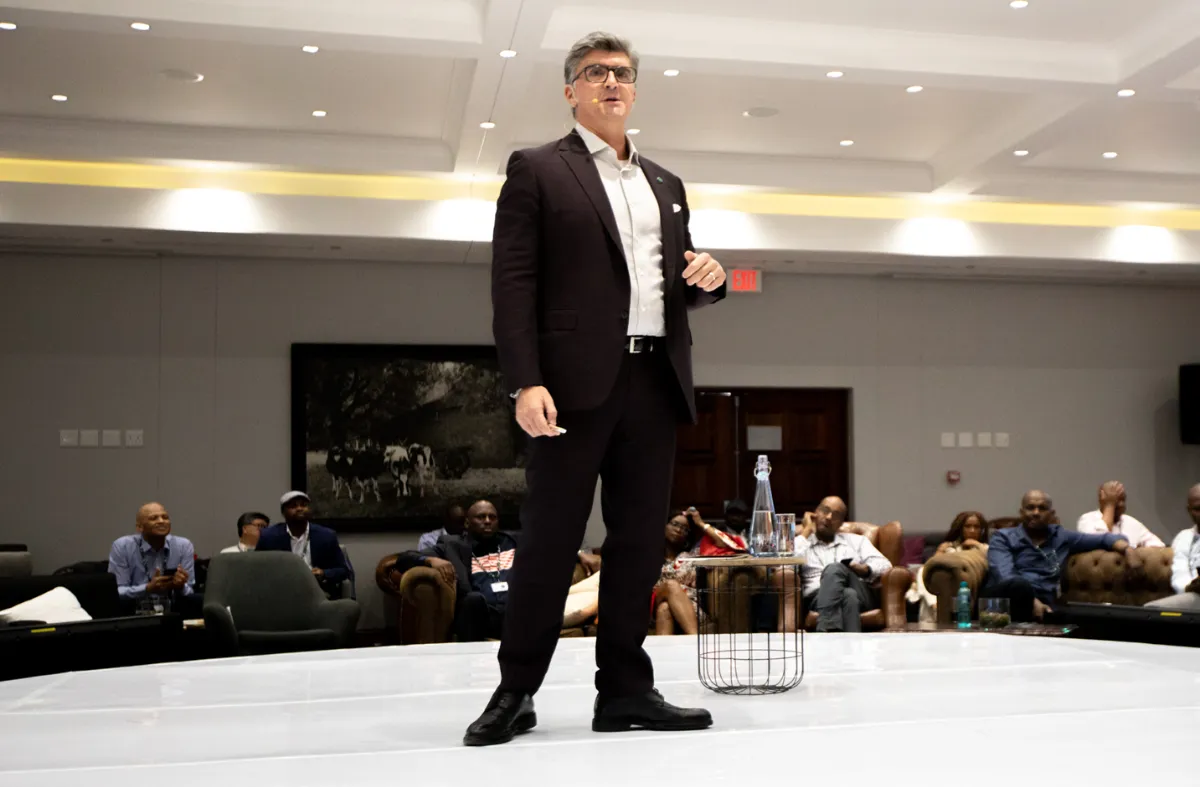
Steven Hatfield ’88 recently retired from Deloitte Consulting, where he had his finger on the pulse of the AI transformation. He led the company’s Future of Work initiative, an annual report that examines worldwide trends in human capital, behavior, work, transformation, diversity, and other related areas by surveying large numbers of mid-level and senior HR professionals each year.
He asserts that this is not the first time the work landscape has changed dramatically, pointing to the automation that took hold when England began using looms to mechanize the production of cloth. He says people have been concerned about it since the Luddites, who rebelled over the impact of that new technology on their jobs.
In such previous technological transformations, though, someone had to introduce the technology, figure out how it fit into the business model, and then teach the workforce to use it.
Hatfield says that AI is entering the world in a very different way. “The workforce is actually pulling it into the workplace themselves, much more than any other technology,” he says. AI is already changing tasks, workflows, and how we think about work roles, and he asserts it’s critical to keep the conversation focused on people and how they will adapt in an uncertain employment future.
Like Tantoco, he is convinced that liberal arts students will be valuable players as we continue to shift how work gets done, and the most valuable employees will be the ones who know how to think.
“There’s a growing realization,” he remarks, “that human skills, curiosity, creativity, and ethical judgment are going to matter more, not less.”
Helping students navigate the AI era
Vassar, which offers an interdisciplinary curriculum and an emphasis on social responsibility, already helps students meet the changing demands that the workforce will soon face. Students learn how to navigate complexity, consider diverse perspectives, question assumptions, and go to the source. These provide a strong foundation for careers that require constant learning and reinvention.
Many educators and career advisors, including those at Vassar’s Center for Career Education, are focusing their energy on the rapid adoption of AI technology and where and how humans fit in. Stacy Bingham, Vassar’s Associate Dean of the College for Career Education, and Jannette Swanson at the Center for Career Education—work closely with students who want to understand how work is changing and ensure their value to potential employers.
The Career Education team has integrated AI literacy into its workshops and job and career search as well as its career planning and counseling services. Team members teach students how to use generative AI as a brainstorming tool when writing résumés or cover letters, to determine how best to present past experiences such as internships or summer research experiences for a specific job application, or to generate a list of questions for an informational interview. They also help students recognize where AI tools fall short and where human insight is still needed.
However, Bingham says networking remains the most effective job search technique. It’s another way human connections are becoming even more critical in this digital, AI-driven job search process. “The Vassar network is deep and wide and brimming with goodwill, and we’re telling students to double down on humans as part of their job search,” she says. “It’s always nicer if somebody comes with some kind of human endorsement or referral. (For more insight into the use of AI in job search and recruitment, see here.)
How work is being rewritten
So, what does the future of work actually look like?
Some positions will disappear. Others will change, and some new ones will emerge. For example, “prompt engineering,” a phrase we’ve been hearing with increasing regularity, is now a highly sought-after skill. Project managers are learning how to lead AI-augmented teams. Some marketers are starting to blend automation with personal storytelling.
These developments demonstrate that while AI tools are evolving, the need for human leadership remains unchanged.
There’s also the question about whether AI will mean the end of entry-level jobs that the tech can do. Hatfield says this will undoubtedly occur in some industries, but that it creates outcomes worth paying attention to.
“Those organizations will still need to figure out how they bring in entry-level folk,” he says. There will still need to be a channel for entry-level employees to join the organization, he explains, so they’ll need to restructure their work to accommodate this, or the company may not survive.
“They may decide they only want experienced hires who are at a certain caliber after a certain number of years, and that’s fine, but then they’ll have to figure out where they’re getting those folks from, too. That restructuring of the work itself has yet to be done.”
If an organization plans to do a limited amount of entry-level hiring, Hatfield recommends hiring those with an intrinsic set of skills that can’t easily be taught to complement what AI is doing for the company. “So suddenly you’re right back at the big picture thinker, and the great writer and the communicator and the empathizer and the person that can be perceptive and navigate the body politic. And so that liberal arts skill set, and those intangibles that come through what you’re studying and how you’re learning it, become very, very important.”
Embracing uncertainty
Tantoco says it’s reasonable to be concerned about how work is changing, but points out that it always has. She talks about the first time she visited the New York Stock Exchange. “People were still waving bits of paper and yelling at each other to make trades. Now, it’s a near-empty room with three guys looking at a screen. But that doesn’t mean the stock market went away. It just created different kinds of roles.”
She says what’s interesting is the stock market was able to scale more after it no longer had a lot of people in a room waving bits of paper. “With every change, there’s both risk and opportunity,” she points out. That also applies to the forthcoming flood of AI.
Vassar’s annual Sophomore Career Connections program hosts alums from the technology, law, media, and policy industries, and, of late, there’s been a good deal of discussion about the impact of AI. Panelists have shared examples of how they are using AI tools in real-world situations to accelerate research, solve problems, and launch new ideas.
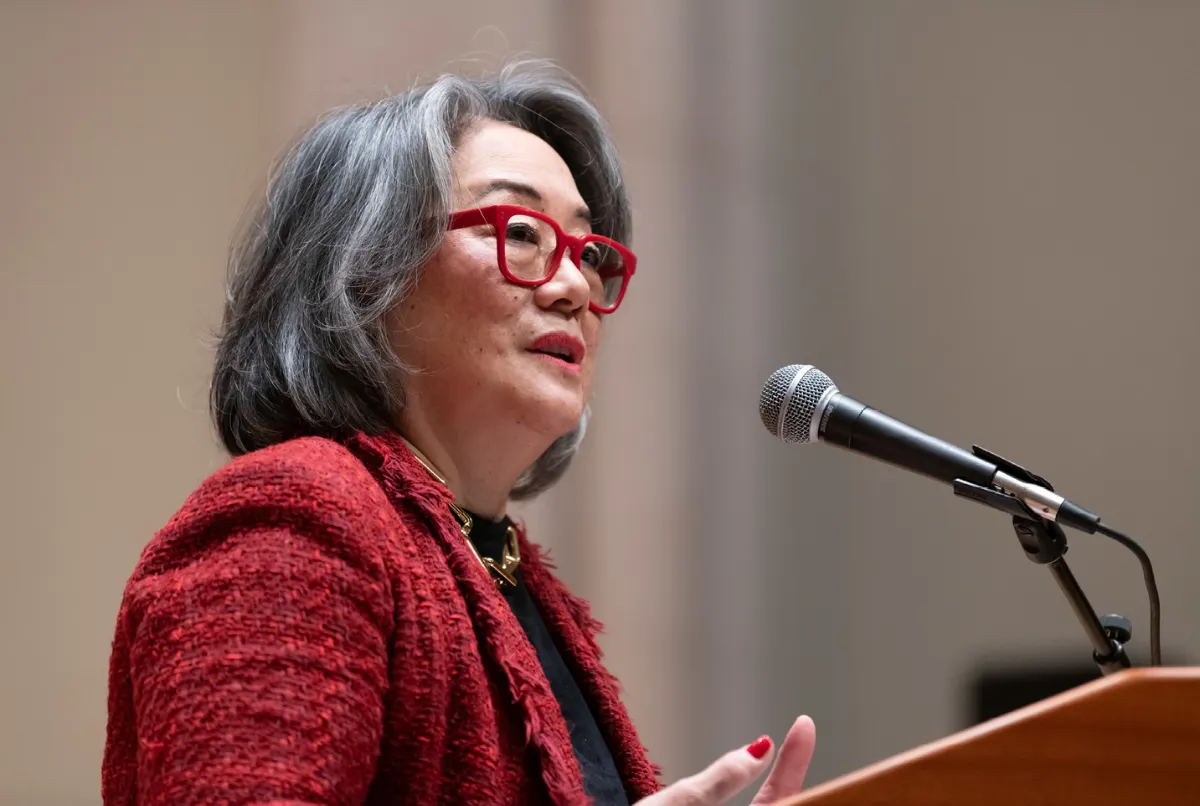
At the January conference this year, Tantoco delivered the keynote speech in which she offered a simple but powerful message: “It’s very important now to know AI, no matter what industry you’re in,” she said. “AI isn’t going to take your job. Someone who knows how to use AI is going to take your job.”
As the workplace continues to shift, perhaps the most powerful preparation isn’t knowing what comes next, but learning how to think, adapt, and keep asking the right questions.