


Summer 2025 Vassar Quarterly


VOLUME 121 ISSUE 2
THE ALUMNAE/I QUARTERLY
Contents

Departments
Leveraging AI
n recent years, liberal arts colleges and universities have seen a distinct shift toward students wanting to major in and pursue careers in STEM; this has been aided by the seismic shifts in knowledge exploding in STEM fields and a marketplace that pays bigger salaries, at least in the beginning, for people with STEM skills. As a liberal arts faculty devoted to multidisciplinary work, Vassar faculty have adapted by enhancing academic advising (e.g., pushing students to take wild-card courses outside their major interests); reducing credit hours needed for a major, enabling students to double-major, often combining STEM with humanities, language, arts, and social-science courses of study; and creating new multidisciplinary paths that integrate STEM and social sciences or humanities (e.g., Science, Technology, and Society; Data Science and Society; Cognitive Science; and Environmental Studies).
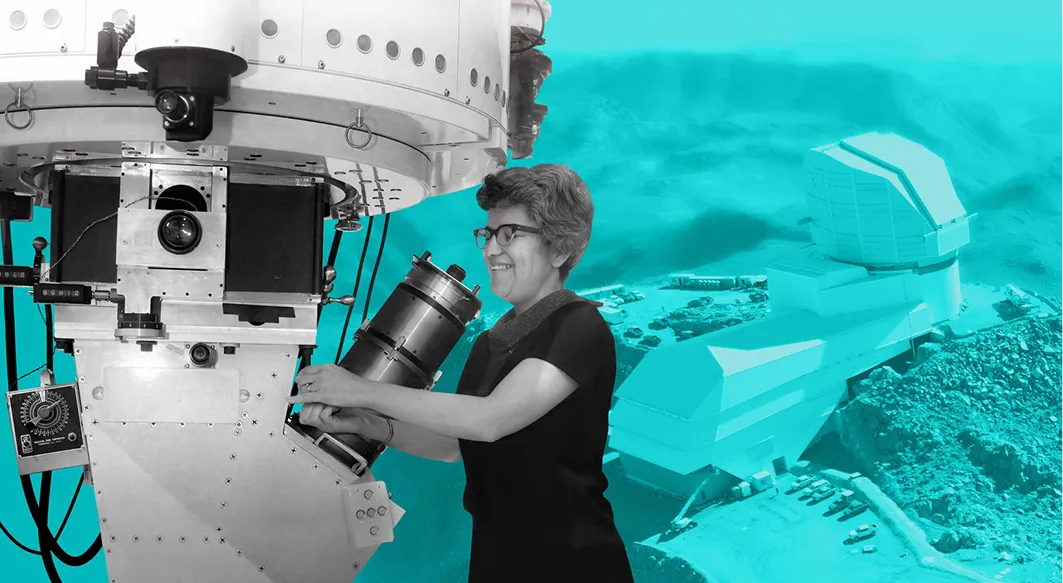
With the advent of AI, all bets are off. It seems that some STEM entry-level jobs may be replaced by AI. Instead of privileging coding or data-analysis skills, employers may be looking for the ability to integrate multiple disciplines, to think outside the box, and to anticipate problems and create solutions—all central to the education and curricular innovations for which Vassar is known. In particular, the multidisciplinary approach—crossing boundaries and finding new perspectives on old problems—may be most valued. This is vintage Vassar. Think Grace Hopper, Vera Rubin, Frances “Sissy” Farenthold, Urvashi Vaid, Anthony Bourdain, and many more.
How are we leveraging AI? To the extent that students, faculty, and staff are experimenting with generative AI in their everyday work, the College is actively pursuing ways to help them do so safely and responsibly—without putting Vassar data at risk. Researchers are using AI to record and transcribe qualitative data and to more quickly perform routine coding tasks. Faculty members in Cognitive Science have trained an AI on the same readings that are assigned to introductory students. Students then, as part of an assignment, must interrogate and evaluate the performance of the AI. Faculty across the College are considering new approaches to assessing knowledge and skills gained—from blue-book written exams to oral exams to integrative and creative individual and group projects. In short, the AI revolution is making us think and innovate, and that is good for higher education.
It is not all rosy. AI presents a whole new set of ethical, social, economic, political, and cultural dilemmas and challenges—issues that cannot be avoided and will impact our collective futures. This is the environment in which liberal arts best thrives: one that has opportunity, uncertainty, and the ability to create anew. Vassar students, faculty, and administrators are navigating these advances in education with openness and courage so that we can experiment, revise, and refine our work to meet the moment, as Vassar always does.
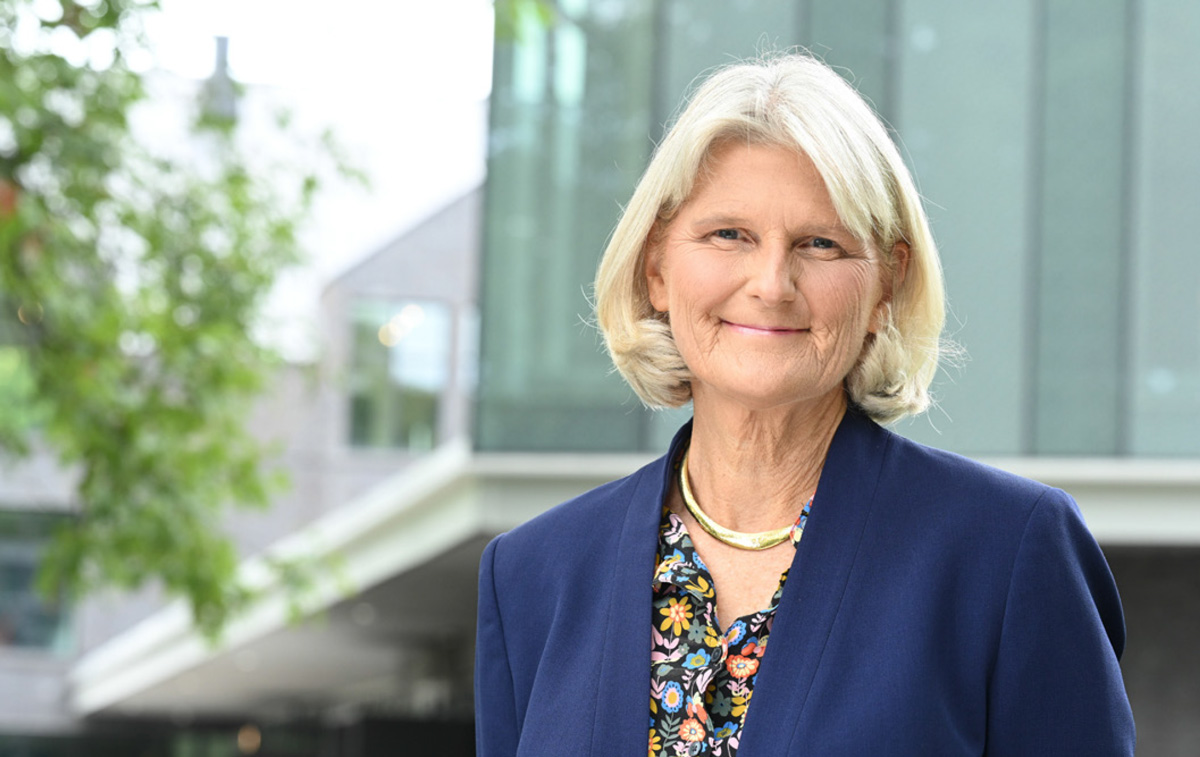

Elizabeth H. Bradley
President
Kelly Marsh
Understanding the Impact of the Vietnam War
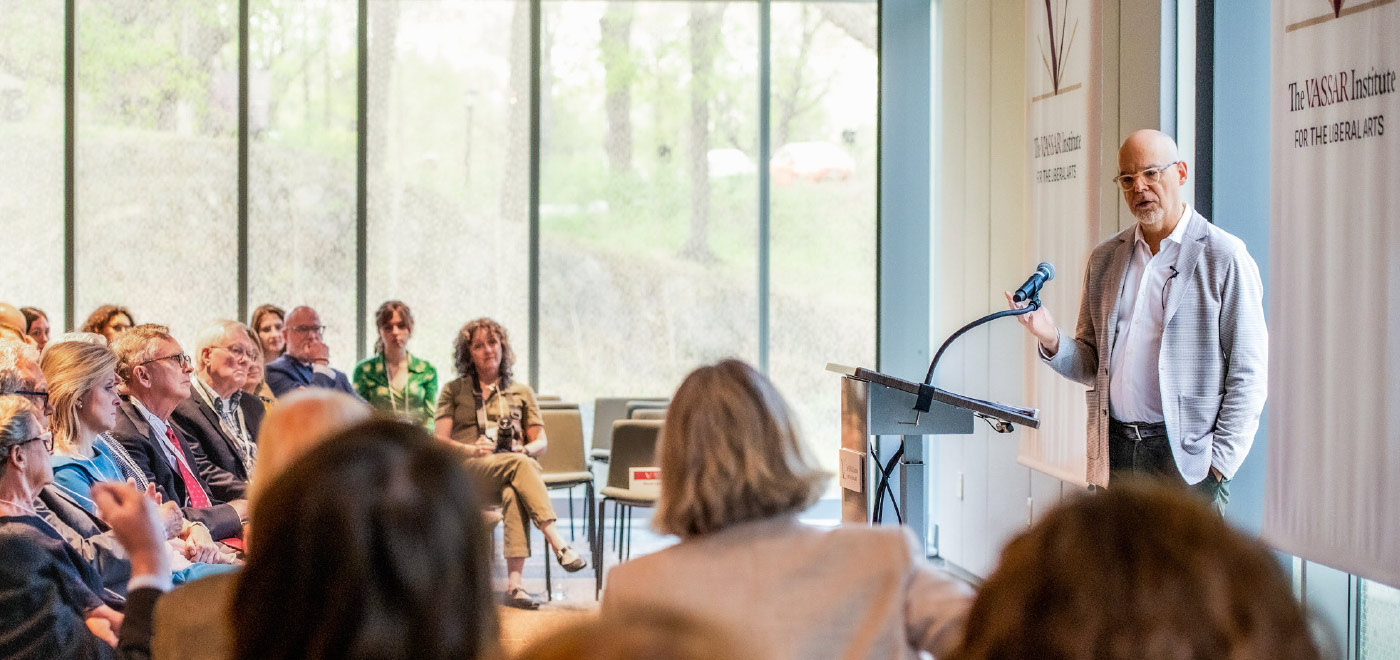
As keynote speaker, Logevall kicked off Remembering the American War in Vietnam: A Fifty-Year Retrospective this spring at The Vassar Institute for the Liberal Arts. Convened by Robert K. Brigham, Vassar’s Shirley Ecker Boskey Professor of History and International Relations, the conference brought together distinguished presenters who shared their experiences and insights on a wide range of issues, including domestic politics, foreign relations, military strategy, and the roles of women and race.
“We grew up with the war in so many ways—in our families and communities, on TV,” said Brigham of the 73 million baby boomers who came of age in the 1960s and 1970s. “It permeated the national consciousness as much as the music that became the soundtrack of that era. It was impossible to avoid, and it’s still resonating.”
In his Thursday evening presentation, Logevall contended that today’s politics of resentment stem from the era when Americans first learned that their leaders were lying about the war.
“I suggest that many of the troubles that plague our nation today—alienation, resentment, cynicism, the mistrust of government, the breakdown of civil discourse and of civic institutions, and the lack of accountability in powerful institutions—have their roots in the Vietnam War era,” he said. “You could argue that Americans went from naivete at the outset of the Vietnam era to cynicism—and cynicism, which alienates us from the government, threatens democracy because it destroys the power of the people to believe in change, and to work for change.”
Kelly Marsh
“Since 1990, Vietnam and the U.S. have been working toward renewed relations,” he said, pointing to the current administration’s initial refusal to have a diplomatic presence at receptions in Saigon. “It says something larger about this administration’s lack of confidence in America’s place in the world.”
Remarks by Peter Osnos—author, journalist, publisher, former foreign and national editor, The Washington Post—dovetailed with both Daddis and Logevall. “There are ironies galore,” he said. “What we went through in Vietnam should have given us real lessons, but the lessons were not learned. We were ignorant of Vietnam’s history, context, and language when we went in, and it was the same in Iraq and Afghanistan, although they were in different parts of the world and of a much smaller scale. We left one in frustration, the other in failure.”
“During the 1960s, lots of Americans—people in uniform and civilians—saw the U.S. military as a model of racial progress,” Bailey explained. “But the institution was definitely not exempt. It did not stand apart from the broader society from which it drew its members, and from which it was going to return its members.”
Toward the end of the 1960s, the perception of colorblindness, fueled by Black Freedom and Black Power movements back home, was impossible to maintain.
Keynote Speaker
In response, the military instituted race training, handbooks, and seminars and, in 1971, established the Defense Race Relations Institute. Understanding race as a critical issue also brought the awareness that culture also mattered.
“That awareness also led to affirmative action programs within the Department of Defense that brought more people of color into enlisted ranks, and also as judges and lawyers,” Bailey explained. “These were very successful programs that continued up until the most recent administration.”
The military and civilian organizations that sent women to Vietnam also had to grapple with rapidly changing ideas about gender and sexuality. Women chose to go to Vietnam for a variety of reasons, including a sense of duty and opportunities for independence as nurses saving lives, soldiers in the Women’s Army Corps, or participants in the Red Cross’s Supplemental Recreational Activities Overseas Program. “Women in the war felt the expectation that they be conventional symbols of American womanhood, even as they endured wartime conditions and performed work that challenged those very traditional assumptions,” said LCpl. Kara Vuic, Benjamin W. Schmidt Professor of War, Conflict, and Society in 20th-Century America, Texas Christian University.
Their Vietnam experience—from oppressive hierarchies and a lack of formal recognition to routine harassment—also played out when they returned home. Many not only felt out of step with their peers but saw their contributions devalued in civil society, both professionally and personally, and it often took them decades, if ever, to achieve recognition. The most tangible legacies in this struggle are reforms within the VA, including the establishment of the first women’s health clinic and the Vietnam Women’s Memorial, dedicated in 1993, after decades of persistence.
Today’s military, despite the current administration’s devaluation of women’s contributions, relies on women to fulfill every role.
How The Vassar Network Fuels Success

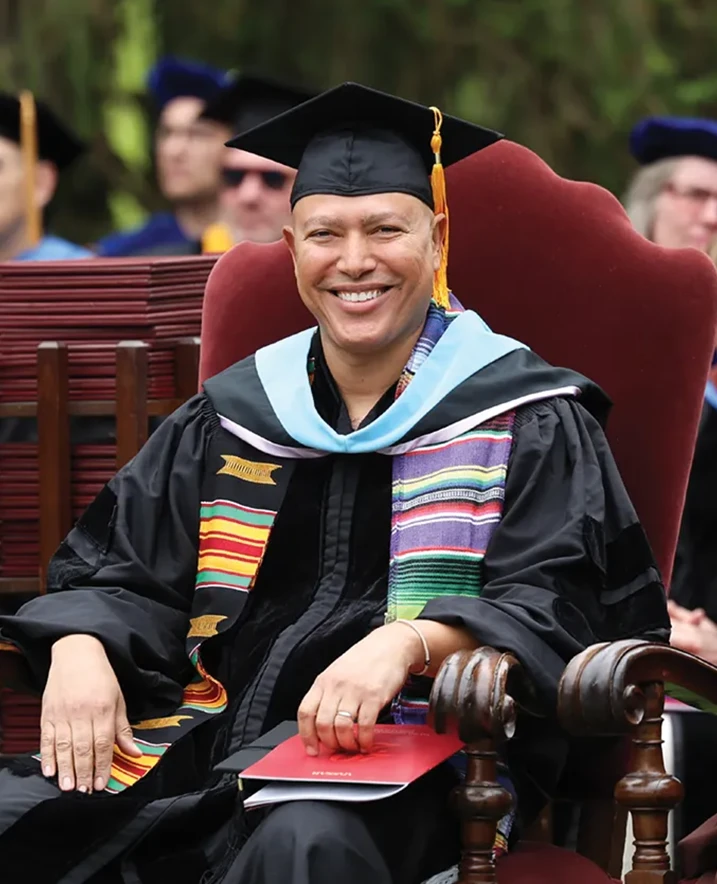
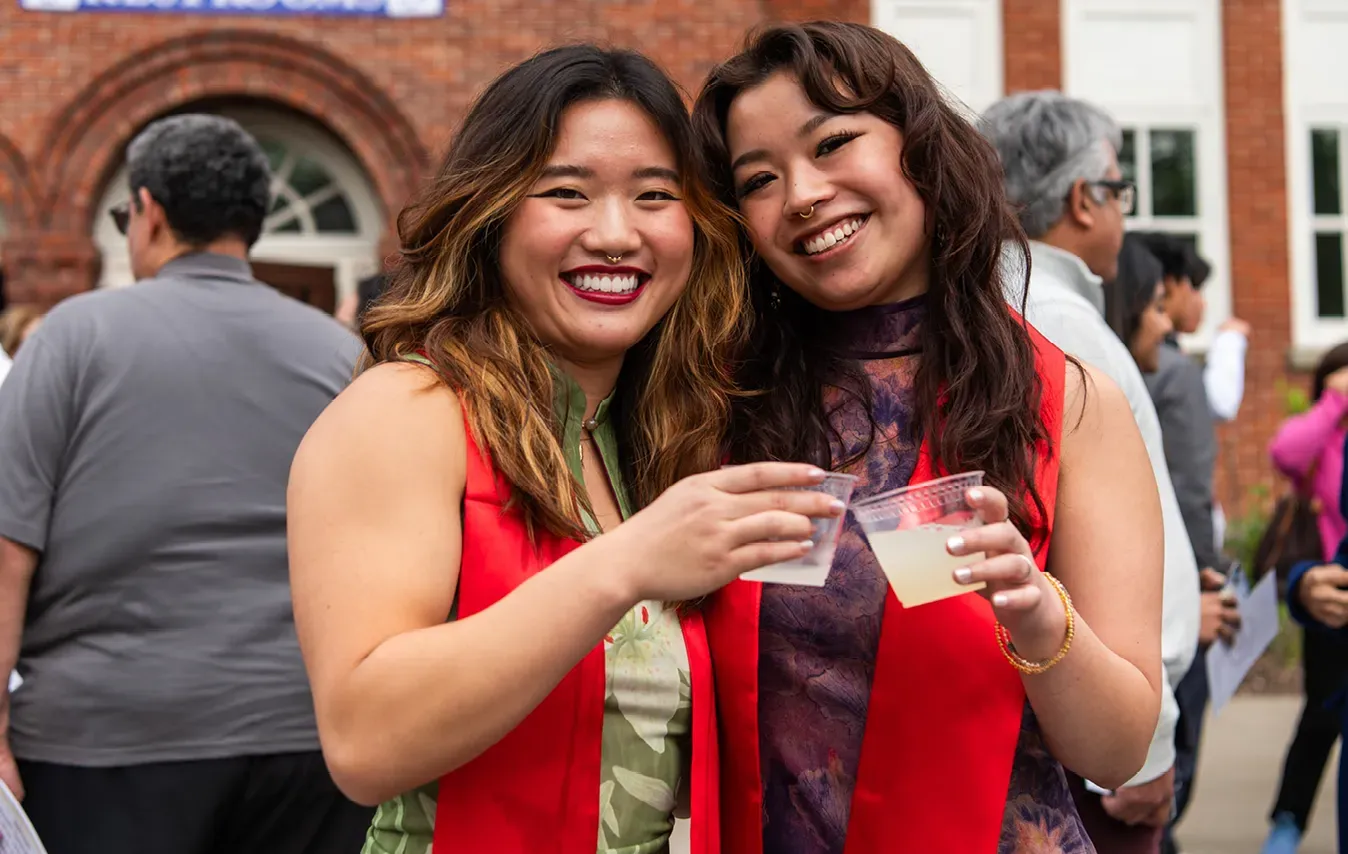
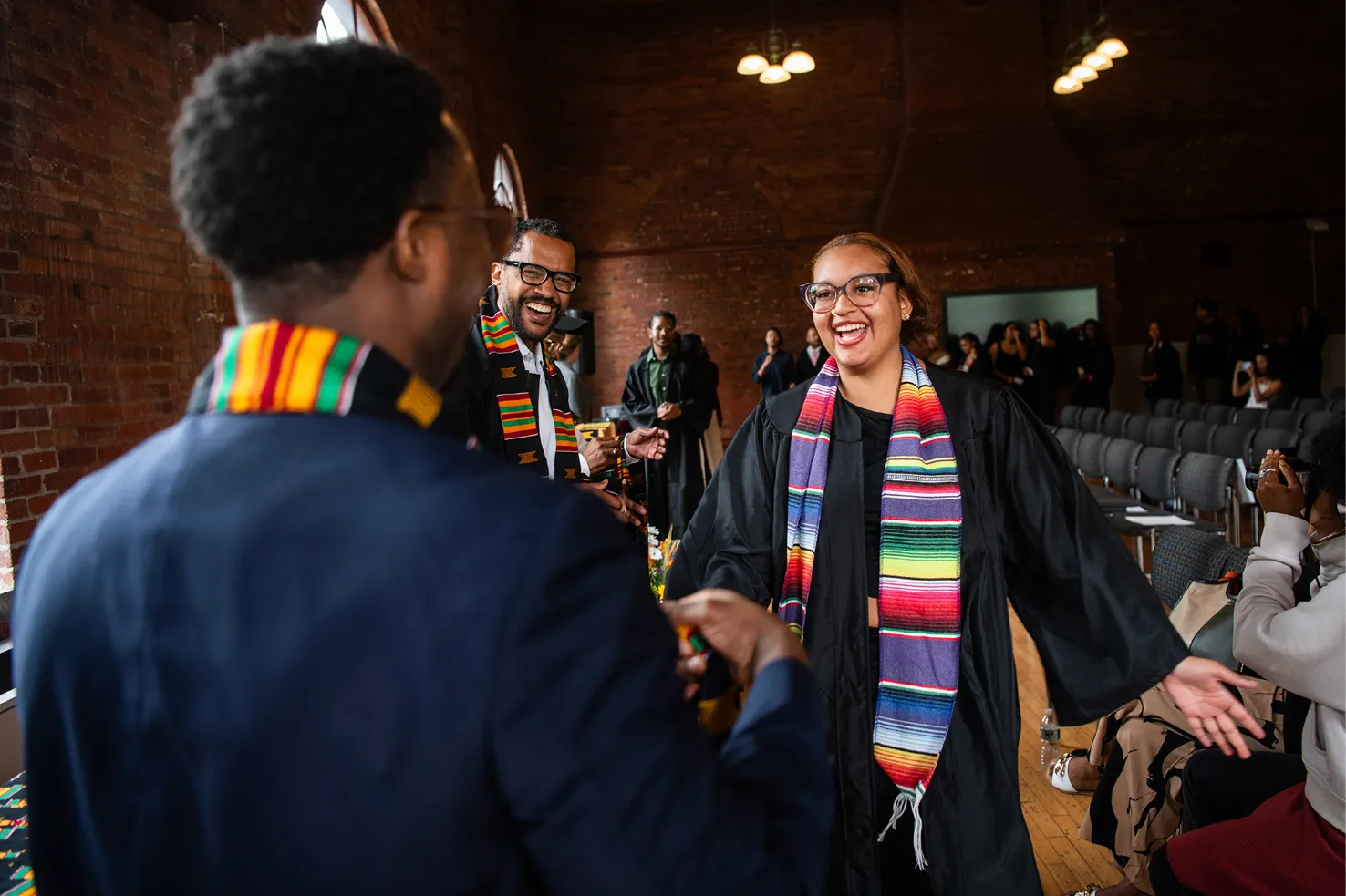
“Many of us here, we can’t imagine what the future holds,” Maldonado, an author and educator, told the graduates. “Whatever your future holds, know this: You are your ancestors’ wildest dreams.”
He then described how, upon moving to campus from his home in a Brooklyn housing project LIFE magazine had dubbed “one of the 10 worst neighborhoods in the United States,” his single mom had seen fit to present him with a baseball bat to defend himself against potentially hostile older students.
Maldonado recalled how his mother, Carmen Lilly Negron, instructed him, “If anyone comes in through your window, hit them.” This made him laugh, he said, because he knew it was unlikely he’d need this gift. “Now, this is Vassar. We need a bat under our bed, right?” he joked.
Eventually, Maldonado came to know Vassar as a place of openness and opportunity, and his mother was able to laugh about having gifted him a useless weapon. But that’s not to say Negron hadn’t given him anything of use during his time at Vassar.
“My mom, she was sort of my Star Wars Yoda. Not just ’cause she was short,” he explained. “She would tell me quotes that sounded like Yoda was speaking. Yoda’s ‘In a dark place, a little more knowledge lights our way’ [is just like] Ma telling me Maya Angelou’s quote, ‘Be a rainbow in someone else’s cloud.’ That’s another valuable attitude as we go into our futures.”
Maldonado noted that throughout his 30-year career, “the pen, words, education have been my weapons. As both a teacher and a published author, I’ve been reminded that the power is not in wielding a bat or any weapon of crass destruction. But the power is in wielding weapons of mass instruction—stories, words, connectivity.”
Before leaving the podium, Maldonado said he was presenting the graduates with a gift, which would not be a baseball bat but “whatever made you feel luminous at Vassar”—be it a special interest, skill, anything that lifts them up and could, as they make their way in the world, lift others.
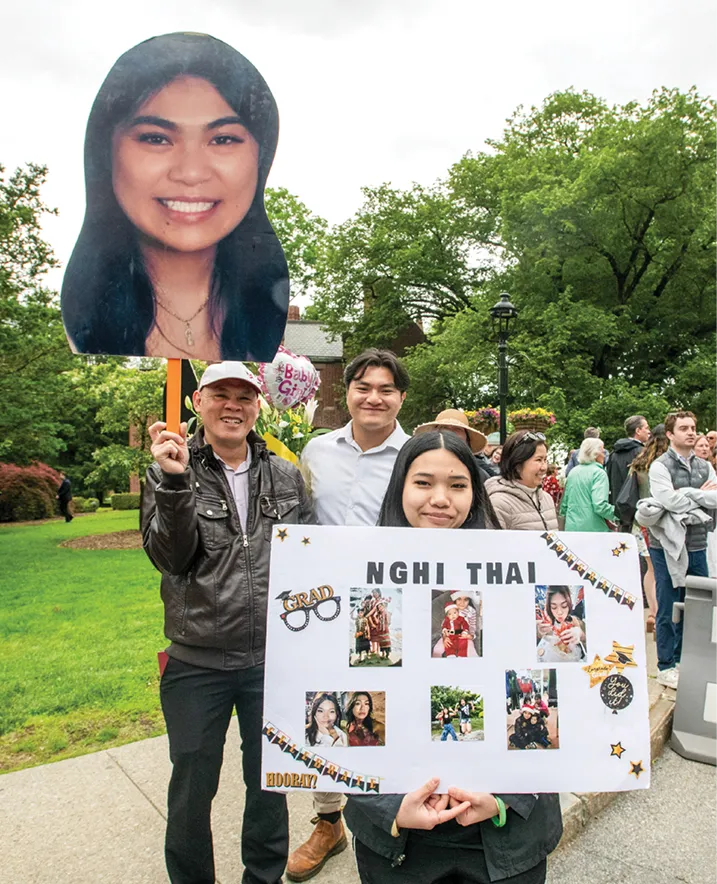

In his invocation, Reverend Samuel Speers, the recently retired Associate Dean of the College for Religious and Spiritual Life and Contemplative Practices, noted that some graduates were without those very people. “We feel especially our connection with all those who cannot gather with us in person—including the families of our students from around the world for whom travel is not possible at this time—but whose joy in you and what you have accomplished is not dimmed by distance,” he said.
President Elizabeth H. Bradley also acknowledged the challenging political climate in which the graduating students had had to function throughout the year and said that “staying in conversation is really the strongest way forward. I’ve seen this happen in your class again and again for four years, and it gives me immense hope in these challenging times.”
Bradley closed with a poem by Mary Oliver that describes “a thread that can bring us back to who we are,” and told the graduates, “I hope you’ll remember, there’s always a thread—a connection—between you, your friends at Vassar, and with Vassar itself … I hope you will keep close your Vassar memories and those relationships.”
Outgoing Vassar Student Association President Emily Doucet ’25 continued this theme by describing what she found when she surveyed classmates about their favorite Vassar memories. She said connection to people, places, and little moments are what made Vassar feel like home.

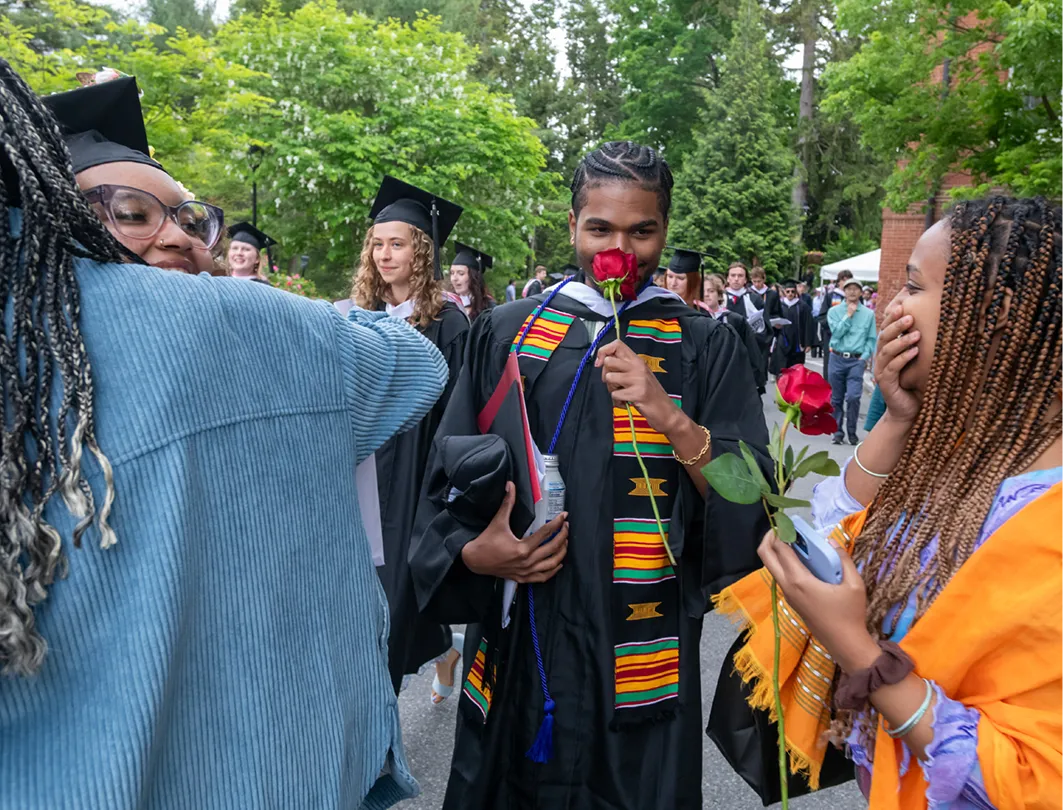

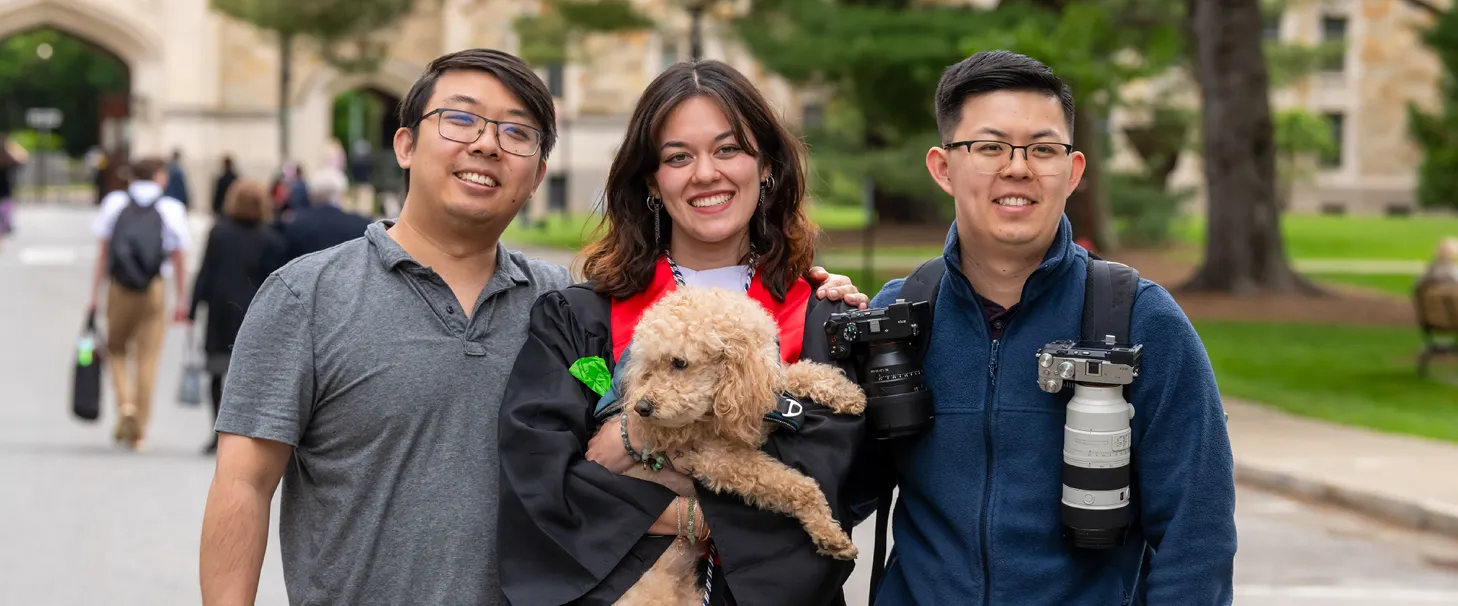
The graduates then heard from two more alums, Board of Trustees Chair Sharon Davidson Chang ’84, P’19, and Monica Vachher ’77, President of the Alumnae/i Association of Vassar College.
Chang told a story about her toddler granddaughter Chloè, whose wobbly steps sometimes led to falls, bumps, and tears—but not for long. Chang said Chloè’s resilience served as a wake-up call to live her life differently. Chang urged the graduates to embrace their own awkward, wobbly steps “and know that they’ll become steady.” Meanwhile, she added, seek support from “our lifelong Vassar community.”
“As of today, you are each an essential part of a dazzling community of over 42,000 Vassar alums, and each of you will bring added brilliance to it,” added Vachher. “So, as you depart to make your distinct and distinctive impressions upon your world, I hope you will always find time to connect with Vassar, and that you will cherish the special bond that ties us all together, forevermore.”


Vassar Salutes Eight Faculty Members and Two Administrators Who Retired in 2025
Janet Andrews
Associate Professor of Cognitive Science
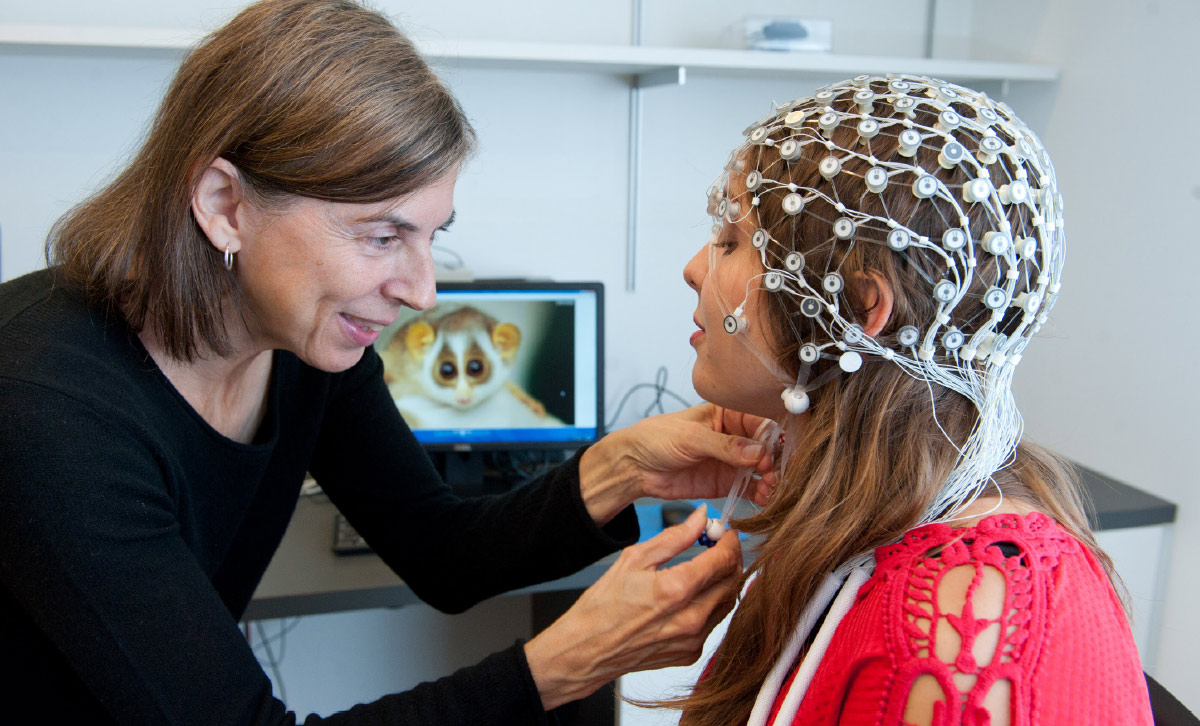
Andrews is a scholar of the way that humans perceive, categorize, and learn. She has published 20 scientific papers—many with undergraduate co-authors whom she also took to national research conferences. Her current project is a meta-analysis of a half a century of work on what happens to the mind when learning a new way to categorize something.
Andrews also served four years as Dean of Freshmen (now First-Year Students) from 1982 to 1986 and co-chaired the College Institutional Review Board for more than a decade. With 46 years at Vassar, she is the longest-serving faculty member in this year’s cohort of retirees.
Andrew Bush
Professor of Hispanic Studies
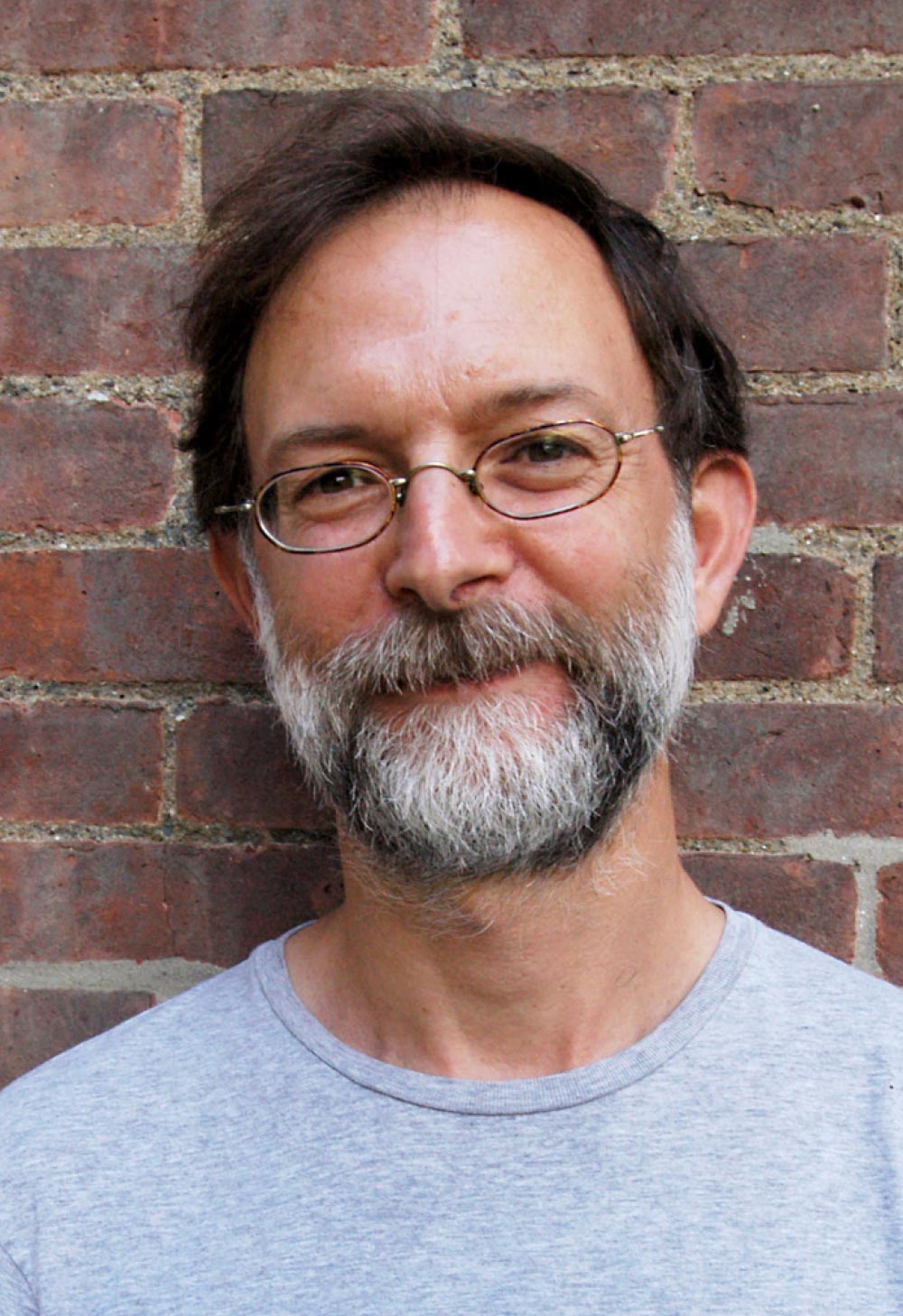
Bush’s areas of scholarship include Golden Age Spain, contemporary Peninsular literature, Spanish American literature, comparative literature and literary theories, and Jewish studies. In 2002, he published the monograph The Routes of Modernity: Spanish American Poetry from the Early 18th Century to the Mid-19th Century and in 2011, Jewish Studies: A Theoretical Introduction. He also has authored more than 50 articles, book chapters, reviews, and translations. From 1987 to 1991, he served as Editor in Chief of the journal Revista de Estudios Hispánicos.
At the College, Bush served two terms as Chair of Hispanic Studies and two terms as Director of Jewish Studies. He also served as Director of Community Works, the annual charitable-giving campaign that coordinates gifts from Vassar’s employees to local nonprofits.
Leslie Dunn
Professor of English
A scholar of English Renaissance lyric poetry and music, Dunn’s research focuses on music, gender, and representation in early modern England. She led a faculty study trip to the Globe Theatre in 2007 and performed archival research there as well. She authored many essays and reviews and edited the 1995 collection Embodied Voices: Representing Female Vocality in Western Culture.
Dunn served as Dean of Freshmen (now First-Year Students) and also as a Class Advisor. She directed Vassar’s Learning and Teaching Center from 2003 to 2006 and the Women’s Studies Program from 2012 to 2015. More recently, she co-chaired the Library Committee and served on the Faculty Appointments and Salary Committee.
Dunn said her favorite thing about Vassar is the students. “They are amazing,” she said. “It’s been a privilege to learn from them.” As for post-retirement, Dunn said, “In the immediate future I plan to finish a book, travel, get back to playing the piano, and learn to make bagels. After that, who knows?”
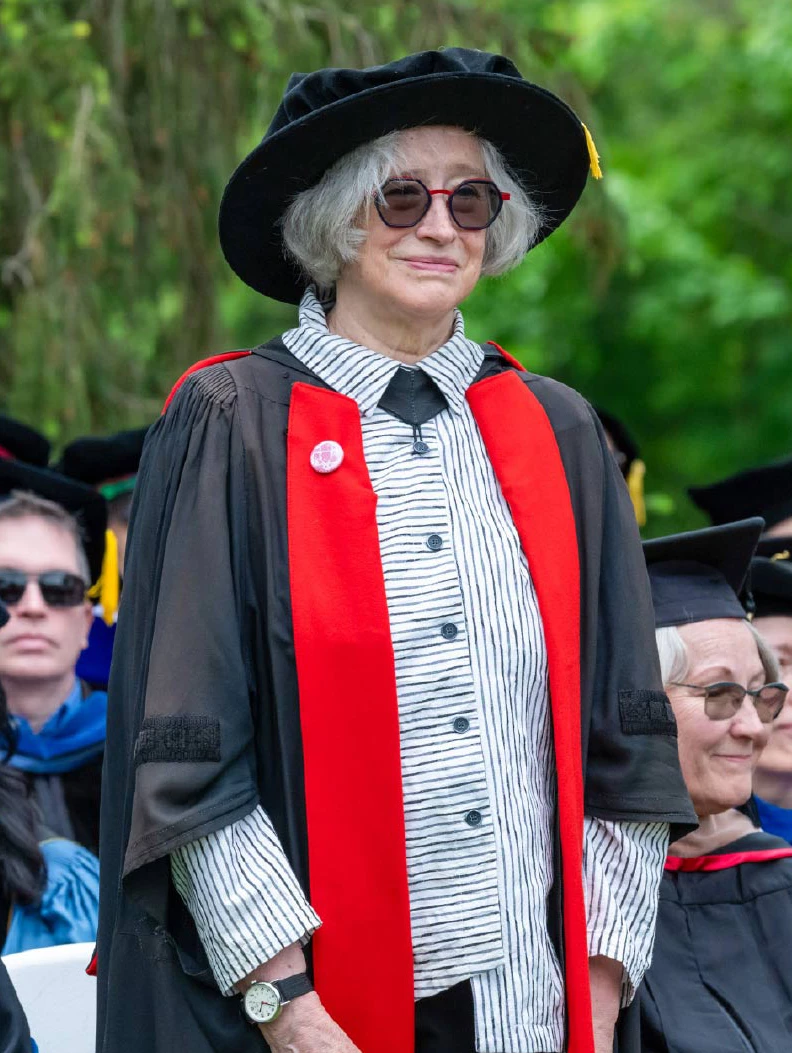
Peipei Qiu
Professor and Chair of Chinese and Japanese on the Louise Boyd Dale and Alfred Lichtenstein Chair
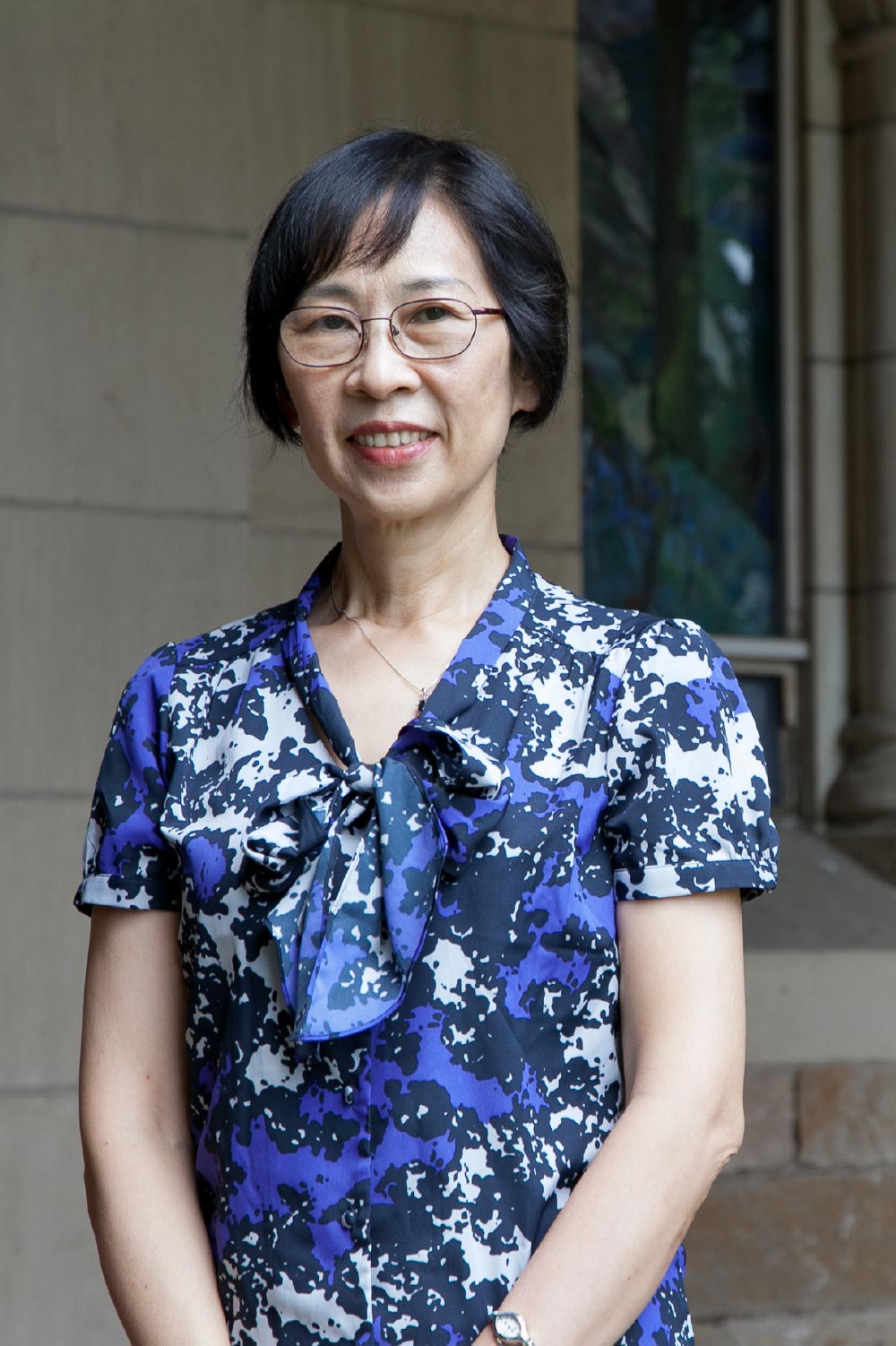
Qiu is a specialist in classical Japanese literature with a focus on comparative studies of Japanese and Chinese poetry, Daoism, and women in Asian societies. Besides publishing many articles, translations, and reviews, Qiu also authored the award-winning 2013 book Comfort Women: Testimonies of Imperial Japan’s Sex Slaves. She is also playing a major role in a project employing artificial intelligence technology to shed further light on the horrors these women endured in the 1930s and 1940s.
Qiu served as a Class Advisor during the height of the COVID-19 pandemic, overseeing a gift from parents of Vassar’s Chinese students of more than 25 shipments of personal protective equipment for those in the Vassar community who had to remain on campus.
“My favorite thing about Vassar has been witnessing the incredible growth and development of students here,” said Qiu. “I feel truly privileged to support them on their journeys at Vassar, helping them overcome challenges and celebrate successes. What I will miss most are their bright smiles and the rewarding experience of working closely with such talented and passionate individuals. After retirement, I’d love to continue seeing many of them, as I will be visiting the Vassar library often to finish my book project on Daoist studies—a three-volume study and translation of a thirteenth-century commentary on the Daoist classic Zhuangzi, to be published by Oxford University Press.”
Luke Harris
Professor of Political Science
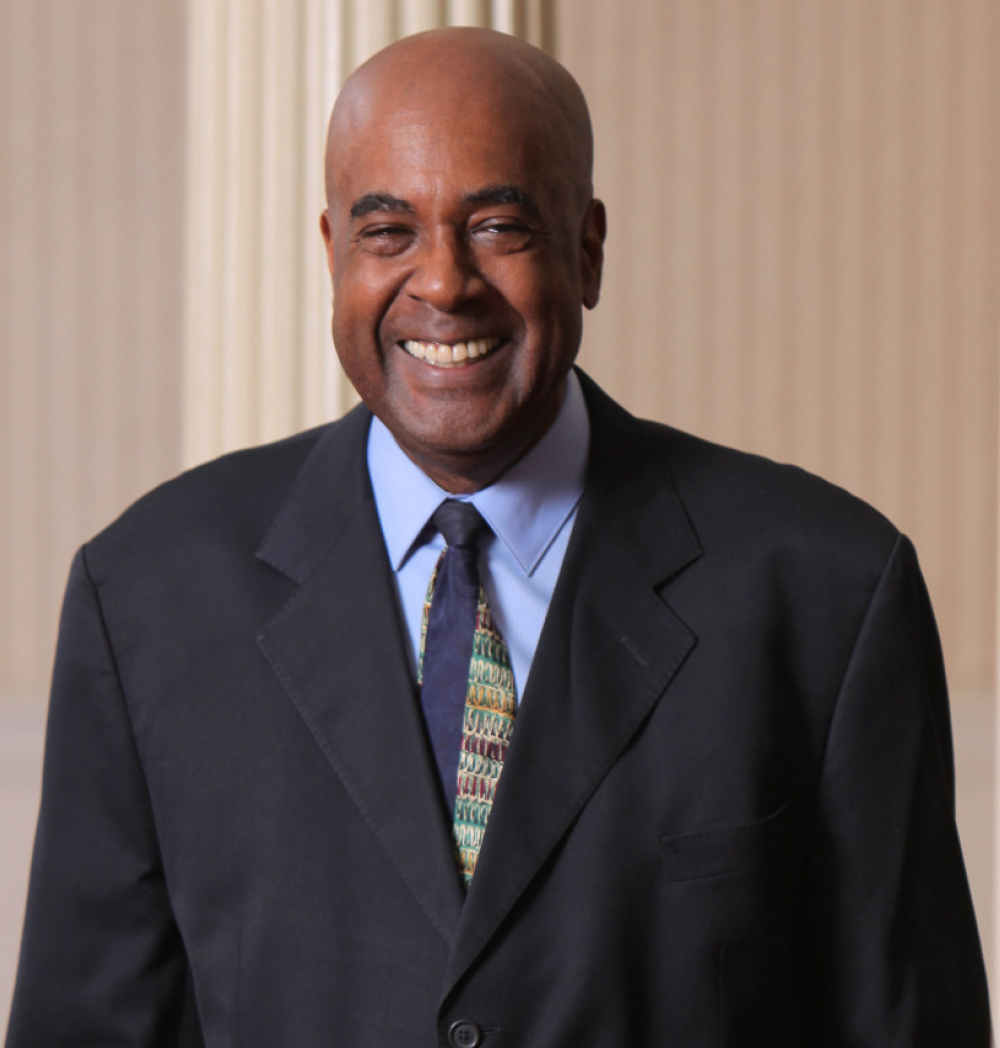
Harris has authored numerous critically acclaimed articles on questions of equality in contemporary America and is a frequent speaker in major forums espousing the positive impacts of affirmative action. Along with Professor Kimberlé Crenshaw of Columbia Law School, he co-founded the African American Policy Forum—a nationally recognized think tank that works to dismantle structural inequality in U.S. society—and said he will continue that work post-retirement.
At Vassar, Harris served as Director of Affirmative Action, Chair of the Political Science Department, and on the Committee on Inclusion and Equity.
William Straus
Associate Professor of Biology
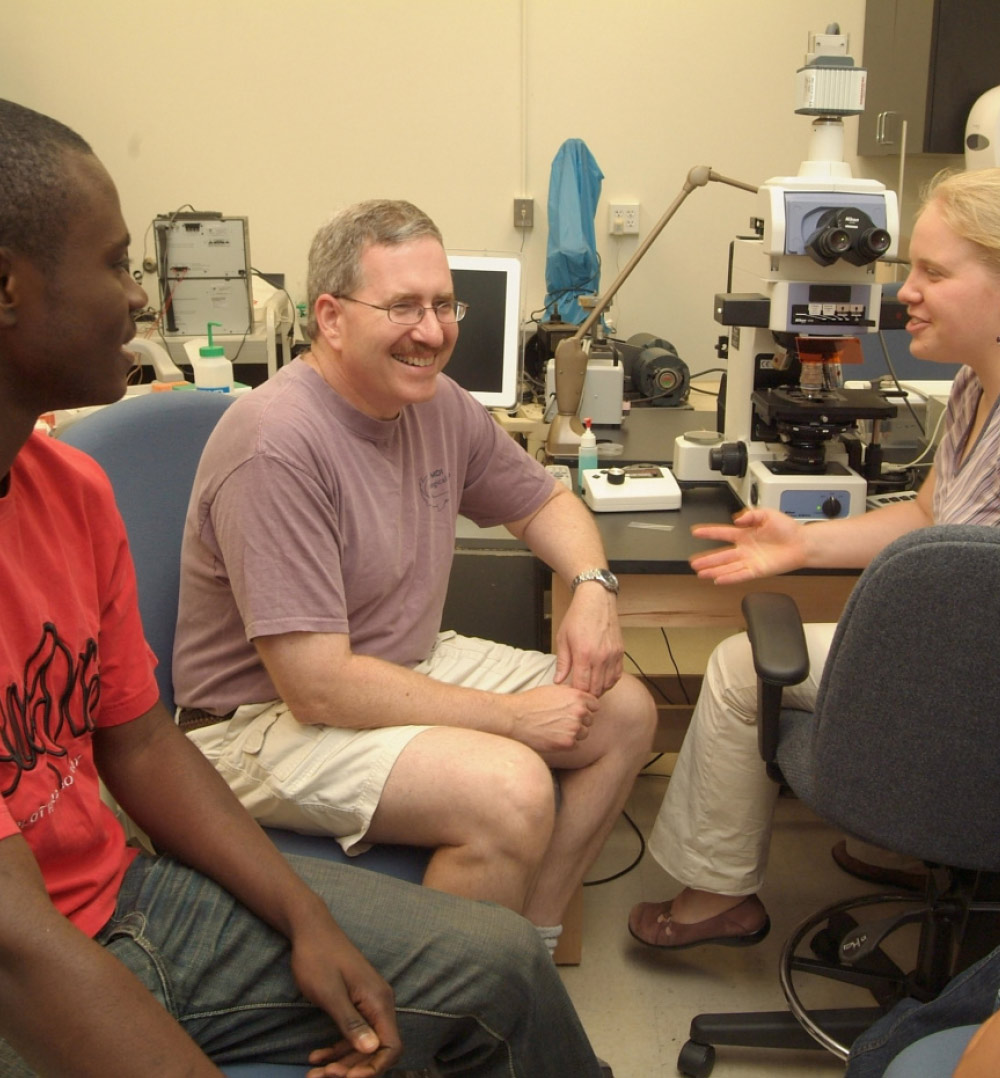
A scholar of biochemistry and molecular biology, Straus publishes on the topic of enzymes that allow the digestion of proteins—studying these processes in such diverse creatures as single-celled organisms and little skate fish. He prioritized making his work accessible to students, whom he frequently brought on research trips and to national conferences. “My favorite thing about Vassar has been the wonderful students that I’ve been privileged to work with, both in the classroom and the research laboratory,” he said.
Straus led efforts to secure multiple institutional grants totaling more than $3 million that supported science education of Vassar students, Vassar students who wanted to become science teachers, and access to higher education for students from the Poughkeepsie School District. He was a Class Advisor in the Dean of Studies Office and also served multiple terms on Vassar’s Faculty Policy and Conference Committee and a term as Vassar’s Faculty Director of Affirmative Action.
Paul Ruud
Professor of Economics
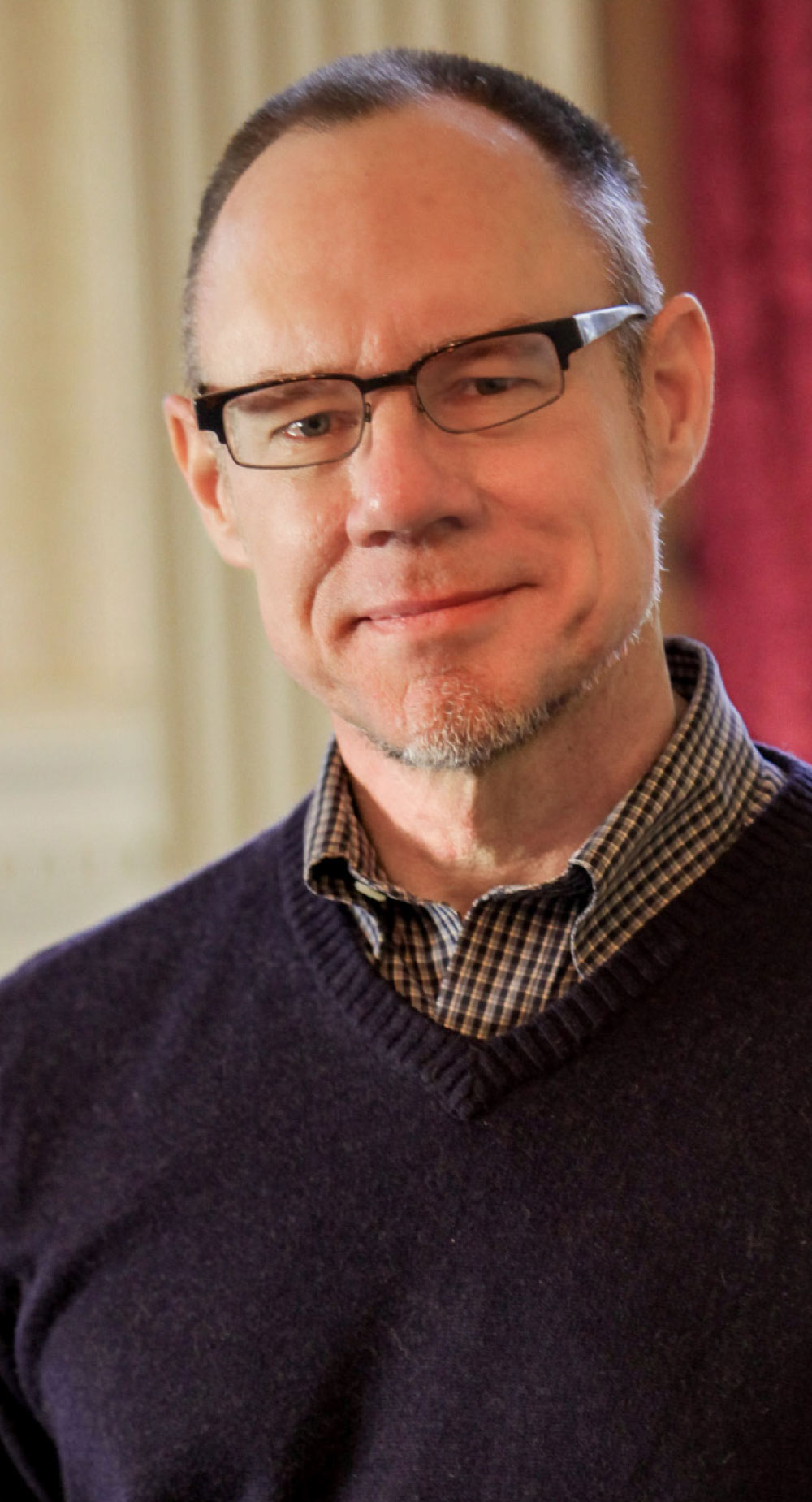
Rudd is author or co-author of more than 40 research and review articles in top economics journals. Vassar’s most advanced students used his textbook, An Introduction to Classical Econometric Theory. He also taught courses on climate change and economics as it relates to the environment.
His academic leadership roles included chairing the Economics Department and serving on the Benefits Committee, the Committee on Curricular Policies, the Faculty Policy and Conference Committee—and on the hiring committee that brought President Elizabeth Bradley to the College in 2017.
Denise Walen
Professor of Drama
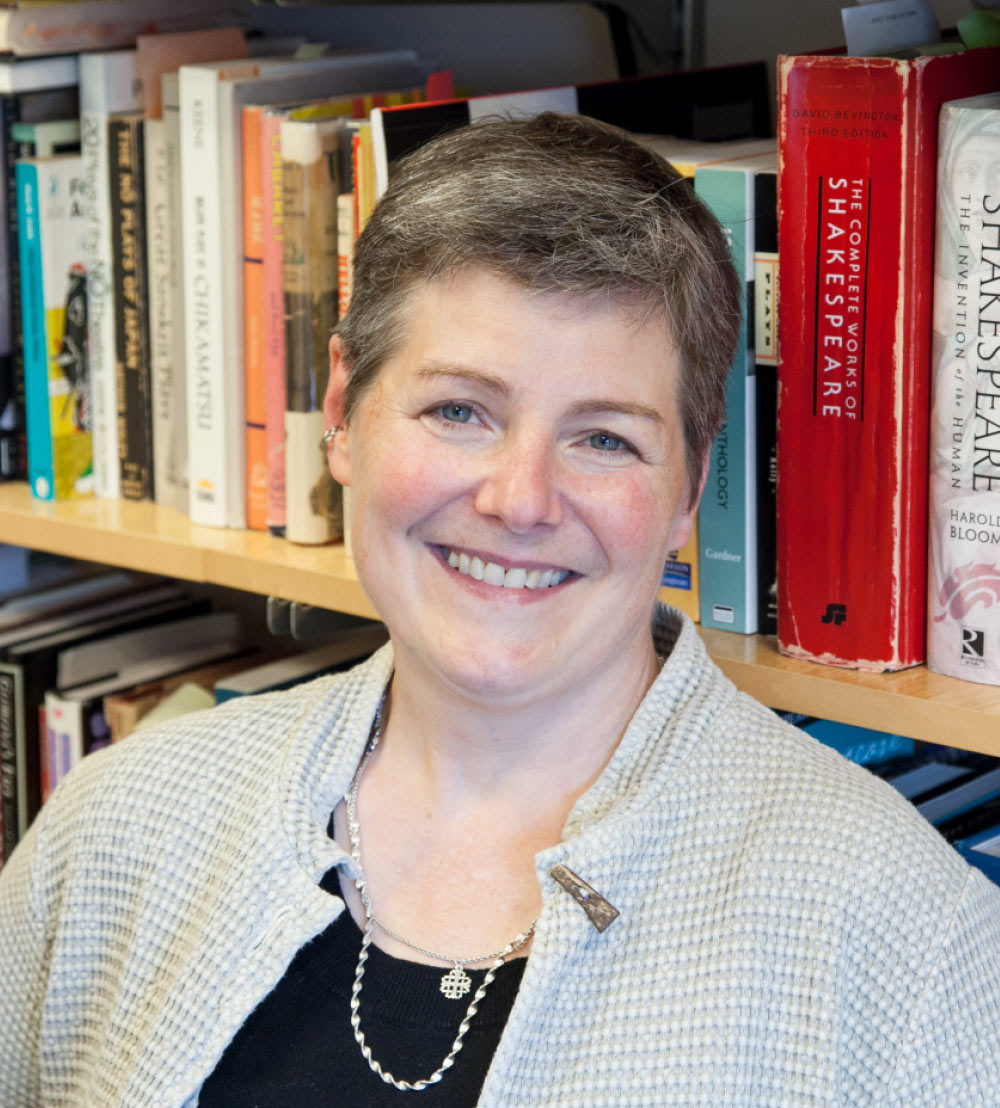
Walen’s work often focused on the disappearance from performance, sometimes for centuries, of scenes involving female characters. She is the author of more than 20 articles, reviews, and book chapters and wrote the monograph Constructions of Female Homoeroticism in Early Modern Drama. In 2013, she curated an exhibition for the Folger Shakespeare Library in Washington, DC, and worked at the Globe Theatre in London. She was also a member of the editorial board for Shakespeare in Performance: Prompt Books from the Folger Shakespeare Library.
Walen also served as Chair of the Drama Department, Dean of First-Year Students, and many faculty committees.
Walen said she was planning to write a few articles about Macbeth in retirement, “one especially about the scene in which Lady Macduff and her son are murdered and its disappearance from productions for some two hundred years.”
Rev. Samuel Speers
Associate Dean of the College for Religious and Spiritual Life and Contemplative Practices
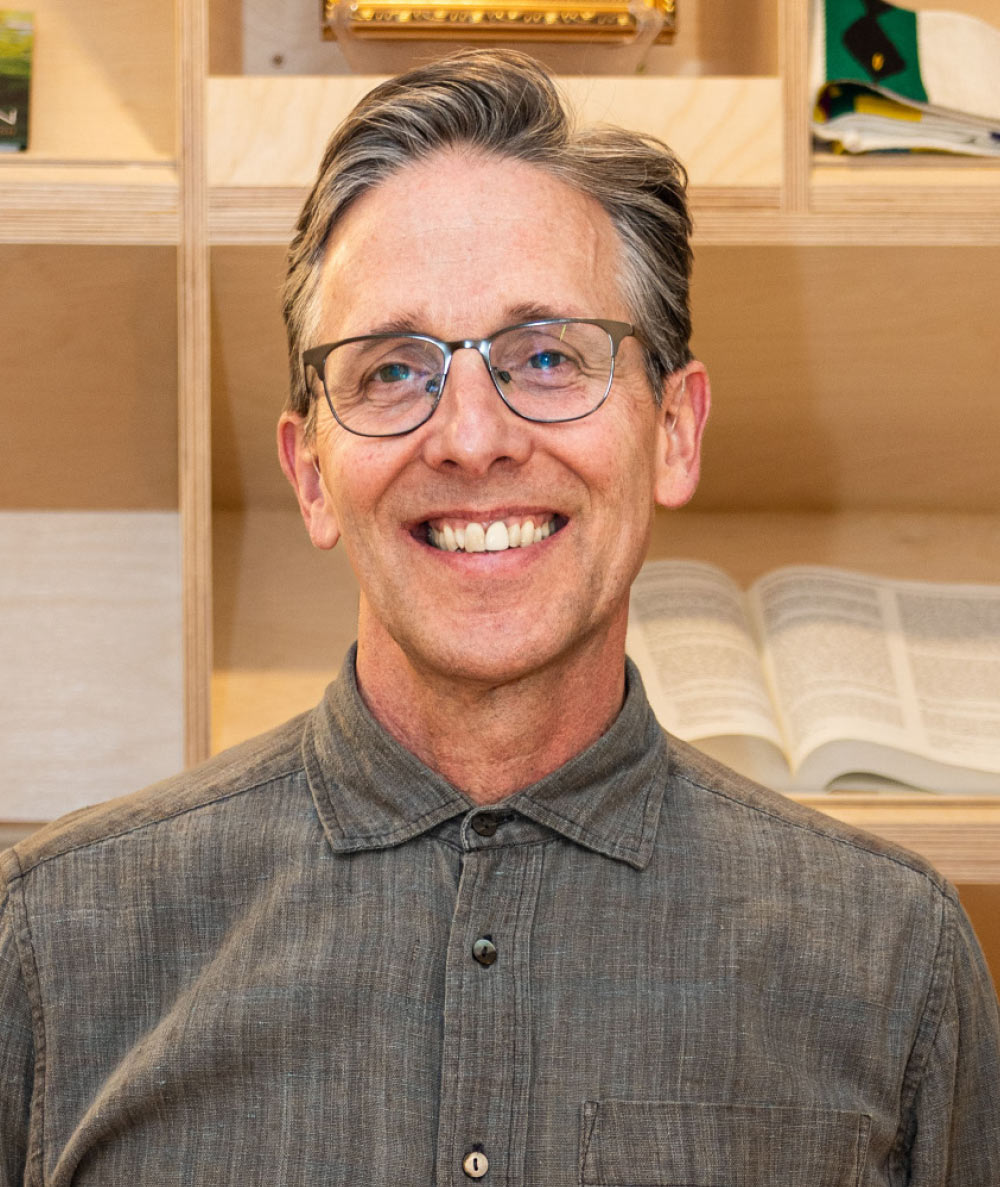
The office now employs two other full-time advisors, Rabbi Bryan Mann, Rachlin Director for Jewish Student Life, and Saba Ali, Advisor of Muslim Student Life. Together, Speers, Rabbi Mann, and Ali oversaw the conversion of Pratt House, formerly the Dean of the College’s residence, into a gathering place for students engaged in programs initiated by the Office of Religious and Spiritual Life and Contemplative Practices and other students just looking for a quiet and welcoming place to study or share meals.
Speaking at Speers’s farewell party, Dean of the College Carlos Alamo-Pastrana talked about a special role his sense of empathy had played during times of crisis on campus. “Work in the Dean of the College area is incredibly hard,” Alamo-Pastrana said. “It’s very exhausting and painful. We tend to cry a lot because of that. Sam is actually the Chair of what we call Weepers Anonymous. “He’s opened up space in meetings for us to be able—during these very difficult moments—to unload and cry with each other . . . One of the things that he does each and every day is be the holder of our pain.”
Speers said retiring was not an easy decision, “but in a way, one thing that does make it perhaps a little bit easier, at least for me, is realizing anew that, actually, goodbye is a blessing. Goodbye means ‘God be with you.’ It’s a contraction that we’ve lost in our secular time. So, as I say goodbye, I say it with a very, very full heart in that full way of what goodbye really means. And that makes it a little easier. My heart is so full with thanks as I say goodbye.”
John Bradley
Executive Director of the Vassar Education Collaboration
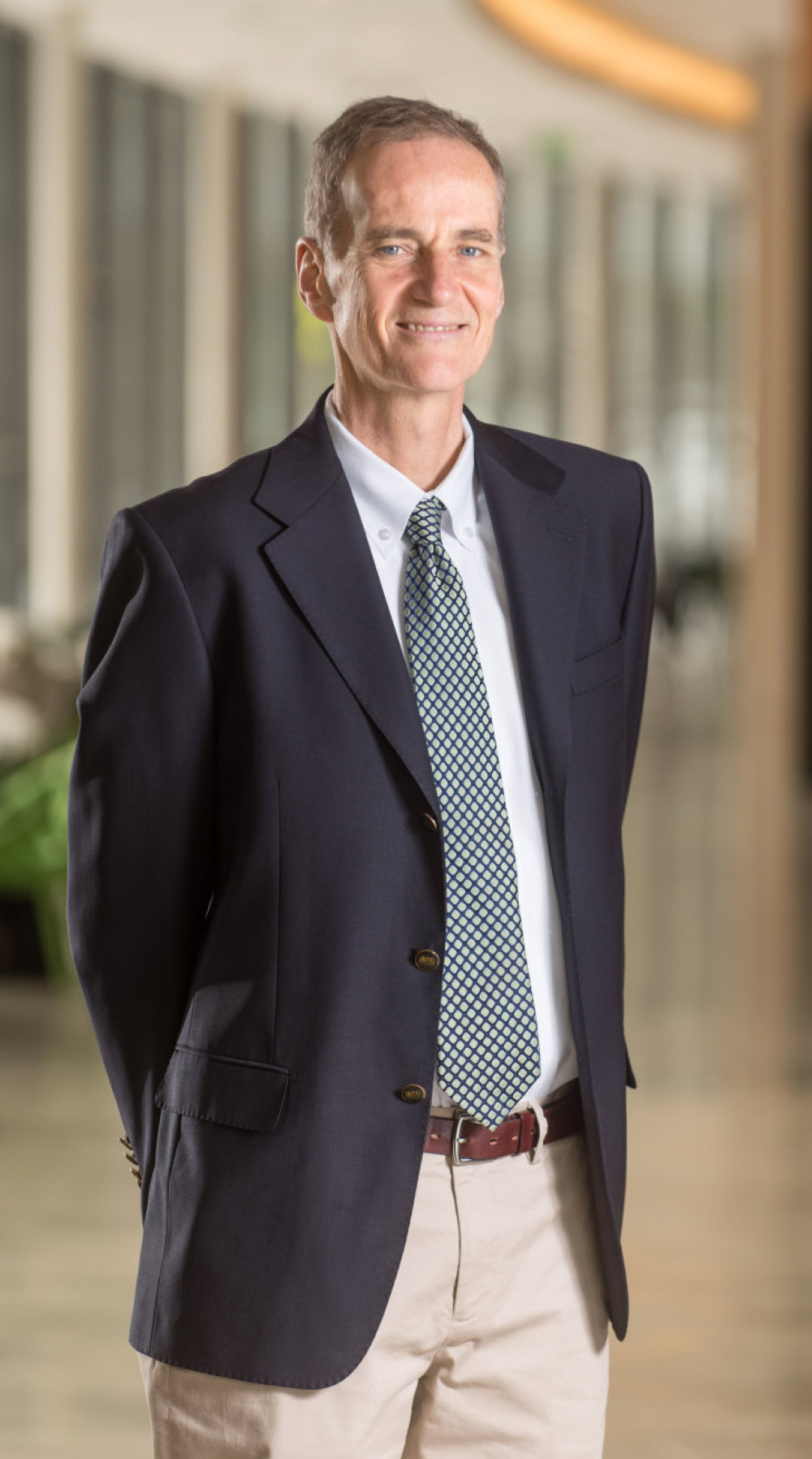
“Vassar was my sixth employer in my 40-plus-year working career and was the best workplace of them all,” Bradley said. “My fellow staff members and the faculty were supportive, helpful, and eager to assist with any new idea or program. One memory that will stand out to me is the generosity of time and spirit that I saw from the Vassar students who were working in the Vassar Education Collaboration, which connected the students on campus to the City of Poughkeepsie school children.”
Fortunately for Vassar and the local community, Bradley will remain a campus resident as he begins his retirement. “I want to spend more time exploring the Vassar Arboretum, Preserve, and the outside spaces of the Hudson Valley,” he said. “I would also like to get more involved in civic life in Poughkeepsie and Dutchess County.”
Stockton Photo, Inc.
Rising Together: How Vassar Student-Athletes and Supporters Are Redefining What Is Possible
The Brewers’ student-athletes posted a 3.63 cumulative GPA and received the Hudson Valley Community Service Award from Special Olympics New York for their volunteer efforts in the local community.
The department also launched the Vassar Athletics Hall of Fame, inducting eight former student-athletes, three teams, one coach, and former Vassar President Frances Fergusson, under whose leadership Vassar’s athletic programs experienced significant growth, expanding to include 25 varsity teams and varsity clubs.
Fergusson was instrumental in developing an athletics master plan that led to significant improvements in staffing, funding, and facilities. Today, 35 years after Fergusson’s efforts, Vassar is reaffirming its commitment to athletics at a moment when its student-athletes are excelling like never before.
A New Era for Vassar Athletics Facilities
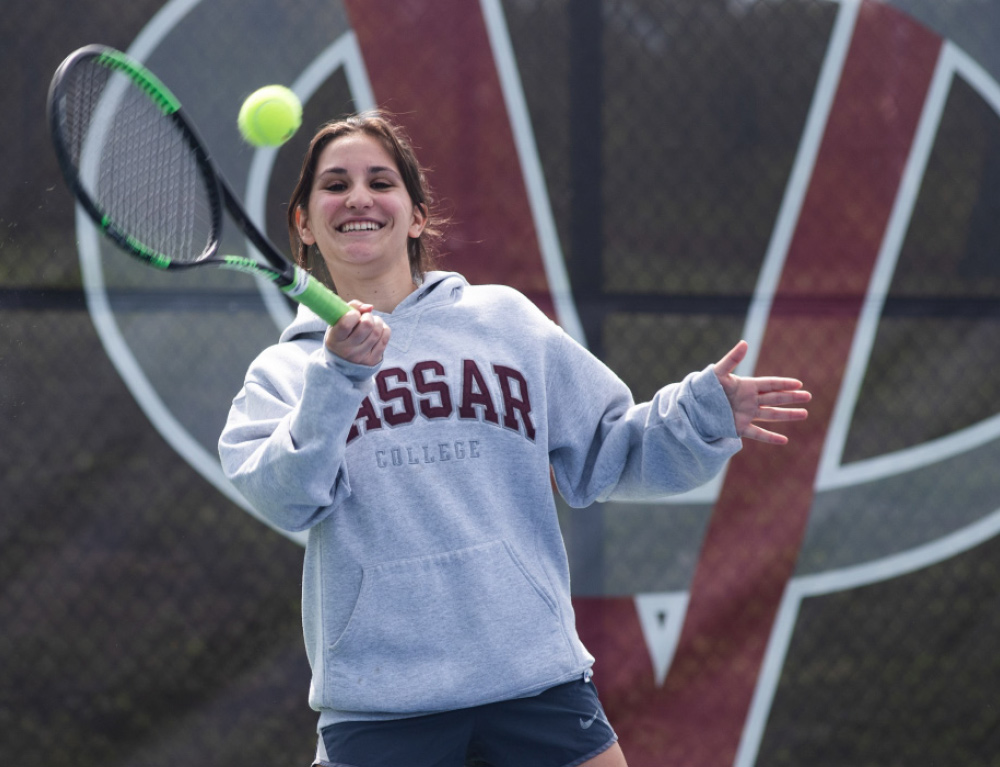
The Brewers recently celebrated the grand opening of the Richard L. Cretella Tennis Center, marking the beginning of a new chapter for the men’s and women’s tennis teams in fall 2023. This state-of-the-art, eight-court tennis complex was made possible by gifts from alums and Vassar parents. See more on the next page.
Built on the former site of Ballentine Field, the center features “post-tension” concrete courts designed for long-term durability, upgraded spectator seating, team equipment storage, and a scoreboard. Student-athletes also have convenient access to their locker rooms, indoor courts, and sports medicine facilities. Since its opening, the facility has already contributed to success: In 2024–25, the women’s team clinched their first conference championship since 2010.
Stockton Photo, Inc.
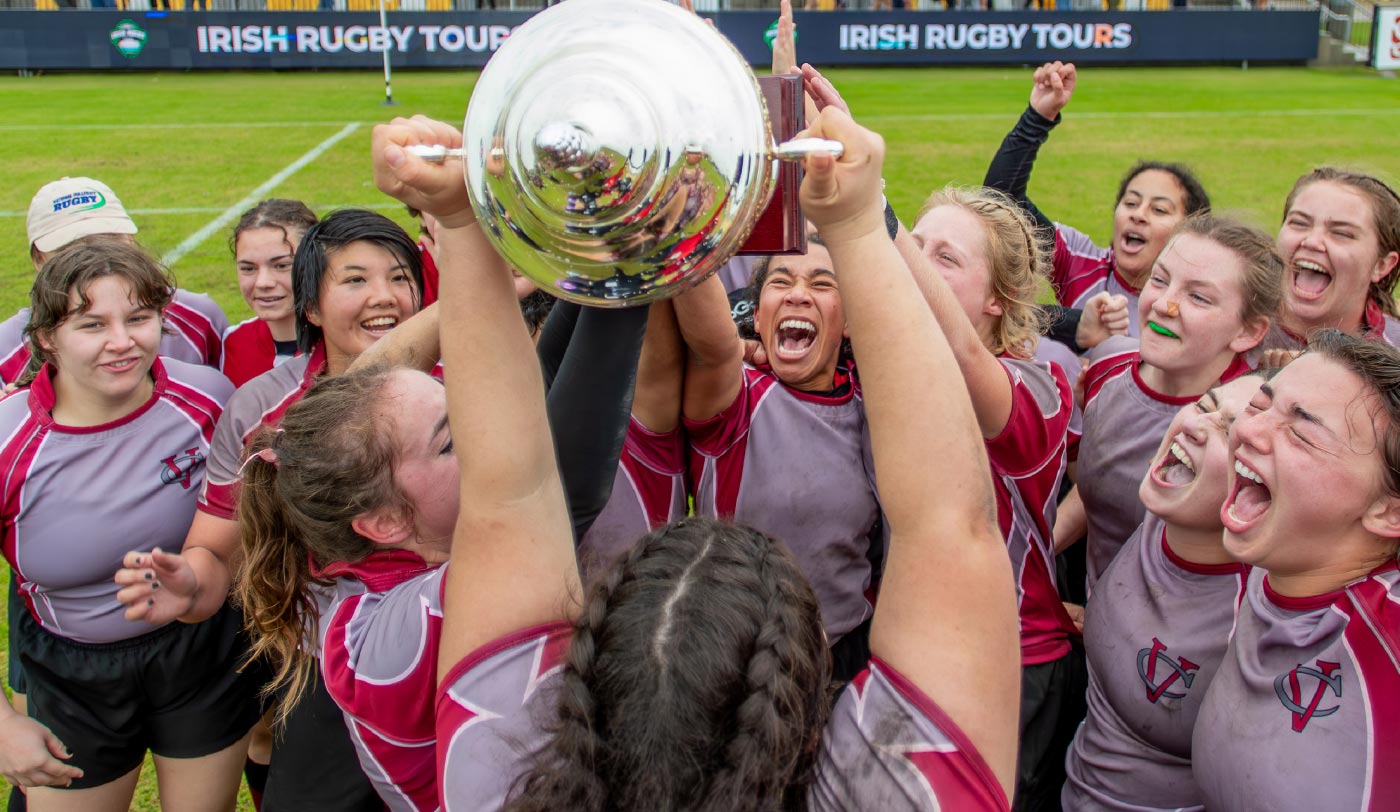
“Credit is due to the whole squad, as each player pushed hard to improve, and all were supportive of each other,” Rugby Coach Tony Brown said. “From a coaching perspective, we felt the team still had a lot more to offer. We focused a lot more on our team defense, and when it mattered, the players gave 100 percent.”
The men’s team also had a stellar season, finishing with a 9-1 record. When both teams return in fall 2025, they’ll be playing and practicing on two brand-new grass fields. The improvements were made possible by a gift from Ann R. White P’25 and Philip H. White P’25, whose child, Danny White ’25, was a rugby player. The upgrades include resurfacing and resodding of the game and practice fields, new irrigation, goal posts, a scoreboard, and a hydration station.
The Whites were introduced to rugby when Danny joined the team as a sophomore. After witnessing Brown’s personal investment in his players, particularly following an injury Danny sustained during the national semifinals, they became increasingly engaged with the program. After meeting the team and learning more about its impact, they were inspired to help realize Brown’s vision for improved playing fields.
The upgraded championship-level fields—one of which will be named in Brown’s honor at a September dedication—are expected to enhance safety, attract recruits, and create opportunities for Vassar to host competitions, reducing travel and strengthening the rugby program’s visibility. “Rugby has been played at Vassar for 50 years now, and I’m sure alums are beaming with pride seeing how it has flourished,” Brown said.
During the 2024–25 Athletics season:
Seven teams (the five aforementioned as well as men’s volleyball and women’s soccer) advanced to their respective national tournaments.
Men’s rowing won the New York State Championship.
Women’s rugby claimed its fourth Division II national championship.
Haley Schoenegge ’27, a standout in cross country and track and field, won the Division III indoor mile and is now a two-time 1,500M outdoor champion, clocking the ninth fastest time in Division III history.
Six student-athletes were named conference players of the year.
Sixteen student-athletes received All-American honors.
Benson added that he and his teammates “expect to climb significantly in the college rankings in the coming years” and that the upgraded facilities will help strengthen their recruitment and competitiveness.
“There’s a sense of pride and accomplishment in seeing student-athletes and coaches recognized with a facility that reflects their competitive spirit and to make the most of their athletic experience at the College,” Walsh said. “They’re really excited.”
With Vassar Athletics more competitive than ever—and the need to recruit and retain top-tier student-athletes—continued investment in student-athletes and facilities remains a priority.
Building on a Strong Foundation
As teams rise to new levels of competition, the need for improved facilities continues. Walker Field House, for example, requires critical upgrades; some teams are currently unable to host competitions due to changing regulations and standards and the infrastructure’s deterioration. Additional turf at the Prentiss Athletic Complex would also improve practice and gameplay for many outdoor teams.
“We’re so incredibly appreciative of support in whatever form it takes, whether it funds an upgraded facility or it’s outreach from an alum to a current student to tell them how proud they are of what’s happening,” Walsh said. “All of that truly makes a difference.”
Looking ahead, Walsh is optimistic that the teams will continue to grow and compete at higher levels while staying true to what it means to be a Vassar student-athlete.
“My emphasis will continue to be on providing an outstanding experience for our student-athletes, one that contributes in a meaningful way to their overall education at the College.”
As Vassar Athletics celebrates many recent accomplishments, it also reaffirms a legacy that began with the College’s founding. Matthew Vassar placed physical education at the heart of his vision for a complete education, and that ideal continues today. With over 20 percent of students participating in Vassar’s 25 varsity programs and four varsity club teams, athletics remains a vital part of campus life. Continued investment in student-athletes and facilities has the potential to elevate competition and strengthen the well-being of the College as a whole.
To learn more about Vassar Athletics, please visit vassarathletics.com.
Vassar Wraps Up Inaugural Year of Signature Programs
at The Vassar Institute for the Liberal Arts
The first Signature Program—EcoVisions: Finding Your Place in Environmentalism—held in fall of 2024, illustrated how environmental action could take shape in all aspects of our lives and highlighted how legal innovations could aid and contribute to climate justice. The Institute will continue to serve as Vassar’s public classroom, playing a critical convening role in tackling contemporary challenges during the coming academic year.
Promoting Partnerships to Advance Educational Justice in Poughkeepsie

Kelly Marsh
Participants included officials from Vassar, Marist, and Dutchess Community colleges; representatives of the City of Poughkeepsie and its school district; local government leaders; and members of local not-for-profit agencies. “Our goals for the weekend were to break the silos that exist among higher education, local school districts, and community organizations and to collaborate as a group,” said Associate Professor of Political Science Taneisha Means. “We identified some issues that exist from various perspectives and developed conversations that will hopefully lead to collaborations.”
Assistant Professor of Mathematics and Statistics Andy Borum said the informal conversations that occurred throughout the weekend were just as significant as the formal panel discussions. “Some of the best moments for me were the conversations that took place over lunch and the networking that resulted from those conversations,” he said.
Professor of Education Erin McCloskey agreed. “Just getting to know each other was the important first step, and then following that up with deciding on ways to connect with each other,” she said. “Our next step will be to bring more students and their parents into the conversation, and we will continue to meet regularly to follow up on developing specific programs. All of the attendees were incredibly excited, and I look forward to the next steps in the process.”
Convened by: Andy Borum, Assistant Professor of Mathematics and Statistics; Erin McCloskey, Professor of Education; Taneisha Means, Associate Professor of Political Science; and Molly (Mary L.) Shanley, Professor Emerita of Political Science.
The Entrepreneurial Mind and the Liberal Arts

Kelly Marsh
Johnson Lin ’21 told the audience about the multiple failures he and his business partner endured along with the success they ultimately achieved in launching a tech startup company. “Nobody has ever gotten it right on the first try,” Lin said. “My first two ideas failed, but I had raised $1 million and remembered what my Vassar Commencement speaker (tech entrepreneur Jessica Matthews) had told us: ‘Just don’t be the worst at what you’re doing, and you’ll have time to grow and learn.’”
In addition, Town of Poughkeepsie Supervisor and Professor of History Rebecca Edwards and Dutchess County Legislator Lisa Kaul spoke about the entrepreneurial elements required to run for office and serve in local government.
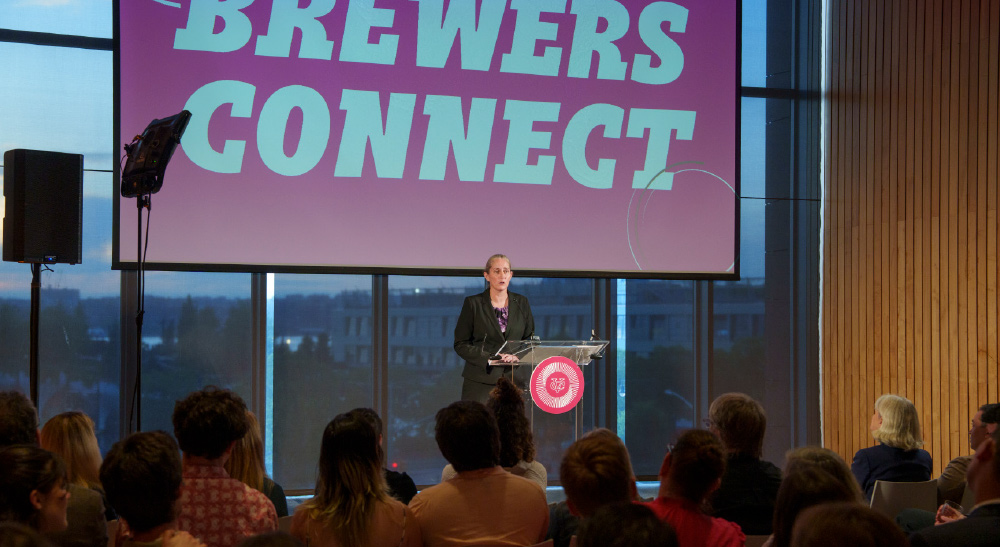
Julián Aguilar ’23, who leads Vassar’s entrepreneurship program, noted that the conference highlighted how “entrepreneurship within the liberal arts is not just about the pursuit of economic success, but about fostering meaningful change. It is about developing ventures, ideas, and initiatives that challenge norms, uplift communities, and create sustainable solutions.”
Convened by these members of the Office of the Vice President for Technology and Human Resources: Julián Aguilar ’23, Academic Computing Consultant; Jean Tagliamonte, Assistant Vice President for Planning and Engagement; Erin McHugh, Program Administrator; Breille Irahoza, Administrative Fellow; Amy Laughlin, Interim Director of Academic Computing Services; and Asy Connelly, Innovation Lab Manager.
Belonging and Beyond: Using Future Histories to Reimagine Teaching and Learning

Kelly Marsh
Associate Professor of Anthropology Candice M. Lowe Swift, a convener of the conference, said a key goal of the gathering was to enable participants “to generate ideas from their individual experiences that might help unlock our collective imagination and strengthen the relationship between institutions of higher education and the communities in which these institutions are embedded.”
Keynote speakers Nicole Mirra, Associate Professor of Urban Teacher Education at Rutgers University, and Antero Garcia, an Associate Professor in the Graduate School of Education at Stanford University and Vice President of the National Council of Teachers of English, cautioned against fighting for a status quo in education that hasn’t been serving students. Instead, they urged workshop participants to practice the future world they want and center student voices in those efforts. “When young people feel like education is in favor of something they care about, they will want to engage,” Mirra noted. “Speculative visions doesn’t mean imagining 100 years in the future, but making changes in the here and now and practicing the future we want to live in,” Garcia said.
Convened by: Candice M. Lowe Swift, Associate Professor of Anthropology, Africana Studies, and International Studies; Eréndira Rueda, Associate Professor of Sociology and Director of Latin American and Latinx Studies; Alison Cook-Sather, PhD., Mary Katharine Woodworth Professor of Education at Bryn Mawr College and Director of the Teaching and Learning Institute at Bryn Mawr and Haverford Colleges; and Caleb Elfenbein, Professor of History and Religious Studies at Grinnell College and Associate Dean for Faculty Development and Diversity, Equity, and Inclusion, past Director of the Center for the Humanities.
Transgressing Borders: Reimagining Education and the Role of Learning in Community

Kelly Marsh
Throughout the weekend, educators, activists, organizers, and community members learned alongside one another, sharing their lived knowledge. Participants heard from community members engaged in such fields as health care, legal aid, affordable housing, and food justice.
Elizabeth Cannon, Director of Vassar’s Office of Community-Engaged Learning, hosted a panel of educators who discussed ways to integrate college and community resources. As the event concluded, Cannon said she was certain the insights she heard throughout the weekend would enable her and her Vassar colleagues to find new ways to connect with the community. “This program was a labor of love that began a year ago,” she said, “and we are grateful to have had the opportunity to make so many connections and ways to build and share resources and create new networks.”
Asilia Franklin-Phipps, Assistant Professor of Education and Co-Coordinator of the Social Justice Education Program at SUNY New Paltz, said the event had inspired her to develop a course in community building “that anyone in the area can take, perhaps through facilities at local libraries.” She added, “I plan to stay connected with many of the people I met this weekend; so many of our interests overlap, and it will be exciting to see what emerges from this event.”
Convened by: Elizabeth Cannon, Director of Community-Engaged Learning and Co-PI of the Mellon Foundation’s Community-Engaged Intensives in the Humanities; Zoë Markwalter, CEIH Research and Program Associate; Asilia Franklin-Phipps, Assistant Professor of Educational Studies and Leadership, Co-Coordinator of the Social Justice Education Program at SUNY New Paltz; and Robyn Stout Sheridan, Assistant Professor of Educational Studies and Leadership, Co-Coordinator of the Social Justice Education Program at SUNY New Paltz.
Soundscapes and the Anthropocene
Karl Rabe
Associate Professor and Chair of Music Justin Patch, who studies sound in religion and politics, highlighted the impact of sound in presidential campaigns: At the peak of stadium rallies in the 2010s, candidates who spoke to enthusiastic crowds that shook the rafters were more likely to win. “Sound helps people feel they are part of something greater than themselves,” he said.
Megan Gall, Associate Professor of Biology and Director of the Neuroscience and Behavior Program, studies sound from an animal’s perspective. She and her students conduct studies of birds in the Preserve at Vassar, where human noise is increasingly affecting birds’ ability to hear signals from each other. This has parallels for humans, she said: “People who live in really loud environments have a harder time concentrating, and they have higher cortisol levels. So, the way we build and shape environments is really important for humans too.”
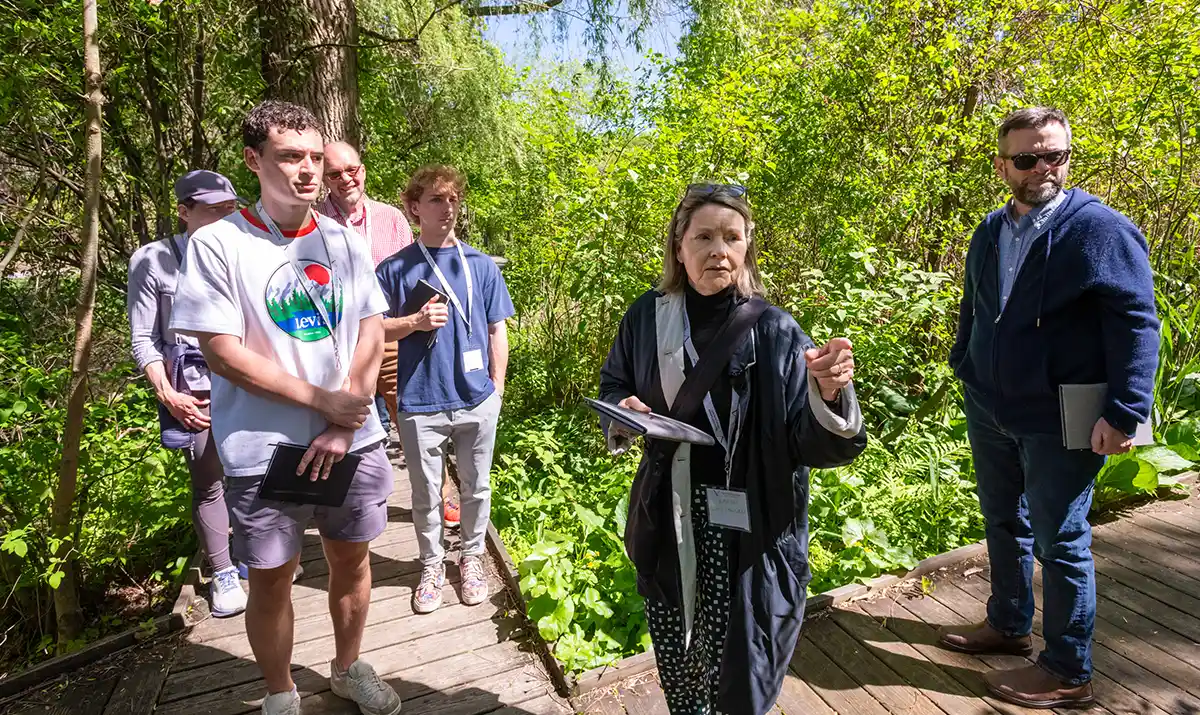
Karen Van Lengen ’73, William R. Kenan Jr. Professor of Architecture and former Dean of the School of Architecture at the University of Virginia, led a group walk exploring soundscapes on the Vassar campus. Van Lengen has recorded the sonic qualities of iconic buildings and spaces.
The evening concluded with a screening of the Emmy Award-winning documentary Sonic Sea, which reveals how human-generated sounds are affecting ocean environments, and a Q&A with filmmaker Daniel Hinerfeld ’85, Director of Content Partnerships at the Natural Resources Defense Council.
Convened by: Megan D. Gall, Associate Professor of Biology and Director of Neuroscience and Behavior, and Justin Patch, Associate Professor and Chair of Music.
Vassar Institute for the Liberal Arts Signature Programs for the 2025-2026 Academic Year
Storytelling for Change: Shaping and Sharing Inclusive Narratives in Higher Education, Media, and the Arts
November 7–8, 2025
SIMS: Students in Museums Summit
November 14–16, 2025
Women’s Work: Preserving Independent Film and Video Histories, Connecting Media Futures
February 26–28, 2026
Lessons from the Poughkeepsie Journal Photo Morgue: Empowering Communities to Preserve Their Visual Histories
March 6–7, 2026
Vassar Goes to the Source Over Spring Break
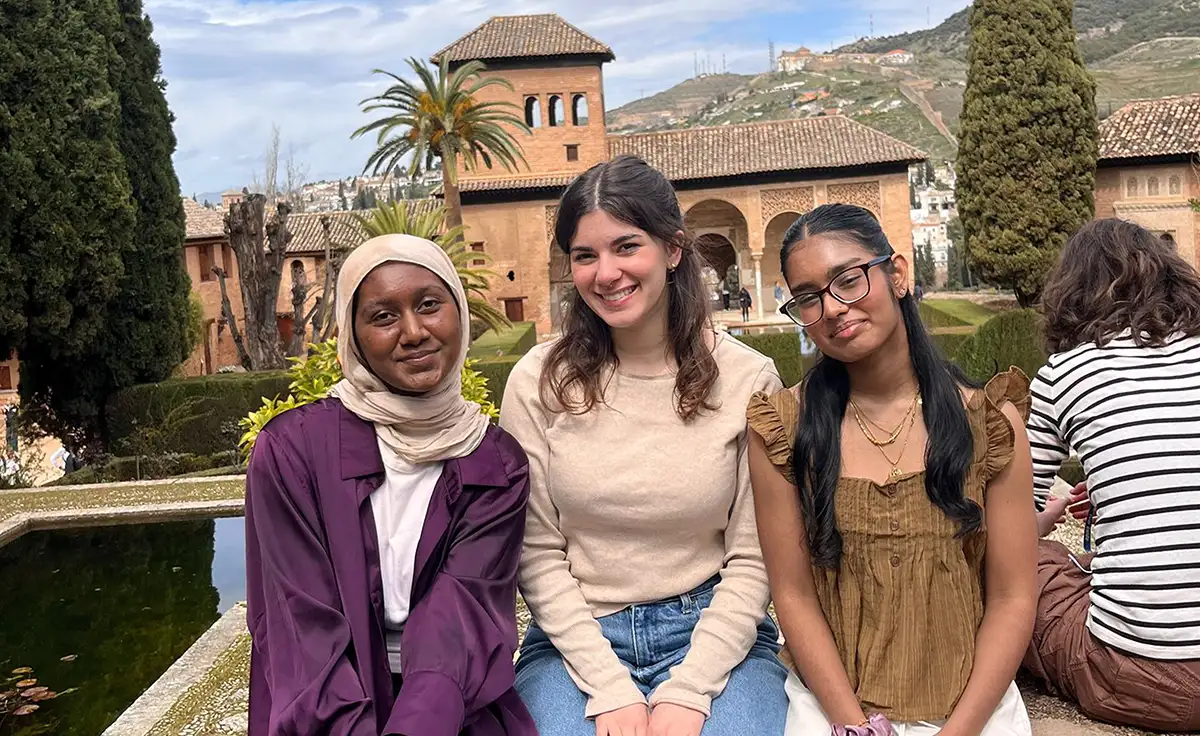
Jewish Studies Travel Seminar in Spain
Epstein said a particularly profound moment occurred when the group was gathered in a synagogue crafted in the Mudéjar style (preserving or reviving Muslim design motifs in Christian Spain) that had been transformed into a church during the persecution and expulsion of Spanish Jews. “Surrounded by a now-intimate group of students, who had once been strangers but were now deeply connected, I felt a sense of unity,” Epstein recalled. “Some wore kippot, others fasted for Ramadan in hijabs, and one had just been seen in rapt genuflection at the cathedral. I sang for them in Hebrew the psalm that was inscribed on the Muslim-design-inspired wall in beautiful Hebrew letters, in the melody that would have been used in this very place before the Expulsion. It was an immensely moving experience and embodied the essence of what we strive to achieve with students in Jewish Studies at Vassar.”
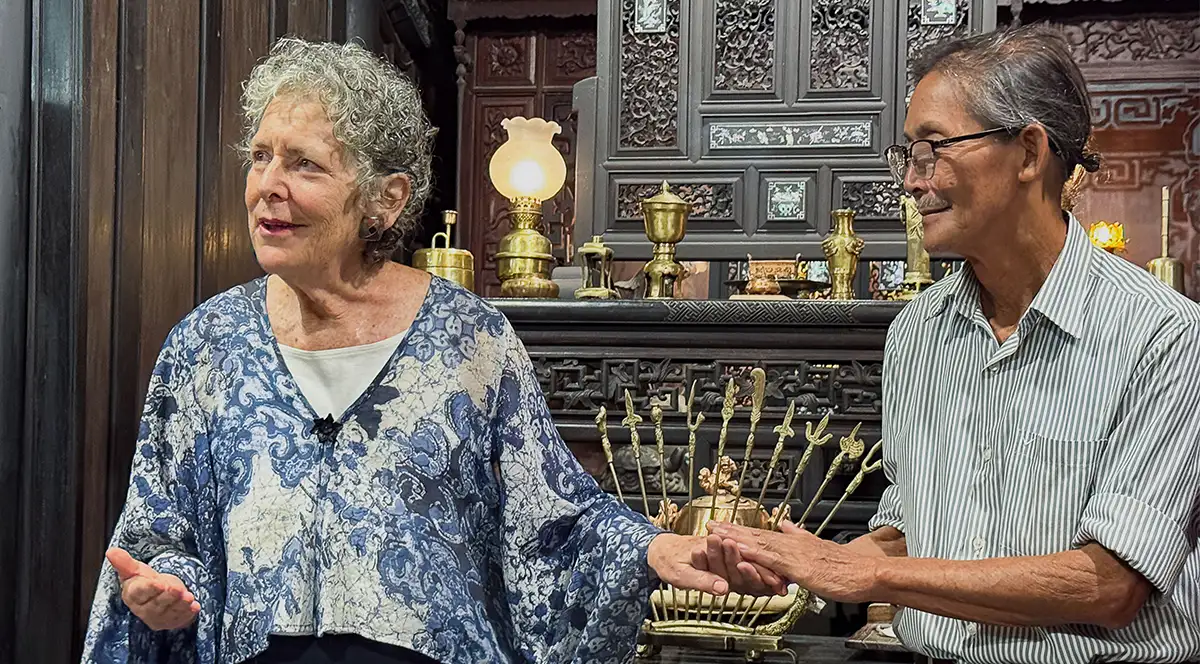

History and Culture of Vietnam
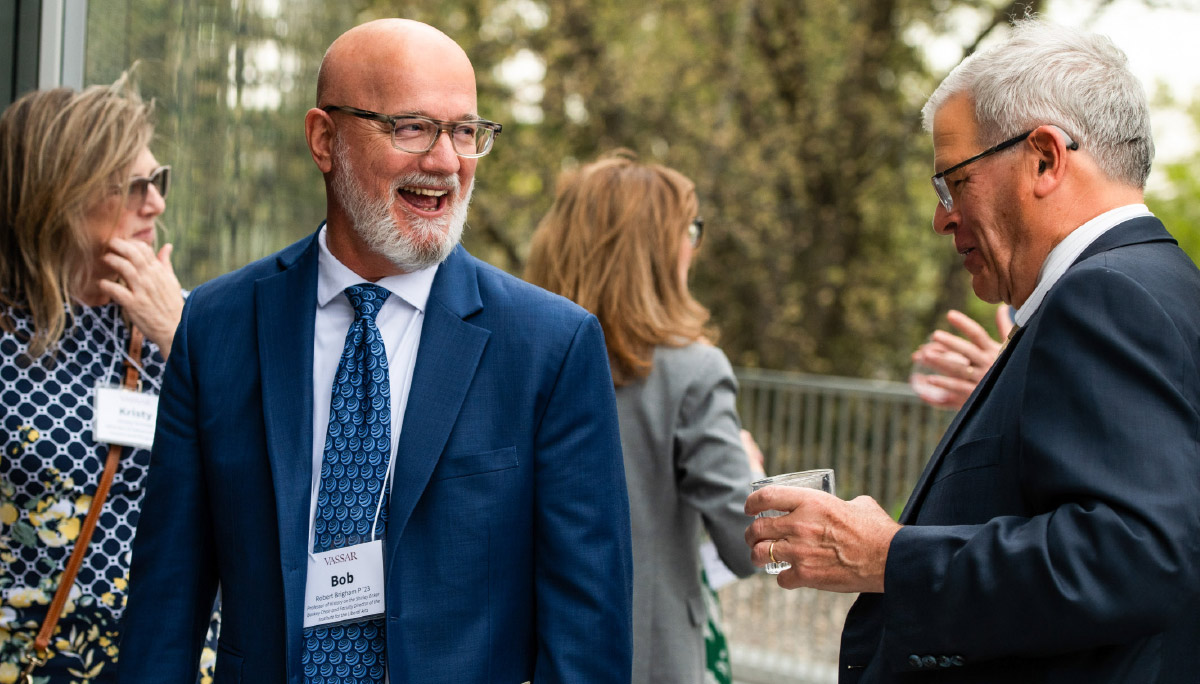
The group of 30, mostly alums and family, spent five days in Hanoi meeting with U.S. embassy staff, exploring historic sites, and viewing art. They then flew to Hue, where the longest urban battle of the war took place. “We retraced my father’s footsteps during the 1968 Tet Offensive in Hue,” noted Brigham. “My father, U.S. Marine Corps Sergeant Bruce Allen Atwell, was a combat photographer and took some of the most iconic shots during the Tet Offensive.” Brigham, who has been using Atwell’s photographs in his courses on Vietnam for many years, only recently learned that the photographer is his biological father and will soon publish a book about this.
The group then drove to Hoi An, an ancient seaside town. The last stop was Saigon, where the group toured the Presidential Palace, the War Remnants Museum, art galleries, the Cu Chi Tunnels, and even the Mekong Delta. They also met with the president of Fulbright University. “It was a magical trip,” said Brigham, “a trip filled with history, art, economics, politics, and culture.”
Vassar Trustee Robyn Field ’86 agreed. “Traveling with Professor Bob Brigham and his wife, artist Monica Church, was incredibly special, as we were treated to so much insight and detailed stories about the history, politics, and culture of Vietnam,” Field said. “We had insider access to places we would never have had the opportunity to see without Bob and Monica and our Vassar connection. Vietnam’s landscape was beautiful, the people were warm and engaging, and the food and culture were amazing. A highlight was sharing in the personal family history and stories of the Vietnam War through Bob’s perspective. And, it is always a pleasure to meet and get to know generations of Vassar alums.”
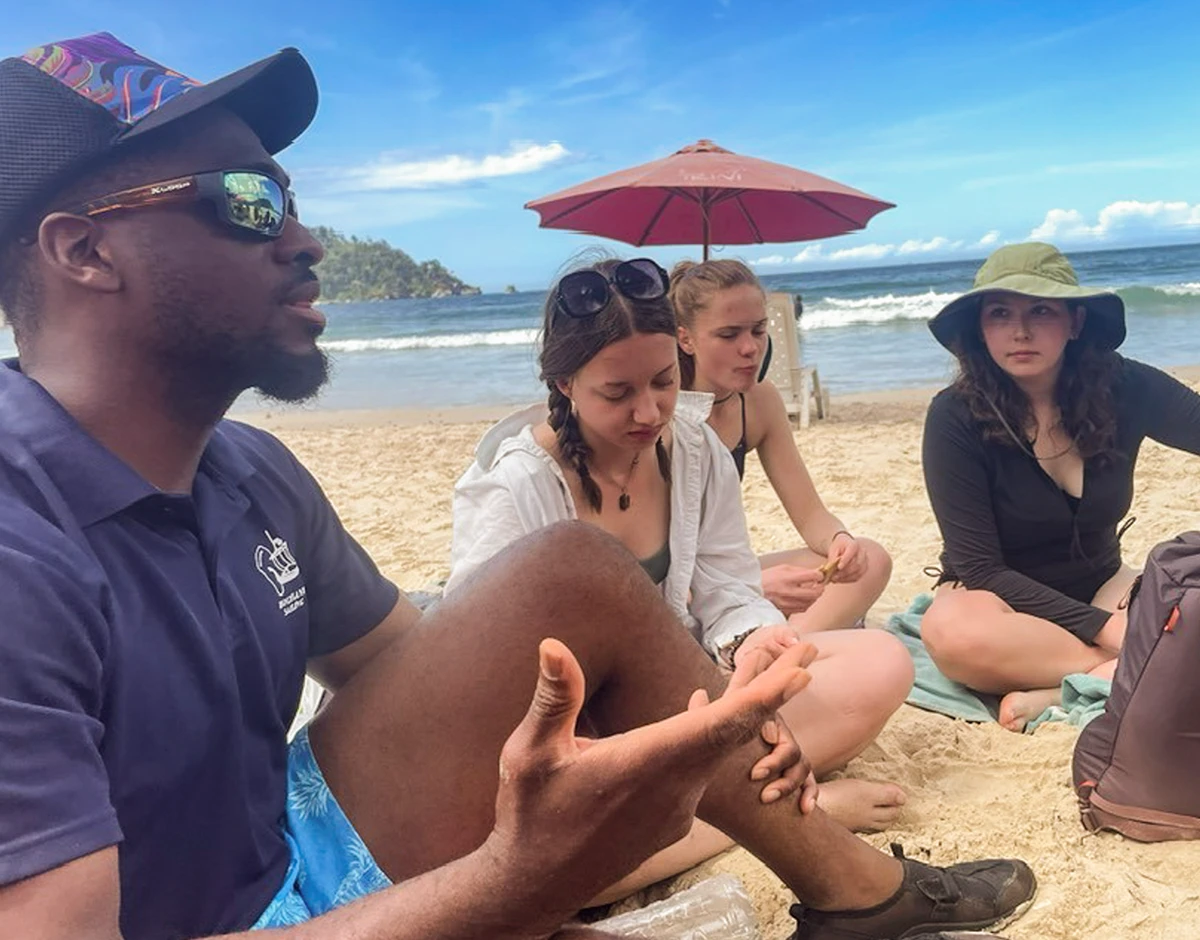
Earth Science and Environmental Studies in Trinidad and Tobago
A main goal, said Schneiderman, was to avoid “parachute science,” whereby “foreign researchers swoop in, disregard people with on-ground experience, and give little to no credit to local collaborators on published works.”
Students described the trip as unforgettable. “This trip was incredibly special to me because it was my first time visiting Trinidad and Tobago, where my family is from,” said Namdeo. “I had the chance to see the houses my parents grew up in and meet relatives I’d never met before, which was deeply fulfilling on a personal level. It was equally enriching academically, as I was able to engage in meaningful, hands-on learning by applying scientific concepts to a place that holds so much personal significance. The experience was both intellectually and culturally transformative; it will stay with me forever.”
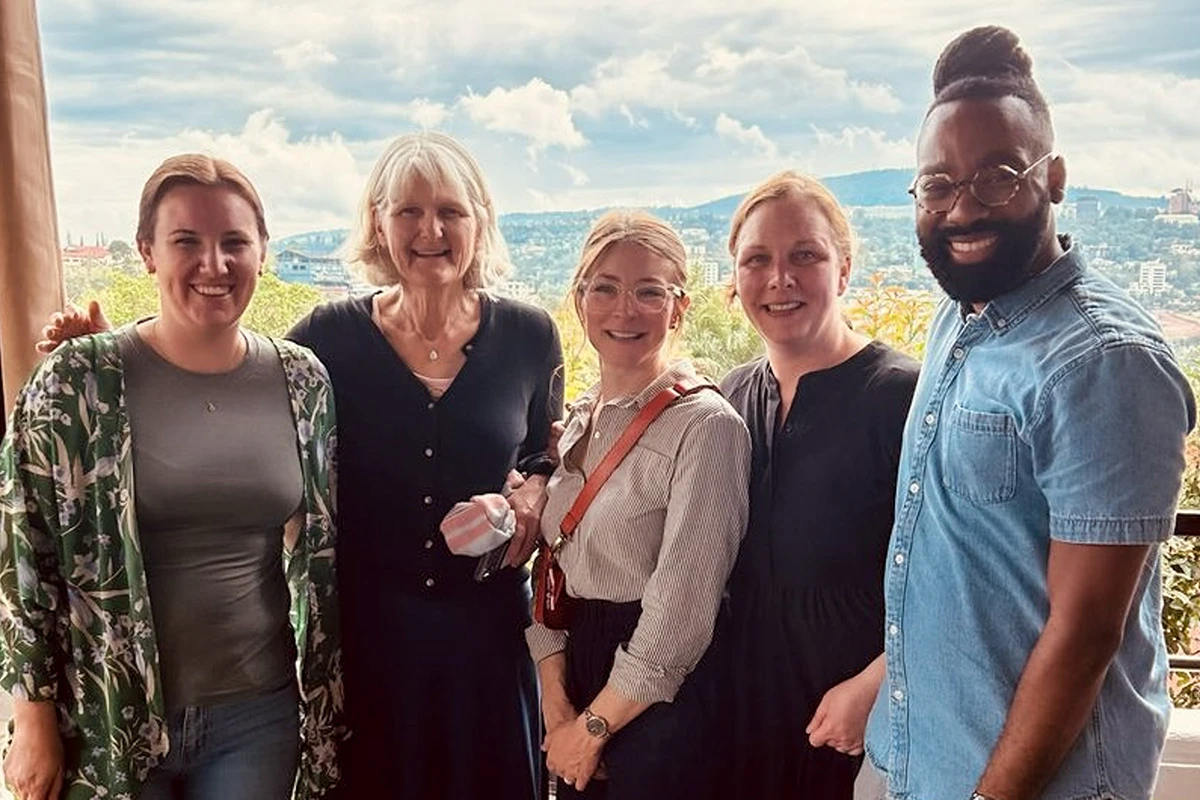
Courtesy of President Elizabeth Bradley
The Global Collaborative for the Liberal Arts in Rwanda
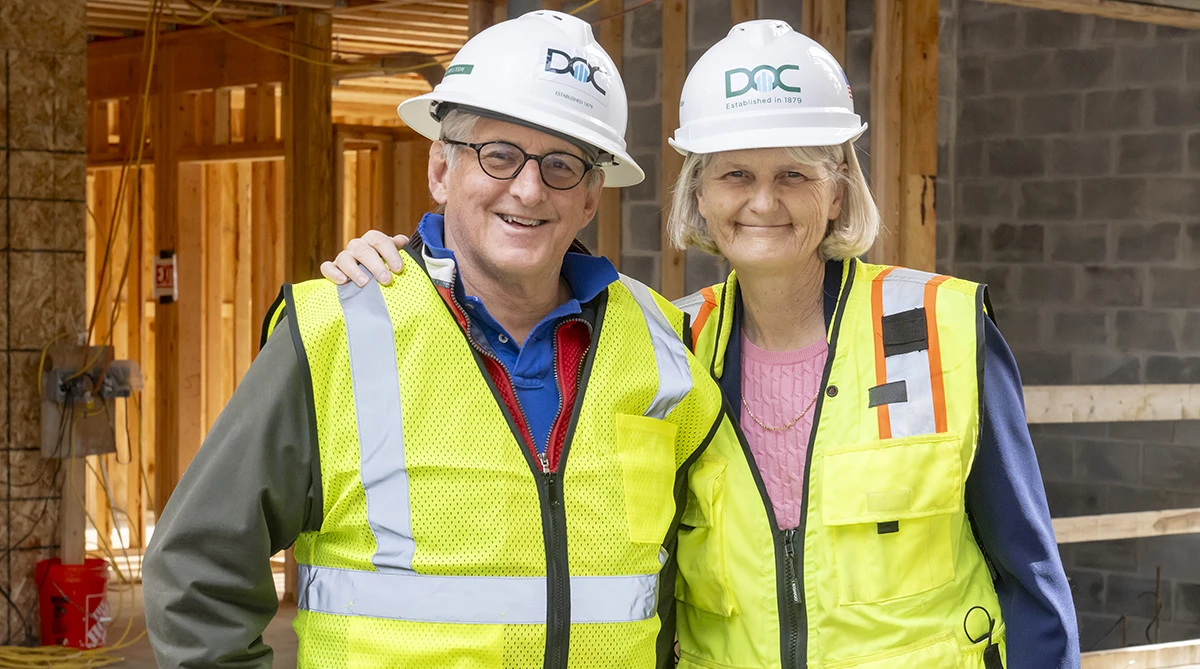
Besides Bradley, the Vassar delegation included Deputy to the President Wesley Dixon; Adjunct Instructor in Science, Technology, and Society Christie VanHorne; Associate Professor of French and Francophone Studies Anne Brancky; and Ingrid Munezero ’28, a Vassar first-year student and Global Collaborative intern from Rwanda whose sister is a medical student at UGHE.
Munezero said that during the course of the week that she was in Rwanda, she gained a new appreciation of the liberal arts model of learning, in which acquiring knowledge is a collaborative process among faculty and students, when she heard UGHE students describe how much they believed it was helping them become better doctors. She said the trip had made her thankful that she is getting a liberal arts education, which she had previously “taken for granted.”
Stockton Photo, Inc.
Honoring Barbara Dixon ’69 Through Career Education
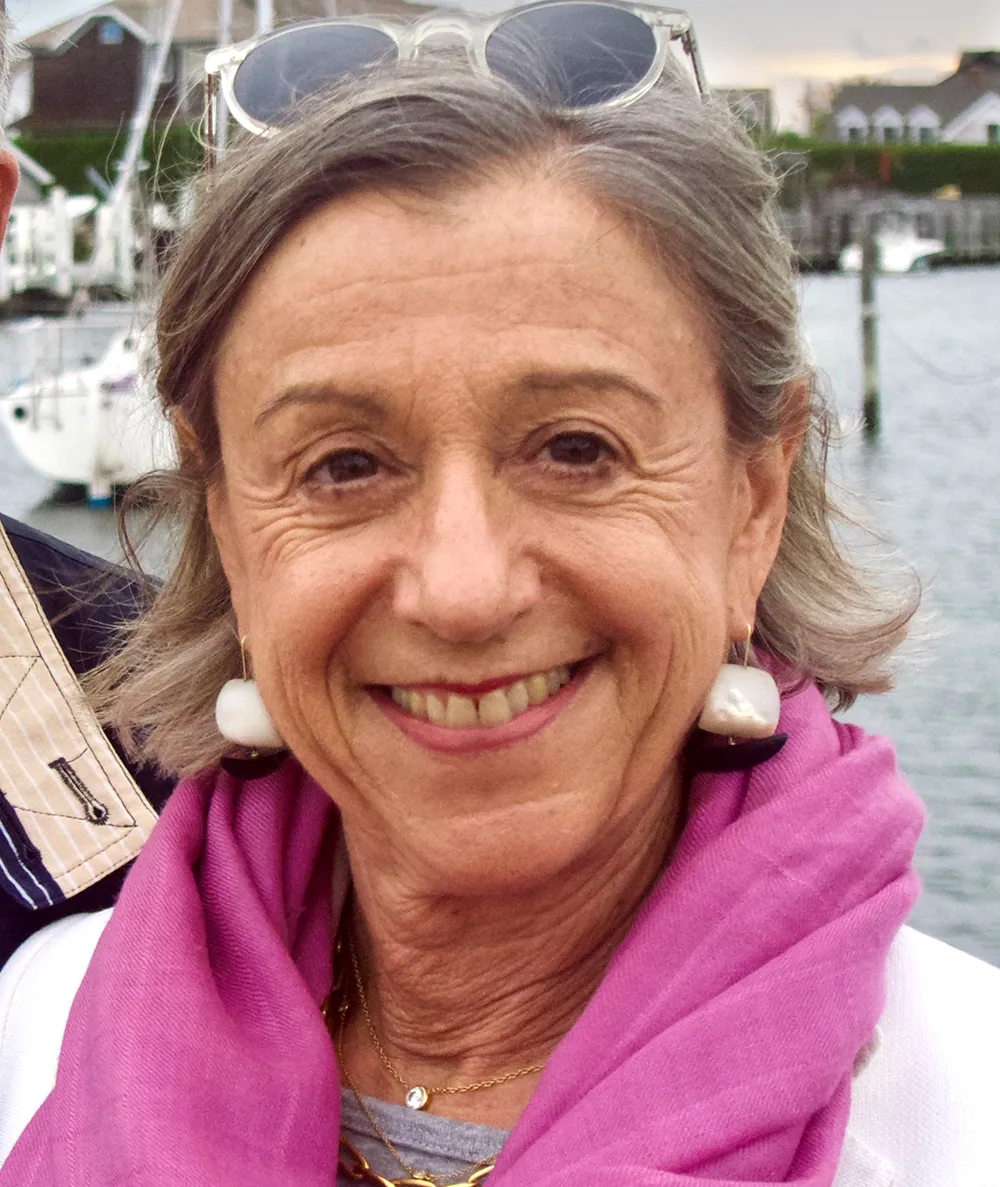
Her husband, Christopher Dixon, recalled a friend’s observation after Barbara’s death, underscoring how powerful a presence she was, defying expectations with quiet authority and demanding respect the moment she appeared. “You have to remember that in those days [the 1970s], when a man walked into your office, he looked at your chest before he looked at your face,” the friend told him. “But when Barbara would walk into a room, everybody would take a step back.”
Now, through a transformative gift from Christopher to Vassar’s Center for Career Education (CCE) programming and The Dede Thompson Bartlett Center for Admission and Career Education, Barbara’s legacy will continue to inspire future generations of students and alums. The gift supports on- and off-campus programs, internship opportunities, professional development, networking, and career advisement, and bolsters staffing to guide students on their career journeys. These services will be housed in the new Bartlett Center, which also benefited from the Dixon gift.
This investment in Vassar students draws inspiration from Barbara herself, whose career was marked by visionary leadership and a fearless drive to pursue her dreams.
Charting a Course in Finance
“I can’t emphasize enough how important that group of women in that last all-female class is,” Christopher said. “We had all grown up through the ’50s, and there was this whole notion that if you got a really good education, you could do anything you wanted to do … And if you went to a prestigious university or college, the doors were wide open to you, and folks took that seriously. [The Class of 1969] worked hard.”
Barbara did, indeed. She rose through the ranks, shattering the glass ceiling to become a renowned trader and honored member of the FIA Futures Industry Hall of Fame. She became a senior manager in the commodity division and one of two women executive vice presidents at Shearson American Express, where she also participated in college recruiting efforts. Shearson acquired Lehman Brothers in 1984, and she continued in senior roles until she left in 1992. She then returned to her early interests in the natural world.
A Shift Toward Stewardship
“Once Barbara left Wall Street, she focused on the whole notion of sustainability, of open space, of the landscape that surrounds us, education, the impact of climate change,” Christopher said, “and that’s part of her legacy as much as she was successful on Wall Street.”
Christopher’s career evolved from filmmaking to securities analysis, culminating as Managing Director and Global Coordinator of Entertainment and New Media Research at UBS. He also taught finance for 14 years at NYU’s Stern School of Business.
Together, the Dixons helped found Stone Acres Farm in Stonington, CT, in 2016 and launched the Yellow Farmhouse Education Center in 2017, whose mission is to “use culinary and farm-based education to connect people to each other and to where their food comes [from].”
Barbara remained committed to these organizations until her passing in September 2023. Christopher remains Chair of Stone Acres Farm.
“Barbara grew up in Poughkeepsie and went to Vassar, which was an integral part of her life. She would tell you her success was primarily because she felt that Vassar taught her about primary sources,” Christopher said. “To be able to find and dig and get an answer that could easily be supported—that led her to a logic that she was able to use in her later career.”
Courtesy of Chris Dixon
Back to Vassar
Wanting to honor her where her legacy began, Christopher reached out to President Elizabeth Bradley, who mentioned The Bartlett Center.
“Barbara would have found great joy in witnessing the realization of this building, and I thank Dede Thompson Bartlett for her vision,” he said. “To ensure that the Center for Career Education programming flourishes for many years to come, our gift, along with others, will support the administrative needs—the meat and potatoes of CCE.”
Christopher found the opportunity serendipitous. Not only would his gift help students, but the architect behind The Bartlett Center is Maryann Thompson Architects, who also built the Dixons’ home.
“Career education is really important,” Christopher said. “There are the tactical and technical pieces: How do you write a résumé? How do you tell the story about yourself? How do you define that process? Finding a career is finding something that you want to do, combined with your particular skill sets and personal capabilities, and, at the same time, understanding the technical aspects of how to go about getting a job. It’s a very important part of development.”
Vassar’s CCE is adopting a Life Design model, empowering students to shape their career paths through intentional exploration. The Dixon gift will help expand real-world experiences through internships, student organizations like the Vassar Business and the Healthcare Industry Clubs, and hands-on learning. Personalized advising, workshops, and mock interviews will further equip students and alums to reach their goals.
“Building on the success of signature programs like Sophomore Career Connections, an expanded Life Design model and four-year plan will prompt students to see connections between their curricular and extracurricular pursuits, and to practice articulating the meaning and value of their liberal arts education,” Stacy Bingham, Associate Dean of the College for Career Education and Interim Director of Fellowships, said. “In short, we are giving students the tools to navigate a lifetime of career decisions and changes.”
Asked what Barbara would think of the gift, Christopher chuckled. She was humble and might have questioned the decision—until she saw the impact on students, he said. Then she’d be ecstatic.
Barbara’s Legacy
“I found it important that she be honored at Vassar, and at the same time, to be able to give back some of what Vassar had created and informed in this extraordinary woman,” Christopher said.
Construction on The Bartlett Center is well underway and expected to be completed in November 2025. Located at the corner of Raymond and Collegeview Avenues, it will house the CCE and Office of Admission.
Vassar Celebrates 100 Years of Tech Pioneer Grace Hopper, Class of 1928
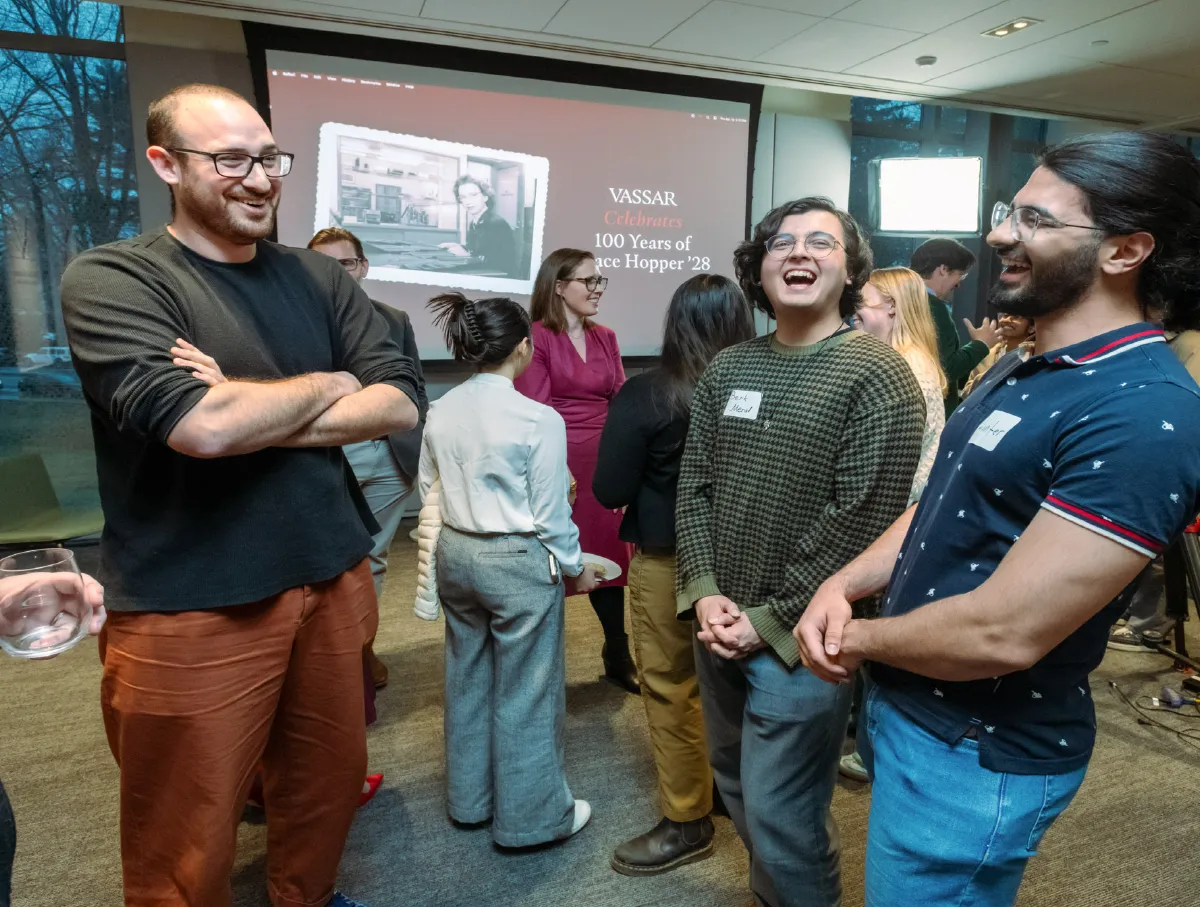
Hopper biographer Kurt Beyer observed that one of the first things Hopper did in the Navy was to reject the notion of doing things as they’d always been done. “Prior to World War II, all data was analog,” Beyer said. “She broke the notion of single-use function calculators and developed a coding system”— a computer program that translates human-readable source code into machine code that a computer can execute. The development of COBOL (Common Business-Oriented Language), a system that democratized coding that made it simple for everyday users and businesses to use computers, was a game-changer. Despite her remarkable achievements, Beyer said, Grace Hopper’s contributions to the modern technological landscape have largely gone unnoticed until recently.
The event also featured a fireside chat between Grace Hopper Day organizer Alison Lindland ’00, Chief Marketing Officer at Movable Ink, a company that uses artificial intelligence and other high-tech tools to help businesses succeed; and Naomi Seligman ’55, a thought leader in the field of computing and technology who knew Hopper personally. Seligman said she had met Hopper when she was working for a consulting firm and was giving a speech at a conference at the Waldorf Astoria Hotel in New York City. She said Hopper convinced her to resign and start her own business, “and she was a captain in the Navy, so I followed her orders.
“Grace knew her technology,” Seligman continued, “but she was also charismatic. She understood that promoting the use of computers was not just science. She knew we needed the private sector to become involved in computing.”
An all-alum panel was moderated by Nancy Ide, Professor Emerita of Computer Science, who had founded Vassar’s Computer Science Department in 1990. The panelists—Peter Leonard ’97, Director of Customer Engineering Excellence for Google Cloud; Reena Mehta ’01, most recently the Senior Vice President of Streaming and Digital Content Strategy at ABC News/Disney; and Matt Foster ’14, an Advanced Senior Game Designer at Insomniac Games in Los Angeles, California—all said that following Hopper’s legacy at Vassar had helped them advance in their post-Vassar careers.
The event concluded with a CBS TV 60 Minutes video clip in which Hopper reflects on her long career as a tech pioneer. The clip was introduced by Professor of Mathematics and Statistics Emeritus John McCleary, who has written a history of the Mathematics Department; a significant portion of the text is devoted to Hopper’s contributions to Vassar and to the world of science and technology. Marc Smith, Professor and Chair of Computer Science, said a few final words, revealing that he had chosen to come to Vassar partially because of Hopper’s legacy. “I’d long known that Grace Hopper attended and taught at Vassar, and it was an honor to have the opportunity to be a part of that,” Smith said. “I could not be more proud to be following in Grace’s footsteps as a faculty member at Vassar. She is ours.”
A Fitting Arbor Day
Vassar Honors the Centennial of the Campus Arboretum
President Elizabeth Bradley took to the microphone—first to thank the Arboretum Centennial co-chairs: Director of Sustainability Kenneth Foster and Art History professor Yvonne Elet. She gave a quick rundown on the 1925 founding of the Arboretum, which is commonly attributed to the efforts of landscape architect Beatrix Farrand and less commonly to Vassar botany professor Edith Roberts.
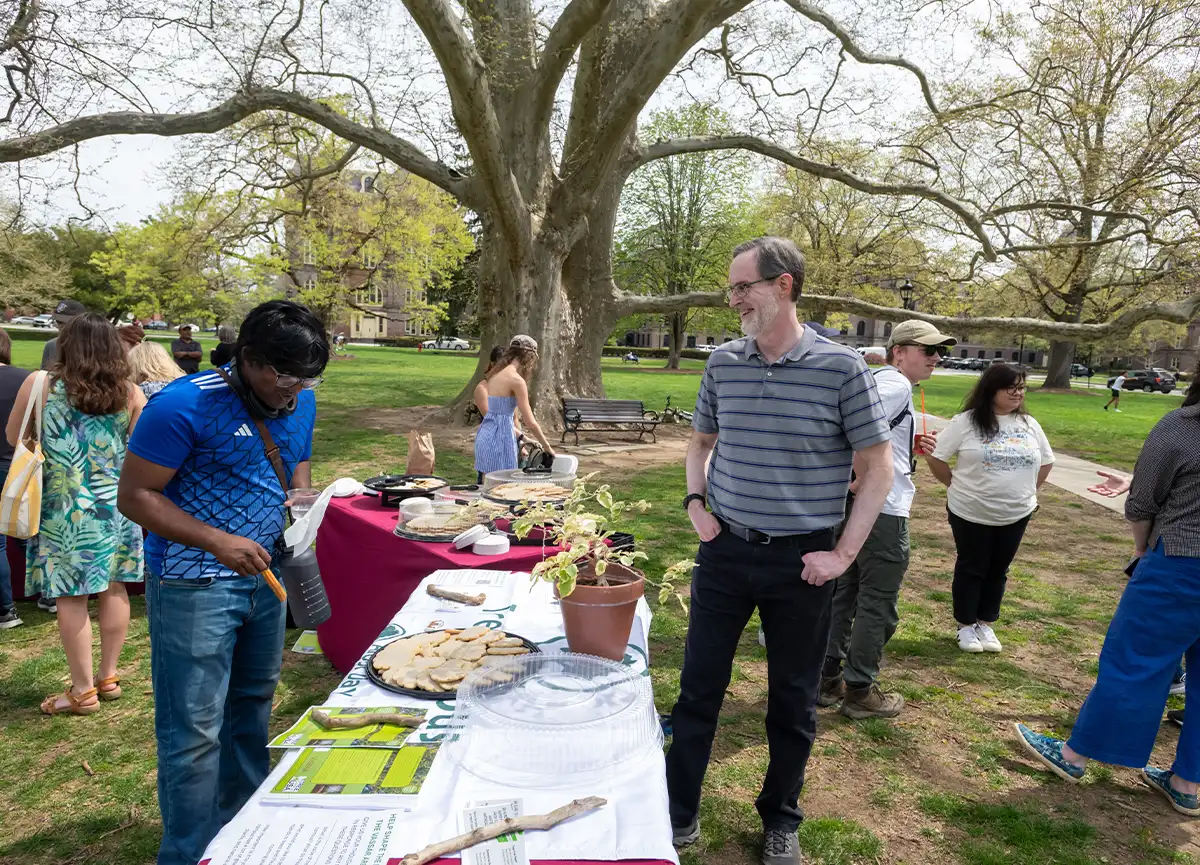
The afternoon continued with a self-guided “gratitude walk” among the trees, which offered visitors the chance to stroll through campus, past Noyes and Cushing and down to Sunset Lake.
Back on the Library Lawn, members of the Vassar Artists’ Group were creatively painting wooden benches to be placed around the Preserve, and Foster was giving away an abundance of tree-shaped cookies.
Mental health was top of mind. Wendy Maragh Taylor, Associate Dean of the College for Student Growth and Engagement, reminded the crowd that the day was also a “Community Care” day, first launched during the COVID pandemic so students could lift their spirits by interacting outdoors. At a nearby table, a student hosted a station for Vassar’s Counseling Service, handing out a flyer on the mental health benefits of nature. The messages fit right in with a new initiative, Vassar Nature Rx, launched as part of the Campus Nature Rx Network, which describes itself as “a coalition of colleges and universities dedicated to nurturing healthy, nature-connected campus communities through inclusive and equitable nature engagement teaching, research, and outreach.”
The afternoon would have felt incomplete without acknowledging the grounds crew who keep the campus beautiful and the trees healthy. They were honored in front of the beech tree planted in memory of Superintendent of Grounds Henry Downer, who held the position at the founding of the arboretum.
Just a few steps away from the beech tree stood a small Eastern Redbud sapling planted in a freshly dug patch of soil—the latest addition to the campus Arboretum and the class tree commemorating the Class of 2027. The class tree tradition dates back to the Class of 1868.
As the afternoon came to a close, students and an eclectic group of local clergy, led by Sam Speers, Vassar’s recently retired Associate Dean of the College for Religious and Spiritual Life and Contemplative Practices, offered interfaith prayers and songs to suit the moment.
The Centennial celebration of the Vassar Arboretum continues all year. To learn more about the activities and events, visit vassar.edu/arboretum.
Vassar Today

Eric Spitzer
Yvonne Elet, Professor of Art at Vassar, was awarded the Elisabeth Blair MacDougall Book Award for her recent book, Urban Landscape in the Third Rome: Raphael’s Villa and Mussolini’s Forum (Edifir-Edizioni Firenze, 2023), which details a study of the urban landscape of Fascist Rome through the restoration of the gardens of Raphael’s Villa Madama.
Bestowed by the Society of Architectural Historians, this award honors the most distinguished work of scholarship in the history of landscape architecture or garden design. The award was named for the late Elisabeth Blair MacDougall ’46, who was instrumental in the development of those fields. The book also received the David R. Coffin Publication Grant from the University of Virginia Center for Cultural Landscapes in 2023.
Courtesy of the subject
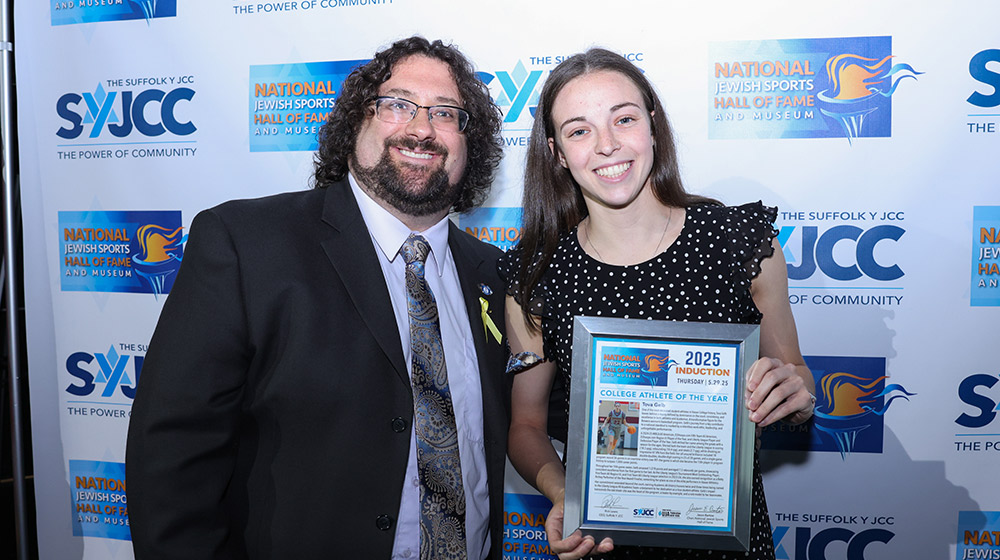
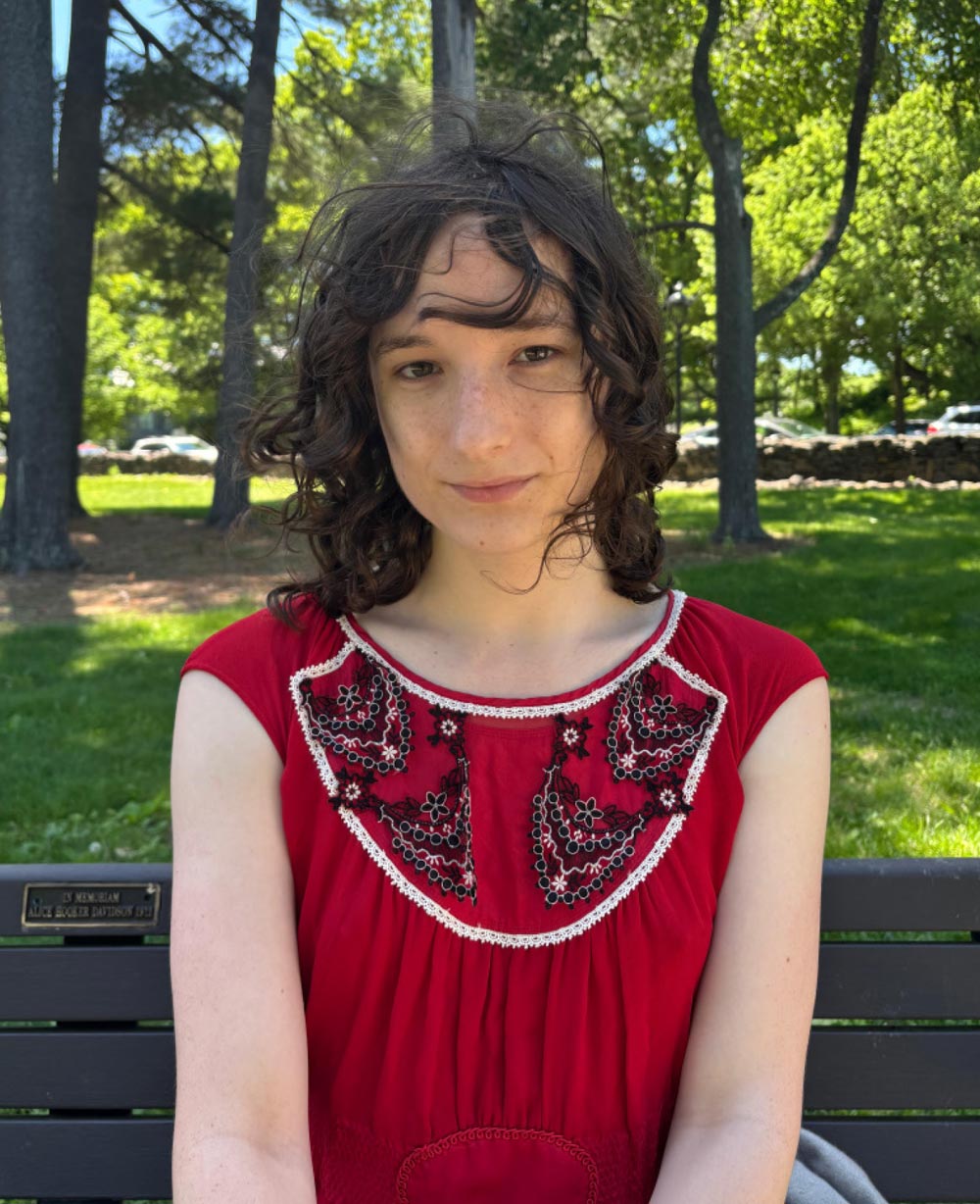
Born and raised in Chattanooga, TN, Buck is studying geography and anthropology at the College. Her research examines social movements, the politics of solidarity, and urban political economy, particularly in the U.S. South. Presently, she is studying the linkage between histories of the Black freedom struggle and contemporary activist efforts toward economic cooperation in Mississippi. Outside of research, she is a peer-consultant at the Writing Center and co-chair of the Vassar Working Student Coalition, an organization of student workers and allies dedicated to the improvement of student labor conditions on campus. After graduating, Buck hopes to pursue a PhD in anthropology or geography.
The Beinecke Scholarship received 93 nominations this year, and with this newest cohort, 759 students have been named Beinecke Scholars since the first awards were given out in 1975. Buck is the 13th Beinecke Scholar to hail from Vassar and the first since 2021.

Lucas Pollet
According to the publication website, “Spaces on the Spectrum examines the autistic rights and alternative biomedical movements, which reimagine autism in different and conflicting ways: as a difference to be accepted or as a sickness to treat. Both, however, provide a window into how ideas that conflict with dominant beliefs develop, take hold, and persist . . . Spaces on the Spectrum offers timely insights into the roles of shared identity and communal networks in movements that question scientific and medical authority.”

Buck Lewis
Means is the author of several short-story collections, including Two Nurses, Smoking; Instructions for a Funeral; The Spot, a New York Times Notable Book of the Year; Assorted Fire Events, winner of the Los Angeles Times Book Prize for Fiction and a finalist for the National Book Critics Circle Award; and The Secret Goldfish. His novel Hystopia was long-listed for the Man Booker Prize. A Guggenheim Fellow and three-time winner of the O. Henry Prize, Means has had stories published in The New Yorker, Harper’s Magazine, The Best American Short Stories, The Best American Mystery Stories, and many other publications.
Means will be honored at the annual PEN/Malamud Award Ceremony, held in partnership with American University, in December.

Stockton Photo, Inc.
Vassar Honors Inaugural Round of
Athletics Hall of Fame Inductees
The Vassar Resolutes: Established in 1866, it was the first organized women’s baseball team in the United States. Since it had no opponents, the members split and played against each other. The team’s historical significance has been recognized by the Baseball Hall of Fame in Cooperstown.
The 1991 Women’s Tennis Team: Coached by Vassar legend Kathy Campbell and Assistant Coach Kelly Ryan, the team made school history by becoming the first to earn a spot in the NCAA Championships. It finished with a 17–3 record, and Hannah Palmer ’92 earned All-American status.
The 1995 Men’s Volleyball Team: Led by Head Coach Bill McCarthy and Assistant Coaches Bill Doyle and Mary Ann McCarthy, the team won the EIVA Division III national title after posting a 19–9 mark in the regular season, including six victories over NCAA Division I squads.
Frances Fergusson, Vassar College President, 1986–2006: President Fergusson was instrumental in developing an athletics master plan that led to significant improvements in staffing, funding, and facilities for the department. Her major improvements to the athletics facilities included the renovation of Walker Field House, the construction of the Athletics and Fitness Center, the construction of the Prentiss Sports Complex and the Weinberg Sports Pavilion, the renovation of Kenyon, including the construction of the Mary Rousmaniere Gordon ’32 Squash Courts, and the purchase of land on the Hudson River for development of rowing facilities. Under her leadership, Vassar’s athletic programs experienced significant growth, expanding to include 25 varsity and varsity club programs. Fergusson also secured funding for new coaches, athletic administrators, and athletic training positions, propelling the teams to unprecedented levels of competitive success during her tenure.

Stockton Photo, Inc.
Katharine Hubbell ’43, Women’s Tennis: During her time at Vassar, Hubbell won several national singles and doubles titles. She continued her tennis career after graduating, making two appearances at Wimbledon and winning the U.S. Indoor singles title in 1955. In 1958, Hubbell received the USTA Service Bowl Award, an honor recognizing female players who have made outstanding contributions to the sportsmanship, fellowship, and service of tennis.
Martha Lewis ’85, Women’s Swimming and Diving: Lewis became the first Vassar student-athlete in any sport to earn All-American honors with a 10th-place finish in the NCAA championship in the 3-meter springboard diving competition and 14th place in the 1-meter diving event.
Tracy Nichols ’91, Women’s Cross Country: Nichols was the women’s cross-country program’s first national qualifier in 1988, and she achieved NCAA All-American status in 1990. That same year, Nichols’s resilience and determination were recognized with the prestigious Honda Inspiration Award, making her the first Vassar College recipient of this national accolade. Presented by Honda and the Collegiate Women’s Sports Award Board of Directors, this award honors NCAA female student-athletes who have overcome adversity and demonstrated extraordinary perseverance and dedication in their return to play.
Shirin Kaufman ’95, Women’s Squash: Kaufman earned four first-team All-American honors from 1992 to 1995. During her time at Vassar, she achieved a 110–15 overall record. Her contributions were instrumental in leading the team to its highest College Squash Association team ranking, finishing 11th during the 1992–1993 season.

Diane Zucker
Margaret Kwateng ’14, Women’s Rugby: Despite playing just three seasons due to injury, Kwateng is the all-time leader in tries with 99. She ranks second all-time in career points with 495 and second all-time in single-season tries with 44. During her time with Vassar, the team achieved an impressive 50–15–3 overall record. In her senior season, Kwateng led the team to the American Collegiate Rugby Association Division II Final Four and was named to the All-Tournament Team.
Cydni Matsuoka ’14, Women’s Basketball: Matsuoka graduated as the program’s all-time leading scorer with 1,923 points and earned eight All-American citations throughout her four-year career. She was named D3hoops.com National Rookie of the Year in 2010 and D3hoops.com East Region Player of the Year in 2013–2014. She was named Liberty League Player of the Year twice.
Heather Ingraham ’15, Women’s Track and Field: Ingraham became the first Brewer to win an individual national title with a victory in 2015 in the 400-meter dash at the NCAA Division III Outdoor Championships. She earned All-American status twice and was named Liberty League Track Athlete of the Year in 2015. In addition to her individual honors, she was a member of the 4×400 meter relay team that won four Liberty League championships.
Michelle Walsh, Director of Vassar’s Department of Athletics and Physical Education, said she was delighted to greet many of the inductees at a dinner at the Athletics and Fitness Center on June 7. “It was one of the incredible thrills of my career to be part of this event, which was the culmination of more than 165 years of athletics history at Vassar College,” Walsh said. “Our department undertook this endeavor together with a shared purpose of honoring former student-athletes, employees, and friends of the program for outstanding contributions to Vassar athletics and for making a positive impact on their community, their profession, and/or their alma mater. Our call for nominations as well as our internal review of our athletic communications archives resulted in a pool of more than 150 highly deserving nominees leading to the 13 honorees in this first class. There was tremendous excitement leading up to the induction dinner and the energy in the room that evening was simply amazing: joy, gratitude, celebration, and above all else, connection to one another. I cannot imagine a better way to have kicked off our Hall of Fame and am thankful for the many alums who returned for the event to make it such a special evening.”
College President Elizabeth Bradley opened the remarks at the dinner by saying how much she enjoyed attending Vassar athletics events. “I know some of them as just regular students, and then I see them on the whatever field/court/swimming pool and think, ‘Wow, they are really: cool.” she said, “. . . and now the success rates of our teams really is unparalleled, and I do think the Hall of Fame is such an important initiative for Vassar. I am thrilled to see it finally come to its fruition.”
President Emerita Fergusson could not attend the dinner, but she sent some remarks to Walsh via email. “I am very honored indeed to be named to the Vassar Athletics Hall of Fame,” Fergusson wrote. “It is a surprising honor for someone who never had the opportunity to play intercollegiate sports. It was not even a possibility for women in the early 1960s when I went to Wellesley. How things have changed, both nationally and especially at Vassar! When I first arrived at Vassar in 1986, Vassar Athletics was in shambles and was jokingly seen as an oxymoron. There was no facility beyond the old field house, itself leaking badly onto its hard-linoleum-over-hard-concrete floor. The fields were full of potholes and had no scoreboards. Coaches were almost all part time, from local high schools. Student-athletes faced challenges beyond those of their athletic capabilities. It was truly amazing that some achieved so much with so little help or encouragement from Vassar.


Stockton Photo, Inc. / Wilhelm Woelper
Speaking at the Hall of Fame dinner, Erica Weber Smith ’91, a co-captain of the enshrined 1991 women’s tennis team, said she was honored to share the experience with many of her former student-athletes. “When I got the news that our team was being inducted, three things really stood out to me,” Smith said. “One, what it meant to be a student-athlete; two, our shared experiences full of unforgettable memories; and three, the lasting relationships we built along the way.”
The youngest Hall of Fame inductee, track All-American Heather Ingraham, said the accolades she had received were not the most significant part of her Vassar athletics experience. “It’s incredible to be recognized alongside so many other remarkable athletes who have left their mark on the school. When I arrived at Vassar as a freshman, I wasn’t sure what to expect. The varsity track program was still in its early years, and there weren’t many sprinters on the team. I was quiet and reserved, probably speaking no more than 20 words during my overnight visit, but what I found at Vassar was so much more than a team. I found a community. I found coaches who saw potential in me, teammates who pushed me, inspired me, and ultimately became lifelong friends. And I found a campus that gave me room to grow as an athlete, yes, but more importantly, as a person. Winning a national championship in the 400 meters stands as one of the proudest moments of my life.”
The inductees were chosen from a pool of candidates nominated by Vassar alums, students, faculty, and staff in three categories: (1) alums who participated on an athletic team while pursuing a Vassar degree and who have completed their athletic career at least 10 years prior to the year of election, (2) college employees or individuals who have made a significant contribution to Vassar athletics and who have ended their employment at least 5 prior to their election, and (3) teams that have brought recognition and honor to the College by their significant achievement at least 10 years after the date of those achievements.
The selection committee was composed of Athletics Director Walsh, and a variety of faculty members, administrators, coaches, and former student-athletes.
Walsh said she was looking forward to more Hall of Fame inductions in the future. “As our Hall of Fame will now grow over time and we will induct classes every two years, we hope that all of our alums and friends of the program will help us in the coming years by continuing to submit nominations and by supporting the Brewers Fund so that we can continue to offer these opportunities in the future,” she said.

Working and Learning in the Age of AI


AI? Meet Academia…
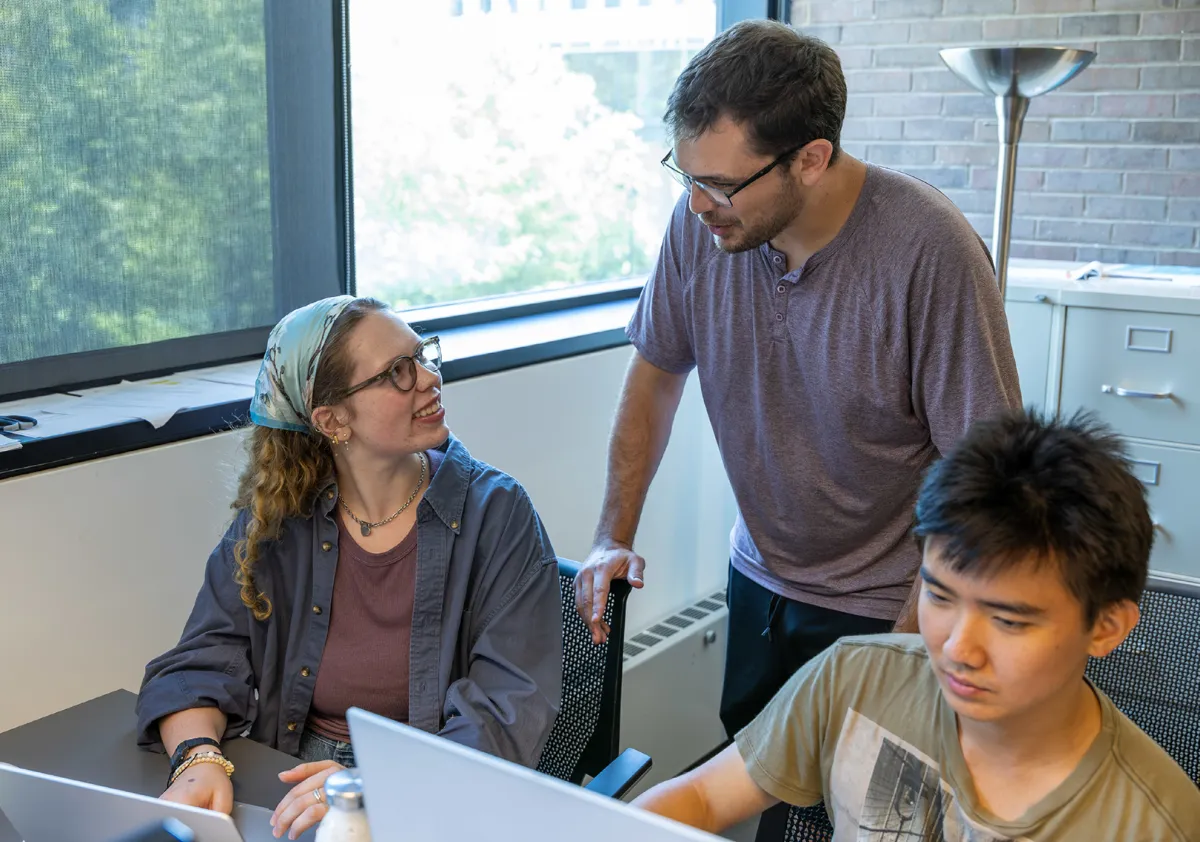
tudents in Josh de Leeuw’s Introduction to Cognitive Science class spend their first assignment sparring about the mind’s complexities with Pat, an artificial intelligence chatbot he created. Pat asks: “Can the richness of our mental experiences be reduced to the firing of neurons?”
From there, students engage with Pat in a back-and-forth dialogue designed to encourage critical thinking and assess their grasp of the course’s early philosophical concepts. It’s a modern version of an oral exam. De Leeuw ’08, an Associate Professor of Cognitive Science at Vassar, trained Pat with course materials. “The AI tools already out there just help students [do things],” he says. “ChatGPT won’t come back with questions.” Chat with Pat encourages students to think more deeply about alternative perspectives. The focus shifts to broadening one’s understanding of a topic, rather than merely using AI as a shortcut to answers.
Students submit two reflective paragraphs about their experience, plus their Chat with Pat transcript, allowing de Leeuw to review their insights and how they interacted with the AI. He hopes assignments like these will help to guide Vassar students’ use of AI—both on campus and beyond.
De Leeuw is one of a growing number of professors actively grappling with AI’s place in higher education and doing what they can to ensure it’s integrated into campuses in an ethical and safe manner.
It’s important “to teach students to use AI as a tool to invest in their learning,” de Leeuw says. “What I hope is that by getting something like the Chat with Pat assignment early on in their college education, students can see there’s another way you can use these tools other than just asking it to do things for you.”

AI as a supplement, not a substitute
Since OpenAI released ChatGPT in 2022, college students have rapidly embraced AI to outline essays, generate practice questions, and even complete entire assignments. Some 86 percent of students globally regularly use AI in their studies, according to a Digital Education Council Global AI Student Survey. At Vassar from 2024 to 2025, the number of first-year students reporting experience with AI and related technologies increased roughly fourfold, according to Vassar’s Chief Information Officer Carlos Garcia.
On college and university campuses—where deep learning, scholarship, and personal growth are hallmarks—administrators and faculty walk a fine line: embracing technological progress without compromising critical thinking or creativity. One recent study from MIT’s Media Lab found that participants who wrote SAT essays with ChatGPT showed the weakest neural activity when compared with students who used a traditional search engine or no tool at all. As they wrote subsequent essays, students also fell behind in their ability to quote from the paper they had just written, and they began to mostly copy and paste.
“AI is looking like it might be a bigger disruption to higher education than the pandemic was,” says Assistant Professor of Computer Science Jonathan Gordon ’07. “We’re looking at a long-term change that’s making us rethink all of our classes.”
Vassar professors recently mulled over AI’s role in teaching and learning at a Vassar Pedagogy in Action workshop—“A Beginner’s Guide to Assembling Your AI Toolkit.” One idea was to monitor how Vassar students are using AI by performing an annual baseline study. “Right now we’re making a lot of assumptions, some true, some not,” says participant and Professor and Chair of History on the Marion Musser Lloyd ’32 Chair Ismail Rashid.
“I wanted to introduce it in a transparent, and not accusatory, way so students know we’re aware AI could be useful,” says Rashid. “AI is going to be another tool that will help students not only acquire but also process information.” He believes that AI will be transformational for accelerating students’ understanding of existing research. “It’s time they can dedicate to furthering their projects or their research studies,” he says.
Other Vassar professors are using AI to crunch numbers, code, and identify readings for class. De Leeuw uses it to gain a deeper understanding of new mathematical concepts.
Last summer, as part of an Undergraduate Research Summer Institute (URSI) project, he and two Vassar students ran a study that assessed whether initially engaging with a chatbot on a challenging topic increases a person’s willingness to interact with people who hold opposing views. Results are forthcoming. But the work has implications for how AI is used in the classroom. De Leeuw theorizes that engaging first with AI may help students with minority views to feel more comfortable speaking up in class.
A key question, says de Leeuw, is “Are we maximizing our agency?” Is AI helping students and faculty to accomplish their goals through co-creating, or is it minimizing people’s agency by offloading tasks to AI systems? “Higher ed is still fundamentally about human relationships, building connections,” de Leeuw says; there’s still value in the human brain, in how humans think about things.
“One of the goals in higher education should be, how do we expose students to positive use cases and teach skills needed to work with these systems and evaluate them,” says de Leeuw, “to be critical of what these systems are doing, and how what they’re doing might be impacting our thoughts and agency.” Faculty will have to weave these lessons into coursework. One possibility de Leeuw poses is for Vassar to offer a foundational workshop during orientation for first-year students on the positive and negative uses of AI.
Prioritizing the process over the final product
John Long, Professor of Biology and Professor and Chair of Cognitive Science on the John Guy Vassar Chair, is intentional about differentiating helpful AI uses from potentially hurtful ones with his students. In his Introduction to Cognitive Science class, one assignment is particularly tempting to outsource to AI: critiquing and then rewriting a science news article based on a research study. During office hours, Long explains the importance of writing and self-editing—without AI.
“It’s not about the final product, it’s about the process,” he says. “We talk about how, when you don’t do your own editing, when you let ChatGPT do your editing, you’re missing out on this skill that helps you evaluate the quality and veracity of any piece of writing—including your own.” Increasingly, as AI becomes more prevalent in classrooms, professors will need to be even more intentional about helping students to hone these types of life skills—critical reading and thinking; wise, fact-based decision-making; accepting accountability; and effectively working with people from a variety of backgrounds.
“The goal should be learning and growing as a person, not getting an A,” adds Gordon. “It’s about what you get out of class that changes you as a person, or the way you think about the world—that’s the valuable part, that’s what we should be optimizing for.”
Gordon is leaning toward letting students in his 300-level Natural Language Processing project-based class use AI—with a caveat: They’ll have to meet with him one-on-one to talk him through the project after completion, and that will figure into their grade. “Can they defend the claims in their report?” he says. In the entry-level course Programming with Data, to be taught this fall, he and other professors will spearhead discussions about the ethics surrounding the use of people’s data to train AI, AI-related job losses, and AI’s climate impact.
“If students are thinking about this in 100-level classes, then maybe they do use AI more thoughtfully in those 200 and 300 classes,” he says. He prefers these types of proactive approaches to guiding students on AI rather than punitive ones. “AI detection tools don’t work that reliably,” Gordon says. “They just turn people from cheaters into people who are working to hide their cheating, and that’s even worse than just the cheating.”
Professor of Physics Jenny Magnes is testing to see whether AI can solve homework problems issued in her Electromagnetism course. She plans to use AI’s mistakes as teachable moments to help students critically analyze AI output and reinforce key concepts. She found that some of AI’s answers referenced mathematical notations not used in the class textbook, such as the Einstein summation notation. Magnes asked AI to create and format a reference document teaching Einstein notation, saving her valuable time.
Still, she and other faculty members continue to grapple with where to draw the line on how students use AI in and for class.
The return of blue books?
Gordon’s approach to AI in his classes has been to ask students who’ve used AI to complete an assignment to provide a brief written statement on how, or to show him their full chatbot transcript. “We need to know, where are you in the work?” he says.
Many of his students ask AI questions like, “I’m stuck with this, can you help?” Gordon says. “Things they would come to office hours for. Now, they’re getting office hours at 3:00 a.m. I don’t offer that—fine.” Last year, however, one student’s transcript began with the query “I have a project due in five days,” and then AI ended up doing the work.
“That was not a project that turned out very well,” Gordon says. “There was a disturbing lack of human interaction. That was not an ideal way to use AI.”
To safeguard against problematic usage, Vassar professors are considering reviving ways of evaluating students that have been less common in recent years—from handwritten blue-book exams to oral evaluations—or giving more weight to in-person, interactive aspects of pedagogy, such as class participation. “These are things we’re definitely talking about,” says Gordon. And it’s a trend that’s building at colleges and universities nationwide.
The Wall Street Journal reported that blue-book sales increased by almost 50 percent at the University of Florida and by 80 percent at the University of California, Berkeley, over the last two years. Gordon will add an in-person midterm exam for the first time ever to his Natural Language Processing course this fall. In the age of AI, “I just don’t trust that homework assignments are an accurate way to assess what students know,” he says. John Long says his Introduction to Biology quizzes are in person and on paper, too.
Still, Gordon says, colleges and universities must be mindful of the reasons alternative assignments became popular in the first place: for example, to prevent panic attacks during test taking, or to accommodate students who are shy about speaking up in class. “This is where we need to be careful,” says Gordon. “There’s definitely that trade-off.”
Professor of Cognitive Science Ken Livingston worries that relying too much on face-to-face assessment could come at the expense of students barely writing at all, and becoming less capable of refining and evolving their thinking.
“There are ways of thinking that are hard to master if you don’t learn how to write,” he says. “Losing our ability to think in complex, deep ways, that would be a real hit to the culture, to human beings, and to our ability to do deep work and even to enjoy our lives in a deep and profound way.”
“It’s a delicate balance,” he adds. Professors have to get more savvy at AI so they can teach students to use systems and, ultimately, partner with the technology in the workplace. But students also need support in preserving and refining skills that will be more important as AI evolves, including deep thinking.
Lately, more of Livingston’s assignments require students to be in class, in person to collect data, write reports, and draw and label sketches. For the six pieces of writing he assigns during his first-year writing seminar, he meets in person with every student during the drafting stage to ensure they’re grasping the material and not outsourcing to AI.
“And I do spend a lot of time talking with students and thinking about the long term, not just the short term,” he says, “about what kind of mind you want to have when you leave [Vassar], and what you need to do to achieve that goal. Some of it is trying to provide that larger context, and then hope students have their own self-interest at heart.”
AI and the enduring values of the liberal arts
As AI grows in sophistication, colleges are working faster to establish clear guardrails and guidance around teaching and learning in the age of AI that position them as leaders—promoting responsible AI use, defining and discouraging misuse, and shaping how students engage with the technology. At Vassar, ensuring safe AI that doesn’t expose students’ and faculty’s information to the outside world is a core concern for the college’s AI working group, comprising administrators and several dozen professors across disciplines.
Alongside security and data privacy concerns, AI raises other important concerns, like its impact on the climate, says Vassar’s CIO Carlos Garcia. “We also need to be facilitating discourses on campus about the ripple effects of issues associated with AI,” he says. “Given the inevitably of this technology to transform the way that humans learn and work, we’ve got to grapple with those issues and prepare students for engaging in problem-solving when they leave.”
The working group is beta testing solutions like ChatGPT, Claude, and Perplexity to see which could be the best fit for most Vassar students and faculty—if the college pursues a license agreement with a major provider. That’s been the path other universities have forged, including Duke, which began offering unlimited ChatGPT access to students, faculty, and staff in June. Other universities, such as the University of Michigan, have developed their own homegrown generative AI tools.
“There’s an incredible push in academics to pick one type of AI and subscribe to a campus-wide license and give it to everyone,” says Academic Computing Consultant for the Sciences and Laybourne Visualization Laboratory Manager Susannah Zhang, who’s leading the working group. “We don’t want to jump into that, and then find it doesn’t meet the needs of most departments on campus.”
Making these types of broad decisions about AI usage for faculty, staff, and students is especially challenging given the current dearth of government regulations around the industry, adds Garcia. “Helping to set standards and best practices then becomes an opportunity for [Vassar] to lead if we position ourselves right,” he says.
Any AI will have its limitations, Zhang notes, and Vassar will have to clearly outline those for students and faculty—creating an AI best practices guide is on the group’s to-do list. But, no matter the platform, “Students have to continue to build their own foundational knowledge on a topic,” Zhang says. “AI is not a substitute for learning the subject matter.”

Long contends that integrating AI into higher education should be grounded in the core values of a liberal arts education. “Now is actually the time to double down on liberal arts, which has always been about critical thinking, a community of scholars, honesty, transparency, and responsibility,” he says.
Gordon wants those in academia to fight to maintain humanity. “I want our graduating seniors to know how to use AI effectively, in ways that make them more capable and more powerful as researchers and as people who are doing data analysis. It’s okay to have the computer as a collaborator. It’s not okay to replace yourself with a computer.”
D. Graham Burnett, who teaches the history of science at Princeton, and will present as part of a Signature Program at The Vassar Institute for the Liberal Arts this fall, recently penned the essay “Will the Humanities Survive Artificial Intelligence?” for The New Yorker. In it, he argued that AI systems allow us to return to the reinvention of the humanities, of humanistic education itself. “But to be human is not to have answers,” he writes. “It is to have questions—and to live with them. The machines can’t do that for us. Not now, not ever.”
“But,” he suggests, “these systems have the power to return us to ourselves in new ways.”

THE FUTURE OF WORK
WHERE DO HUMANS FIT IN THE AGE OF AI?
n retrospect, she says she’s glad she studied philosophy at a liberal arts college rather than majoring in computer science elsewhere. “It gave me a far more holistic and, frankly, innovative view of applying these newish AI techniques to different kinds of problems and the confidence to continue pursuing innovation in things that didn’t exist yet.”
She went on to work as New York City’s first Chief Technology Officer and Chief AI Officer at NYU, obtained four AI-related patents, and now consults with start-ups and universities on AI technology.
While many of us are just starting to learn about AI and wonder how it will change the employment landscape, Tantoco already has extensive experience with the technology.
She says that although today’s headlines often focus on what AI can do, a deeper question is where humans fit into an AI world. Everyone entering the workforce now, she points out, needs to be literate in AI. “They need to know how to use AI to do their job better and be familiar with all the different chats and with automation.”
Beyond that, she predicts, there will also be a need for subject matter expertise. “I think there’s going to be a need for people who can train the AI in some specific subject matter. So it’s going to place a much greater emphasis on subject matter expertise, because how else can you train it if you don’t, yourself, know the topic?” she points out. “Maybe in the future you will go to an intelligent doctor robot who will just consume all of your blood tests and your family history and conduct. But somebody has to train those systems to do it.”
A tipping point for the workforce
The Microsoft Work Trend Index 2025 found that more than 8 in 10 business leaders view 2025 as a pivotal year for rethinking operations, one in which AI is prompting major shifts in how they approach their strategies, structures, and decision-making. The report refers to this as the rise of the “frontier firm,” an agile organization highly reliant on on-demand intelligence and run by hybrid teams of humans and AI assistants.
The index reports that frontier firms are already forming and expects that every organization will be on the path to becoming one within the next two to five years. Eighty-one percent of those surveyed stated that within the next 12 to 18 months, they expect AI agents—automated systems that can perform tasks or make decisions independently—to be integrated into their company’s AI strategy, either moderately or extensively.
According to the Microsoft report, an increasing reliance on AI agents may result from leaders and employees being “tapped out.” In the global workforce, 80 percent of leaders and employees say they lack time and energy to do their work, 53 percent of leaders say productivity needs to increase, and 82 percent of leaders expect to use agents to meet the demand for more workforce capacity.
LinkedIn, according to the report, predicts that 70 percent of the skills used in most jobs today will change by 2030 and that AI will be the catalyst. Already, it reports, more than 10 percent of people hired on LinkedIn globally have job titles that didn’t exist in 2000.

Top Four Reasons Employees are Turning to AI
Organizations are demanding more from employees but are keeping a tight human headcount. According to the Microsoft Work Trend Index 2025, employees use AI rather than turning to a colleague for these reasons.
Cite the 24/7 availability of AI
Say AI gets the job done faster and/or with higher-quality output
Turn to AI for an endless stream of new or creative ideas
Choose AI for its infinite capacity for repetitive or complex tasks.

Jackson Chidiac ’26 is an example. He spent the summer as a Generative AI Intern with the AI software company BlueSpace, where he worked on a chatbot project. He says he uses AI a lot. “If I’m working with a technology I don’t understand well, rather than comb through all its documentation, I’ll often just ask ChatGPT. It makes it really easy to understand a new topic, but often at a surface level.”
He also talks about the value of using AI to solve problems. All this lets him work and solve issues faster, but he says, “I fear this shortcutting makes the learning process actually take longer.”
When employers figure out the best ways to use AI in the workplace, their expectations of productivity will likely grow, he says, “and those that don’t know how to use it will fall behind.
Ryan Kilpadi ’25, who has worked as a software engineer at Amazon Web Services for three summers (and starts there permanently this fall) says large language machines are great tools but he thinks the “hype” is overblown. “A lot of people are under the impression that AI can write pretty much any code a junior engineer could write, and the only reason there are still software jobs is because AI isn’t good enough yet to replace a few very skilled programmers.” But the engineers he’s worked with rarely use AI to directly write code.
He’s skeptical of the narrative that the difficult entry-level job market has to do with AI automating simple tasks that would normally be left to new grads. “Maybe increased productivity could reduce the need to hire as many people, but, in my view, the current capabilities of AI have resulted in a modest but significant boost in productivity rather than full-blown automation,” he says.
Liberal arts get its moment
There’s no question that AI is transforming how work happens. At the same time, something is happening that might be surprising or even counterintuitive: Many experts agree that the sometimes maligned liberal arts education is becoming increasingly relevant and valuable in an AI-driven workplace.
That’s because even the most sophisticated machines, of course, don’t think. They mimic patterns and generate predictions based on data. They can’t understand context, nuance, or emotion.
“That’s what the humanities are for,” says Tantoco. “Programming is going to become less and less important, because computers will write the code. What will be important is how you define a problem and identify the solution. It will become even more important to study things like philosophy, ethics, history, and have those interpretive and analytical skills that a liberal arts education gives you.”
That sort of interdisciplinary thinking teaches one how to define a problem, look at the context, set up tests, provide feedback, and identify solutions.
“Machines can do all the boring, easy stuff,” Tantoco reminds us. “You need to lean into what you have to offer as a creative, critical-thinking human being.”
Jannette Swanson, Director of External Engagement at the Center for Career Education, says says that Vassar students and alums have a liberal arts education that gives them the flexibility and adaptability AI demands. “They may have that skill set much better in hand than those from other educational backgrounds.”
“AI is ever-changing and fast evolving, and I think liberal arts grads are, by their very nature, nimble,” she says. “That nimbleness makes them particularly well suited to engage.”
In a world where you have AI coworkers, being deeply human might be the most powerful skill of all.
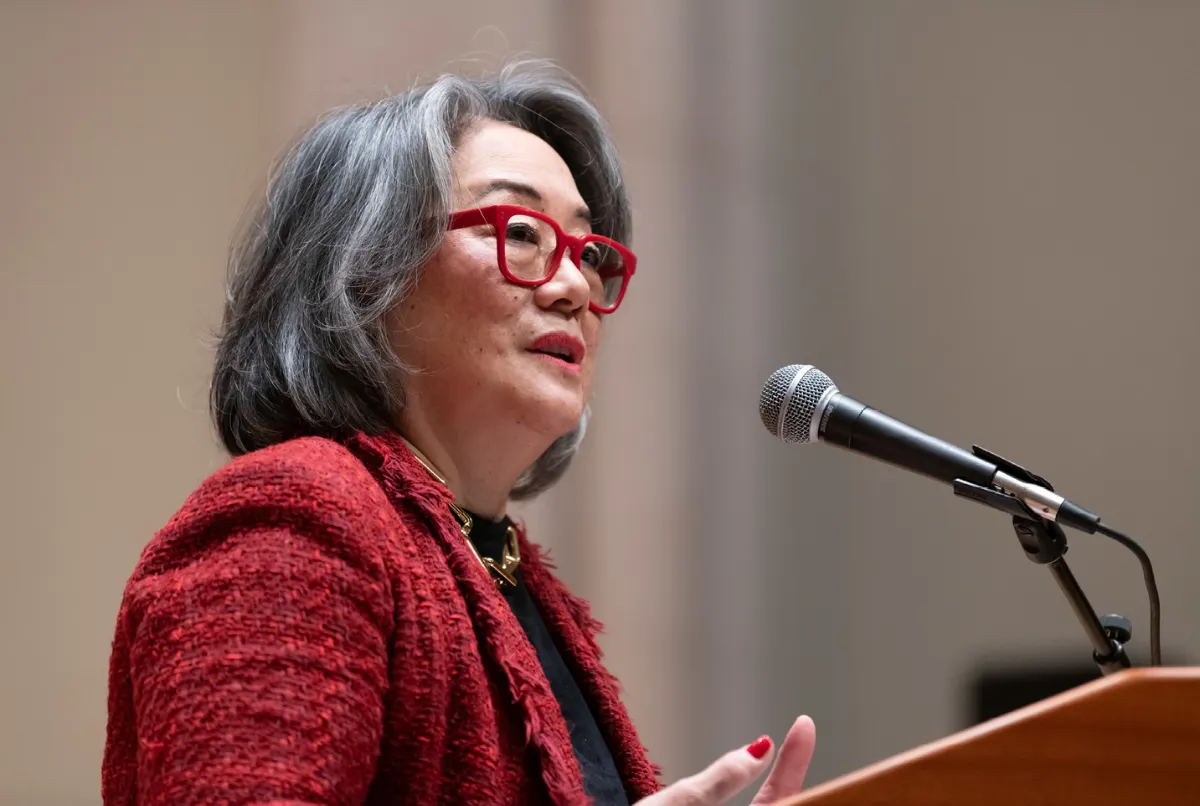
The worldwide AI transformation
Steven Hatfield ’88 recently retired from Deloitte Consulting, where he had his finger on the pulse of the AI transformation. He led the company’s Future of Work initiative, an annual report that examines worldwide trends in human capital, behavior, work, transformation, diversity, and other related areas by surveying large numbers of mid-level and senior HR professionals each year.
He asserts that this is not the first time the work landscape has changed dramatically, pointing to the automation that took hold when England began using looms to mechanize the production of cloth. He says people have been concerned about it since the Luddites, who rebelled over the impact of that new technology on their jobs.
In such previous technological transformations, though, someone had to introduce the technology, figure out how it fit into the business model, and then teach the workforce to use it.
Hatfield says that AI is entering the world in a very different way. “The workforce is actually pulling it into the workplace themselves, much more than any other technology,” he says. AI is already changing tasks, workflows, and how we think about work roles, and he asserts it’s critical to keep the conversation focused on people and how they will adapt in an uncertain employment future.
Like Tantoco, he is convinced that liberal arts students will be valuable players as we continue to shift how work gets done, and the most valuable employees will be the ones who know how to think.
“There’s a growing realization,” he remarks, “that human skills, curiosity, creativity, and ethical judgment are going to matter more, not less.”
Helping students navigate the AI era
Vassar, which offers an interdisciplinary curriculum and an emphasis on social responsibility, already helps students meet the changing demands that the workforce will soon face. Students learn how to navigate complexity, consider diverse perspectives, question assumptions, and go to the source. These provide a strong foundation for careers that require constant learning and reinvention.
Many educators and career advisors, including those at Vassar’s Center for Career Education, are focusing their energy on the rapid adoption of AI technology and where and how humans fit in. Stacy Bingham, Vassar’s Associate Dean of the College for Career Education, and Jannette Swanson at the Center for Career Education—work closely with students who want to understand how work is changing and ensure their value to potential employers.
The Career Education team has integrated AI literacy into its workshops and job and career search as well as its career planning and counseling services. Team members teach students how to use generative AI as a brainstorming tool when writing résumés or cover letters, to determine how best to present past experiences such as internships or summer research experiences for a specific job application, or to generate a list of questions for an informational interview. They also help students recognize where AI tools fall short and where human insight is still needed.
However, Bingham says networking remains the most effective job search technique. It’s another way human connections are becoming even more critical in this digital, AI-driven job search process. “The Vassar network is deep and wide and brimming with goodwill, and we’re telling students to double down on humans as part of their job search,” she says. “It’s always nicer if somebody comes with some kind of human endorsement or referral. (For more insight into the use of AI in job search and recruitment, see here.)
How work is being rewritten
So, what does the future of work actually look like?
Some positions will disappear. Others will change, and some new ones will emerge. For example, “prompt engineering,” a phrase we’ve been hearing with increasing regularity, is now a highly sought-after skill. Project managers are learning how to lead AI-augmented teams. Some marketers are starting to blend automation with personal storytelling.
These developments demonstrate that while AI tools are evolving, the need for human leadership remains unchanged.
There’s also the question about whether AI will mean the end of entry-level jobs that the tech can do. Hatfield says this will undoubtedly occur in some industries, but that it creates outcomes worth paying attention to.
“Those organizations will still need to figure out how they bring in entry-level folk,” he says. There will still need to be a channel for entry-level employees to join the organization, he explains, so they’ll need to restructure their work to accommodate this, or the company may not survive.
“They may decide they only want experienced hires who are at a certain caliber after a certain number of years, and that’s fine, but then they’ll have to figure out where they’re getting those folks from, too. That restructuring of the work itself has yet to be done.”
If an organization plans to do a limited amount of entry-level hiring, Hatfield recommends hiring those with an intrinsic set of skills that can’t easily be taught to complement what AI is doing for the company. “So suddenly you’re right back at the big picture thinker, and the great writer and the communicator and the empathizer and the person that can be perceptive and navigate the body politic. And so that liberal arts skill set, and those intangibles that come through what you’re studying and how you’re learning it, become very, very important.”
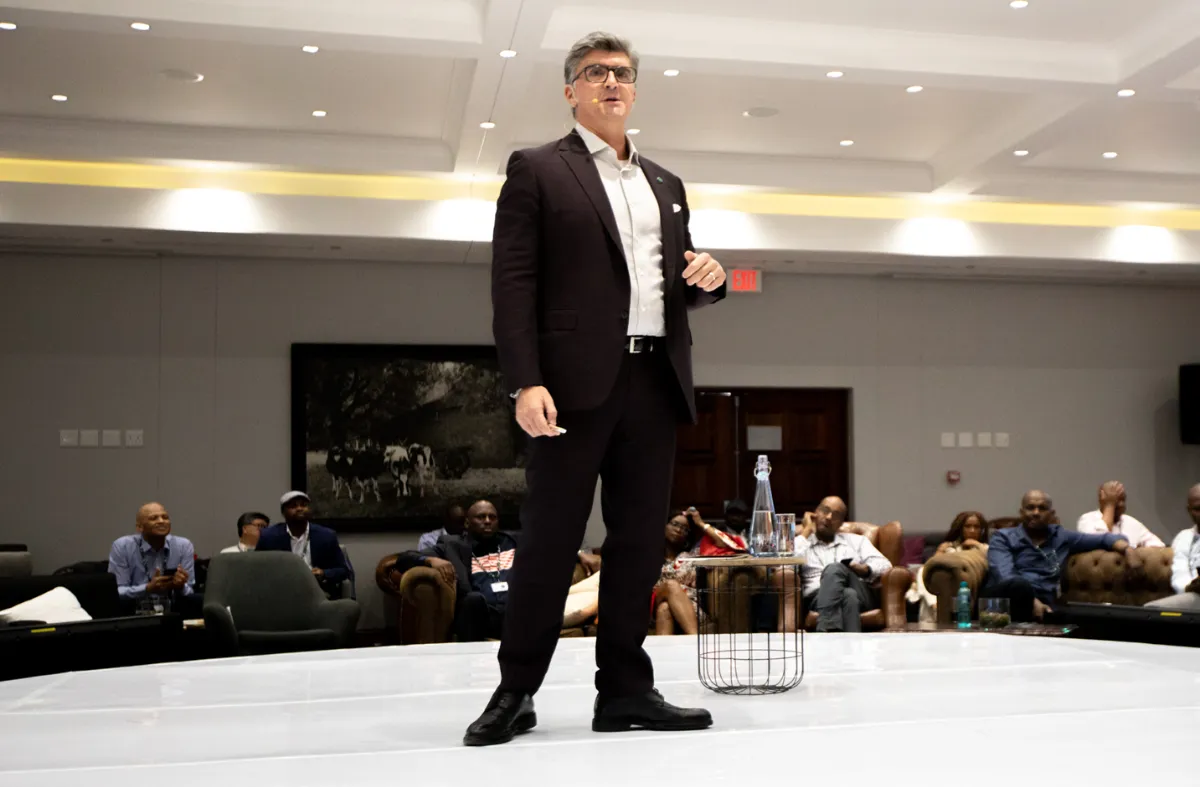
Embracing uncertainty
Tantoco says it’s reasonable to be concerned about how work is changing, but points out that it always has. She talks about the first time she visited the New York Stock Exchange. “People were still waving bits of paper and yelling at each other to make trades. Now, it’s a near-empty room with three guys looking at a screen. But that doesn’t mean the stock market went away. It just created different kinds of roles.”
She says what’s interesting is the stock market was able to scale more after it no longer had a lot of people in a room waving bits of paper. “With every change, there’s both risk and opportunity,” she points out. That also applies to the forthcoming flood of AI.
Vassar’s annual Sophomore Career Connections program hosts alums from the technology, law, media, and policy industries, and, of late, there’s been a good deal of discussion about the impact of AI. Panelists have shared examples of how they are using AI tools in real-world situations to accelerate research, solve problems, and launch new ideas.
At the January conference this year, Tantoco delivered the keynote speech in which she offered a simple but powerful message: “It’s very important now to know AI, no matter what industry you’re in,” she said. “AI isn’t going to take your job. Someone who knows how to use AI is going to take your job.”
As the workplace continues to shift, perhaps the most powerful preparation isn’t knowing what comes next, but learning how to think, adapt, and keep asking the right questions.

How AI Is Changing The Job Search
okrit Movel ’25 was a sophomore majoring in computer science when he first used generative artificial intelligence (gen AI) to help him apply for internships. An early adopter of ChatGPT when it was released in 2022, Movel also began experimenting with the technology to help him write résumés appropriate for various roles—a management consultant, for example—so that he could better understand how to tailor them for various audiences, even if he wasn’t applying for that specific role. “I was using AI to play with voice, positioning, and framing—trying to understand how subtle shifts in language affect outcomes,” he says. Movel is now a software engineer with Amazon.
Gen AI is disrupting everything from how we access information to the very nature of work. And job-search and hiring processes are no exception. Human resources teams, recruiters, and job seekers themselves have access to a wide range of AI-powered tools that can assist with matching talent and job openings—but not without a few caveats.
On the recruitment side, bots are being used for a variety of tasks, including writing job descriptions, screening candidates, and conducting early-stage interviews, to name a few. A 2024 survey of chief human resources officers by Boston Consulting Group found that, among companies experimenting with gen AI, 70 percent were doing so within their human resources (HR) functions. And that’s probably not going to abate anytime soon, since the majority of those respondents (92 percent) were seeing benefits, including significant productivity gains.
Job seekers are also embracing the benefits of gen AI. Career Group Companies’ 2025 Market Trend Report & Salary Guide Mid-Year Update found that the number of job seekers using gen AI to write a cover letter, résumé, or writing sample doubled to 62 percent from just six months ago.
HR technology isn’t new. Companies have been using digital tools like applicant tracking systems, recruitment marketing platforms, applicant screening tools, and others for many years. However, there is an influx of gen AI start-ups focused on the HR space. Future of work and human capital strategy expert Emily Omrod ’16 reports that, on a recent trip to San Francisco, she was astonished by the number of billboards touting AI start-ups. “Being from the East Coast, I think perhaps we don’t appreciate the incubation that’s happening in AI around Silicon Valley, in California, and I’m sure, in other hubs across the U.S.,” she says.
Help for hiring managers
But the impact of generative AI on recruitment is still emerging, according to Omrod. Many of the organizations with which she works are still in the experimentation phase. “We have not yet, in my opinion, seen full-blown AI turned on in any kind of real way in HR,” she says.
Work futurist Terri Horton, founder of the consultancy FuturePath, LLC, works with organizations and higher education institutions to help them navigate AI and its impact on the workplace. Horton—whose LinkedIn Learning AI courses have been taken by more than 300,000 learners worldwide—says she sees teams using AI in virtually every stage of recruitment, including sourcing, screening, scheduling interviews, writing job descriptions and interview questions, and onboarding, among others. “[AI] not only streamlines processes and increases efficiency and productivity,” she says. “It allows them to focus on more strategic aspects of the recruitment process.” So platforms like LinkedIn and others have incorporated semantic matching, which uses context from candidate profiles to more accurately assess skills, qualifications, and fit to match candidates to relevant positions.
However, AI-powered HR tools have demonstrated high-profile instances of bias. HR technology consultant Michelle Marino, founder of AI.M People Solutions, says it’s important for companies to understand how vendors are training AI tools to evaluate candidates. “[Hiring organizations] should ask the vendor about ‘explainability’ [the criteria on which the technology screens candidates] because they want to be able to defend any decision that’s made,” she says.
There are no guarantees that AI-powered screening technology will be any better or worse than human review, she says; mistakes and oversights have always been part of the process. Marino recalls her days working in HR at MTV Networks when she would receive roughly 1,000 résumés for every job opening. “For one recruiter to go through that many résumés, it’s impossible,” she says. “Now, you can use AI to scan based on skills and the job description, to find the top talent.”
Omrod adds that employers should have clear governance in place to guide their use of AI throughout the organization, and hiring managers should be aware of the risks involved. “If you don’t have standard application, you don’t have standard processes,” she notes.
A job-search assistant
When it comes to AI adoption, job seekers are ahead of the game. “Actually, job candidates have embraced the use of AI well before companies,” says Amy Dufrane, CEO of HRCI, a global HR professional credentialing and learning organization. “For companies, it’s a much more complicated situation that involves careful consideration of how AI will interact—or not—with other systems and established workflows.”
For job seekers, generative AI can be a handy tool when it’s time to spruce up a résumé or write a cover letter. After the marketing agency where she was a creative director shut down, Cincinnati resident Michelle Taute began a job search. She had tweaked her résumé to optimize it for AI-powered applicant tracking systems, including adding the appropriate keywords. But when the first application she submitted received an invitation to interview with the company, she realized it had been nearly two decades since she had last been in a job interview.
Taute wasn’t sure what kind of questions she would be asked, so she turned to ChatGPT. “I pasted the job description into ChatGPT and asked it, ‘What do you think would be the likely interview questions for this job description?’ And it spit out 30 questions that were pretty good,” Taute says. “It definitely brought up questions I wouldn’t have thought of on my own,” she says.
Taute chose to write the answers herself to practice them and make them more authentic. She can see the value for some people who need a little help with answers, although she recommends editing them to be sure they’re genuine and fact-checked. She chose the questions she thought the team would be most likely to ask and says the list was accurate. While Taute ultimately didn’t get that job, she says having those questions helped her feel more prepared and able to focus on other aspects of the interview, such as her body language and how interviewers were responding to her answers.
Courtesy of the subject
In addition to leaving out parts of applicants’ stories, gen AI tools are known for fabricating material—having so-called “AI hallucinations,” in which the output from AI is factually incorrect or even entirely fabricated. So, be sure your bot isn’t embellishing your accomplishments or adding elements that are not true, Marino advises.
However, the technology can also deliver helpful assistance and deeper insight into the job-search process. In addition to ChatGPT, Wokrit Movel sought out other gen AI-powered tools and found Simplify, which could not only help him tailor his résumé and anticipate interview questions, but could help him organize deadlines for specific job applications and actually complete those applications with his information. Tasks that took an hour could now be completed in under 10 minutes.
The tools can help you get a lot done, but he notes it’s also important to be aware of the ethical implications of using the them.He points to the controversy around apps such as Cluely, which has been the subject of controversy because of its alleged ability to coach people—in real time—during interviews.
“I think we’re at a point where how you use the tool matters just as much as whether or not you’re using it,” he adds.
A bold, new AI-powered world
Omrod says that the ease with which AI tools allow candidates to create customized résumés and apply to jobs has led to people “applying to more jobs with less intention.” Candidates may apply for hundreds of jobs in less time than it would have taken to do so manually. But Omrod wonders whether that time might be better spent applying to fewer jobs and working on making personal connections that could help with the job search.
Despite AI’s utility to hiring managers and job seekers, there are already signs of backlash. A July 2025 article in The New York Times details the experiences of candidates who were interviewed by chatbots. One described the experience as “dehumanizing.” Another called the interaction “some horror-movie-like stuff.” Recruiters have their own horror stories: A crop of AI-powered apps is now generating answers for candidates, which some have clearly been reading out during virtual interviews.
“Recruiters are increasingly able to flag AI-generated language, and candidates must be able to demonstrate skills and competencies in human-to-human interviews and often across a host of screening assessments,” Horton says. Plus, she notes that because so many candidates are using AI tools to move through the selection process, candidate pools are becoming larger and more inauthentic. Recruiters are looking for ways to “AI-proof” the recruitment process.
As far as where the technology will go from here, Dufrane says the outlook is mixed. “It’ll be exciting and a bit scary,” she says. “Clearly, its potential is far more disruptive than some of the technologies that have previously impacted the recruiting experience, such as cloud computing or data analytics. It’s a game-changer, similar to how the commercialization of the internet changed everything for candidates and companies.”
For now, treating AI as a tool or assistant—with ample human input and oversight—seems to be the safest route for using the technology. As AI continues to proliferate on both sides of the job search process, candidates and organizations alike will need to evolve in their understanding and use of it.
Six Tips for Job Seekers Using AI
-

Don’t be afraid of it
Terri Horton, founder of future of work consultancy FuturePath, LLC, advises, “As [AI tools] become more widespread, candidates should become familiar with tools that can help them tailor their résumé or help them practice interview questions. Developing AI fluency and a foundational understanding of agentic AI [which can perform tasks autonomously] can improve a candidate’s ability to navigate the evolving AI-driven recruitment landscape.” Tools include interview improvement tools like Yoodli.ai or HireVue; job search matching tools like Jobscan AI Job Matcher or Otta; and résumé-writing tools like Rezi or Kickrésumé AI.
-
Treat AI like your intern
An intern can be invaluable for doing legwork and improving efficiency through capable helping hands. However, “You wouldn’t let an intern make the final decision on anything,” says HR technology consultant Michelle Marino. “You need to make sure that you’ve checked that output for hallucinations, wrong tone, etc.”
-
Add your own voice and flair
Future of work expert Emily Omrod ’16 advises job seekers to use gen AI as a “partner tool” and to ensure that they infuse their writing style into the final document. Omrod, who majored in English at Vassar, worries that candidates will lose the ability to communicate authentically—a factor that could help them stand out—if they rely too heavily on tools like ChatGPT or Perplexity to write for them. “The way you write a simple sentence shows something about how you think and communicate,” she contends.
-
Know your stuff
According to Marino, even if you use gen AI tools to help you write your résumé and cover letter, be prepared to answer questions about everything in those documents. “There will be behavioral interview questions that will ask you how you handled certain situations,” she says. “If you’re unable to do so, that will be a red flag.”
-
Use AI to prep
Marino says that generative AI tools can also suggest interview questions that employers might ask during the interview process. In addition to using general tools, there are some specialized “interview warm-up” tools designed for interview prep available online. Google offers Interview Warmup. Other resources include HeyMilo or Interviews by AI.
Jannette Swanson, Director of External Engagement at Vassar’s Center for Career Education, says gen AI tools can be helpful for informational interviews, too. Just enter a brief description of the person and what you hope to learn from them, then ask the platform to craft an introductory message and three to five questions to ask in an informational interview.
-
Explore other tools
New tools are emerging that can help you envision your career path, says Stacy Bingham, Associate Dean of the College for Career Education. Resources like Google’s Career Dreamer—which helps analyze your skills and explore various career scenarios—“help you connect some dots,” she says, and they do it in a more visual and interactive way than traditional career assessments do. That can be particularly helpful for liberal arts majors who may have a vast variety of skills and interests to explore.
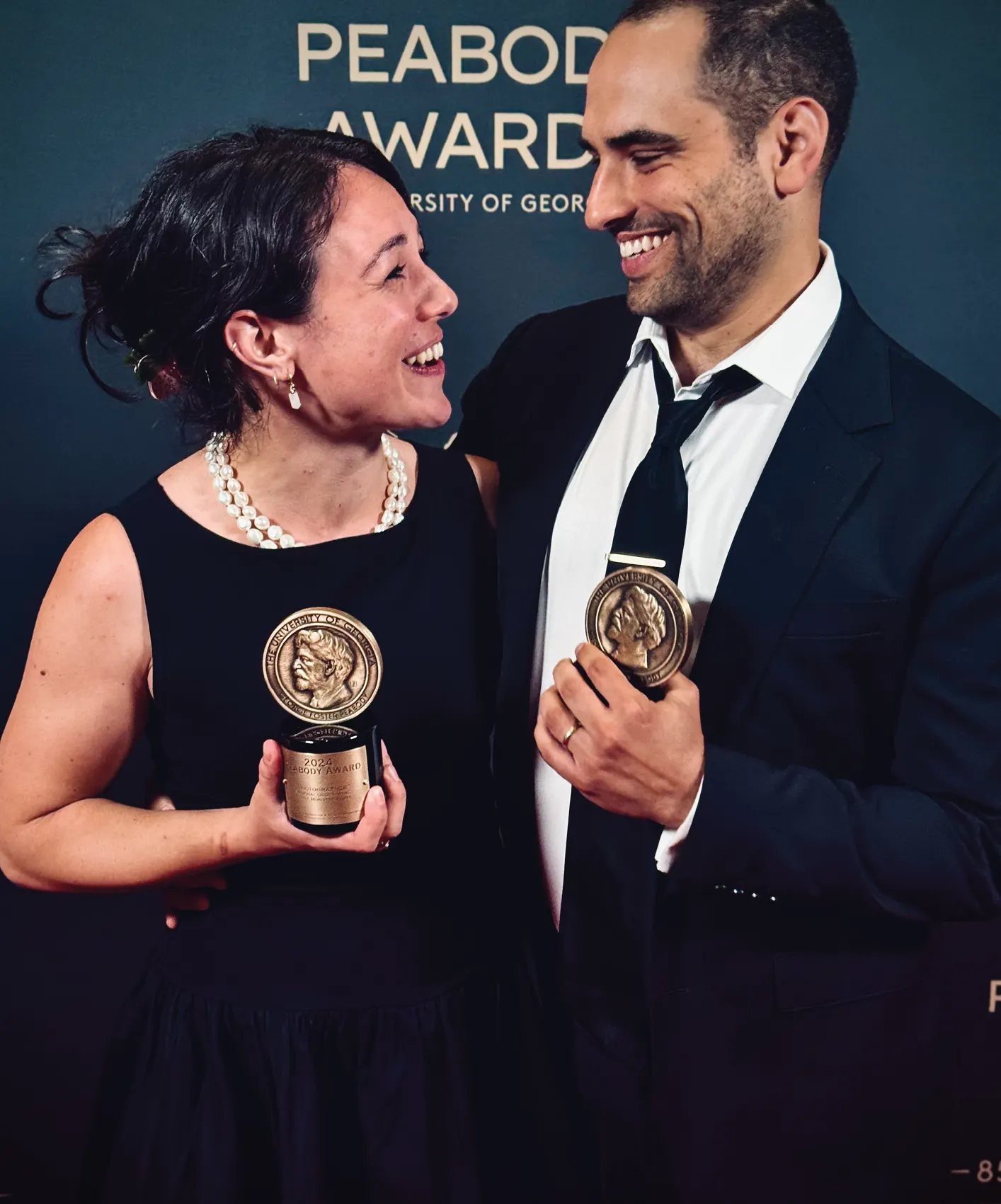
Gaby was a producer on the National Geographic series Photographer, which won, according to the Peabody website, “for its expansive and eye-catching vision of the artistry of photography—for showing us that photos are made, not merely taken—and reminding us, in turn, of the importance of bearing witness to the world around us….!”
“My film school BFF, Gilad Thaler, and I are Peabody winners!” enthused Gaby in an Instagram post. “UNREAL to have coincidentally won beside my dear friend and collaborator on SEPARATE projects in the same year.”
“The two of us were the first sophomores to audit the senior production narrative thesis class,” noted Thaler in an email to VQ. “We continued to collaborate together throughout our years at Vassar and have continued to stay close friends in the 13 years since graduating.”
The awards were bestowed during a televised ceremony in Los Angeles on June 1.
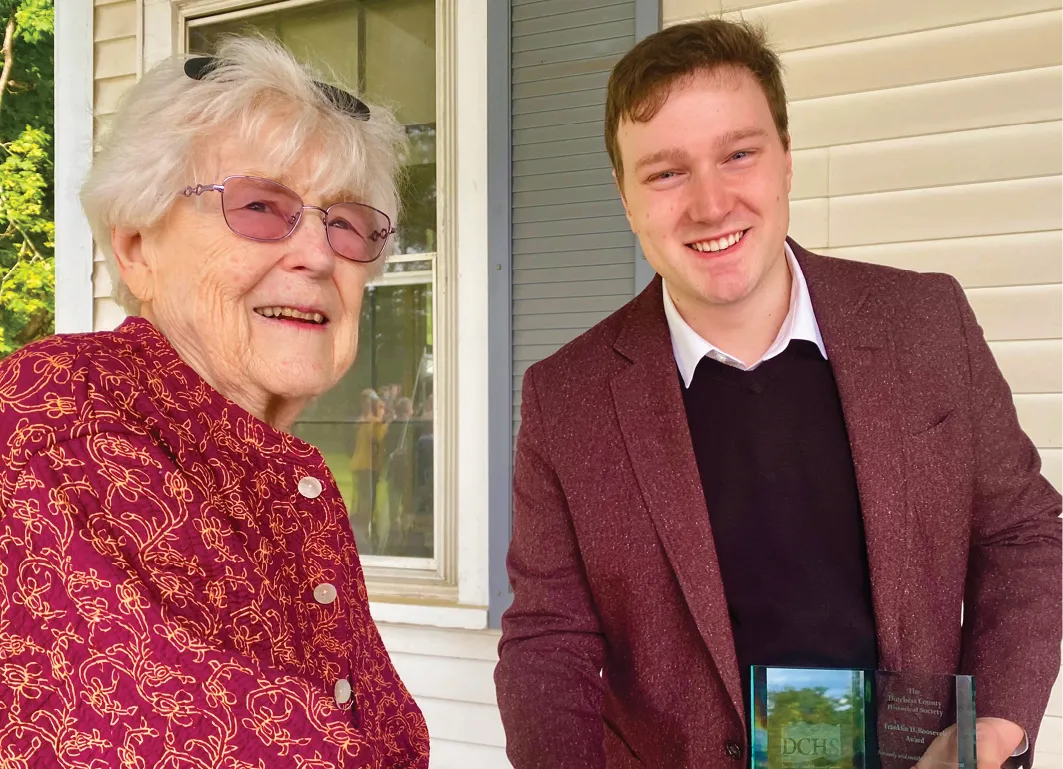
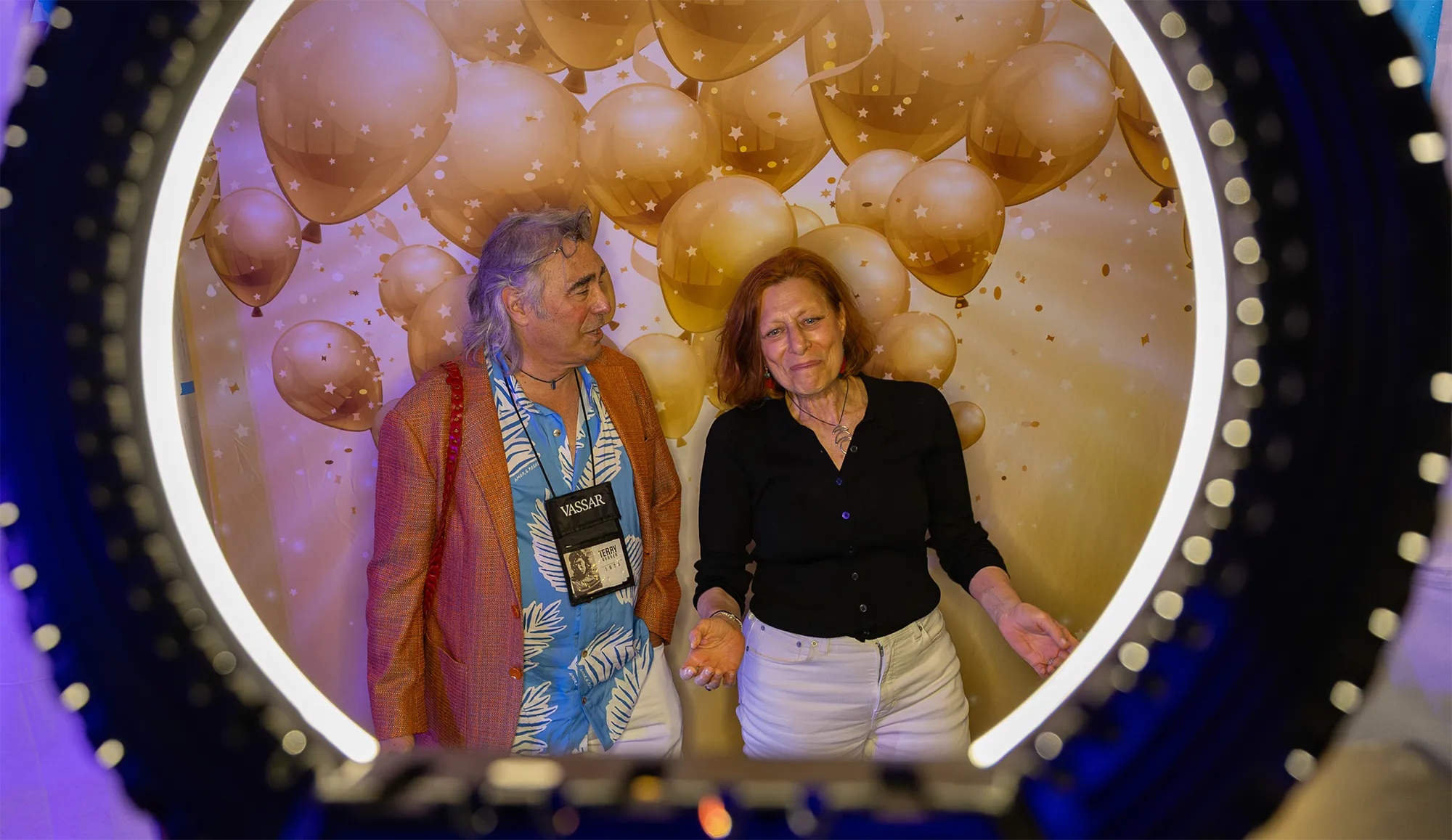
hen we imagine Vassar reunions, we picture meandering along the pathways getting to and from the many events across campus, stopping by the Quad for refreshments and games, catching up with friends under Vassar’s beautiful trees, and, most of all, donning class regalia to march joyously across campus for the annual Reunion parade.
But torrential rains and severe thunderstorms washed over the campus during Reunion weekend, June 5–8. Phones buzzed several times a day with emergency weather alerts, urging alums to take shelter inside. That didn’t seem to dampen spirits, though.
“It was a terrific weekend, and there were benefits to being forced to shelter in place during the Saturday afternoon wild thunderstorms,” says Eric Marcus ’80. “I re-met an acquaintance from the Class of ’81 who is on the AAVC Board, Heller An [Shapiro], and we wound up trapped in Rocky 200 for an extended period while the dramatic thunderstorms blew through. We had a wide-ranging, very personal conversation.” Quite a few alums reported similar encounters.
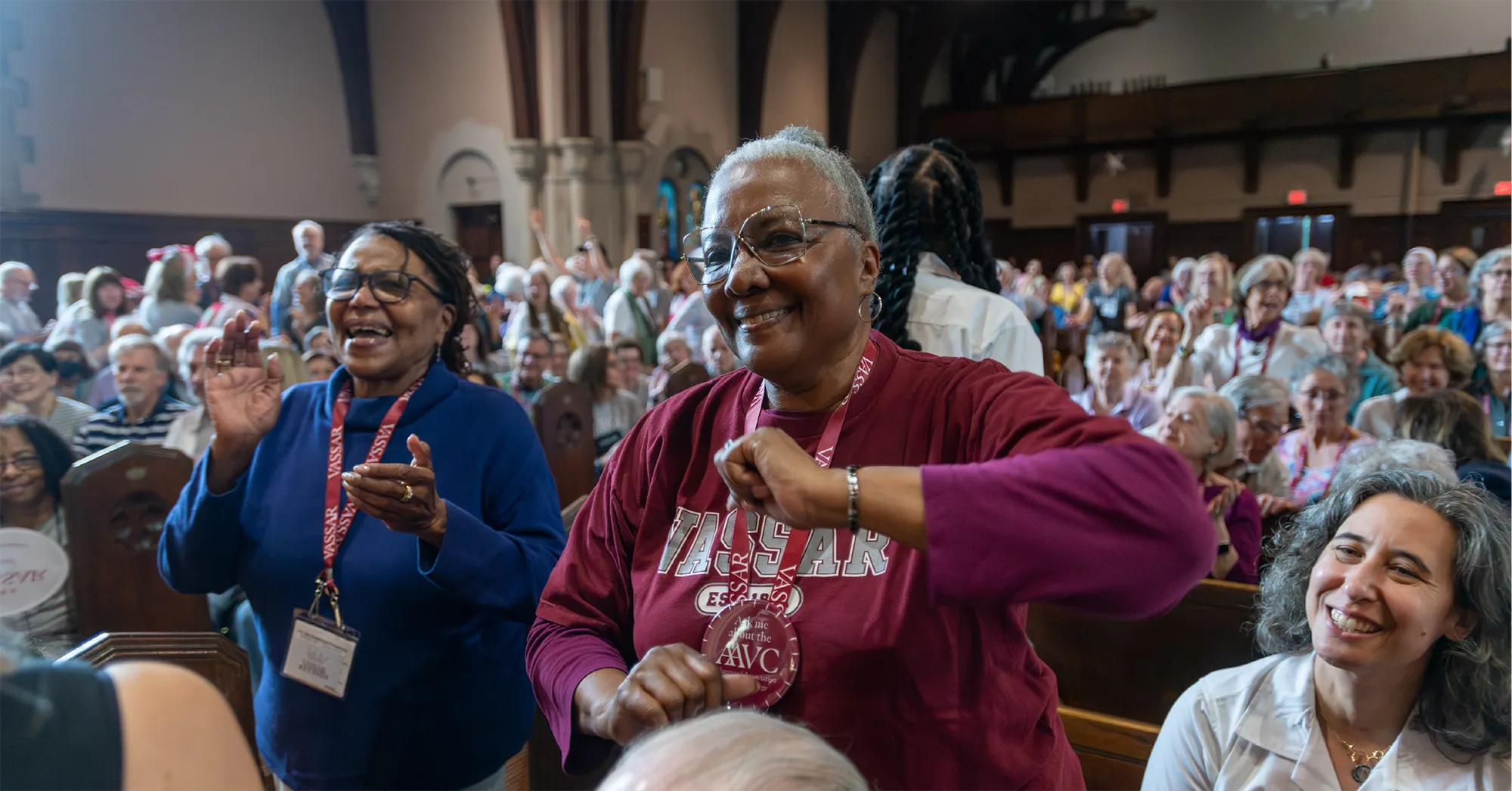
“I am still in awe of how this campus came together to support the largest on-campus event sponsored in partnership by the Alumnae/i Association of Vassar College and the College itself. Much of the 18 months of preparation were altered due to the horrific weather we experienced on Friday and Saturday. Nevertheless, there was such a positive energy buzzing throughout the weekend. Folks really seemed to enjoy just being back on campus again after 10 years.”
The Class of 1975 celebrated its 50th Reunion this year. Patricia Neely, Class President, says, “We had a great time just being together—celebrating ourselves through an artist showcase featuring visual and decorative arts we created and the books we published, and a musicale in which we performed.”
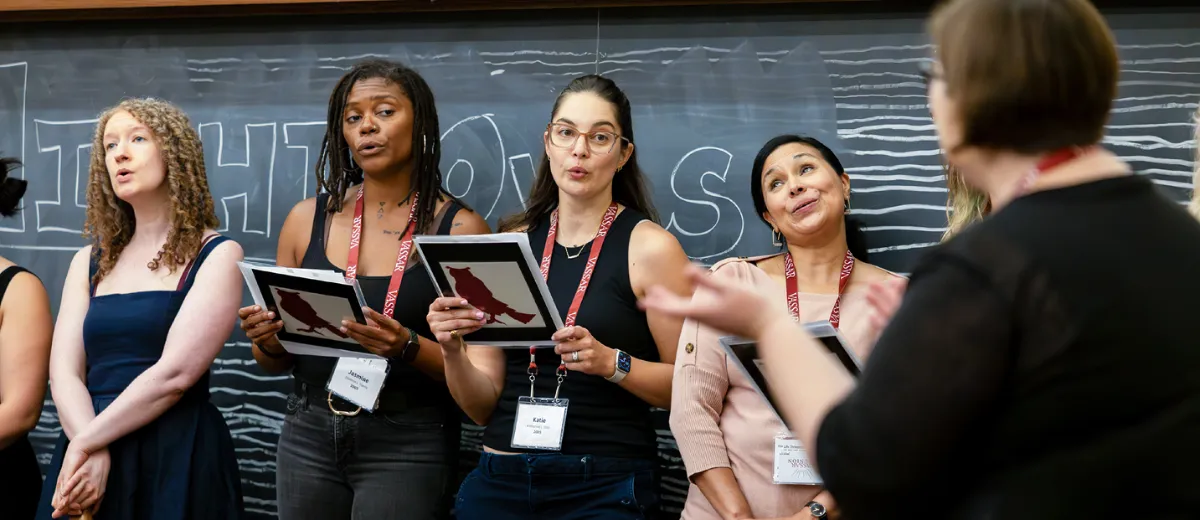
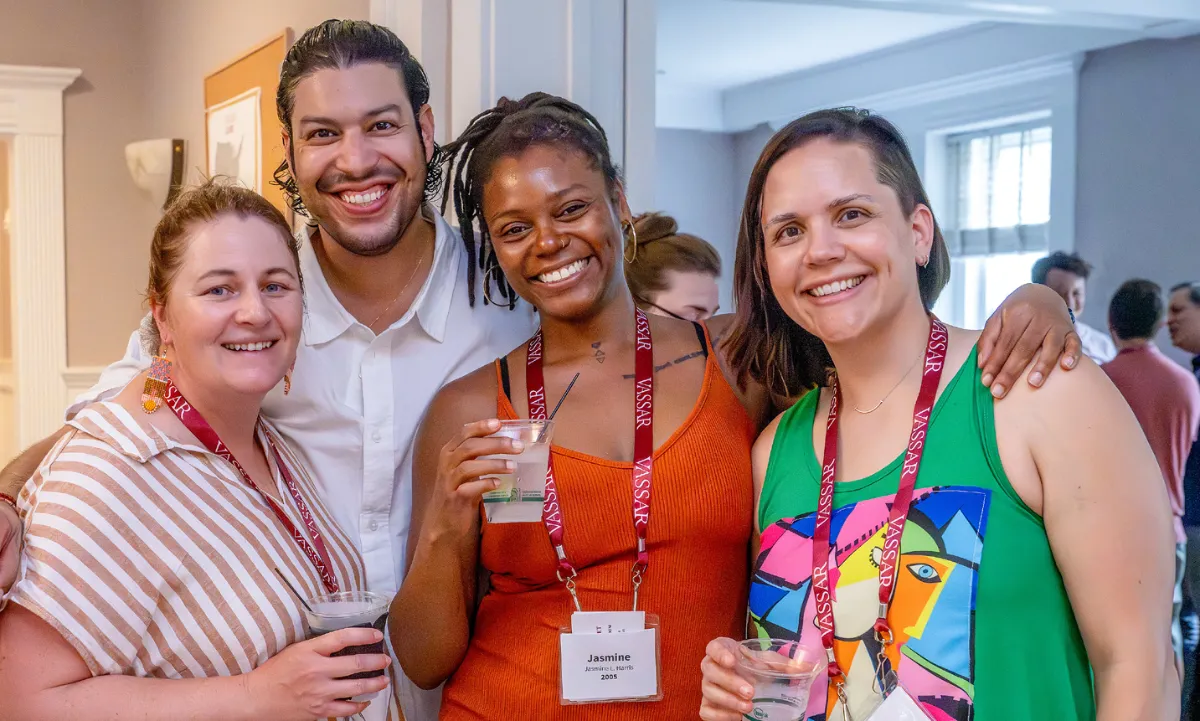
Two classical musicians—Neely and classmate George Litterst ’75—organized the musicale that featured alums from the classes of 1985, 1990, 2000, and 2020, in addition to members of the Class of 1975. Via Zoom, the group also thanked and entertained Rowland Winton Evans ’75, a musician whose recent $28 million donation will rename the campus’s Bridge for Laboratory Sciences, subsidize the cost of individual instrument lessons for students, and help support the Music Department’s annual concert programming, as well as support the Vassar Fund.
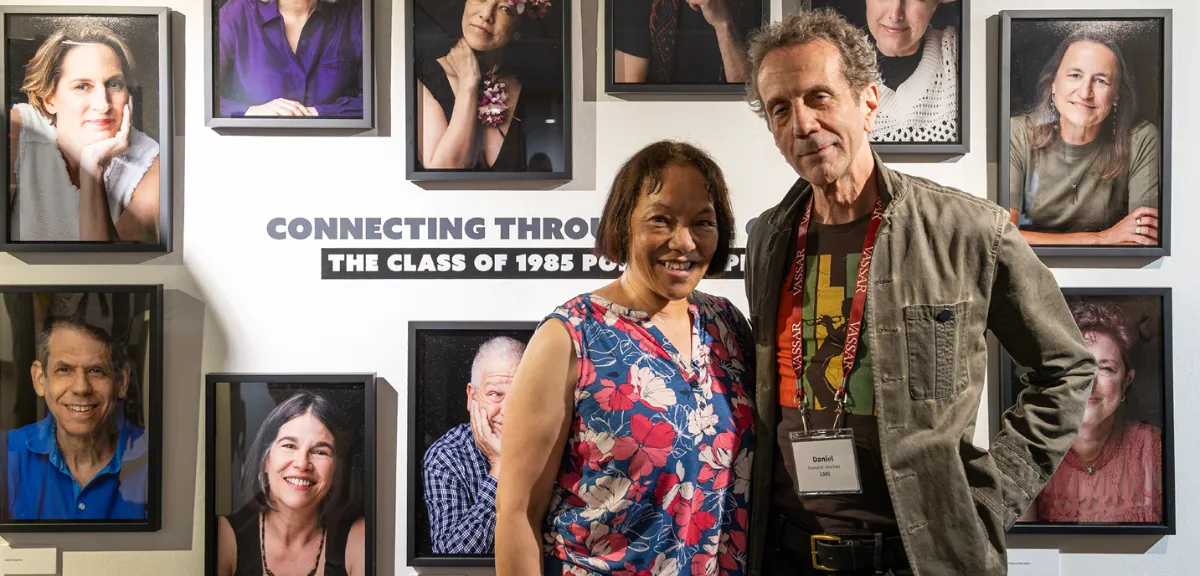
Buck Lewis
The parade is typically held after the president’s hour, but due to approaching thunderstorms, it was canceled, and alums remained in the Chapel for Celebrate Vassar—where classes report on and celebrate Reunion giving and the Alumnae/i Association of Vassar College (AAVC) holds its annual meeting. The event opened with alums dancing in the aisles as their classes were called. The 50th reunion class, 1975, joyously moved their hips to the sounds of their selected serenade song, “We Are Family” by Sister Sledge, and the class of 1970, which had missed out on their serenade in 2000, boogied down to “Respect” by Aretha Franklin.
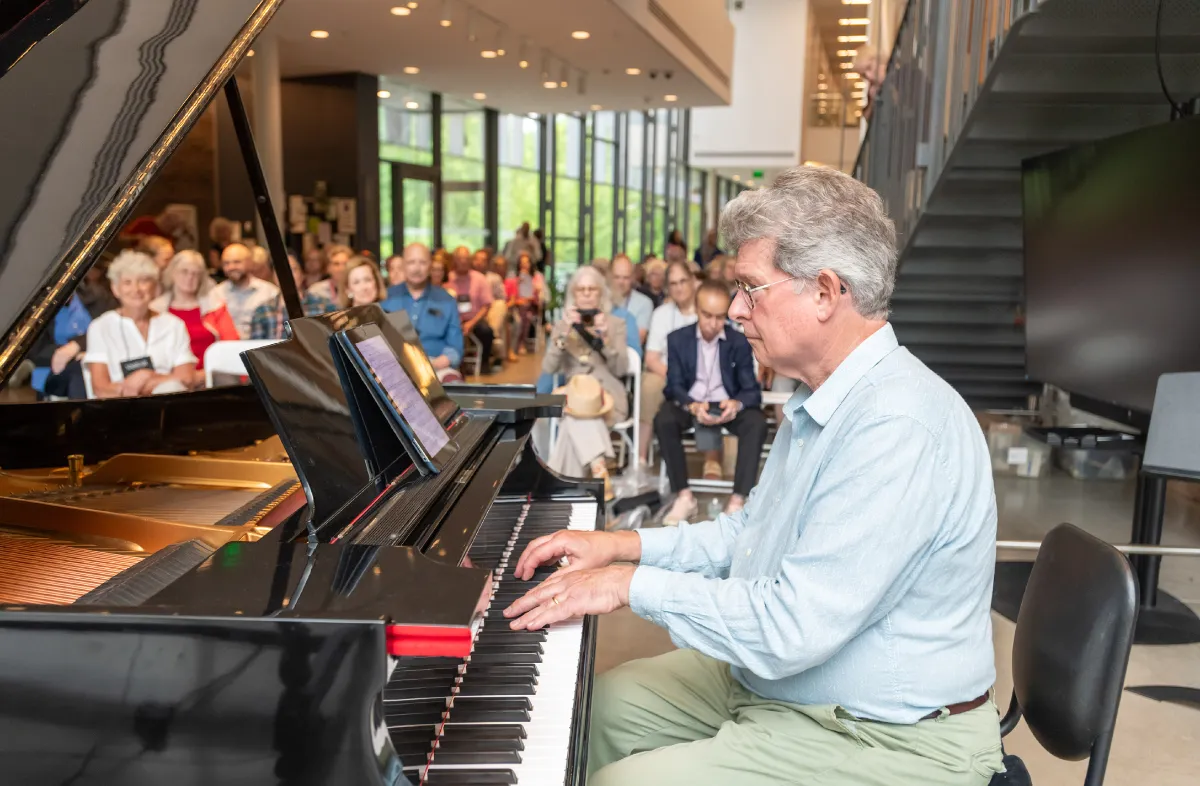
Karl Rabe
During a luncheon in Alumnae House after Celebrate Vassar, the AAVC bestowed the 2025 Outstanding Faculty Award upon Ronald D. Patkus, Head of Special Collections and College Historian, and Adjunct Associate Professor of History on the Frederick Weyerhaeuser Chair, citing his efforts to make Special Collections holdings more accessible in a variety of ways.
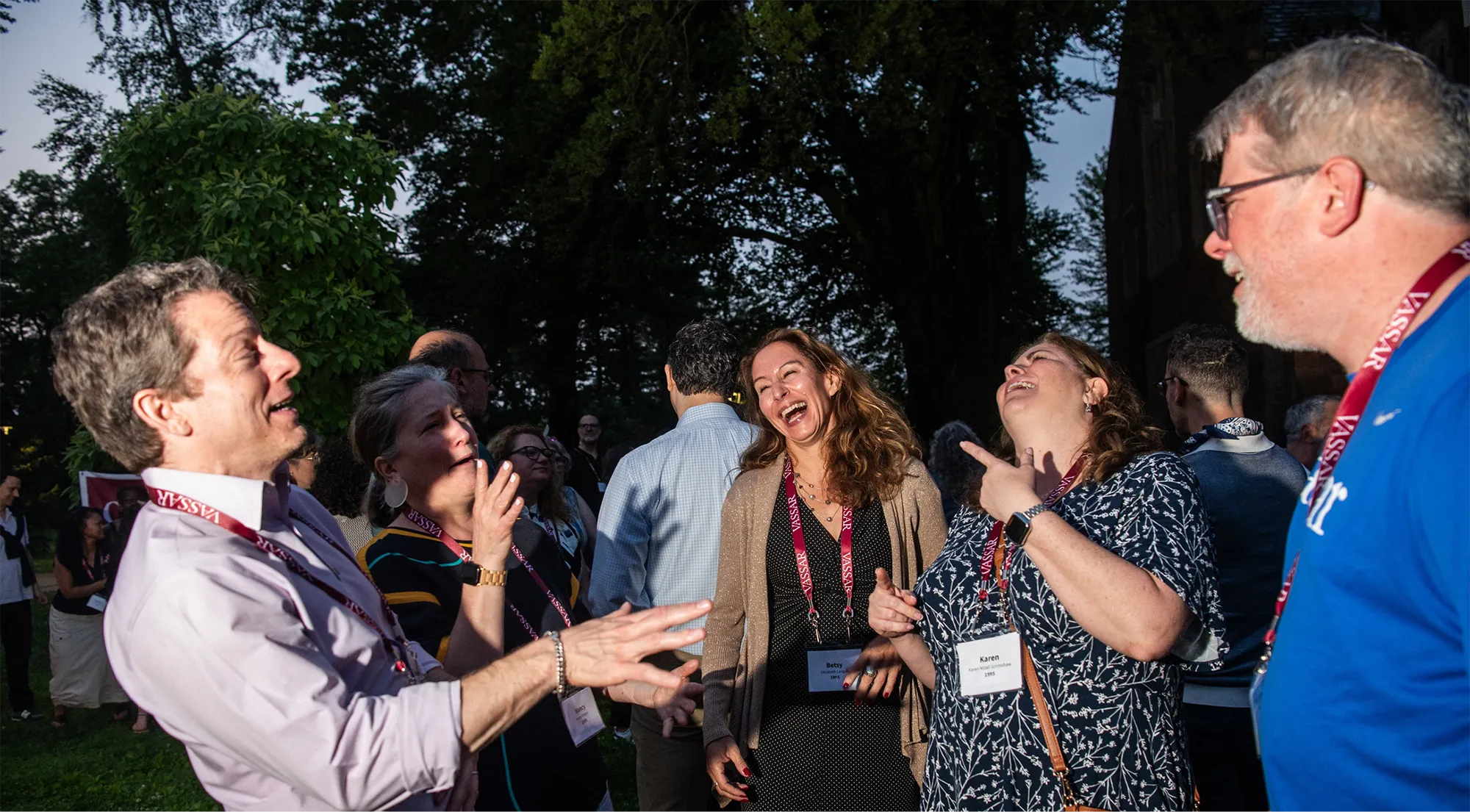
Kelly Marsh
Jedlicka says she’s thankful to all those who helped the weekend come together. “All of the class volunteers that I worked with over the last year to make this weekend special for their classmates were amazing. The creativity, dedication, care, and thoughtfulness to make this weekend meaningful always takes my breath away. I am beyond grateful to work with such a great group of alums.”
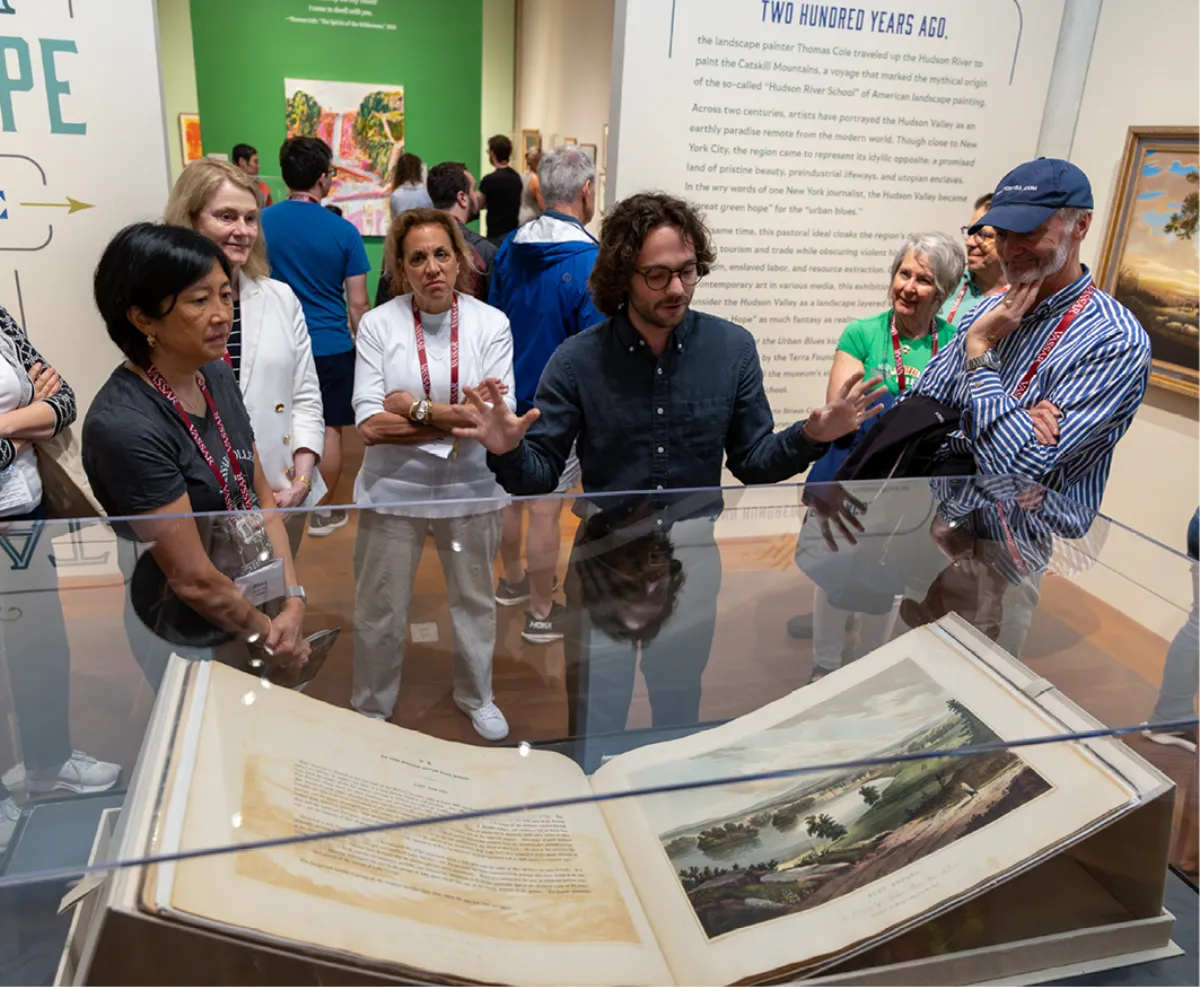
Buck Lewis
Alum Association Selects Five to Honor in 2025 for Achievement and Service
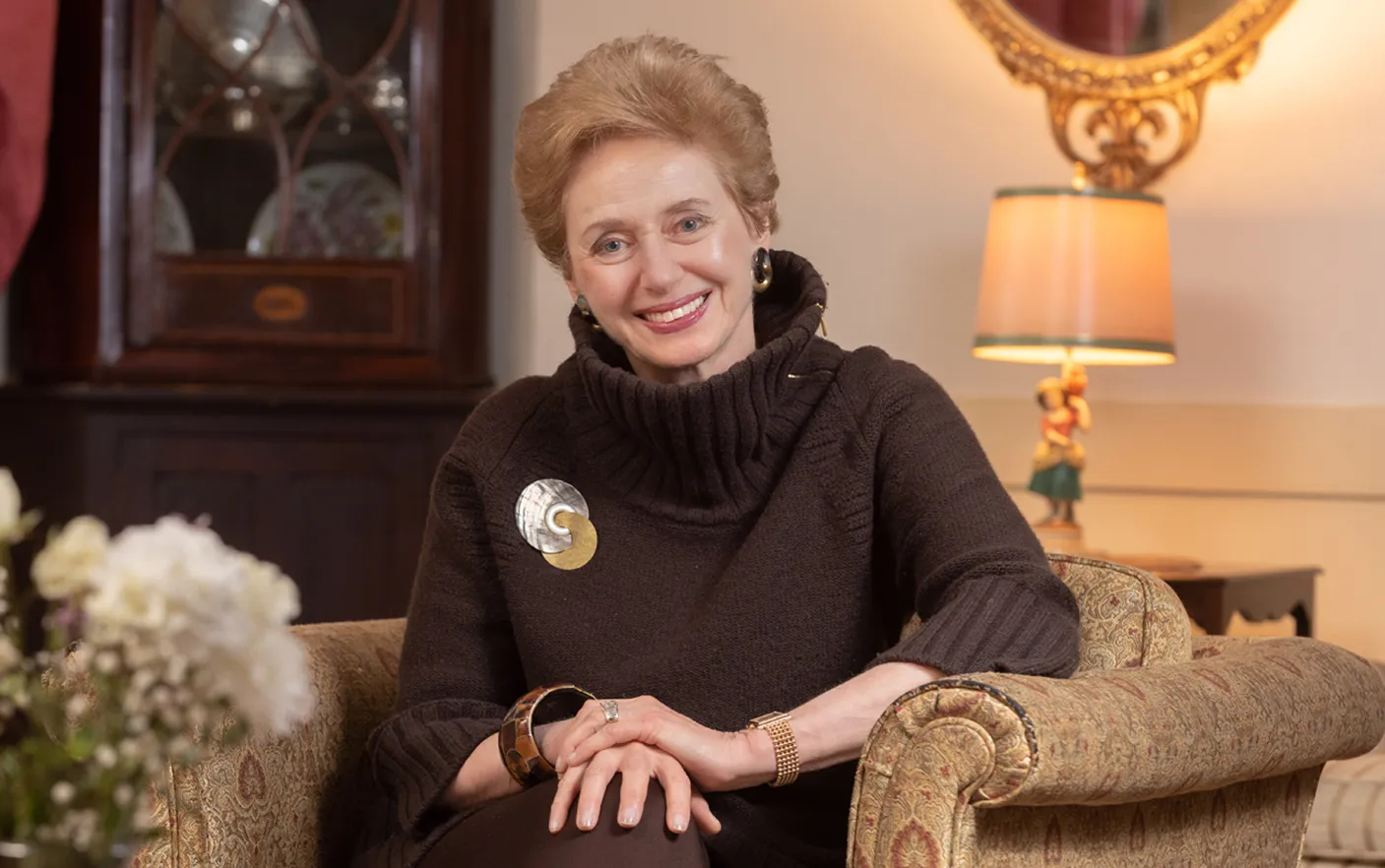
Spirit of Vassar Award
Over the course of her life, Georgette F. Bennett has had several distinct careers—academic, feminist advocate, award-winning criminologist, national broadcast journalist, financier and city government official, author, lecturer, and, for the past 30 years, a broker of peace and understanding in some of the most divided regions around the globe. Almost all of these pursuits, she says, stemmed from passions she developed while at Vassar.
She arrived on campus in September 1964 during a heady time. “Everything was percolating on campus—you had second-wave feminism, the war on poverty, the civil rights and anti-war movements. All of it was really blowing up,” she recalls. Indeed, during freshman orientation, Bennett was required to read Betty Friedan’s The Feminine Mystique along with the works of other feminist icons, including Germaine Greer and Simone de Beauvoir. “Right away, I was being exposed to alternative roles for women,” she says.
For a young woman from Kew Gardens, Queens, who had fled war-torn Hungary as a Jewish refugee and was subsequently raised by a single mother after her father’s sudden death, it was eye-opening and stimulating. Bennett dove into the intellectual life—“The beautiful campus invites studying and contemplation”—first majoring in psychology, then switching to sociology, with a liberal sprinkling of religion courses along the way. “As a child, I hoped to be the first Jewish nun,” she laughs. Instead, after graduation, she got a PhD in sociology and began teaching at the City University of New York. In 1970, Bennett was recruited to be one of 12 members of the now iconic Women’s Advocacy Committee, a feminist powerhouse organization that spearheaded the first Women’s March in New York City during the administration of Mayor John Lindsay.
Suddenly, Bennett found herself working alongside none other than Betty Friedan and other feminist leaders. Specifically, she was assigned to the New York City Police Department to look into the situation of women as victims, colleagues, and criminals. “That was the start of my career as a criminologist, where I used some of the same tools I’d learned studying sociology at Vassar.”
There were many more pivots along the way, including marriage to the late rabbi and interfaith leader Marc H. Tanenbaum. “He inspired me to do the work that has dominated the second half of my career—founding the nonprofit Tanenbaum Center to work for interreligious understanding,” she says. The endeavor has led her to help displaced people and combat prejudice in the world’s hot spots, including Gaza, Syria, Israel, and Palestine, her goal being to get historic enemies to talk to one another, something the world sorely needs today. “The first step to conflict resolution is to acknowledge the pain of the other—that’s always where listening and trust begins,” she says.
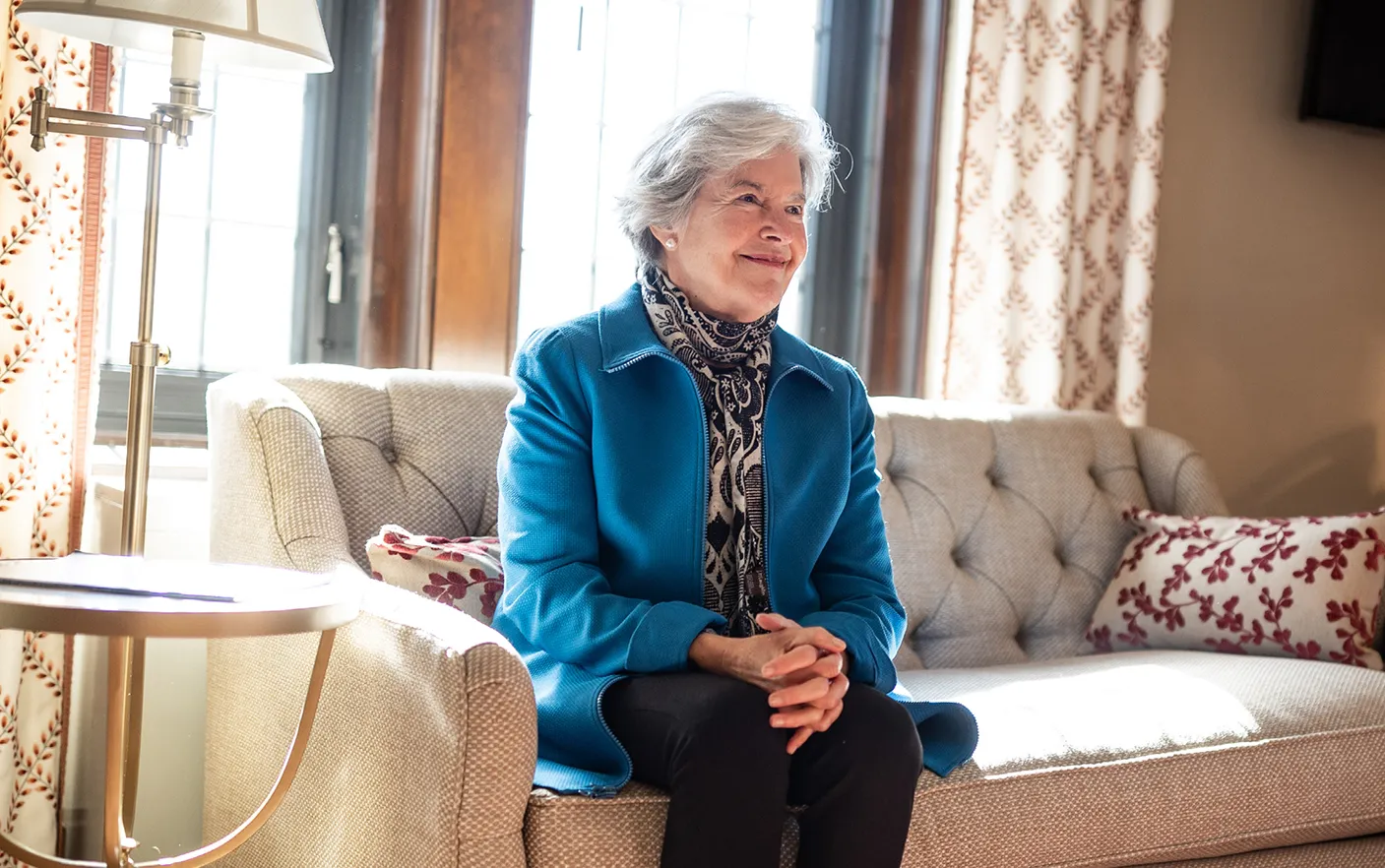
Outstanding Service to Vassar Award
Sally Dayton Clement always assumed that she’d end up in the family retail business. But largely because of her experiences at Vassar, “I ended up going my own way,” she says. Though she started out majoring in math, then switched to economics, it was a stint in Vassar’s Wimpfheimer Nursery School, as part of a course in child development, that sparked her career as a mental health professional. “After Vassar, I started as a volunteer mental health worker at McLean Hospital in Belmont, MA, then eventually earned my PhD at NYU in clinical social work and began clinical practice and teaching. But I discovered that what I really wanted to focus on was sharpening my clinical skills,” Clement says. She fulfilled that dream, graduating from training programs in adult and child psychoanalysis at the New York Psychoanalytic Society & Institute, where she became a member of the faculty and a training and supervising analyst. She also served for 25 years as a psychological consultant at the Nightingale-Bamford School in New York City.
“Vassar professors like Anne Constantinople and Henrietta Smith inspired me and inspired my career dreams, for sure,” she says. “At Vassar, I received what I consider to be a liberal arts education at its best—that’s what I love most about the College.”
Clement has shown that love in numerous ways, serving as a trustee for the College for a total of 16 years—she was the first designated “Young Trustee” in the 1970s. With some amusement, she reported that her young trustee term was capped by her being asked to deliver the prayer that then began each board meeting! She knew that she was asked to do so only because her husband was a graduate of Union Theological Seminary; she dared not decline the assignment, though she considered the reasoning behind it sexist.
She served an additional 12 years on the board after that term ended. Her mother, Mary Lee Lowe Dayton ’46, also served as a Vassar trustee, and upholding the tradition, her son, Winston W. Clement ’09, is currently a trustee. Clement considers the trustee experience to be a continuation of her Vassar education. “Serving on the board at a young age helped me learn about what a good board and good board service look like,” says Clement, who has since gone on to serve as a trustee for many educational institutions, including Bank Street College, the Collegiate School, and the Chamber Music Society of Lincoln Center, where she now chairs the Education and Community Outreach Committee.
But what has stayed with her most are the connections she made with Vassar students during her tenure. “At one point, I was Chair of the Committee on Student Life, and I loved being able to talk with the students when I was on campus,” she says. “There’s something quite unique about serving on a board of an institution devoted to fostering the educational and personal development of late adolescents and young adults. We lucky trustees have the chance to spend time with Vassar students and to work with the adults who teach and care for them. In doing so, we have opportunities to resonate with the energy of our students—and with the adolescent that never ceases to exist within each of us.”
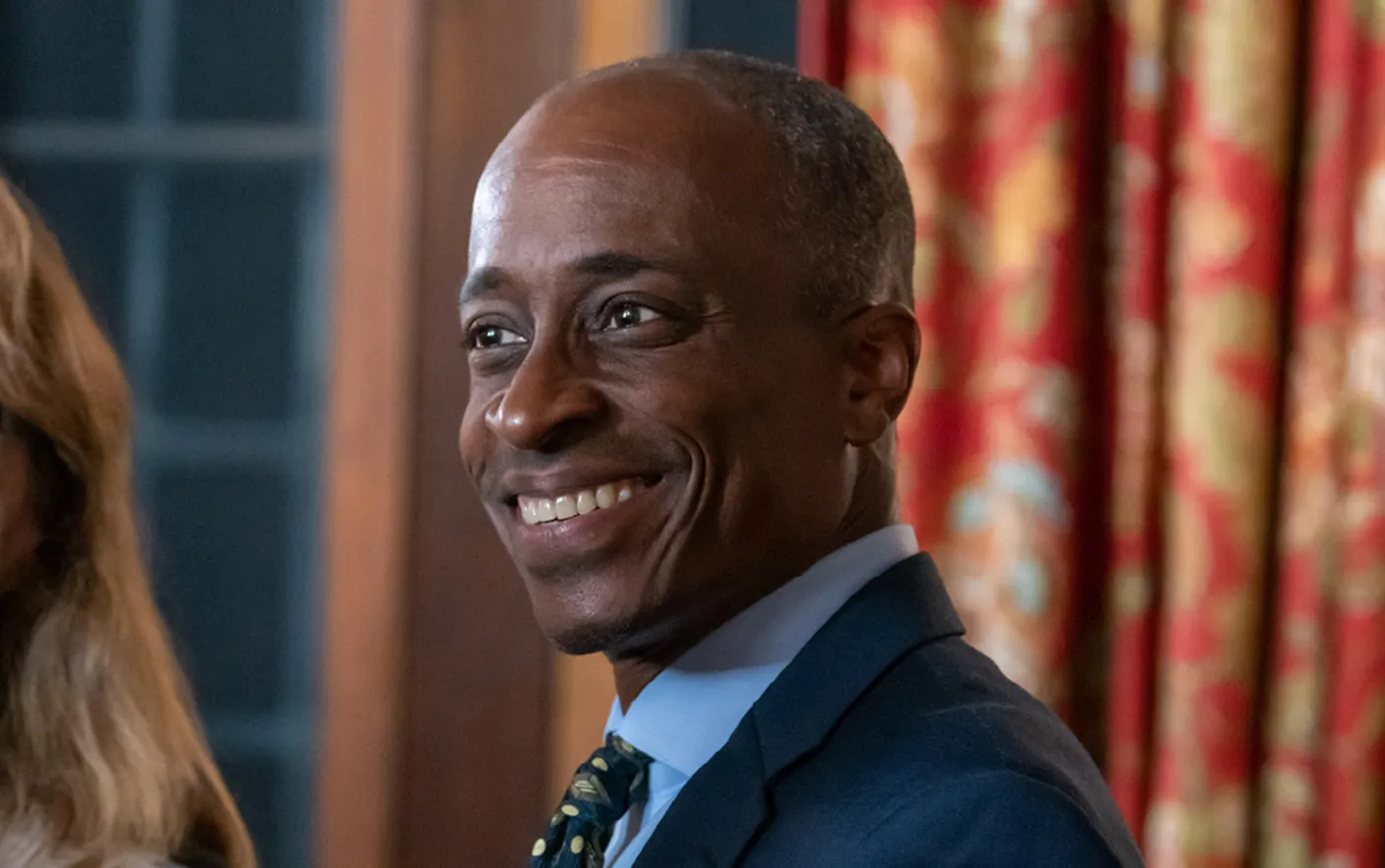
Distinguished Achievement Award
Philip N. Jefferson, a former College trustee, vividly recalls the day he graduated from Vassar—and not for the reasons you might expect. “I remember thinking, Wow, what happens now? Because I didn’t have a job yet. My next stop was back at my parents’ house, in inner-city Washington, DC. I had no idea what came next.”
That didn’t stop Jefferson from reaching what many would consider to be the pinnacle of achievement in his field, first in academia as the head of the Economics Department at Swarthmore College, then as the Vice President for Academic Affairs and Dean of Faculty at Davidson College. That is, until he got a call from the White House in December 2021 to serve on the Board of Governors of the Federal Reserve for a 14-year term, helping to meld global economic policy. He is currently the board’s Vice Chair.
“One thing I didn’t fully appreciate on that uncertain graduation day was the impact of a Vassar education,” he says. “It sends you out into the world with a foundation that is going to support you going forward and will generate opportunities, but you have to meet those opportunities with energy and recognize that they won’t always come in the form you expect.”
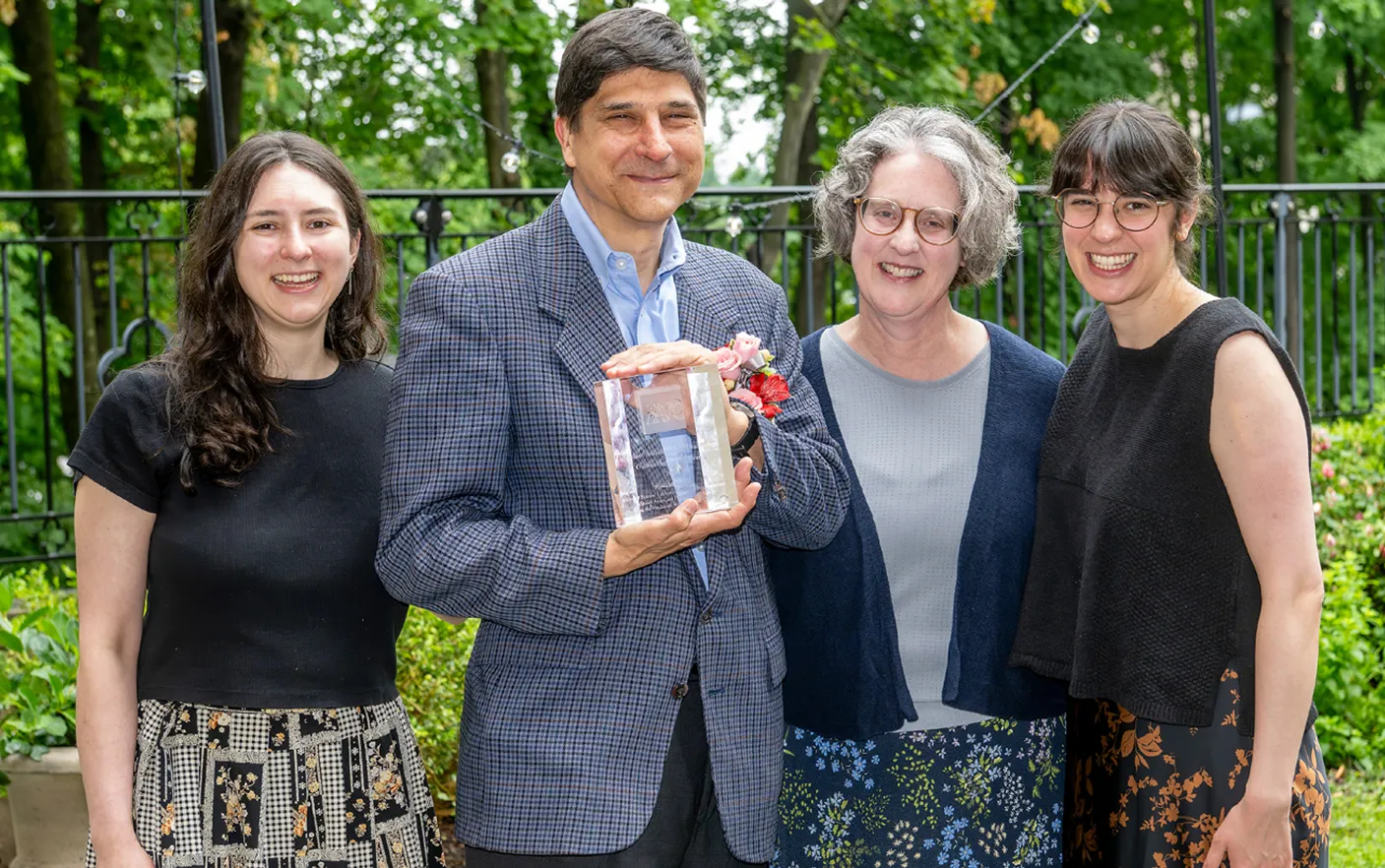
Outstanding Faculty/Staff Award
When Ronald Patkus first came to Vassar 25 years ago to head up Vassar’s Special Collections, what he found wasn’t exactly promising: “When people entered and exited Special Collections, a bell would ring. And in order to see a book or manuscript, you had to walk up to a sliding window and make a verbal request to a staff member who sat behind it. Then someone would retrieve the materials and pass them back through the window. In other words, Special Collections felt like a place where people shouldn’t go.” Patkus, who developed an interest in rare-book libraries as an undergraduate at Boston College, worked to change that. “I wanted to share the wealth of Vassar’s amazing holdings by making them all accessible,” he says.
Another problem was that much of the collection was essentially invisible because it wasn’t catalogued. Patkus set out to unearth the treasures, whether a collection of architectural prints by the 18th-century artist and architect Giovanni Battista Piranesi—“seeing them inspired one student to go to graduate school in architecture,” recalls Patkus—to writings by Sojourner Truth and Vassar alums Edna St. Vincent Millay and Elizabeth Bishop. “Vassar’s contributions to the world have been substantial, and our Special Collections highlight that,” says Patkus.
In 2022, Patkus was named Vassar’s College Historian, and the following year, he helped launch the Inclusive History initiative, bringing to light stories that often haven’t been told, with contributions not just from faculty, students, and alums but also from the wider community. “We’re taking a fuller look at our past, breaking new ground and involving the public in a broader way,” says Patkus. He also spends his time traversing the globe, building relationships with alums as he showcases highlights from the Special Collections.
He is especially proud of the Adopt-a-Book Program, which encourages Vassar graduates to engage with and help preserve individual books and other pieces in the collection with their donations. You’ll also find him leading alums on behind-the-scenes tours of the latest Special Collections exhibition during reunions, bringing Vassar’s past vividly into the present. “And the work is not over,” he says. “Our amazing resources need to be developed and cared for into the future.”
Patkus, shown here with daughter Laura; spouse, Beth; and daughter Margaret, received the award on Saturday, June 7, during an AAVC luncheon held during Reunion weekend.
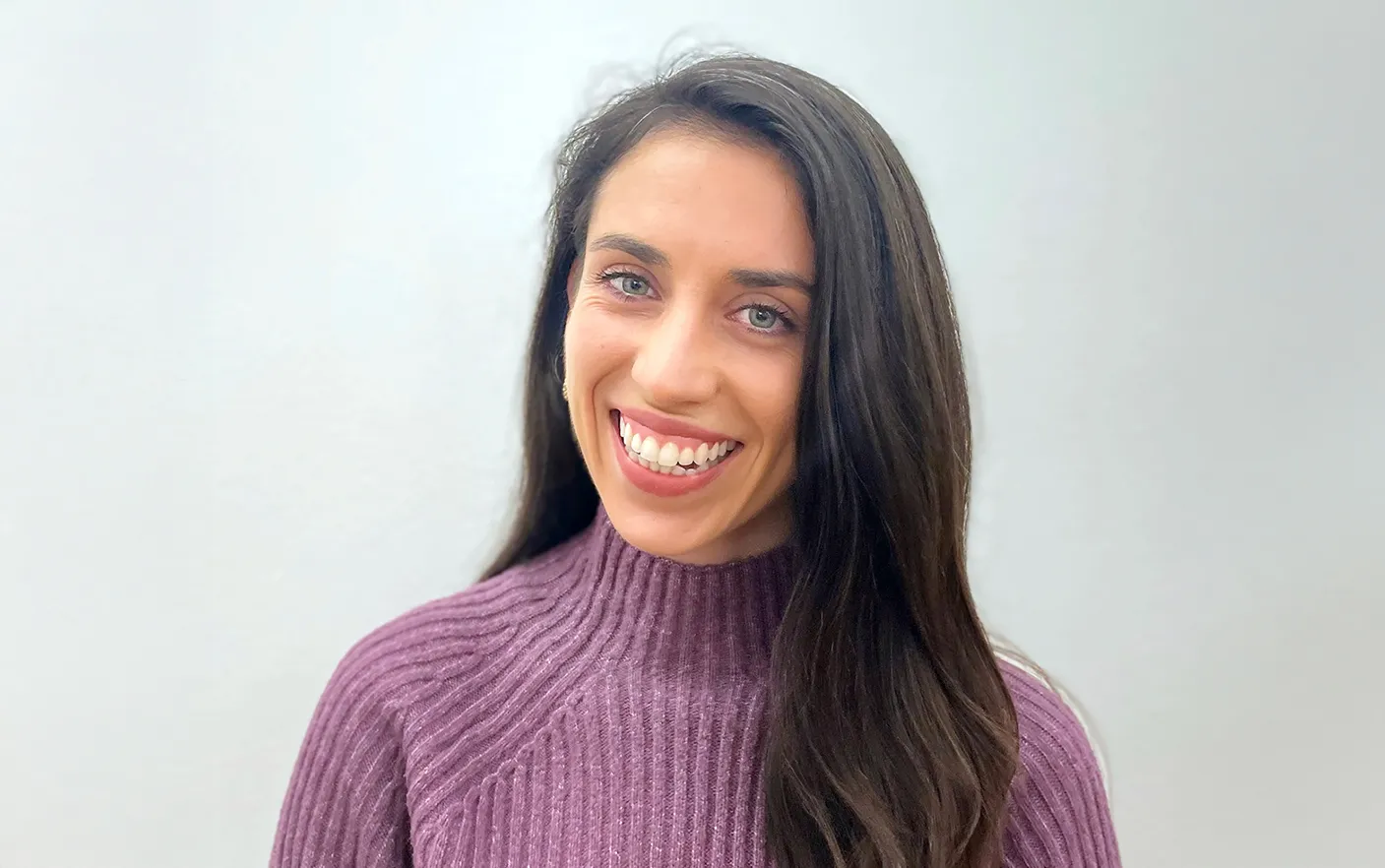
Young Alum Achievement Award
Elise Shea learned the importance of giving back early on, accompanying her pediatrician mother, Lytitia Shea ’86, on medical trips to Haiti when she was a teenager. “I’d help with administrative work at the clinic, using my high school—level French to support the staff,” Shea remembers. “That was my first exposure to international aid.”
Yet when she arrived at Vassar, following in her parents’ footsteps (her father, Richard Shea ’85, is also an alum), her perceptions about humanitarian aid were shattered. “I took courses with Professor Mark Hoffman, who exposed the politics of humanitarianism, particularly the violence and disempowerment that can come from aid.”
Shea decided to double major in French and International Studies and was a founding member of Vassar Refugee Solidarity. She also found time to dance at a high level. Shea danced with a professional ballet company after high school and before attending Vassar. “One reason I chose Vassar is that they have an incredible Dance Department—that program and community was integral to my experience there.”
She also credits Professor Tim Koechlin, Director of International Studies, for instilling within her the confidence to run with her ideas. “He had this trust in us, encouraging us to learn in the way we wanted to learn and study what we wanted to study. His trust taught me to trust myself.”
When Vassar Refugee Solidarity was being founded in response to unprecedented global displacement, Shea didn’t hesitate to throw an idea into the ring: What if the disempowering aid dynamic could be flipped to enable displaced people to be paid language tutors for language students?.
That idea eventually became Conversations Unbound, a decade-old nonprofit that has a presence not only at Vassar but on other campuses as well, offering displaced people the opportunity to earn money by being “conversation partners” who teach Arabic, Spanish, French, and German to college language students and anyone passionate about language. Shea continues to serve on Conversations Unbound’s board and currently lives in London with her partner, Hassan Saad ’17, working to help social entrepreneurs launch their ventures. And though it may seem as if she was headed in this direction all along, she says it wasn’t that way at all. “When I was a senior at Vassar,” she recalls, “I wanted someone to tell me what next steps I should take. But I realize now that there is no pathway to follow. Just like my professors taught me to trust myself, Vassar grads have to trust that they have the skills, grit, and critical-thinking ability to get where they want to go.”
Powerful Telescope at Observatory Named for Astronomer Vera Rubin ’48 Captures Stunningly Detailed Images of the Cosmos
hen noted astronomer Vera Rubin ’48 accepted the Distinguished Achievement Award from the Alumnae/i Association of Vassar College (AAVC) in 2007, she said the College had enabled her to acquire “the confidence that I could learn anything I wanted to know.”
Eighteen years later, the most powerful telescope on Earth, named in Rubin’s honor, is enabling scientists across the globe to learn a lot more about the nature of the universe. The Vera C. Rubin Observatory, situated high in the Andes Mountains, has begun to send stunning images of the cosmos, from asteroids in our solar system and other near-Earth space debris to millions of galaxies thousands of light-years away. “The Rubin Observatory is an investment in our future, which will lay down a cornerstone of knowledge today on which our children will proudly build tomorrow,” said Michael Kratsios, Director of the White House Office of Science and Technology Policy.

NSF–DOE Vera C. Rubin Obs/AURA
The Rubin Observatory will be taking more than a thousand images of the Southern Hemisphere sky every night from its perch at the summit of Cerro Pachón in Chile. The facility is jointly funded by the National Science Foundation and the Department of Energy’s Office of Science. It is the first observatory to be named for a woman. The observatory’s mirror design, sensitive camera, and telescope speed are all the first of their kind, enabling Rubin to spot tiny, faint objects such as asteroids, some of which could be on a collision course with Earth.
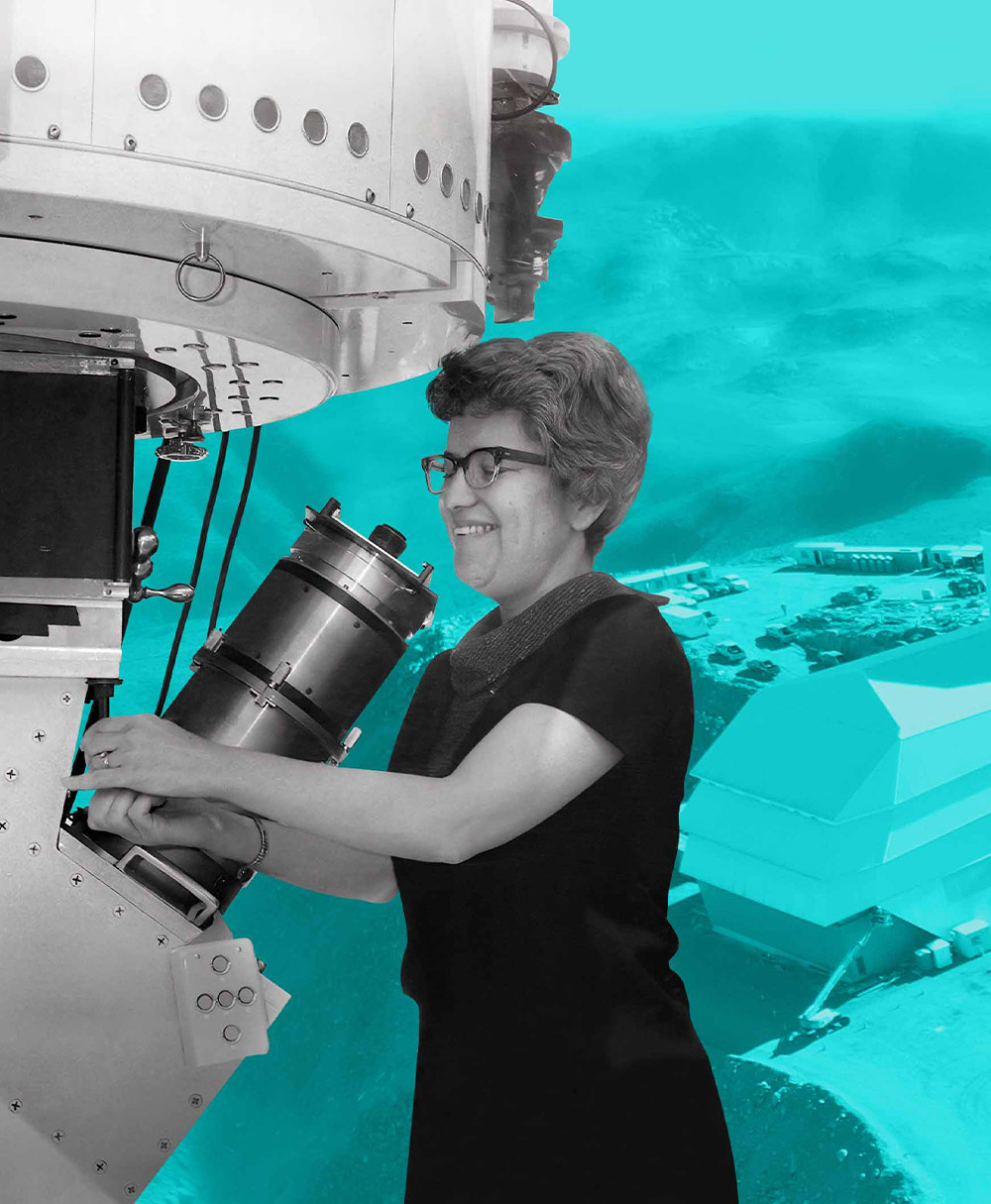
NSF–DOE Vera C. Rubin Obs/AURA
Vassar Professor and Chair of Physics and Astronomy Colette Salyk said she knew about Rubin’s ties to Vassar when she joined the faculty in 2015. “I was aware of Vera’s history at Vassar when I came here,” she said, noting the legacy of renowned women astronomers at Vassar had stretched from Maria Mitchell, one of the first faculty members hired at the College in 1865, to Rubin to Professor of Physics and Astronomy Emerita Debra Elmegreen, who conducted much groundbreaking research using data from the Hubble Space Telescope and several Earth-based observatories during her tenure. Elmegreen, who retired in 2022, was acquainted with Rubin and was an admirer of her work, Salyk said.
Salyk added that while her own research doesn’t involve most of the data currently being provided by the Rubin Observatory, she plans to develop a course for her students about the discoveries astronomers will be making by viewing the images it is gathering. “What’s unique about the Rubin Observatory is its ability to show us so much of the sky over a long period of time,” she said. “This will enable us to spot changes in the cosmos, such as exploding stars, which tell us a lot about the birth of the universe, and to spot exoplanets as they cross in front of stars. It’s almost like a movie instead of a collection of images.”
Rubin died in 2016 at the age of 88, but in an interview in the June 2025 edition of Smithsonian magazine, her granddaughter, Ramona Rubin, said she was certain her grandmother would be pleased about the launching of the observatory. “I think she’d be both deeply moved and also a little overwhelmed by all this recognition,” Rubin said. “When she was just fighting for observation time at the telescopes, I don’t think she could have ever imagined her name on an observatory in Chile.”
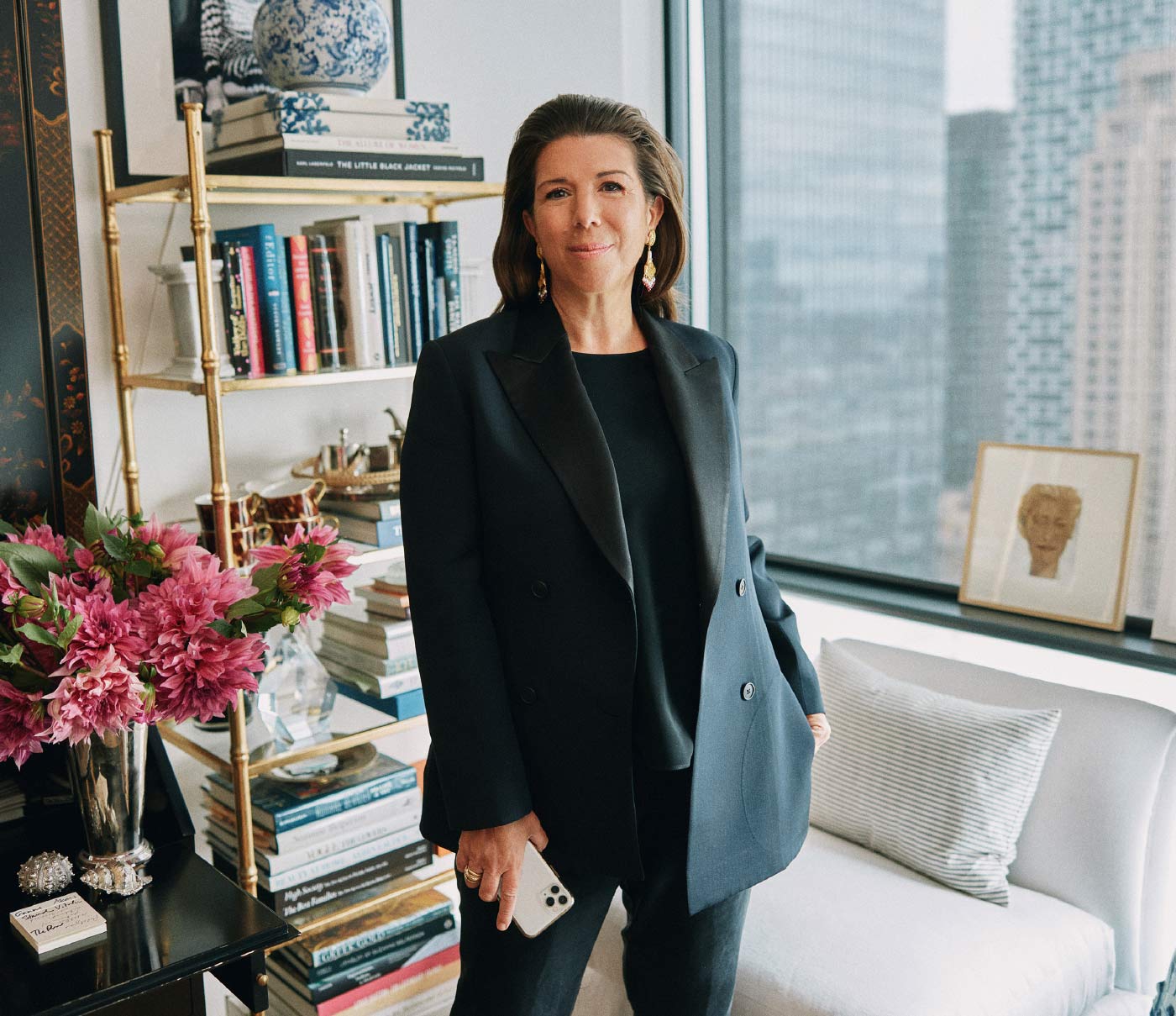
Stellene Volandes ’93: Human of New York City
tellene Volandes ’93 always knew she was meant to have a life and career in the Big Apple: “Growing up, I went to the theater all the time and loved to go shopping in Manhattan. For my sixth birthday, I famously asked my parents for tickets to Evita on Broadway. From early on, I had my eyes on New York City.” Indeed, Volandes, who was raised in a tight-knit Greek family in Bay Ridge, Brooklyn, spent a large part of her time at Vassar on the early-morning Metro North train to New York City, traveling to one of the many internships she completed during her time as a student there—including stints at Ralph Lauren Home, Hermès, New York Magazine, and Elle Decor.
This early experience clearly served her well. In February 2025, she came full circle and was named Editorial and Brand Director of Elle Decor. This, along with her role, since 2016, as Editor in Chief of Town & Country, where she has been credited with bringing new life and younger readers to the 179-year-old magazine.
Volandes is still passionate about theater—she is now on the board of Lincoln Center Theater—but after one drama class at Vassar, she says, “I knew I wasn’t destined for a life onstage.” Instead, two professors in the English Department, Patricia Wallace and Mark Amodio, stoked an already existing passion for English literature.
“I’d always loved reading and writing, and they were such dynamic teachers,” says Volandes. “I loved the way they connected whatever we were reading with so many elements of culture beyond what was on the page. Learning how to make those connections has had a huge impact on me and my career. In my job as an editor, I find it’s where I use my Vassar education the most. To do my job well, it’s important to be able to find the broader connections in a story so that it really reverberates with readers. Vassar nurtures that kind of broad thinking.”


No surprise, then, that her first job out of college was as an editorial assistant at Vogue. “I got a foot in the door at Condé Nast because a Vassar alum [Sarah Slavin ’59] worked in human resources there.” Volandes stayed at the magazine for nearly three years before leaving to get a master’s in English and comparative literature at Columbia University. “After that, I taught English at LaGuardia High School in New York City, but as much as I loved it, I decided it wasn’t what I wanted to do with the rest of my life.” So when her former boss at Vogue, Richard David Story, offered her a job as an associate editor at Departures magazine, Volandes pivoted back into print journalism.
She stayed at Departures for nearly a decade, getting what she considers to be her magazine education. “I did a bit of everything. I loved learning to make magazines and figuring out how to pitch a story, not just to my colleagues but to readers who think they are not interested in a subject. My goal is to get them to care about it.”
This skill is even more important now, when print journalism and magazines are competing with everything on people’s screens. “When it comes to what I do, I don’t think of print versus digital,” says Volandes. “For me, the challenge of media right now is how to do everything, whether print, digital, or social. That can be difficult in terms of bandwidth and staffing. But the truth is, a good story is a good story is a good story, whether it’s in print or on your phone. Whatever the platform, you have to make sure that you’re positioning the story so that someone wants to read it. That’s the most fundamental part of the job.”
Volandes’s nose for a good story is part of why she has made her way to the very top of the masthead, while still finding time to write two books on jewelry published by Rizzoli, with a third book idea still germinating. All this is coupled with her still newish directorship at Elle Decor and nights at the theater, at restaurants, and with friends—the active social and cultural life of New York City that was in her dreams. “I love what I do so much that balancing it all comes quite naturally to me,” says Volandes. “That’s where the drive comes from. I’m incredibly lucky and eternally grateful to have made a career doing something I love that encompasses all the things I love. I chose a profession where I’d be around like-minded people, much the same way I chose Vassar. My time there really set up so much of what my life is about now.”
Phyllis Klaus ’57: Doyenne of Doulas
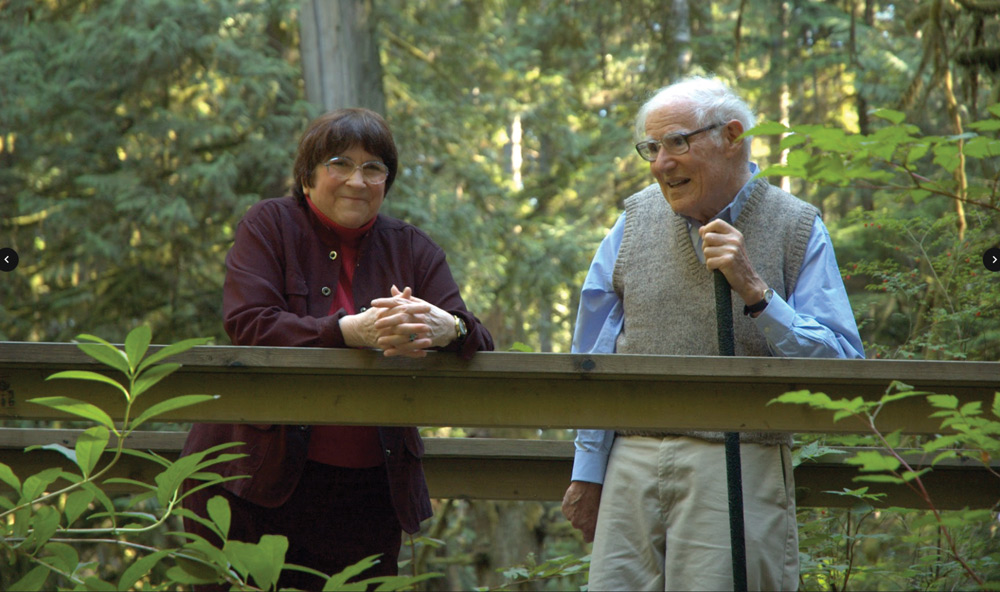
“We need to be open to many different experiences that make a difference for somebody,” Klaus said.
At Vassar, Klaus’s studies often took her to the Wimpfheimer Nursery School, where, with parents’ permission, she and her classmates observed babies’ developmental milestones. She even had the memorable opportunity to meet—and hug—Eleanor Roosevelt during a campus visit. Klaus also helped with College recruitment efforts.
College brought out Klaus’s activist side; she occasionally traveled to New York City to march for causes she and her classmates believed in. Though she’s no longer able to march, she wishes she still could.
After graduating, Klaus became a licensed marriage family therapist and social worker. She had three children from her first marriage: Geoffrey ’82, John, and Jocelyn Stoller (who passed away). Though that marriage ended, her second marriage to neonatologist Dr. Marshall Klaus was, in her words, “one of the most wonderful gifts that the universe could ever give me.” Marshall, who passed away in 2017 at the age of 90, shared Phyllis’s passion for improving maternal and newborn care.
Klaus became part of a transformative moment in maternal care. Working alongside Marshall and pediatrician Dr. John Kennell in Guatemala, she helped turn a breastfeeding study into a groundbreaking exploration of emotional support during and after childbirth.
Marshall saw a change in the women Phyllis was working with versus those visited by other people. Phyllis’s gentle words and compassionate presence noticeably improved the women’s labor experience.
The team’s investigation into this phenomenon led Marshall to Dana Raphael, who coined the term “doula,” an ancient Greek word meaning “a woman who serves,” to describe this critical support role. Through meticulous research, including studies on “non-talk, non-touch” doulas, Klaus, Marshall, and their colleagues found that emotional support could dramatically improve birth outcomes, challenging medical norms.
In 1992, along with their colleagues Penny Simkin and Annie Kennedy, the Klauses and Kennell founded DONA International, an organization dedicated to promoting doula care. Simkin, Kennedy, and Phyllis Klaus also founded PATTCh (Prevention and Treatment of Traumatic Childbirth) in 2007 to expand awareness of trauma’s effects on childbearing people, care teams, and communities. Klaus also coauthored several influential articles and books, including The Doula Book, When Survivors Give Birth: Understanding and Healing the Effects of Early Sexual Abuse on Childbearing Women, and Your Amazing Newborn.
During the pandemic, in her mid-to-late 80s, Klaus pursued another dream of hers: getting her PsyD.
“I had always wanted to do it, but was always too busy doing other things. I feel really good about it and proud. I hope it can be helpful,” said Klaus, who continues to consult with patients and speak at conferences. “I’m putting some of my body, mind, and spirit techniques of working with trauma and memory, to be able to explore those aspects of one’s life and how it has affected the way one lives.”
“I am just so impressed by and inspired by [Klaus’s] commitment toward some of the most vulnerable people,” said Elizabeth Geras Paruchuru ’05, Klaus’s Embracing Every Chapter nominator and COO of When Survivors Give Birth, a program founded by Klaus that trains professionals to support pregnant, birthing, and postpartum trauma survivors. “She has helped so many families start out on the right foot … I feel beyond privileged to be a part of keeping that legacy going, and it feels fated that we are both Vassar girls.”
For more information about Klaus’s work, visit bondingandbirth.org. Know of an alum from an earlier class—pre-1975—thriving and living an extraordinary life? Let us know!
-
FICTION
Piecework
by Abby Paige ’97
University of Maine
Press, 2025 -
NON-FICTION
Move. Think. Rest: Redefining Productivity and Our Relationship with Time
by Natalie Nixon ’91
Hachette Publishers, 2025 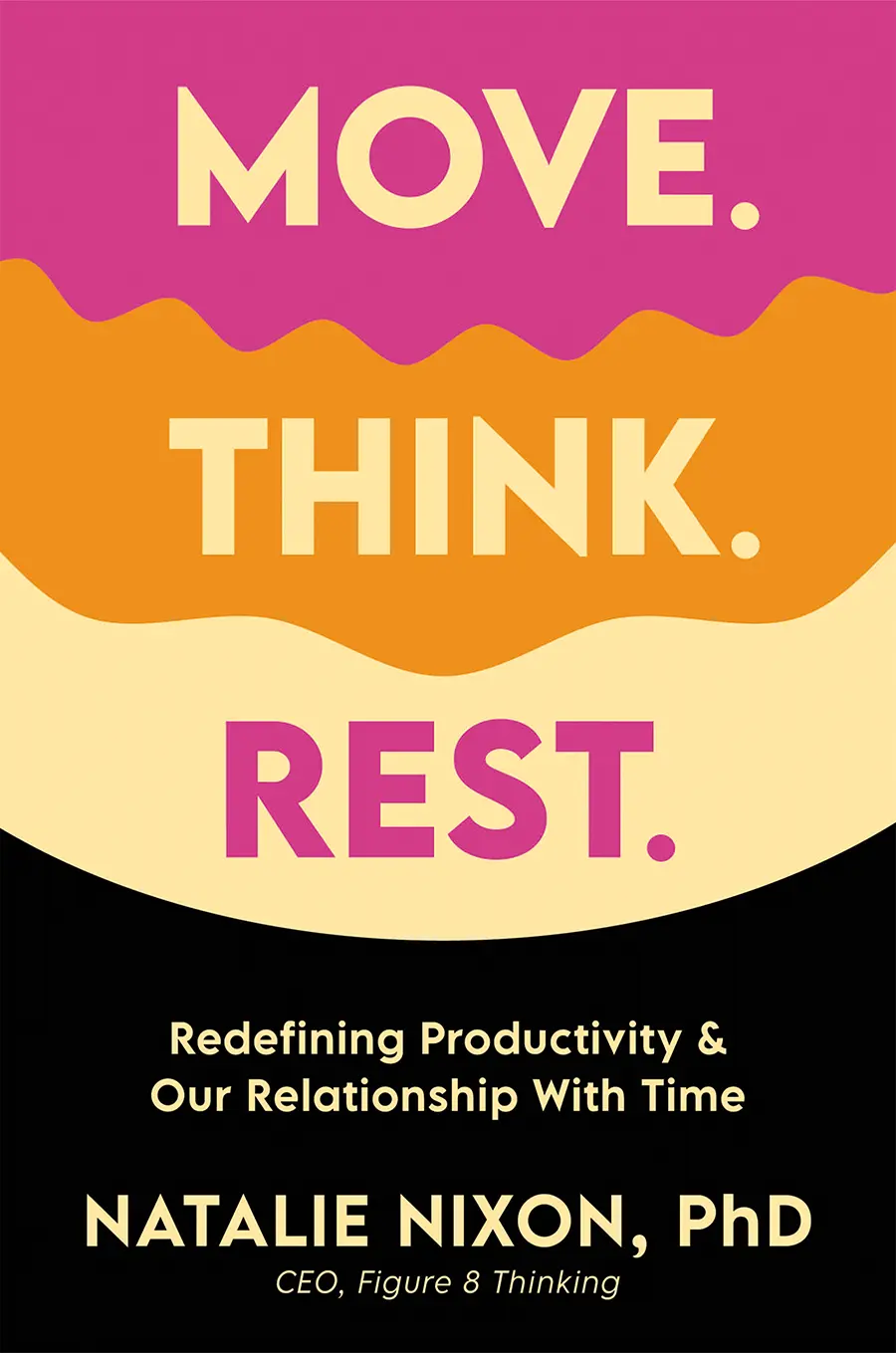
- Spaces on the Spectrum: How Autism Movements Resist Experts and Create Knowledge
by Professor Catherine Tan
Columbia University
Press, 2024 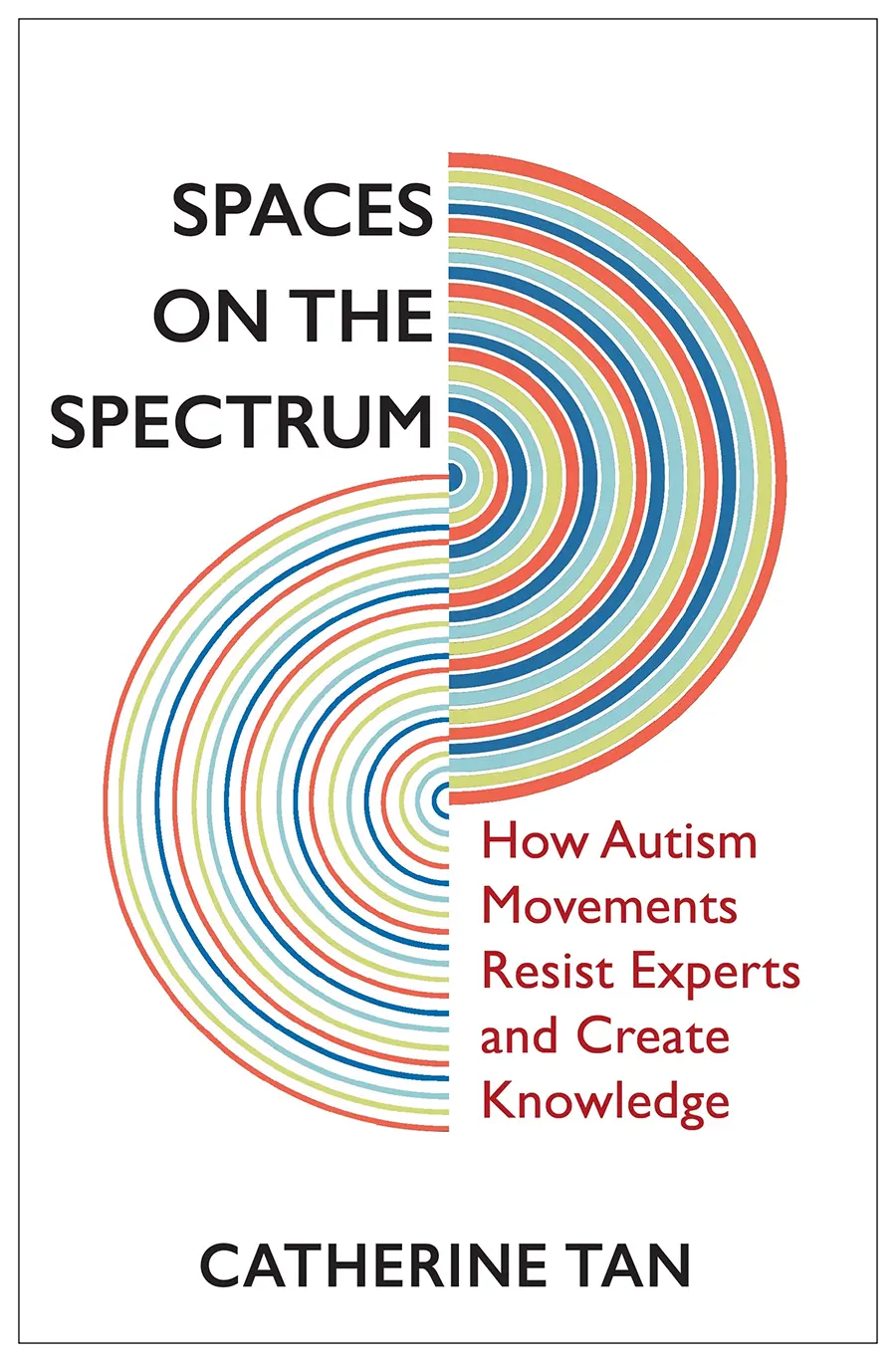
- After Caliban: Caribbean Art in a Global Imaginary
by Erica Moiah James ’92
Duke University Press, 2025 
- America’s Cold Warrior: Paul Nitze and National Security from Roosevelt to Reagan
by James Graham Wilson ’03
Ithaca: Cornell University Press, 2024 
- Including the Periphery
by Roselee Blooston ’73
Apprentice House Press, 2025 
- The 10: A Memoir of Family and the Open Road
by EA Hanks ’05
Gallery Books, 2025 - Cultivating the Learner-Led Classroom Through Universal Design for Learning
Co-author, Rochelle I. Mitlak ’84
Kendall-Hunt, 2025 - Unmaking Russia’s Abortion Culture: Family Planning and the Struggle for a Liberal Biopolitics
by Michele Rivkin-Fish ’90
Vanderbilt University Press, 2024 -
CHILDREN’S
A Sky That Sings
by Anita Sanchez ’77 and George Steele; Illustrations, Emily Mendoza
Lee & Low Books, 2025 -
POETRY
The American Revolution
by Richard Barakat ’81
Clancy, Dublin 2025 - What the Pause Gives
by Colleen Teasdale Filler ’74
Finishing Line Press, 2025 -
OTHER
The Oracle of Rewilding: Pathways for Renewing Our Kinship with All Things
by Sherry Salman ’74, illustrated by Alexandra Eldridge 
Letter from the President of the AAVC
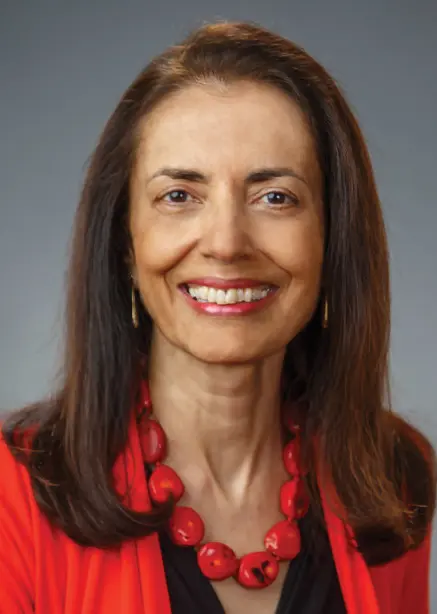
I hope you have had a fabulous summer, with time for enjoyment and relaxation. Mine kicked off with a joyous and emotional Commencement Weekend, as we welcomed 630 new Vassar graduates to our worldwide community of over 41,000 alums. We celebrated with them and their families at a champagne reception on the Chapel lawn, and also toasted Jacqueline Evangelista ’25, the recipient of the Stephen Hankins ’85 Spirit of Student Philanthropy Award.
Then it was on to Reunion weekend, with alums of the ’0s and ’5s joining us from 39 states and 25 countries, including Australia and New Zealand. Despite the rather uncooperative weather, alums from the Classes of 1955 up to 2020 and their loved ones—nearly 1,800 in all—gathered on campus, and it was fabulous! The Class of 1975, celebrating their Landmark 50th Reunion, set a new record with an outstanding gift to the College, augmented by a very special contribution from Rowland Evans ’75, honoring the memory of his grandfather and his mother, Katherine “Kay” Winton Evans ’46.
We celebrated the inaugural Alum Athletic Hall of Fame, organized by Michelle Walsh, Director of Athletics and Physical Education, honoring three teams and 10 individuals, with spectacular and moving remarks from alums who were honored. We also welcomed four new directors to the AAVC Board—Stephanie Goldberg ’14, Kevin Lee ’14, Patricia Neely ’75, and Sam Thypin-Bermeo ’11—and appointed Maybelle Taylor Bennett ’70 as an AAVC Trustee.
It was a special privilege to present the 2025 Outstanding Faculty/Staff Award to Ron Patkus, Head of Special Collections and College Historian, for his many contributions to our alum community and to the College. We bade farewell to Reverend Sam Speers, a beloved figure on campus, who retired after serving as Associate Dean of the College for Religious and Spiritual Life for the past 25 years. I would also like to express my gratitude to Peipei Qiu, a treasured Professor of Chinese and Japanese who retired from the faculty after 31 years, for her embrace of our alums, especially with respect to the AANHPI ceremonies held during Commencement Weekend.
As always, Reunion was packed with social events for specific classes, grand gatherings for all in attedance, and fascinating panel discussions and presentations. It was a joy to be with you for the weekend, and so many of you remarked on the wonderful additions to campus and how beautiful the campus looked. I hope all who were there were revived by the spirit of Vassar, and that you will continue to honor the ties that bind us together. Thank you for all that you do to support the College and the AAVC, your alum association.
My very best,


- Monica Vachher ’77, Illinois
President and AAVC Trustee - Brian Farkas ’10, New York
Vice President and AAVC Trustee - Tyrone Forman ’92, Illinois
Vice President - Alisa Swire ’84, New York
Nominating and Governance Committee Chair - Gail Becker ’64, New Jersey
- Maybelle Taylor Bennett ’70, Washington, DC
AAVC Trustee - Patrick DeYoung ’18, Pennsylvania
AAVC Trustee - Eddie Gamarra ’94, California
Alum Recognition Committee Chair - Stephanie Goldberg ’14, New York
- Anne Green ‘93, New Jersey
AAVC Trustee - Delia Cheung Hom ’00, Massachusetts
AAVC Trustee
Diversity, Equity, and Inclusion
Ad Hoc Committee Chair - Kevin Lee ’14, California
- Peggy Ann Nagae ’73, Oregon
- Patricia Ann Neely ’75, New York
- Michael Neuwirth ’89, New York
- Katherine “Kat” Mills Polys ’93, Virginia
Vassar Fund Committee Chair - Heller An Shapiro ’81, Maryland
- Sheryl Smikle ’81, Georgia
- Andrew Solum ’89, United Kingdom
Clubs Committee Chair - Keith St. John ’81, New York
Alumnae House Committee Chair - Carlos Hernandez Tellez ’14, Brazil
Career Networking Committee Chair - Sam Thypin-Bermeo ’11, New York
- Kerri Tillett ’91, Massachusetts/North Carolina
- Emily Weisgrau ’96, Massachusetts
(on leave) - Lisa Tessler
Executive Director of the AAVC - Patricia Lamark
Associate Director, AAVC Engagement
AAVC Board of Directors
Call For Nominations
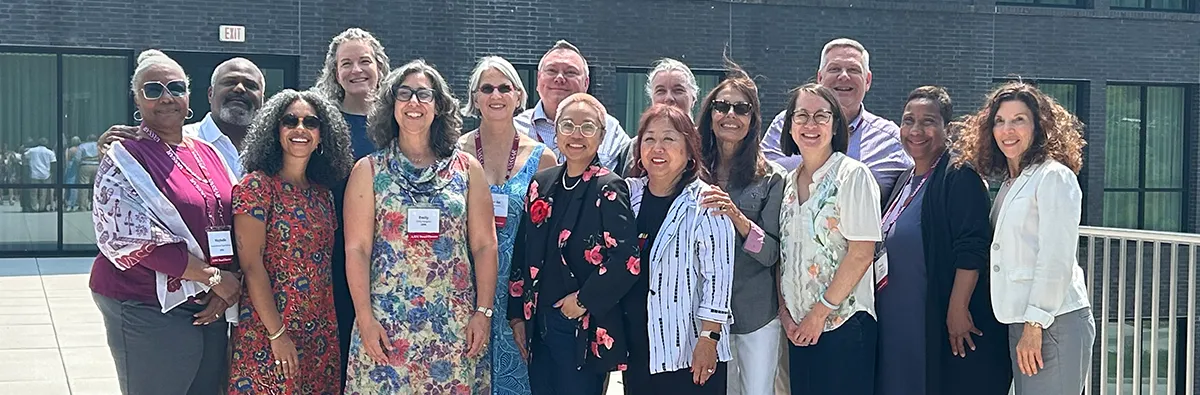
Stockton Photo, Inc.
The Nominating and Governance Committee of the Alumnae/i Association of Vassar College (AAVC) is soliciting nominations for candidates to serve on the AAVC Board and its standing committees. All nominations are confidential.
Founded in 1871, the AAVC leads Vassar alums to advance the interests and mission of the College. The principles of diversity, equity, and inclusion guide the practices and policies of the Association as well as the internal guidelines and work of its committees.
The AAVC Board and its committee members represent Vassar’s nearly 42,000 alums across the globe, and comprise a diverse group reflecting the demographics, skills, and attributes of the greater alum population, including class year, gender identity, ethnicity, geography, profession, and other factors. Some committees of the board include alums who are not board members but play an integral role in serving the interests of all alums.
We are seeking nominations for the positions and committees described on our website at go.vassar.edu/AAVCBoardPositions. We are especially interested in candidates who have a record of participation and engagement with and service to Vassar and/or who have served in volunteer leadership roles within other organizations. Core people skills such as collaboration, mentorship, and bridge-building are also highly valued. If you would like to recommend someone or would like to be considered yourself, kindly submit nominations by filling out this nomination form by Friday, October 10, 2025. Please reference the candidate’s volunteer role(s) and describe the individual’s qualifications for the nominated role.
Many thanks, and we look forward to hearing from you!
Alisa Swire ’84
Chair, AAVC Nominating and Governance Committee
Sheryl Smikle ’81
Vice Chair, AAVC Nominating and Governance Committee
In Memoriam
-
1944
Phyllis Vandewater Clement
March 15, 2025 -
1945-4
Anne Lyman Powers
December 19, 2024 -
1946
Eleanor Vandewater Leonard
October 26, 2024 -
1946
Jacqueline Bogin Levine
January 18, 2025 -
1946
Edith Julier Orbison
February 25, 2025 -
1946
Barbara Hinrichs Moriarty
May 15, 2025 -
1947
Edith Scott Bouriez
November 5, 2024 -
1947
Mary Lehman Harvey
December 10, 2024 -
1947
Penelope S. Egan
January 21, 2025 -
1947
Lydia Kerr Lee
May 1, 2025 -
1947
Edith McLane Edson
May 24, 2025 -
1947
Elizabeth Hathaway Swanson
June 13, 2025 -
1948
Betty Glas Wolf
March 3, 2025 -
1949
Elizabeth Brownell Weinstock
January 10, 2025 -
1949
Helen Forve O’Leary
February 1, 2025 -
1949
Mary Kirkpatrick Moffat
February 26, 2025 -
1949
Mary McChesney Ten Eyck
May 10, 2025 -
1950
Alvin Rose
May 23, 2021 -
1950
Ellen Thomas Phillips
September 30, 2021 -
1950
Patricia Kraus Selig
November 17, 2021 -
1950
Robert Deyo
July 9, 2022 -
1950
Katharine Cosgriff Kurtz
March 20, 2025 -
1950
Frank A. Sellitti
April 17, 2025 -
1951
Jean Fanning Costigan
November 15, 2020 -
1951
Eleanor Young Lord
May 2, 2024 -
1951
Elizabeth Bemis Cameron
December 27, 2024 -
1951
Joy Glik Sandweiss
March 2, 2025 -
1951
Alice Creighton Garfield
March 27, 2025 -
1951
Gerda Rice Whitman
April 18, 2025 -
1951
Frances Levy Rodgers
May 6, 2025 -
1951
Maidi Ebel Hall
May 19, 2025 -
1951
Alison Bean Birney
May 22, 2025 -
1952
Mary Gilman Clark
September 5, 2020 -
1952
Elizabeth Bristow Jacobs
November 1, 2020 -
1952
Sally Carson
September 13, 2023 -
1952
Virginia Self Bunker
May 12, 2024 -
1952
H. Lee Mills Petty
February 2, 2025 -
1952
Ellen Vorzimer Langner
April 11, 2025 -
1952
Barbara Brown Hardy
May 30, 2025 -
1953
Anne Sullivan Leavitt
February 20, 2022 -
1953
Anne Tierney Axt
May 1, 2024 -
1953
Marie Mapleton
June 1, 2024 -
1953
Leslie Hewitt Bird
January 27, 2025 -
1953
Alexandra Leys Rickenbacker
February 6, 2025 -
1954
Kirby McCaw Udall
August 23, 2021 -
1954
Joan Sherako Gimlin
December 15, 2021 -
1954
Judith Bryant Friend
July 19, 2023 -
1954
Jane Sowell Donoho
April 10, 2024 -
1954
Doris Sumerson Calman
February 11, 2025 -
1954
Patricia Purcell Chappell
March 1, 2025 -
1954
Elsie Warrington Gould
April 7, 2025 -
1954
Mary Dickson Nelson
May 28, 2025 -
1955
Toni Thorson Rockwell
February 1, 2020 -
1955
Irene Sienty Duncan
February 20, 2020 -
1955
Pamela Jones Baader
September 3, 2021 -
1955
Kathryn Underwood McDevitt
November 13, 2021 -
1955
Josephine Tracy
January 26, 2022 -
1955
Virginia Carden Ebey
October 16, 2023 -
1955
Leila Mann Meyerson
April 1, 2024 -
1955
Johanna Wislocki McKenzie
December 24, 2024 -
1955
Claire Burgess Steiger
February 3, 2025 -
1955
Joan Anderson Turnure
May 3, 2025 -
1955
Sarah Myers Bailey
June 3, 2025 -
1956
Diane Farquharson Fleming
June 18, 2020 -
1956
Barbara Bauer Lyons
September 13, 2022 -
1956
Anne Bergeron Baldwin
May 5, 2023 -
1956
Elena Pitt
March 10, 2024 -
1956
Norma Babbin Horowitz
July 19, 2024 -
1956
Beverly Stewart Almgren
January 30, 2025 -
1956
Alexandra Habsburg Wurttemberg
March 10, 2025 -
1956
Roberta Miller Coughlin
March 23, 2025 -
1957
Mary McGreevy
February 5, 2020 -
1957
Emma Patten Casey
May 15, 2020 -
1957
Patricia Breckir Miller
November 20, 2022 -
1957
Margaret Jones Donovan
October 19, 2023 -
1957
Lela Ottley Leslie
June 20, 2024 -
1957
Anne Sibley Kennedy
February 7, 2025 -
1957
Alice McElvenny Oldham
February 18, 2025 -
1957
Ann Collier Cohen
April 20, 2025 -
1958
Gayle Henrotte
May 4, 2023 -
1958
Cynthia Kelley McGrath
April 11, 2024 -
1958
Lucy Pulling Cutting
May 15, 2024 -
1958
E. Tucker Blackburn
February 7, 2025 -
1958
Julie Bres Slavik
April 25, 2025 -
1959
Anne Aldrich
March 12, 2021 -
1959
Annelisa Hubbard Randall
March 14, 2024 -
1959
Tara Collins Holbrook
March 27, 2025 -
1959
Mary Agnes Foshee Norman
March 27, 2025 -
1959
Emily Rounds Mitchell
April 18, 2025 -
1960
Barbara Wyatt McClintock
March 29, 2024 -
1960
Alice Louise Saulnier Ritchie
August 21, 2024 -
1960
Jacqueline Benton Childress
January 25, 2025 -
1960
Emily-Ellen Bohn Mudry
February 23, 2025 -
1960
Jane Whitehouse Goodwin
March 26, 2025 -
1960
Nan Budde Schwartz
March 27, 2025 -
1961
Barbara Bayliss
July 29, 2022 -
1961
Susanna Buie Matthews
May 1, 2024 -
1961
Maralean Gillis Woodcock
January 14, 2025 -
1961
Sheila Rice Zaretsky
January 29, 2025 -
1961
Ginger Dunlap-Dietz
April 9, 2025 -
1962
Susan Scholl Picciotto
July 6, 2023 -
1962
Gerda Talesnik
May 9, 2025 -
1962
Susan Binder
June 6, 2025 -
1963
Linda O’Carroll Liebman
March 11, 2021 -
1963
Florence McDowell Magassy
June 21, 2021 -
1963
Anne Nicholson Weller
March 19, 2025 -
1963
Joan Stubenbord Clark
April 2, 2025 -
1964
Ona Werner Ziegler
November 1, 2024 -
1964
Michal Jamison Offutt
March 19, 2025 -
1964
Theodora Zopko Wei
March 26, 2025 -
1964
Katherine Kelton Bozarth
April 27, 2025 -
1965
Marcia Greene Ullett
January 20, 2020 -
1965
Susan Kahn
July 14, 2020 -
1965
Constance Sheidler Mehrhof
March 25, 2021 -
1965
Allegra Mertz Torrey
April 13, 2024 -
1965
Meredith Stotz Campbell
May 8, 2025 -
1966
Susan Stein Burkhard
August 7, 2021 -
1966
Marcia Porter Hughes
May 20, 2023 -
1967
Nancy McHugh
August 27, 2023 -
1967
Helen Sanger Pierce
October 17, 2024 -
1967
Priscilla Jones Meyette
February 11, 2025 -
1968
Nancy Le Court Deeks
April 16, 2022 -
1970
Anne Scofield Nuss
October 7, 2024 -
1970
Valerie Ann Vaughan
January 19, 2025 -
1972
Sandra Farrah Haji-Ahmed
February 26, 2025 -
1973
Oliver Stern Gilbert
December 23, 2023 -
1973
John W Steller
August 31, 2024 -
1974
Stephanie Page
December 26, 2022 -
1974
Maria Jessup Robinson
December 17, 2023 -
1974
James Keith Blaine
April 15, 2024 -
1974
Christopher W Smith
November 27, 2024 -
1974
Mark Allan Schneider
January 27, 2025 -
1974
Charles Ferd Burgdorff
February 28, 2025 -
1975
Linda Sue Eaton
August 18, 2021 -
1975
Mary Catherine Messinger Royer
August 31, 2021 -
1975
Nancy Jill Farber
July 12, 2022 -
1975
Meg Ina Rubin
March 26, 2024 -
1975
Sandye Wilson
April 15, 2025 -
1976
Gretchen Lee Megowen
March 26, 2024 -
1976
Jane Levin
April 19, 2024 -
1976
Marlysa A. Raye-Jacobus
May 29, 2024 -
1978
Victoria Richardson
May 20, 2023 -
1978
Vilma Yuzbasiyan
April 10, 2025 -
1978
Carol Ann Pavacic Dubin
April 11, 2025 -
1978
Elizabeth Bour
February 8, 2025 -
1979
Kendolyn Hodges-Simons
March 11, 2025 -
1980
Christopher D. McCarthy
December 1, 2020 -
1980
Katherine Hogan
April 12, 2025 -
1981
Drew Zingg
April 10, 2025 -
1981
Merry McInerney-Whiteford
June 9, 2025 -
1982
James W. Haley
May 17, 2025 -
1983
James E. Shavick
December 22, 2020 -
1984
Susan P. Benkard
November 30, 2020 -
1985
Patricia Braz Wright
November 24, 2024 -
1987
David W. Tompkins
July 1, 2021 -
1987
Sarah N. Christ
May 22, 2025 -
1988
James H. Lee
August 19, 2023 -
1993
Dorothy Pomerantz
March 25, 2025 -
1997
Jeremy Drosin
June 23, 2023 -
1998
Alexander M. Harrison
May 5, 2025 -
2002
Theresa Waymire Dunn
February 20, 2025 -
2011
Daniel J. Files
February 5, 2025 -
2014
Benjamin L. Kaplan
May 9, 2021
Correction: In the Spring 2025 Vassar Quarterly “In Memoriam,” the Last name of Misao Masumoto Maki, deceased member of the class of 1957, was misspelled. We apologize for the error.
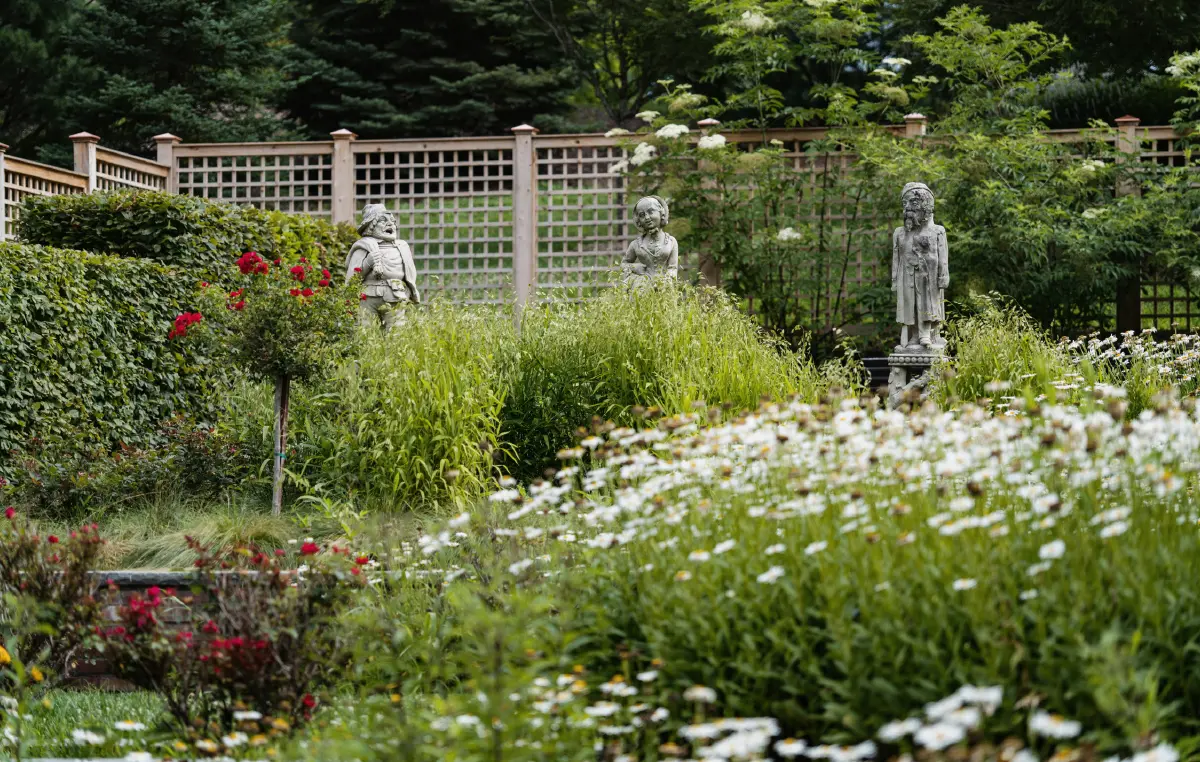
Announcements
-
Apartment Rental, Yellowstone
Cozy modern studio for two on the Yellowstone River, steps from Yellowstone National Park’s North Entrance in Gardiner, Montana. Private river access, covered deck overlooking the river, and incredible mountain views. Living space includes comfortable seating, gas fireplace, work desk, and dining table. Fully furnished kitchen with breakfast bar. A half wall separates the king bed from the living area. Full bath. Available year-round.
-
Cute Cottage Near Santa Barbara
Available year round! Come relax on the beach, boogie board, and build sand castles with your loves and littles and enjoy some of the world’s most beautiful sunsets! Cute cottage, a block from the beautiful and family-friendly Sandyland Cove Beach and walking distance from restaurants, shops, and ice cream! Carpenteria is a sleepy beach town 20 min. south of Santa Barbara and less than two hours to Los Angeles. Our 2/1 sleeps four comfortably in two separate bedrooms, and there’s a pullout couch in the living room for two more. Full kitchen, washer/dryer, dishwasher, microwave, Internet, Roku, and a fenced-in yard with outdoor eating space and parking. Pet friendly. 30-day minimum rental.
Arcadia Haid Conrad ‘94
actuallyarcadia@gmail.com -
Mountain Rental, Colorado
Stay at our gorgeous, 2-BD condo in Summit County, CO; sleeps up to 6. Play in the snow all winter (ski, skin, cross country, fat tire bike, etc.); hike, fish, bike, boat in the summer/fall. Penthouse condo looks out over the Blue River; sunrise/sunset views of Rocky Mountain ranges. Near 7 ski resorts: Keystone (15m), Copper (20m), A-Basin (25m), Loveland (25m), Breckenridge (25m), Vail (35m) Beaver Creek (50m); also, Mary Jane/Winter Park (1hr), Steamboat (1.5h). Attached, heated garage. Vassar discount available.
-
Historic House in Greenport Long Island’s North Fork
Charming, historic home in maritime village, 5-minute walk to town with all amenities. 3 BR, sleeps 5 (2 queen/1 full), 2 full BA, outdoor shower, cook’s kitchen, gracious dining room, library/study, 2 working fireplaces. Sunroom leads to deck with porch & pergola, water views of Sterling Harbor, large private yard. Internet/cable TV, A/C, all utilities incl. Transportation (LIRR, Hampton Jitney, LIE). Two-week or monthly: June $12k, July $16k, August-Labor Day $18k, September $15k. Special rates for October. Other times, please inquire. Information/photos upon request.
-
Christmas and New Year’s Rental in Los Cabos
We have two timeshare weeks (Dec 22, 2025-Jan 5, 2026) in a 2-bedroom unit at Hacienda del Mar in Los Cabos, Mexico. $4,900 USD total for the two weeks. Each week may also be booked separately. Hacienda del Mar is a beautifully landscaped resort on the Sea of Cortez between Cabo San Lucas and San Jose del Cabo. The unit has 2 BRs, 2 BA, LR, small kitchen, dining area, and balconies. One bedroom has a king bed and the other has 2 queen beds. There is also a pullout sofa in the living room. Steps to the beach, pools, small store, restaurants, and timeshare lobby. There are many good restaurants in Cabo, and groceries are readily available.
Susan Guttman ’77
caboweeks51.52@yahoo.com -
Rent/Swap Umbrian Farmhouse
4 BR/3.5 BA, excellent wifi, full AC and lap pool nestled in 6 acres of olive grove near Orvieto.d Sweeping view of the Tiber Valley and surrounding hill towns. Walk up to Guardea for morning coffee and Sunday market, visit hill towns, hike/bike the Borghi dei Silenti trail, or never leave this oasis! Plenty of outdoor space, yoga platform, and pergolas for group workshops, family gatherings, and the digital nomad.
Lisa Brodey ’80 and Lucy Clark ’09
lbrodey@yahoo.com -
You’ve Got Great Stories! Let FamilyLore Record Them!
At FamilyLore.com, we believe every life is brimming with unique stories to be expressed, recorded, and shared. I’m Adam Phillips ‘77, a multi-award-winning radio journalist with 35+ years of experience interviewing world-famous luminaries as well as everyday folks with their own fascinating tales to tell. Together, let’s unearth the “gold” in your life’s journey for present and future generations to enjoy. (We also work with organizations and conduct workshops.)
Adam Phillips ‘77
www.FamilyLore.com -
Career and Job-Search Counseling
Vassar alum and experienced career counselor will guide you to a satisfying career path and successful job search. Can meet with you in person in Westchester or NYC, and/or by phone and email. No situation is too difficult!
-
Opportunity for Volunteer Greatness
Have you stepped down from a rewarding career and are looking for a new challenge? Small 501c3 organization seeks an Executive Director for an exciting VOLUNTEER position. We need a bold, strategic, and values-driven leader at the intersection of mental health, public advocacy, and human dignity. Lead our all-volunteer team to greatness and influence!
Alexandra Roth ’81, LCSW
overroth2@gmail.com -
French Provinces: Rent our lovely rustic farmhouse in southwestern France.
Midway between Dordogne and Lot rivers. Quiet picturesque farming village near Figeac and St. Céré; 45 minutes to Sarlat, capital of the Dordogne Valley; 70km to Cahors and its vineyards. Well located for those interested in pre-history, medieval history, gastronomy, hiking and canoeing.
Going to the Source: Landscape Architecture
Those of us who went to Vassar learned this lesson subliminally, because from the beginning, the truths that govern the relationship between the natural and the human-made were always present for us, every time we walked on the campus. I take my evidence from my Vassar class and the Vassar community in Miami, where I live. I see an intrinsic understanding of the complex relationship of the natural and the human-made.
A few years back, I was asked to write a book on gardens for midcentury houses. I’d just wrapped up a five-year stint as editor of Modern Magazine and was fascinated by the way the midcentury-modern residential landscape broke tradition to connect the indoors and the outdoors. It was a threshold to the way we can (or should) live today. Long in the making, this book with the slightly unsexy title of Gardens for Modern Houses: Design Inspiration for Home Landscapes (Rizzoli, 2025), includes what I hope is a thoughtful essay about the important role of the midcentury garden in transforming the way we live with what the Smithsonian called “pools, patios, and the invention of the American backyard.” The book also, of course, has many beautiful and important residential gardens with images from terrific photographers.
Two of the gardens featured in the book were commissioned by my 1969 classmates, and a third house, in Chicago, was one renovated by the architect Margaret McCurry ’64, a project that was pure and beautiful. Her work has always been fine-tuned and intended to fit in with its surroundings, and this is true here.
The gardens created by my classmates were the result of both vision and aesthetic prowess. The first is a house in Key West, a more typical midcentury house that Susan Henshaw Jones ’69 purchased in the early 2000s with her husband, Richard. Susan hired the renowned, brilliant Raymond Jungles of Miami to design the landscape. Ironically enough, a jury I was on for the American Society of Landscape Architects gave it a national honor award, and honest to goodness, at the time I didn’t know the client was Susan, who—as director of the National Building Museum and the Museum of the City of New York—made an enormous impact on our understanding of architecture and cities. (I actually only learned that the house was hers when I was editing a story on this house, and halfway through, I had the epiphany.)
The second landscape—by the also brilliant, renowned landscape architect Doug Reed, who is based in Massachusetts—was commissioned by the late Barbara Saslaw Dixon ’69 and her husband, Chris. Barbara’s commitment to preserving the landscape was unwavering and admirable. I’d learned of her passion for this, also inadvertently, when we coincided more than 20 years ago at an event in Sonoma sponsored by the Cultural Landscape Foundation at the landmark modernist Donnell Pool and Gardens. Again, it was an unwitting but not unsurprising connection. Barbara and Chris had acquired an endangered swath of the Stonington, CT, countryside and then built a beautiful house designed by Maryann Thompson, who was later selected as the architect for The Dede Bartlett Center for Admission and Career Education at Vassar. Six degrees.
As I think about that Vassar landscape and the hours we spent wandering in it, I realize that the natural beauty of the campus was an implicit and all-important part of the experience. I’ve been growing ever more passionate about its subconscious effect on my life.
At Vassar, we were always taught to “go to the source.” in this case, I’d argue that the source is the land, the landscape, and the architecture, and the future is the way we appreciate, nurture, and preserve them.

- Publisher
Alumnae/i Association of Vassar College
Monica Vachher ’77, President - Vice President, Communications
Victoria Grantham - Associate Vice President, Editorial and Publications; Editor, VQ
Elizabeth Randolph
elrandolph@vassar.edu - Art Direction and Design
Aidan Gallagher
Daniel Silva - Print Production
Dan Lasecki - Staff Writers
Larry Hertz
Kimberly Schaye - Class Notes
Nada Glick ’61, Coordinator
Joan Giurdanella, Copy Editor - Editorial Assistants
Emilee Busby ’25
Nina Sandman ’26
Sofia DeRose ’28 - Editorial Offices
124 Raymond Avenue, Box 647
Poughkeepsie, New York 12604
845.437.5447 Fax 845.437.7239 - Postmaster
Send address changes to Central Records, Box 14, Vassar College, 161 College Avenue, Poughkeepsie, New York 12603 - Yearly Subscriptions $15
- Unsolicited Manuscripts
We discourage the submission of unsolicited manuscripts or stories written without prior consultation with the editorial office. However, we do welcome story ideas and pitches. Please email
vq@vassar.edu with your suggestions. - Articles reflect the opinions of the writers and not necessarily those of the magazine, AAVC, or Vassar College. Vassar, the Alumnae/i Quarterly, is published in the spring, summer, and fall/winter by the Alumnae/i Association of Vassar College (AAVC).
- Mission
AAVC is a living bridge whose mission is to ignite powerful connections to Vassar, to each other, and the world. - Affirmed 2013.
Copyright © 2025 AAVC