

Kelly Marsh
Understanding the Impact of the Vietnam War
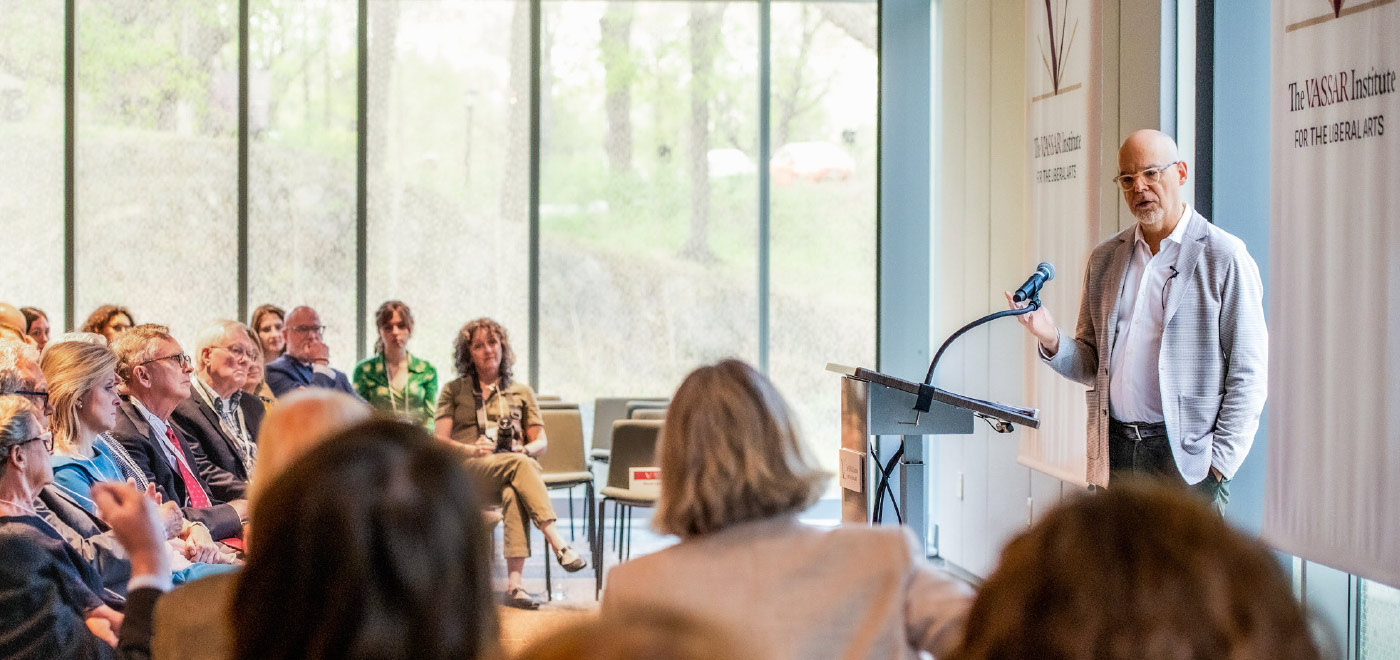
As keynote speaker, Logevall kicked off Remembering the American War in Vietnam: A Fifty-Year Retrospective this spring at The Vassar Institute for the Liberal Arts. Convened by Robert K. Brigham, Vassar’s Shirley Ecker Boskey Professor of History and International Relations, the conference brought together distinguished presenters who shared their experiences and insights on a wide range of issues, including domestic politics, foreign relations, military strategy, and the roles of women and race.
“We grew up with the war in so many ways—in our families and communities, on TV,” said Brigham of the 73 million baby boomers who came of age in the 1960s and 1970s. “It permeated the national consciousness as much as the music that became the soundtrack of that era. It was impossible to avoid, and it’s still resonating.”
In his Thursday evening presentation, Logevall contended that today’s politics of resentment stem from the era when Americans first learned that their leaders were lying about the war.
“I suggest that many of the troubles that plague our nation today—alienation, resentment, cynicism, the mistrust of government, the breakdown of civil discourse and of civic institutions, and the lack of accountability in powerful institutions—have their roots in the Vietnam War era,” he said. “You could argue that Americans went from naivete at the outset of the Vietnam era to cynicism—and cynicism, which alienates us from the government, threatens democracy because it destroys the power of the people to believe in change, and to work for change.”
Kelly Marsh
“Since 1990, Vietnam and the U.S. have been working toward renewed relations,” he said, pointing to the current administration’s initial refusal to have a diplomatic presence at receptions in Saigon. “It says something larger about this administration’s lack of confidence in America’s place in the world.”
Remarks by Peter Osnos—author, journalist, publisher, former foreign and national editor, The Washington Post—dovetailed with both Daddis and Logevall. “There are ironies galore,” he said. “What we went through in Vietnam should have given us real lessons, but the lessons were not learned. We were ignorant of Vietnam’s history, context, and language when we went in, and it was the same in Iraq and Afghanistan, although they were in different parts of the world and of a much smaller scale. We left one in frustration, the other in failure.”
“During the 1960s, lots of Americans—people in uniform and civilians—saw the U.S. military as a model of racial progress,” Bailey explained. “But the institution was definitely not exempt. It did not stand apart from the broader society from which it drew its members, and from which it was going to return its members.”
Toward the end of the 1960s, the perception of colorblindness, fueled by Black Freedom and Black Power movements back home, was impossible to maintain.

Keynote Speaker
In response, the military instituted race training, handbooks, and seminars and, in 1971, established the Defense Race Relations Institute. Understanding race as a critical issue also brought the awareness that culture also mattered.
“That awareness also led to affirmative action programs within the Department of Defense that brought more people of color into enlisted ranks, and also as judges and lawyers,” Bailey explained. “These were very successful programs that continued up until the most recent administration.”
The military and civilian organizations that sent women to Vietnam also had to grapple with rapidly changing ideas about gender and sexuality. Women chose to go to Vietnam for a variety of reasons, including a sense of duty and opportunities for independence as nurses saving lives, soldiers in the Women’s Army Corps, or participants in the Red Cross’s Supplemental Recreational Activities Overseas Program. “Women in the war felt the expectation that they be conventional symbols of American womanhood, even as they endured wartime conditions and performed work that challenged those very traditional assumptions,” said LCpl. Kara Vuic, Benjamin W. Schmidt Professor of War, Conflict, and Society in 20th-Century America, Texas Christian University.
Their Vietnam experience—from oppressive hierarchies and a lack of formal recognition to routine harassment—also played out when they returned home. Many not only felt out of step with their peers but saw their contributions devalued in civil society, both professionally and personally, and it often took them decades, if ever, to achieve recognition. The most tangible legacies in this struggle are reforms within the VA, including the establishment of the first women’s health clinic and the Vietnam Women’s Memorial, dedicated in 1993, after decades of persistence.
Today’s military, despite the current administration’s devaluation of women’s contributions, relies on women to fulfill every role.