

Vassar Celebrates 100 Years of Tech Pioneer Grace Hopper, Class of 1928
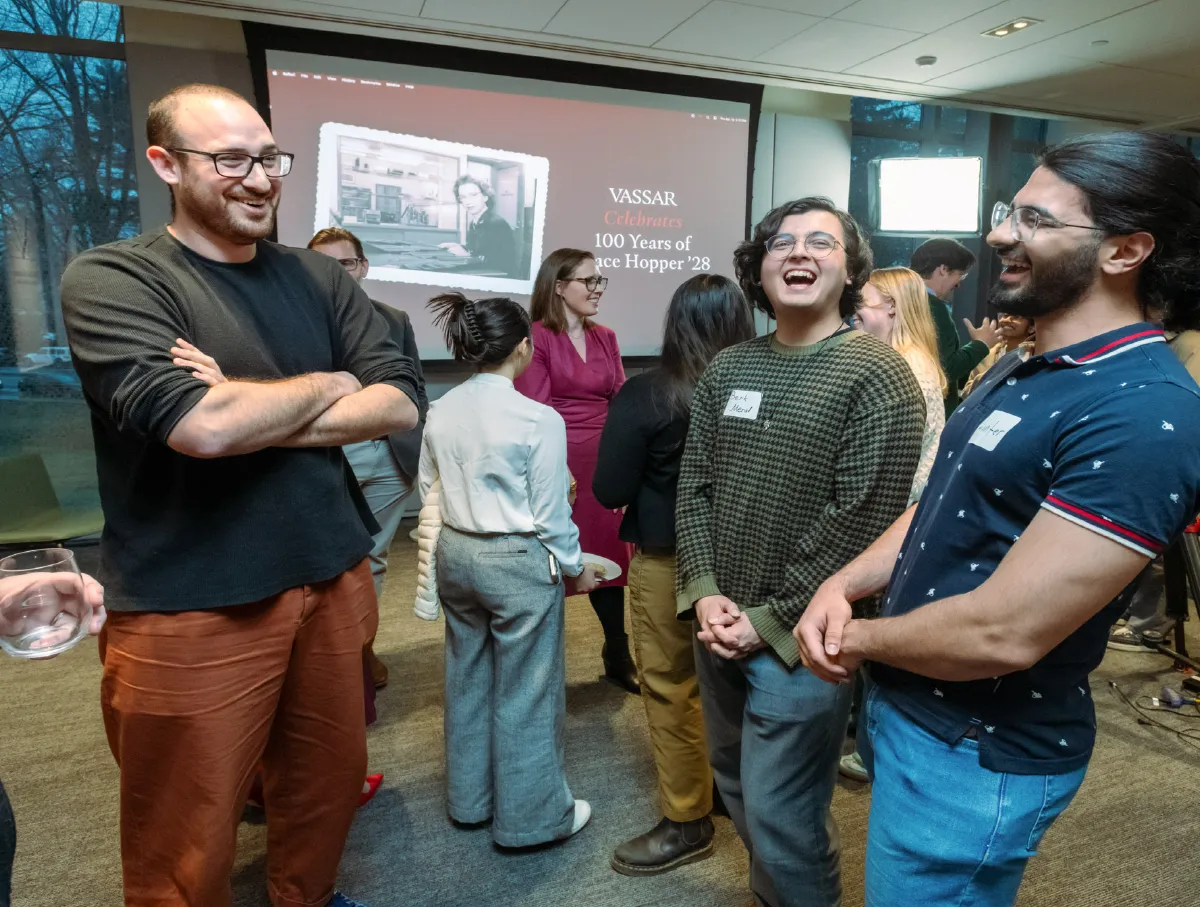
Hopper biographer Kurt Beyer observed that one of the first things Hopper did in the Navy was to reject the notion of doing things as they’d always been done. “Prior to World War II, all data was analog,” Beyer said. “She broke the notion of single-use function calculators and developed a coding system”— a computer program that translates human-readable source code into machine code that a computer can execute. The development of COBOL (Common Business-Oriented Language), a system that democratized coding that made it simple for everyday users and businesses to use computers, was a game-changer. Despite her remarkable achievements, Beyer said, Grace Hopper’s contributions to the modern technological landscape have largely gone unnoticed until recently.
The event also featured a fireside chat between Grace Hopper Day organizer Alison Lindland ’00, Chief Marketing Officer at Movable Ink, a company that uses artificial intelligence and other high-tech tools to help businesses succeed; and Naomi Seligman ’55, a thought leader in the field of computing and technology who knew Hopper personally. Seligman said she had met Hopper when she was working for a consulting firm and was giving a speech at a conference at the Waldorf Astoria Hotel in New York City. She said Hopper convinced her to resign and start her own business, “and she was a captain in the Navy, so I followed her orders.
“Grace knew her technology,” Seligman continued, “but she was also charismatic. She understood that promoting the use of computers was not just science. She knew we needed the private sector to become involved in computing.”
An all-alum panel was moderated by Nancy Ide, Professor Emerita of Computer Science, who had founded Vassar’s Computer Science Department in 1990. The panelists—Peter Leonard ’97, Director of Customer Engineering Excellence for Google Cloud; Reena Mehta ’01, most recently the Senior Vice President of Streaming and Digital Content Strategy at ABC News/Disney; and Matt Foster ’14, an Advanced Senior Game Designer at Insomniac Games in Los Angeles, California—all said that following Hopper’s legacy at Vassar had helped them advance in their post-Vassar careers.
The event concluded with a CBS TV 60 Minutes video clip in which Hopper reflects on her long career as a tech pioneer. The clip was introduced by Professor of Mathematics and Statistics Emeritus John McCleary, who has written a history of the Mathematics Department; a significant portion of the text is devoted to Hopper’s contributions to Vassar and to the world of science and technology. Marc Smith, Professor and Chair of Computer Science, said a few final words, revealing that he had chosen to come to Vassar partially because of Hopper’s legacy. “I’d long known that Grace Hopper attended and taught at Vassar, and it was an honor to have the opportunity to be a part of that,” Smith said. “I could not be more proud to be following in Grace’s footsteps as a faculty member at Vassar. She is ours.”