

Vassar Wraps Up Inaugural Year of Signature Programs
at The Vassar Institute for the Liberal Arts
The first Signature Program—EcoVisions: Finding Your Place in Environmentalism—held in fall of 2024, illustrated how environmental action could take shape in all aspects of our lives and highlighted how legal innovations could aid and contribute to climate justice. The Institute will continue to serve as Vassar’s public classroom, playing a critical convening role in tackling contemporary challenges during the coming academic year.
Promoting Partnerships to Advance Educational Justice in Poughkeepsie

Kelly Marsh
Participants included officials from Vassar, Marist, and Dutchess Community colleges; representatives of the City of Poughkeepsie and its school district; local government leaders; and members of local not-for-profit agencies. “Our goals for the weekend were to break the silos that exist among higher education, local school districts, and community organizations and to collaborate as a group,” said Associate Professor of Political Science Taneisha Means. “We identified some issues that exist from various perspectives and developed conversations that will hopefully lead to collaborations.”
Assistant Professor of Mathematics and Statistics Andy Borum said the informal conversations that occurred throughout the weekend were just as significant as the formal panel discussions. “Some of the best moments for me were the conversations that took place over lunch and the networking that resulted from those conversations,” he said.
Professor of Education Erin McCloskey agreed. “Just getting to know each other was the important first step, and then following that up with deciding on ways to connect with each other,” she said. “Our next step will be to bring more students and their parents into the conversation, and we will continue to meet regularly to follow up on developing specific programs. All of the attendees were incredibly excited, and I look forward to the next steps in the process.”
Convened by: Andy Borum, Assistant Professor of Mathematics and Statistics; Erin McCloskey, Professor of Education; Taneisha Means, Associate Professor of Political Science; and Molly (Mary L.) Shanley, Professor Emerita of Political Science.
The Entrepreneurial Mind and the Liberal Arts

Kelly Marsh
Johnson Lin ’21 told the audience about the multiple failures he and his business partner endured along with the success they ultimately achieved in launching a tech startup company. “Nobody has ever gotten it right on the first try,” Lin said. “My first two ideas failed, but I had raised $1 million and remembered what my Vassar Commencement speaker (tech entrepreneur Jessica Matthews) had told us: ‘Just don’t be the worst at what you’re doing, and you’ll have time to grow and learn.’”
In addition, Town of Poughkeepsie Supervisor and Professor of History Rebecca Edwards and Dutchess County Legislator Lisa Kaul spoke about the entrepreneurial elements required to run for office and serve in local government.
Julián Aguilar ’23, who leads Vassar’s entrepreneurship program, noted that the conference highlighted how “entrepreneurship within the liberal arts is not just about the pursuit of economic success, but about fostering meaningful change. It is about developing ventures, ideas, and initiatives that challenge norms, uplift communities, and create sustainable solutions.”
Convened by these members of the Office of the Vice President for Technology and Human Resources: Julián Aguilar ’23, Academic Computing Consultant; Jean Tagliamonte, Assistant Vice President for Planning and Engagement; Erin McHugh, Program Administrator; Breille Irahoza, Administrative Fellow; Amy Laughlin, Interim Director of Academic Computing Services; and Asy Connelly, Innovation Lab Manager.
Belonging and Beyond: Using Future Histories to Reimagine Teaching and Learning

Kelly Marsh
Associate Professor of Anthropology Candice M. Lowe Swift, a convener of the conference, said a key goal of the gathering was to enable participants “to generate ideas from their individual experiences that might help unlock our collective imagination and strengthen the relationship between institutions of higher education and the communities in which these institutions are embedded.”
Keynote speakers Nicole Mirra, Associate Professor of Urban Teacher Education at Rutgers University, and Antero Garcia, an Associate Professor in the Graduate School of Education at Stanford University and Vice President of the National Council of Teachers of English, cautioned against fighting for a status quo in education that hasn’t been serving students. Instead, they urged workshop participants to practice the future world they want and center student voices in those efforts. “When young people feel like education is in favor of something they care about, they will want to engage,” Mirra noted. “Speculative visions doesn’t mean imagining 100 years in the future, but making changes in the here and now and practicing the future we want to live in,” Garcia said.
Convened by: Candice M. Lowe Swift, Associate Professor of Anthropology, Africana Studies, and International Studies; Eréndira Rueda, Associate Professor of Sociology and Director of Latin American and Latinx Studies; Alison Cook-Sather, PhD., Mary Katharine Woodworth Professor of Education at Bryn Mawr College and Director of the Teaching and Learning Institute at Bryn Mawr and Haverford Colleges; and Caleb Elfenbein, Professor of History and Religious Studies at Grinnell College and Associate Dean for Faculty Development and Diversity, Equity, and Inclusion, past Director of the Center for the Humanities.
Transgressing Borders: Reimagining Education and the Role of Learning in Community

Kelly Marsh
Throughout the weekend, educators, activists, organizers, and community members learned alongside one another, sharing their lived knowledge. Participants heard from community members engaged in such fields as health care, legal aid, affordable housing, and food justice.
Elizabeth Cannon, Director of Vassar’s Office of Community-Engaged Learning, hosted a panel of educators who discussed ways to integrate college and community resources. As the event concluded, Cannon said she was certain the insights she heard throughout the weekend would enable her and her Vassar colleagues to find new ways to connect with the community. “This program was a labor of love that began a year ago,” she said, “and we are grateful to have had the opportunity to make so many connections and ways to build and share resources and create new networks.”
Asilia Franklin-Phipps, Assistant Professor of Education and Co-Coordinator of the Social Justice Education Program at SUNY New Paltz, said the event had inspired her to develop a course in community building “that anyone in the area can take, perhaps through facilities at local libraries.” She added, “I plan to stay connected with many of the people I met this weekend; so many of our interests overlap, and it will be exciting to see what emerges from this event.”
Convened by: Elizabeth Cannon, Director of Community-Engaged Learning and Co-PI of the Mellon Foundation’s Community-Engaged Intensives in the Humanities; Zoë Markwalter, CEIH Research and Program Associate; Asilia Franklin-Phipps, Assistant Professor of Educational Studies and Leadership, Co-Coordinator of the Social Justice Education Program at SUNY New Paltz; and Robyn Stout Sheridan, Assistant Professor of Educational Studies and Leadership, Co-Coordinator of the Social Justice Education Program at SUNY New Paltz.
Soundscapes and the Anthropocene
Karl Rabe
Associate Professor and Chair of Music Justin Patch, who studies sound in religion and politics, highlighted the impact of sound in presidential campaigns: At the peak of stadium rallies in the 2010s, candidates who spoke to enthusiastic crowds that shook the rafters were more likely to win. “Sound helps people feel they are part of something greater than themselves,” he said.
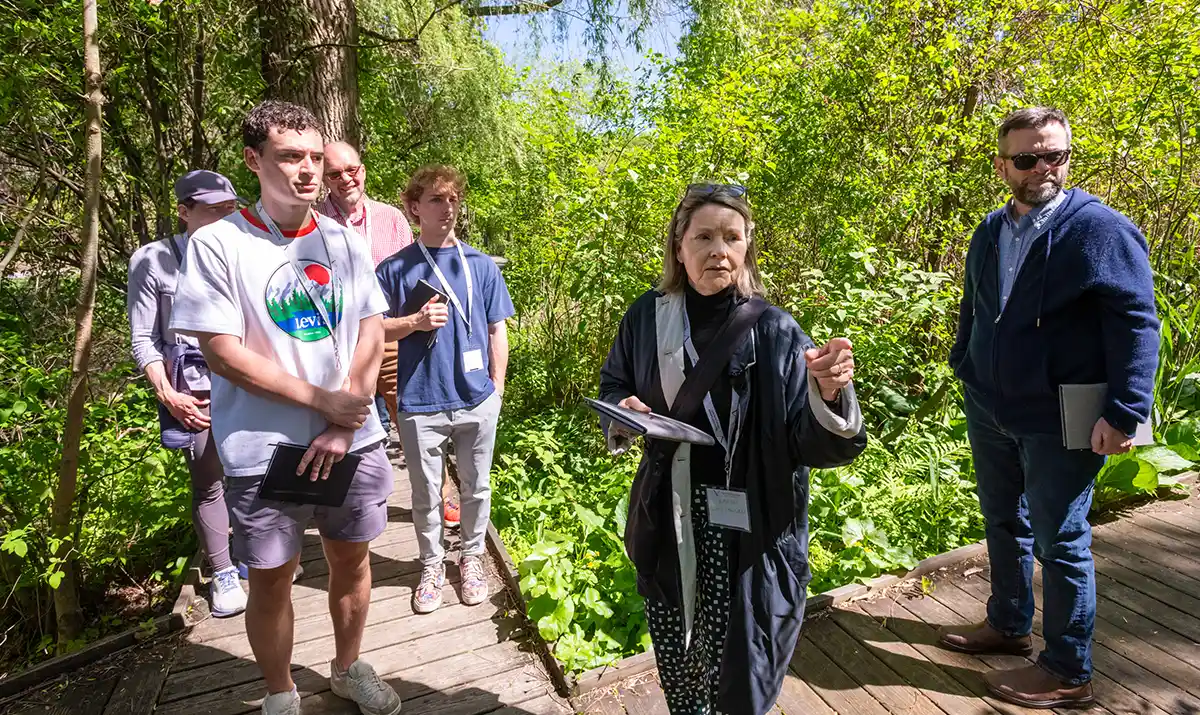
Megan Gall, Associate Professor of Biology and Director of the Neuroscience and Behavior Program, studies sound from an animal’s perspective. She and her students conduct studies of birds in the Preserve at Vassar, where human noise is increasingly affecting birds’ ability to hear signals from each other. This has parallels for humans, she said: “People who live in really loud environments have a harder time concentrating, and they have higher cortisol levels. So, the way we build and shape environments is really important for humans too.”
Karen Van Lengen ’73, William R. Kenan Jr. Professor of Architecture and former Dean of the School of Architecture at the University of Virginia, led a group walk exploring soundscapes on the Vassar campus. Van Lengen has recorded the sonic qualities of iconic buildings and spaces.
The evening concluded with a screening of the Emmy Award-winning documentary Sonic Sea, which reveals how human-generated sounds are affecting ocean environments, and a Q&A with filmmaker Daniel Hinerfeld ’85, Director of Content Partnerships at the Natural Resources Defense Council.
Convened by: Megan D. Gall, Associate Professor of Biology and Director of Neuroscience and Behavior, and Justin Patch, Associate Professor and Chair of Music.
Vassar Institute for the Liberal Arts Signature Programs for the 2025-2026 Academic Year
Storytelling for Change: Shaping and Sharing Inclusive Narratives in Higher Education, Media, and the Arts
November 7–8, 2025
SIMS: Students in Museums Summit
November 14–16, 2025
Women’s Work: Preserving Independent Film and Video Histories, Connecting Media Futures
February 26–28, 2026
Lessons from the Poughkeepsie Journal Photo Morgue: Empowering Communities to Preserve Their Visual Histories
March 6–7, 2026