



VOLUME 122 ISSUE 1
THE ALUMNAE/I QUARTERLY
Contents

These graduates use the intellectual rigor and critical inquiry honed at Vassar to define presidential power, hold Big Tech companies accountable for harm, and defend free speech. Their work converges on a shared principle: that no institution, no administration, and no tech platform stands above the law.
Departments


Education and Its Role in Strengthening Constitutional Democracy
n recent years, liberal arts colleges and universities have seen a distinct shift toward students wanting to major in and pursue careers in STEM; this has been aided by the seismic shifts in knowledge exploding in STEM fields and a marketplace that pays bigger salaries, at least in the beginning, for people with STEM skills. As a liberal arts faculty devoted to multidisciplinary work, Vassar faculty have adapted by enhancing academic advising (e.g., pushing students to take wild-card courses outside their major interests); reducing credit hours needed for a major, enabling students to double-major, often combining STEM with humanities, language, arts, and social-science courses of study; and creating new multidisciplinary paths that integrate STEM and social sciences or humanities (e.g., Science, Technology, and Society; Data Science and Society; Cognitive Science; and Environmental Studies).
With the advent of AI, all bets are off. It seems that some STEM entry-level jobs may be replaced by AI. Instead of privileging coding or data-analysis skills, employers may be looking for the ability to integrate multiple disciplines, to think outside the box, and to anticipate problems and create solutions—all central to the education and curricular innovations for which Vassar is known. In particular, the multidisciplinary approach—crossing boundaries and finding new perspectives on old problems—may be most valued. This is vintage Vassar. Think Grace Hopper, Vera Rubin, Frances “Sissy” Farenthold, Urvashi Vaid, Anthony Bourdain, and many more.
How are we leveraging AI? To the extent that students, faculty, and staff are experimenting with generative AI in their everyday work, the College is actively pursuing ways to help them do so safely and responsibly—without putting Vassar data at risk. Researchers are using AI to record and transcribe qualitative data and to more quickly perform routine coding tasks. Faculty members in Cognitive Science have trained an AI on the same readings that are assigned to introductory students. Students then, as part of an assignment, must interrogate and evaluate the performance of the AI. Faculty across the College are considering new approaches to assessing knowledge and skills gained—from blue-book written exams to oral exams to integrative and creative individual and group projects. In short, the AI revolution is making us think and innovate, and that is good for higher education.
It is not all rosy. AI presents a whole new set of ethical, social, economic, political, and cultural dilemmas and challenges—issues that cannot be avoided and will impact our collective futures. This is the environment in which liberal arts best thrives: one that has opportunity, uncertainty, and the ability to create anew. Vassar students, faculty, and administrators are navigating these advances in education with openness and courage so that we can experiment, revise, and refine our work to meet the moment, as Vassar always does.
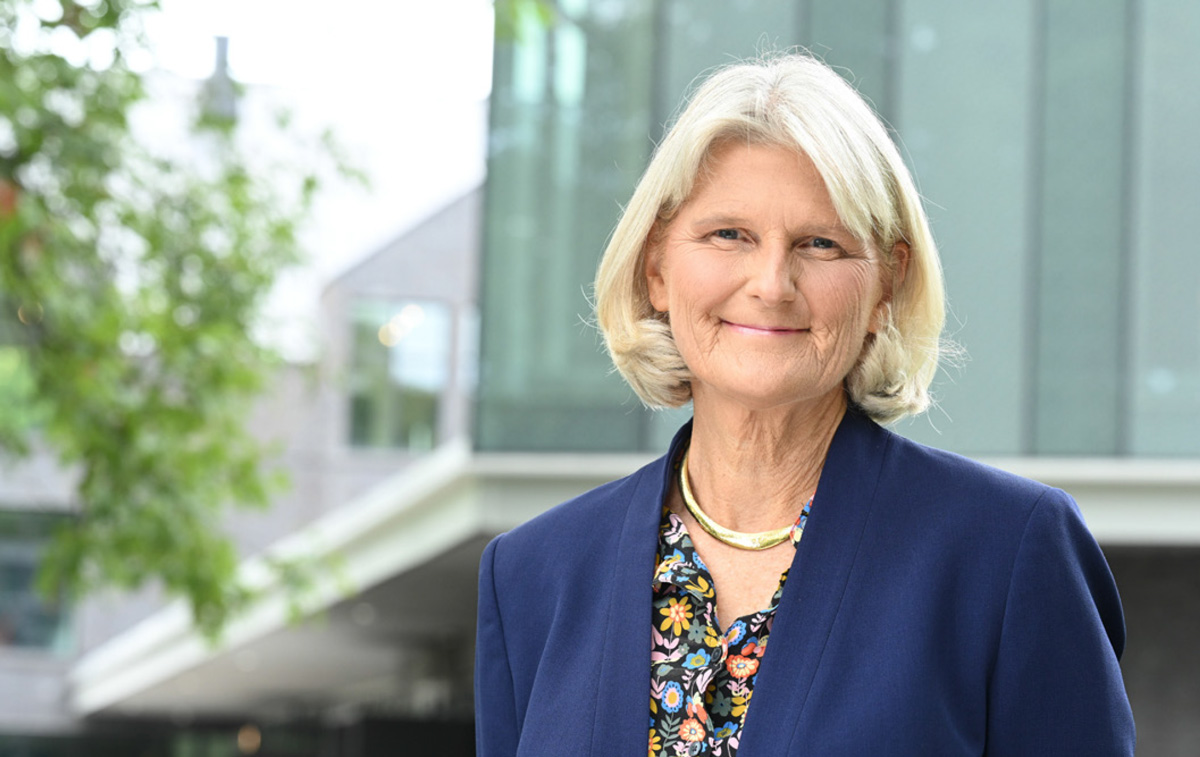

Elizabeth H. Bradley
President
Spring has sprung!
Photo by Grace Adams Ward ’24.
Turns Out, Vassar Is A Media Darling

hat do Marilyn Monroe, Mayim Bialik, and Lisa Simpson have in common? They all speak reverently of Vassar—at least on screen, that is.
For 100 years and counting, the College has served as a setting, a character attribute, and even a laugh-out-loud punchline for numerous movies and television shows—from the silent films of the 1920s to the TV sitcoms of today. And thanks to an amazing gift from David Ezer ’95, many of these segments can now be viewed on the new Vassar on Screen website at vassar-on-screen.vassar.edu.
In the more than 400 clips amassed so far—drawn from over 300 films, television series, radio programs, operas, podcasts, video games, songs, and musical theater shows—viewers can see Vassar turned into the fictional Essex College for the recent HBO Max series The Sex Lives of College Girls; hear it name-dropped repeatedly as the alma mater of “Dharma” on the ABC ’90s sitcom Dharma and Greg; and watch a very capable young astronaut dispatch a pair of villains with a few well-placed punches and judo flips in the 1979 film Moonraker. (An astonished James Bond, played by Roger Moore, asks, “Where did you learn to fight like that, NASA?” The astronaut, played by Lois Chiles, replies, “No, Vassar!”)

Courtesy of HBO
Ezer and his spouse, Vassar classmate Sara Bensman ’95, would look out for College mentions and then add them to their Blogspot page in the early 2000s. “There were times when my obsessiveness was too much, and I would watch many episodes of a particular show to find a reference,” said Ezer. “I did that with Dharma and Greg, because that’s one where there’s a character who went [to the College], and it was a big part of her character, and it was clearly going to be in a bunch of episodes.” Of course, without the type of search capabilities now available for subtitles or quotes, this took considerable time. “You really had no way to do it except watch, and that was fun,” Ezer said. “They talk about tea in the Rose Parlor, things that are actually very specific.”

Courtesy of Fox Networks

Associate Professor and Chair of Film Erica Stein said the department was thrilled to receive the collection and has been working for over a year to build the Vassar on Screen site into the fully functional destination it is now—a resource that she sees as more than just a fun repository of trivia. In fact, there are many ways she envisions using the archive in class.
“We often teach filmmaking classes that focus on editing, and usually you buy a package of footage that the students can use to practice different editing techniques, but it tends to be really kind of anonymous stuff,” Stein said. “This enables us to have our own specific set for demonstrating reels, which is an important technique—to be able to put clips together end to end.”
Taken as a whole, the archive can also be useful in theoretical discussion, Stein said. “I think it concretizes something that a lot of people know intuitively, but that is really hard to pin down, which is the way that media creates and fixes cultural memory and the identity and meaning and persona of institutions, people, and places,” she explained. “You can say that, and I think students often feel it, but it’s something that’s actually hard to prove. This is an example where you can see it over the years, and you can also see meanings shift. You can see the public identity shift.”

Courtesy of the subjects
Theo Rollet ’29 works with Film Department Administrative Assistant Peter Rednour to input metadata on the site and help with quality control. “It’s great to be able to contribute to the preservation of Vassar’s history and explore the many footprints it has left on the film world over the years,” Rollet said. “I love that I get to discover material from different eras, all somehow linked to the place and community I’m in now. It has really opened my eyes to just how far-reaching Vassar College’s influence is and just how much that name means.”
Rollet is not the only one authorized to work on the collection. Just in case Ezer misses his old pastime, there’s a ready fix: “David also has back-end access to the site,” said Stein, “so if he finds new clips, he can add them.” Others who wish to submit new finds should email the Film Department at film@vassar.edu.
Live From New York …It’s the “Vassar Coed”!
The five finalists—including the governor of South Dakota—were brought to New York City to appear on an episode of the show, hosted by Buck Henry, so the audience could decide who would return to host a full show on their own. Though a different contestant was chosen for that honor, Crawford had an absolute blast as a cast member for a day. She appeared in several skits as herself throughout the program, always being referred to as “the Vassar coed” or simply “the coed.” Sharing the stage with some of the most beloved comedians of the day, the unknown 18-year-old held her own with amazing aplomb.
Many years later, Crawford—who now teaches acting and directing at Brown University—recalled the surprising kindness of John Belushi, the effortless cool of Laraine Newman, and, at last, a chance to meet Aykroyd. She also remembered how thrilled everyone at the College was to see her realize her dream. “It brought a lot of excitement to everybody at Vassar,” Crawford said during a 2023 appearance on the SNL Stories podcast. “It was a big deal to the community.” Crawford also noted that she has not herself ever watched her performance, preferring simply to enjoy the memory “as the fun it was.” But you can by visiting the 1970s Film/Television section at vassar-on-screen.vassar.edu..

Faculty Memoir Reveals the Troubling Side of Foster Care … and a Surprising Legacy
obert K. Brigham, Professor of History on the Shirley Esker Boskey Chair, is widely recognized as one of the world’s foremost authorities on the Vietnam War. He has written several books about the conflict, including a blistering indictment of the role of then-National Security Adviser Henry Kissinger in prolonging the war.

Part of the book takes readers on Brigham’s journey to discovering his father’s identity 17 years after his death in 2001. But since both he and Atwell had been part of the nation’s adoption and foster care systems, where many children endured physical and sexual abuse, much of the narrative examines the nexus between poverty and these systems in post-World War II America. Brigham said some of his aunts and uncles were abused while in foster care.

Brigham will be speaking about these issues for several months when he embarks on a book tour starting in April that will take him to bookstores, colleges and universities, and Vassar clubs in 25 states. He expects some of the questions he will be fielding will dredge up difficult memories, but he hopes the book will lead to substantive changes in America’s adoption and foster care systems.
Specifically, Brigham would like to see laws enacted that require birth certificates for adoptees and for medical records of the adoptees’ families to be made accessible so the adoptees can become aware of possible medical issues later in their lives.
“The book tour will be painful at times,” Brigham added. “Making all this public will not be easy, but this is bigger than me.”
Vassar to Offer Pre-College Summer Program for High School Students
“We see this as an opportunity to give high school students a real sense of what a liberal arts education feels like day to day,” said Bill Blake, Vassar’s Director of Campus Programs and Partnerships. “We’re keeping classes small so students can work closely with Vassar faculty and instructors, and they’ll have the chance to live and learn on our campus alongside current students who will be sharing how they’ve shaped their own paths through college.”
Each participant will be enrolled in one course per session taught by Vassar professors, instructors, and visiting scholars alongside Vassar student advisors. Course topics will range from AI to art, entrepreneurship to ecology. Many of the courses will involve guest speakers and visits to the local community, where students will interact with members of nonprofit organizations. Participants will also learn about campus life by staying in supervised campus housing and engaging in social activities throughout the session. To learn more, visit precollege.vassar.edu.
From Classroom to Careers
Lucas Pollet
From Classroom to Careers
hen Alexander North ’28 and Annabelle Tracy ’28 registered for Vassar’s Sophomore Career Connections, a three-day event hosted by the offices of Career Education and Advancement, they wanted to gain advice from alum and parent mentors in various fields to jump-start plans for their post-Vassar lives. When the event concluded on January 18, North and Tracy had gained different but equally valuable insights into their career paths.
“This weekend definitely helped me narrow down my targets for my career,” said North, an economics major from Alexandria, VA. “I had some thoughts about becoming an environmental lawyer, but this experience made me realize how much passion I have for this field. I’ve collected some business cards and will definitely reach out to some alums now that this event is over.”
For Tracy, a psychology and religion double major from Warwick, RI, the workshops, panel discussions, and networking opportunities afforded by Sophomore Career Connections “helped me see I have a lot more options than I thought I did.”
North and Tracy were among more than 250 sophomores who took part in the weekend’s activities, envisioning their future by taking part in interactive activities, and attending a series of 75-minute conversations and other networking opportunities with 105 mentors in 18 industries ranging from law and data science to sustainability and social justice.
The weekend kicked off on the evening of January 16 with an outside-the-box “keynote address” that was not an address at all but rather an interactive game show aimed at highlighting how the Vassar career network benefits its students. Conceived by alums Damon Ross ’94 and Eddie Gamarra ’94, the event pitted two teams—each composed of one mentor and two students—who tried to guess, Family Feud–style, the most common answers to questions about mentors’ careers and how Vassar had helped them achieve success. Some “top answers” on the board reflected these truisms: Mentors said their academic majors didn’t matter as much as they thought they would, and that connecting with others in the Vassar network was a key component in advancing their own careers.
Saturday morning’s program began with an exercise designed to break the ice between students and mentors as they explored their values, shared experiences at Vassar, and what they hoped to accomplish for the rest of the weekend. The “Stitch and Share” exercise was developed by the staff of the Center for Career Education based on training they received at the Stanford Life Design Lab at Stanford University.

Karl Rabe

Karl Rabe
As the event came to a close on the afternoon of January 18, students and mentors reflected on the experience. “I came into the weekend thinking it would be scary,” said Samantha Gorey ’28, “but I enjoyed everything about it, and I have a better idea about where I want to go from here.”
Chemistry major Hannah Pollard said she was curious how she could apply what she is learning at Vassar, “and this weekend introduced me to lots of options that can open many different paths.”
Many mentors said they had enjoyed the weekend and had learned as much as the students. Kevin Lee ’12, Environmental Health and Sustainability Manager at Dr. Bronner’s, a fair-trade body care and food company, served as a mentor for the third time. “Sophomore Career Connections is an amazing program, and it’s something I wish I had had when I was a student,” said Lee.
Vassar Trustee Brian Farkas ’10, an attorney at ArentFox Schiff LLP, said he has reached out to “literally hundreds” of Vassar students and alums since he graduated, some of whom were seeking advice from him and others who helped him in his own career. He thinks of the Vassar network as a big family.
“One question I often hear from students and young alums is ‘has Vassar prepared me for my career?’” Farkas said. “I always tell them the critical-thinking skills and the emotional intelligence Vassar teaches you has prepared you for whatever field you choose.”


Karl Rabe
Sophomore Career Connections was planned and overseen by Stacy Bingham, Associate Dean of the College for Career Education, and Jannette Swanson, Director of External Engagement in the Center for Career Education.
Reflecting on the weekend’s deeper impact, Swanson noted that SCC often feels like a true homecoming for mentors. “Mentors come to campus wanting to give back and support our students, but they often leave feeling deeply hopeful and inspired by them,” Swanson said. “For many alums, Vassar is home, and this weekend is a powerful reminder of the strength of that community. It’s a reciprocal experience.”
Bingham told the students to think of the experience as the start of a lifelong connection with the Vassar alum network. “I hope this is just the beginning of your relationship with both the Vassar network and the amazing staff in the Center for Career Education,” she said. “You have a huge network of champions and supporters in this room and beyond. Seek us out in the days, weeks, and years to come.”
Sophomore Career Connections is made possible by a generous gift from Carol Ostrow and Michael Graff. View a gallery of images from SCC 2026.
Rooted in Community
Karl Rabe
Rooted in Community
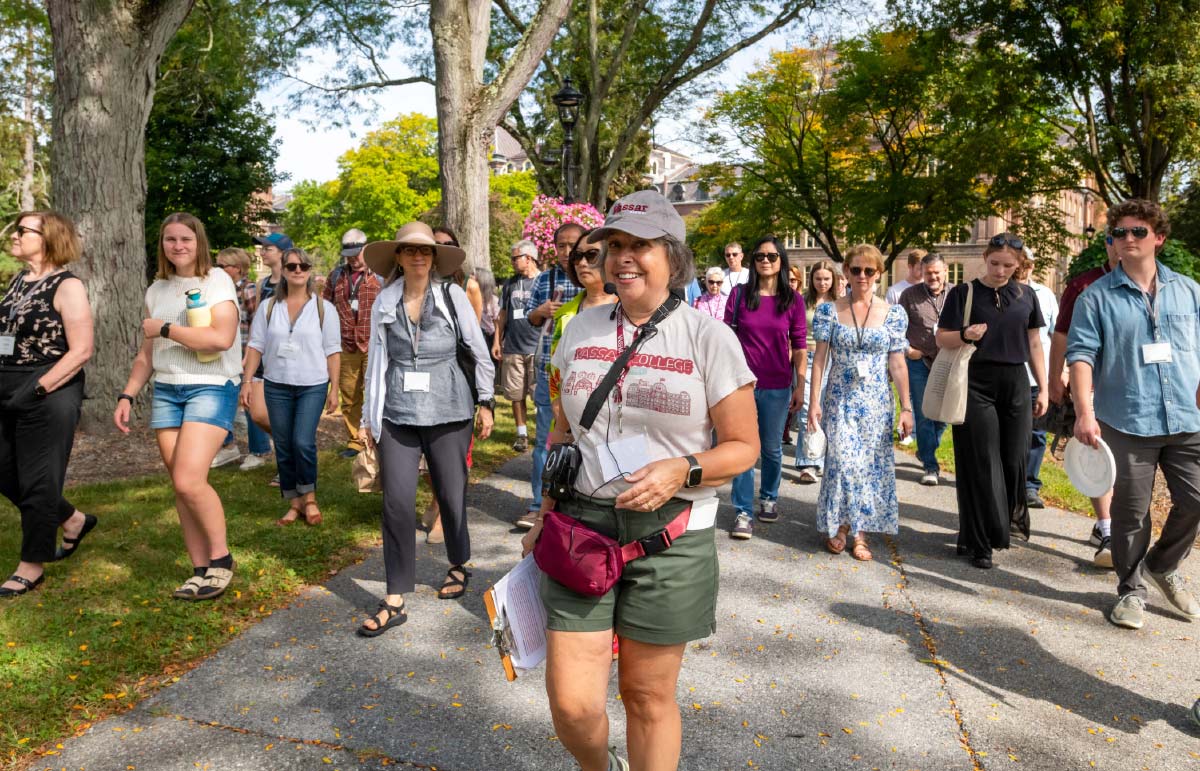
The tour group pauses at familiar landmarks—the ginkgo behind Main, the London planetree in front of Thompson Library, and the class trees planted across Vassar by students decades apart. What began as a way for the couple to share the campus’s botanical history has become something more personal: a return to the living landmarks that shaped so many alum and student experiences.
“The number of people who come on these tours during those weekends is humbling,” Graceffa said. “Both tours are a celebration of community.”
For many in the Vassar community, the trees they passed on their way to class, on late-night walks, and through changing seasons are still standing when they return for Reunion years later. For Graceffa and Schlessman, the trees represent not only continuity but responsibility.

Karl Rabe
In 2018, Schlessman started leading Arboretum tours for alums during Reunion weekend and later, due to the tours’ success, added Families Weekend. He has continued leading both tours even though he retired in 2022.
For Graceffa, who graduated with a biology degree in 1987, the campus’s trees first impressed her when she visited campus as a prospective student. Growing up in New Hampshire, surrounded by the beauty of the natural world, she found inspiration during a return visit to campus, with a special affinity for the ginkgo tree behind Main Building. She went on to receive degrees in education and science from Brown University and taught at Poughkeepsie Day School. She eventually became the head of its middle school, and then Head of School at Robert C. Parker School near Albany.
For Graceffa’s 35th Reunion, the pair decided to lead the Reunion tour together, teaming up with the AAVC to mark the Reunion class trees with garden flags and arrange the tours to stop at each one. “The class tree flags grab people’s attention, and even alums who aren’t aware that they have a class tree become eager to find theirs and learn more about it,” Graceffa said.
The alum-emeritus pairing has also worked for Families Weekend. “We manage to work in a fair amount of interesting botany, and alums and parents alike love hearing about the class tree tradition origin, the iconic ‘Vassar Sycamore,’ and other tree lore,” Schlessman said.
The trees on Vassar’s campus are a part of the College’s story, rooted in its earliest days, when Matthew Vassar supervised plantings, and strengthened in 1925 when landscape architect Beatrix Ferrand secured its recognition as an arboretum. Today, Vassar’s Arboretum is home to more than 2,600 trees representing over 170 species.
Karl Rabe
Today, class trees are planted during sophomore year, giving students time to watch them grow alongside them as a living marker of their class long before they cross the Commencement stage.
After years of shaping the stewardship of Vassar’s landscape, the couple recently created a new endowment to support the Arboretum and the class tree tradition. They timed their gift to coincide with the collection’s 100th anniversary, which was marked by a campuswide celebration on Arbor Day 2025 and events throughout the year.
“We wanted to do what we could to make sure the tradition lasts,” said Schlessman.
For Graceffa, the landscape itself has always been a teacher. “As an educator, we call your landscape and surroundings the ‘third teacher,’” she said. “We acknowledge that space and say, ‘Where you’re learning, it’s having an influence on you.’”
Their gift ensures that the Arboretum and the traditions rooted within will continue to enhance the lives of generations of Vassar students long after individual classes or faculty members have moved on. In recognition of their many contributions, the Office of Sustainability will plant a tree in honor of Graceffa and Schlessman this spring, adding another chapter to the living story they have spent decades helping to preserve.
Learn more about the Vassar College Arboretum at vassar.edu/arboretum. To make a gift to the Laura Graceffa and Mark Schlessman Class Tree and Arboretum Engagement Fund, email Karolina Gomez, Associate Director of Annual Giving and Digital Engagement Officer, at kgomez@vassar.edu.

A “Very Vassar” Opera Highlights One of the College’s Earliest, Most Renowned Professors—Maria Mitchell
As a pioneering scientist of the 19th century, Mitchell is known far beyond the gates of Vassar. She became a national celebrity in 1847 when, at age 29, she discovered a comet from the rooftop of her house in Nantucket. Soon after, she was hired by the U.S. government to calculate the orbit of Venus to aid celestial navigation, thereby becoming the only professional woman astronomer in the country.
Arriving at Vassar in 1865, Mitchell was as dedicated to her students as she was to her profession. She kept them up past their curfew watching the night sky and brought them across the country to observe solar eclipses in Iowa in 1869 and in Colorado in 1878. Unfortunately, Mitchell endured a backlash against women in science led by a Harvard Medical School professor, Edward Clarke, who claimed that “brain work” wrecked female fertility and therefore young women should not pursue science. Clarke is the villain of Computing Venus. The cast featured 15 current students and three accomplished alums in lead roles: sopranos Eden Bartholomew ’23 and Beatrix Postley ’24, and baritone Michael Hofmann ’13.
Professor of Music and Director of Choral Activities on the George Sherman Dickinson Chair Christine Howlett, who conducted the performances, said these interactions with working professionals gave student musicians a fascinating inside look at how a creative project like this comes together—as well as how to earn a living in music. “I think the students really got a lot out of having them here,” she said. “It’s one thing to have your professor in front of you telling you how it’s done; it’s another to have someone come in who does this as a job every day.”
Computing Venus was codirected by Senior Lecturer in Music Drew Minter and Professor and Chair of Drama Christopher Grabowski.
Generous support for Computing Venus, performed January 23–25, 2026, at the Martel Theater, came from Vassar Trustee Kathy Zillweger Putnam ’75 and her spouse, George Putnam III, as well as the Dickinson-Kayden Fund, the Joan Kostick Andrews Fund for Musical Theater and Visiting Artists, and the Departments of Music and Drama, which collaborated on the production.
“It’s about one woman who really swam upstream and achieved great things, and inspired so many women and continues to inspire so many women,” said Putnam, who first brought Computing Venus to the attention of Music Department faculty. “In these challenging times, the message that I got from the performances was that of resilience and hope, and that there is still beauty in the world. It really was top-notch, and I couldn’t be prouder of everyone who participated.”
“I think this opera tells a story of perseverance and progress in the face of deeply unsettling bigotry and doubt,” echoed Bartholomew. “Sadly, a lot of this resonates with today. Computing Venus tells us to persist, resist, and keep looking for hope.”
Watch Vassar’s January 24 production of Computing Venus in its entirety at modfest2026.vassar.edu/computing-venus.


Karl Rabe

Kaleidoscope Photo Contest Features Images from Around the World
Landscapes
Where Time Holds Its Breath
Lora Janczewski ’28
An Axis Deer Grazing. Rudawka Rymanowska, Poland
Cebe Lomis ’13
Under the Full Moon 02
Akshaya Raghavan ’26
Mount Fuji in an Accidental Frame
People and Culture (Top 4)
Lone Traveler
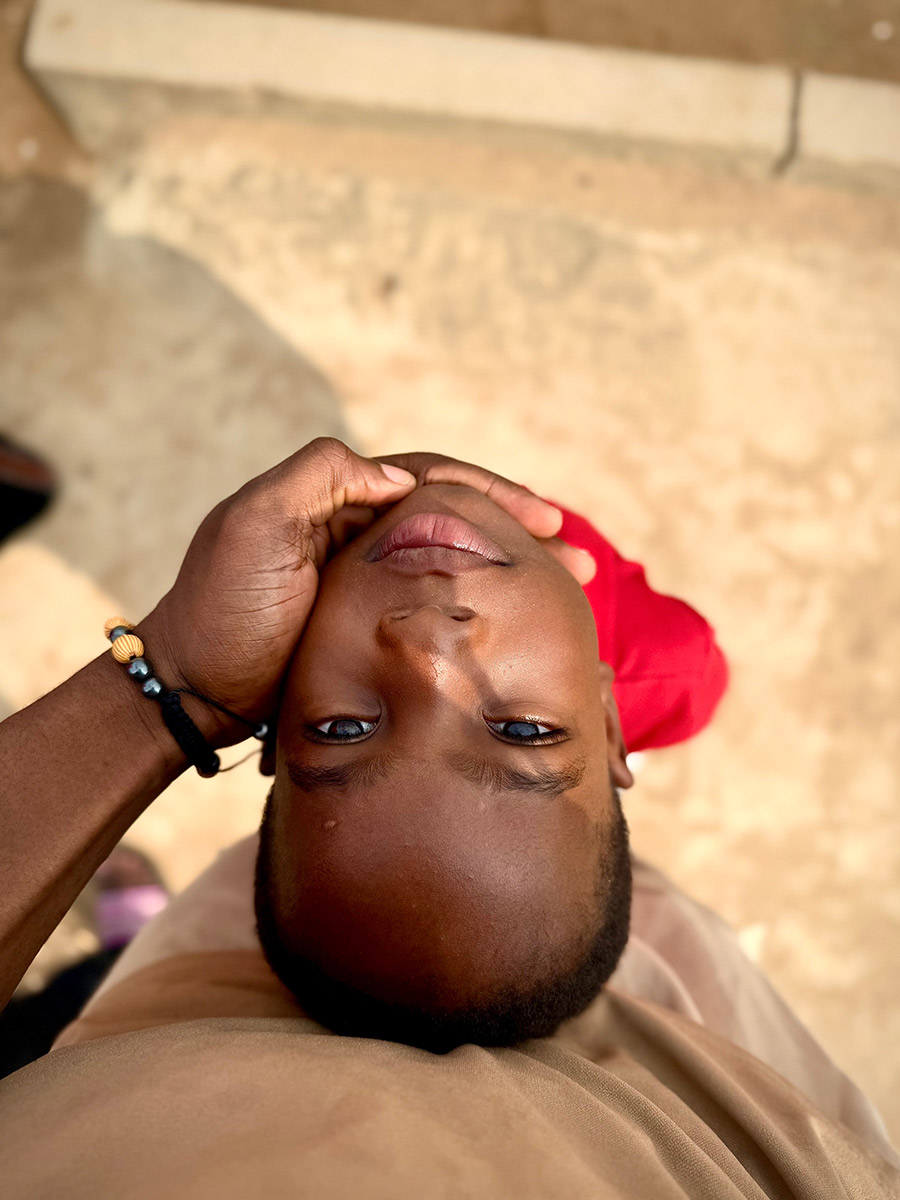
Ahmed Abdul Mumeen ’26
The World Upside Down
Paula Jill Krasny ’85
(Dis)Connection
Yonghan Chen ’29
Greetings
People’s Choice
Sunset at Malta
Younghan Chen ’29
Cavalcade
Younghan Chen ’29
Shimmering


Alum Donates World-Class Collection of Harriet Beecher Stowe Materials to Vassar
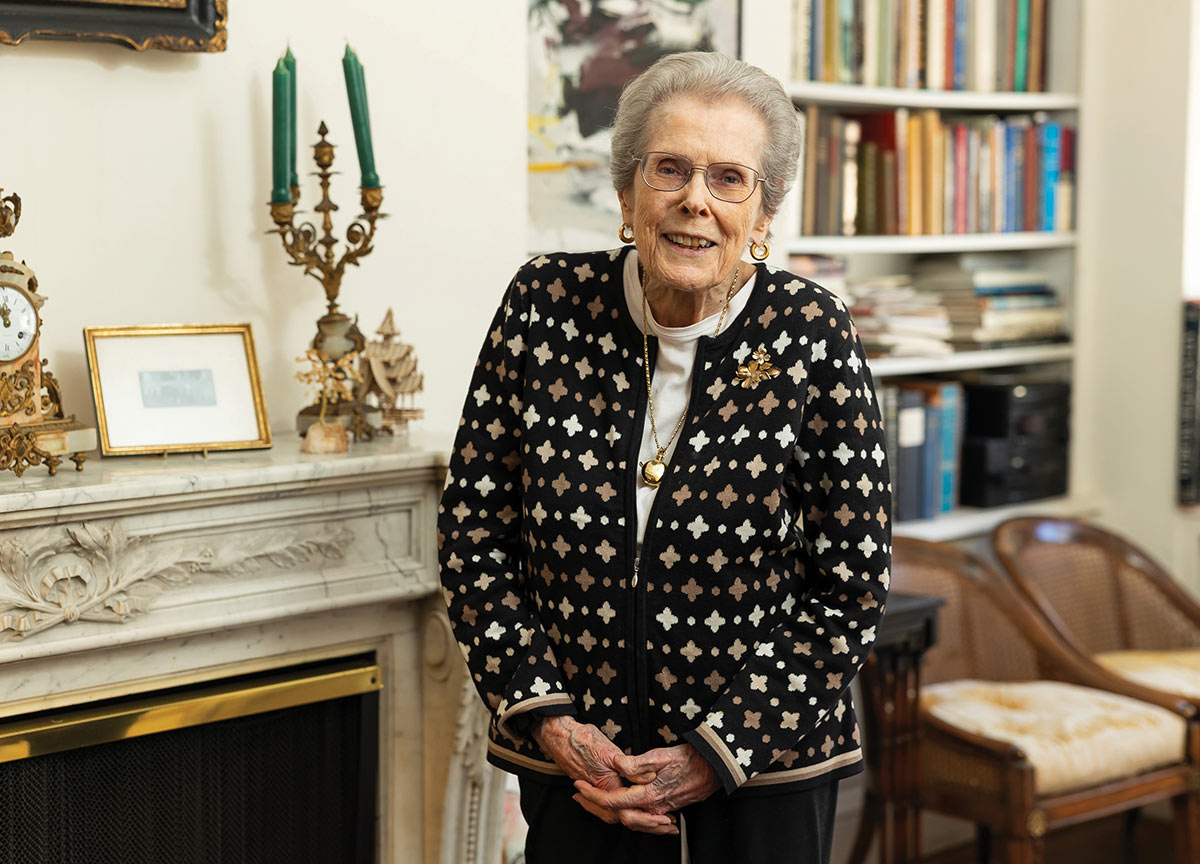
Comprising more than 500 items, the Schlosser collection features all 40 issues of the abolitionist weekly The National Era in which Uncle Tom’s Cabin was first serialized in 1851, plus the 1852 first edition of the printed book and Stowe’s handwritten manuscripts. Advertisements, ceramic plates, and other memorabilia round out the collection.
Schlosser, a descendant of one of Stowe’s 10 siblings (one of whom was a Vassar trustee), said she chose her alma mater to receive the collection because of her enduring fondness for the College, where she had an “absolutely splendid” experience as an art history major, and because of Vassar’s unique approach to allowing undergraduates access to its Archives and Special Collections.

Courtesy, Archives & Special Collections, Vassar College Libraries
“This is one of the greatest acquisitions for the Archives and Special Collections Library during my 25-year career here,” noted Vassar’s Head of Special Collections and College Historian Ronald Patkus. “We are extremely grateful for this wonderful gift. As the largest and most important collection of this kind in private hands, it will add considerably to Vassar’s holdings and provide an outstanding resource for teaching and research.”
Harriet Beecher Stowe intended Uncle Tom’s Cabin as a rallying cry against slavery in the wake of the Fugitive Slave Act of 1850. The book became a cultural phenomenon the likes of which had never been seen before, with printing presses running 24 hours a day to meet the demand. Later, some stage adaptations, particularly in the South, complicated the book’s legacy by changing the story in order to thwart Stowe’s abolitionist message.
“To think about 19th-century American culture, you have to be able to contend with Uncle Tom’s Cabin in all of its messiness,” said Vassar Assistant Professor of English Blevin Shelnutt, who teaches Stowe’s novel at Vassar as an example of the sentimental literary tradition shaped by 19th-century women authors. “I feel really lucky to have this kind of proximity to a collection of this magnitude and importance for 19th-century American culture,” she said.

Obama Foundation’s My Brother’s Keeper Ambassador Herbert Toler III ’26 Focuses on Literacy
Research has shown that support from community members and leaders, as well as public and private agencies, can lead to sustainable improvements in young men’s lives. MBK Ambassadors lead community projects and serve as role models in their communities. The MBK Alliance’s work is rooted in key life milestones that research shows are especially predictive of later success, and where interventions can have the greatest impact. Toler is focused on one particular milestone: reading at grade level by third grade. He aims to close the literacy gap in Newark, New Jersey, by urging kids to read using innovative community programming.
“I have been involved with the MBK Alliance for about a year now, and it has been a powerful experience,” said Toler. “I chose to concentrate so closely on literacy/reading because establishing it as a habit has massive positive implications for the other five milestones of development intended to close opportunity gaps for boys and young men of color.” He aims to “meet young men of color where they are and normalize a culture of ‘reading to learn’ outside of traditional school settings.
“Through this ambassadorship, I aim to empower boys and young men of color to become peacebuilders within their own communities while also expanding my understanding of leadership and social entrepreneurship by applying both the hard and soft skills I have developed throughout my four years at Vassar,” Toler said.
Behind the Curtain
Last semester, Office of Sustainability student interns and students in Professor Mary Ann Cunningham’s Introduction to Environmental Science course set out to determine how much energy was being used in the Bridge building where they were taking class. They used ICO Vision, software developed by ICO Energy and Engineering, to research and interpret energy data.

Freepik
Professor Michael Roth, Research Associate and Adjunct Assistant Professor of Environmental Studies, designed the three-hour lab for Cunningham’s course and measured the wattage of batteries and solar PV panels with students. “The electricity data from ICO Vision enabled students to work with real hourly data from the building they were physically sitting in, directly connecting the lab to real-world sustainability applications on campus,” he said.
The data will allow the Office of Sustainability and Facilities Operations to identify areas of the campus that consume excessive power.
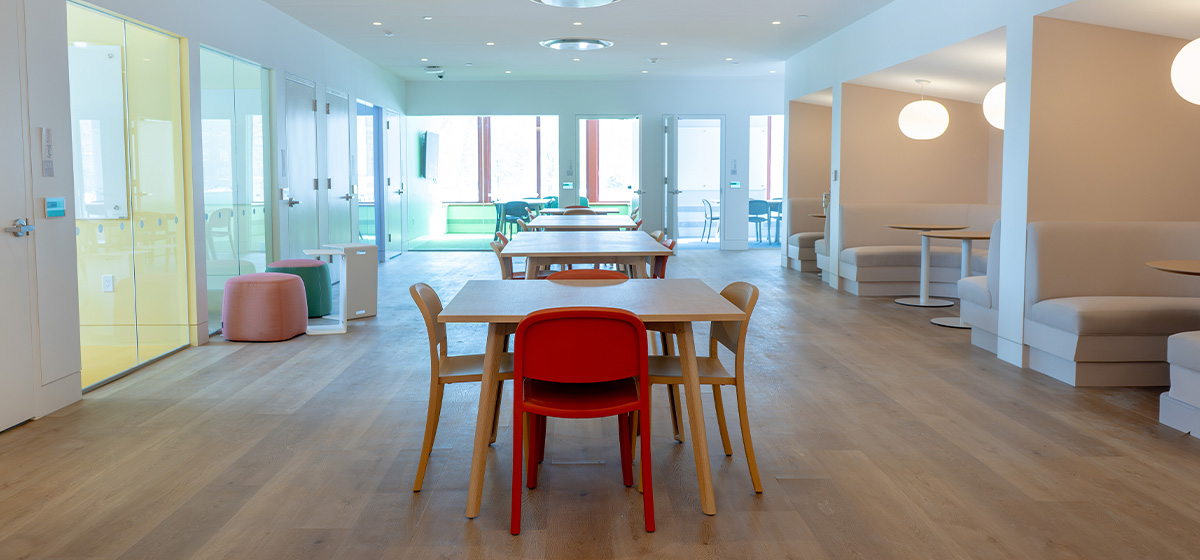

Vassar’s New Library Study Commons—a Boon to Student Learning
- A 24-hour study space with enclosed rooms for study groups
- A fully accessible entrance on the north side of the building
- New space for Vassar’s Writing Center, Quantitative Reasoning Center, and Inclusive Pedagogy programs
- Improved facilities for Library staff
President Elizabeth Bradley thanked Marianne Begemann, Dean of Strategic Planning and Academic Resources and Associate Professor of Chemistry; Sarah Hayes, Project Manager; and Maryann Pilon, Director of Project Management and Construction, for spearheading the project. Bradley said she had visited the newly renovated space the morning before the February 9 ribbon-cutting ceremony, “and there were students here at 9:00 a.m. on a Sunday morning! I’m so happy we have this beautiful space, which, most importantly, is accessible to all.”
“The space satisfies so many long-held needs,” said Andy Ashton, Director of the Vassar Libraries. “We’re deeply grateful to those who helped to plan and fund the new space. Not to mention my library colleagues who patiently rearranged their work-lives to accommodate the construction.”


Found in Translation

Buck Lewis

Courtesy of Prof. Ben Lotto
Math on the Hill
During the annual event, they presented their work and learned about advances in their fields. The day after the meetings concluded, nearly 300 mathematical sciences professionals and students from 46 states participated in a direct-action advocacy campaign, #MathSciOnTheHill, calling for continued funding and support for the mathematical sciences. Participants met with senators and the staff of congressional representatives to emphasize the critical importance of sustaining robust federal support for mathematical sciences research.
“Research in the mathematical sciences is the bedrock underlying nearly all innovations in science, technology, and engineering,” noted Professor of Mathematics Ben Lotto, who participated in #MathSciOnTheHill alongside Vassar Professor Emeritus of Mathematics and Statistics Charles Steinhorn. “Recent developments in artificial intelligence, quantum computing, cybersecurity, and advanced manufacturing all rely in a fundamental way on mathematics, statistics, and data science. Investments in research made by federal agencies such as the National Science Foundation, the National Institutes of Health, and the Departments of Energy, Defense, Education, and Health and Human Services have historically paid off through breakthroughs in these and many other fields.”
Lotto and other participants cautioned representatives about the potentially devastating consequences of proposed budget cuts to these federal agencies.


Stockton Photo, Inc.
Stockton Photo, Inc.
Vassar Celebrates Historic Semester of Athletic Achievement
assar’s 2025 fall sports season was one of the best in the College’s history, as four teams won league titles, two others qualified for their conference championship games, and seven student-athletes earned All-American status.
Michelle Walsh, Director of Athletics and Physical Education, said, “I am incredibly proud of our fall teams and look forward to many more successes in winter and spring. We are experiencing an unprecedented time of success among our teams that is significantly raising the bar on how we define ‘on the field’ success at Vassar while remaining committed to our core values of student-athlete learning and a high-quality experience.”
Here’s a brief look at how these fall-season success stories unfolded:
The women’s cross country team finished the regular season, earning the Liberty League Championship on November 1 on the campus of St. Lawrence University in Canton, NY. It was the team’s third straight Liberty League championship. Haley Schoenegge ’27 finished second overall in a 101-runner field in the 6k race to earn All Liberty League First Team honors. Anika Mueller-Hickler ’26 and Adelaide Nyhan ’27 finished fourth and fifth, respectively, also gaining spots on the All Liberty League First Team. The team followed up that performance with a school-best 10th-place finish in the NCAA Division III Championships on November 22 in Spartanburg, SC. Schoenegge finished 15th overall in the 291-runner field to earn All-American honors for the second straight year. Mueller-Hickler finished 95th, a career-best in the national championship race.
In the NCAA Division III Men’s Cross Country Championship, also held November 22 in Spartanburg, SC, Sean Miller ’27 posted a 56th-place finish, the best for a Vassar runner in the event since the 2006 season.
The women’s rugby team continued its long tradition of excellence, defeating Fairfield University, 88-5, in the Tri-State Conference championship game and advancing to the Final Four of the National Collegiate Rugby tournament. The Brewers were edged by the United States Coast Guard Academy, 29-24, in the semifinals but rebounded to take third place, defeating the University of Binghamton, 73-0. Jude Robinson ’26 and Sophia Bailey ’26 were named All-Americans.
The men’s rugby team reached the Tri-State Conference finals with a 50-28 win over Maritime College on November 2, but fell to the U.S. Merchant Marine Academy, 31-24, in the championship game on November 9.
The women’s soccer team won its first league championship in school history, defeating Rochester Institute of Technology 1-0 in the finals of the league playoffs. Ava Holman ’29 scored the only goal of the game late in the first half, and goalkeeper Laura Shea ’28 posted her seventh shutout of the season. Vassar finished the season ranked 20th among all NCAA Division III teams. Forward Gianna Panarelli ’27 earned Third Team All-American status.

Stockton Photo, Inc.
The men’s soccer team advanced to the finals of the league championship tournament before losing a hard-fought contest to Hobart College, the 16th-ranked team in the country, by a score of 2-1 on November 9. Midfielder Jared Fiske ’26 earned Third Team All-American honors.
The women’s volleyball team lost to Skidmore College in the first round of the league championship tournament on November 11, but outside hitter Maura McAusland ’27 was rewarded for an outstanding season by earning Third Team All-American status.

Donor Support Helps Student-Athletes Thrive
“It was an amazing day of support for Vassar student-athletes,” said Michelle Walsh, Director of Athletics and Physical Education. “Donor generosity plays an integral role in student-athletes striving for and achieving excellence in competition, in the classroom, and in their campus and local communities.”
Eighty percent of each gift to a team goes directly to that team, and the remaining 20 percent is allocated to the Department of Athletics and Physical Education for programs and equipment that benefit all student-athletes. Funds allocated to the teams enable them to acquire necessary equipment and take training and team-building trips to compete in other parts of the country—and, in some cases, other parts of the world.
“When we held our first Day of Giving nearly 10 years ago, we never envisioned this degree of interest and engagement that we have received from our alums, families, and friends,” said Walsh. “We remain deeply grateful for the tremendous support.”


For Those Interested in Sports-Oriented Careers—There’s a Club for That
Raphan and Fitzgerald plan to pursue careers in sports in some capacity when they graduate, and they’ve launched a student organization, the Vassar College Sports Business Association (VCSBA), to help others at the College with similar goals do the same. “We’ve been friends since we first arrived on campus, and shared our interest in sports-related careers,” said Raphan, “so we decided to find a way to create those conversations on campus.”
To engage others with similar interests, the VCSBA publishes a biweekly newsletter. A recent issue contained a story on a fledgling women’s basketball league that offers players a financial stake in their teams, and another on NBA star Steph Curry’s decision to dissolve his partnership with the Under Armour sports apparel company.
VCSBA also hosted a forum last fall on career opportunities in sports management. Panelists were Vassar alum Teddy Borgos ’24, a former Vassar soccer player now employed by an investment firm, Cedar Lane Capital; Rachel Walsh, Senior Vice President of Communications at Excel Sports Management, and Sean Gregory, a senior sports correspondent at Time magazine.
“About 30 students showed up for the event, and the panelists talked to them about ways of getting into the business,” Fitzgerald said.
VCSBA’s future plans include working with Vassar’s Career Education office to plan workshops on résumé writing and other topics for students who wish to pursue careers in the sports industry. Fitzgerald said he and Raphan are also working to recruit more student-athletes to join VCSBA. “We want to ensure this effort continues after we graduate next year,” he said. “Other colleges have such organizations, and we think it can really help students here shape their career plans.”
Upholding the Rule of Law


Goldberg is holding tech platforms liable for harms caused by their designs, insisting that accountability must be brought into the digital age. Kim focuses on cases before the Supreme Court that probe the limits of presidential authority. Nagae is part of a group filing amicus briefs for Supreme Court cases that will decide the constitutionality of actions by the current administration. And Tremonte’s firm has secured major First Amendment victories, affirming that free expression and due process are not partisan ideals, but democratic necessities.
These graduates use the intellectual rigor and critical inquiry honed at Vassar to defend the rule of law and legal accountability, patiently, strategically—and sometimes against formidable odds.
The discussion of legal cases reflects their status at press time.



Groundbreaking Research Led by Alexa Mousley ’20 Identifies Five Stages of Brain Neuroconnectivity
hen Alexa Mousley graduated from Vassar in 2020 and headed to Cambridge University to pursue her PhD, she was following the passion that first led her to major in neuroscience. As a Vassar student, Mousley was fascinated by brain connectivity and development, and she brought this fascination to her PhD studies, serving as lead author on a groundbreaking paper. Her discoveries could change the way scientists understand how physical connections in the brain form and develop at different stages of life.
Published in November in Nature Communications, the paper “Topological turning points across the human lifespan” reveals five distinct stages of brain development from birth to late adulthood. To pinpoint these stages, Mousley gathered 4,000 MRI scans of individuals from infancy to age 90 from open data sets. By using machine learning to analyze the scans, they found patterns in the data that pointed to marked shifts in brain wiring around ages 9, 32, 66, and 83.

Throughout the childhood phase from birth to age nine, connections in the brain consolidate. The most active neuronal pathways grow stronger, while unused or weak connections are pruned. The next phase, adolescence, lasts until age 32, during which the brain’s communication networks are refined so information can move more quickly from one area to another. Mousley says this is the “only phase where the brain is becoming more efficient over time.”
After adolescence, connections begin to stabilize and efficiency decreases. Cognition and behavior are more consistent in the adult phase from age 32 to 66, but the brain’s networks begin to reorganize gradually during early aging, from about age 66 to age 83. By the time a person reaches late aging, the pathways in their brain have consolidated into specific regions that are more connected to themselves than to each other.
“So, there’s kind of this grouping thing where connectivity across the whole brain is weakening and there [are] these strong groups forming,” Mousley explains. “There [are] these hubs that are needed for lots of different paths.” Just as more airplanes pass through large central airports than smaller rural locations, the brain uses more of these hubs and fewer whole-brain connections to process information in late aging.

Image courtesy of Alexa Mousley
“Obviously I’m looking at over 4,000 brain scans, and so the time it took me to gather that together, to organize it, to set it all up—it was a long process.” That freedom to explore allowed Mousley to look at brain development in fresh ways that helped her pinpoint changes in connectivity.
The novel discoveries are earning Mousley and her team’s paper widespread recognition. The research has been featured in outlets like the BBC, the New York Times, National Geographic, Scientific American, and the Washington Post. The outpouring of interest surprised Mousley because researching the paper felt normal to her. Even her supervisor, Duncan Astle, Program Leader at Cambridge’s MRC Cognition and Brain Sciences Unit, didn’t realize the research would get so much attention.
“He said something like, ‘Let’s just make a press release and see what happens,’” Mousley recalls.
While she’s happy that people are excited about her work, Mousley is quick to emphasize that the age ranges are averages based on broad, general patterns, not definitive numbers that apply to every person. She and her team also didn’t evaluate other factors like behavior or cognition; they only looked at the brain.
Still, Mousley hopes that understanding these changes in connectivity across the human lifespan could help predict problems with cognition and brain health, particularly the risk of developing mental health disorders in adolescence or dementia in early aging. She says the potential for future work in these areas is what excites her most about the project.
Mousley’s passion for neuroscience was clear during her time at Vassar. Over the course of two years working in Professor Hadley Bergstrom’s memory neuroscience lab, she played an instrumental role in several projects and co-authored three papers, which Bergstrom says is rare at other undergraduate institutions.
He recalled that “Alexa was just an outstanding, exceptional student. It’s amazing to be able to interact with all these talented students and to potentially have some kind of role or impact, however small it may be. It’s so rewarding for me.”
Mousley says her work with Bergstrom was fundamental to her understanding of science. “I owe Vassar so much. Really, the foundation of all my neuroscience experience, and also excitement, came from those experiences at Vassar.”
A Marketing
Marvel
Looks Back
he first thing you should know about Michael Fanuele ’94 is: Don’t get into an argument with him. He was captain of Vassar’s Debate Team and came in second place in the World Universities Debating Championship as a student.
The second thing you should know about Michael Fanuele is that he firmly believes that winning an argument is a virtually useless skill. In fact, he says his success in the advertising business is predicated on developing campaigns that tickle one’s emotions, not their intellect. “I’ve sometimes suffered from intellectual arrogance,” he said during a recent visit to Vassar’s campus, where he mentored students seeking advice on their career paths. “I’ve learned it’s not as important to be right as it is to generate love and passion in your audience, emotions that actually move people.”
Fanuele, currently Chief Brand Officer for Shake Shack, certainly applied this formula to what may have been the first meme in popular culture, an ad campaign launched 20 years ago for Dos Equis beer featuring “The Most Interesting Man in the World,” who didn’t always drink beer, but when he did, he preferred Dos Equis. The ads never tried to tell consumers what was so good about the beer. Rather, the campaign used humor and wordplay to keep the consumer interested. To wit:
He once cheated death, and death didn’t mind.
He has won the lifetime achievement award … twice.
Sharks have a week dedicated to him.
Once, a rattlesnake bit him. After five days of excruciating pain, the snake finally died.
Fanuele is also famous in the field for his work with Arby’s. “We Have the Meats.” is another campaign that does not attempt to explain why Arby’s has great food, but rather instills a gut emotion in potential consumers of Arby’s products with a strong but simple declarative sentence that is easy to digest. As with Dos Equis, Arby’s is recognized as one of the great marketing success stories of the century.
While Fanuele has become a bit of a legend in the advertising world, his initial path at Vassar had nothing to do with marketing. He thought he’d major in political science or philosophy, but after a couple of classes with Professors Susan Zlotnick and Anthony Wohl, he quickly switched to Victorian studies. “I almost didn’t care what they were teaching, but I knew I wanted to study with these professors who were so passionate, smart, and kind.” It was an early lesson in the infectious power of passion, but as Fanuele explained, “A cross-disciplinary approach to the world has been a massive benefit to my career. You can’t understand Dickens without understanding the Industrial Revolution, just like you can’t understand TikTok or K-Pop without understanding the shifting power dynamics of our world. It’s all connected—so thank you, Victorian studies!”

Fanuele’s first success was an ad campaign for a fledgling Belgian brewery called Blue Moon. Since then, he has become an author. His book Stop Making Sense: The Art of Inspiring Anybody (Post Hill Press), in which he put forth his ideas on marketing, leadership, and life in general, is an Amazon bestseller in its third printing. His writing on inspiration and leadership has been featured in the Harvard Business Review and Ad Age. And he boasts that his TEDx talk on inspiration “has been watched by people who are not even related to me.”
Most personally, Fanuele shared an essay about discovering his birth parents and learning the secrets of his adopted family this past December. Published by The Free Press, it was the most-read article on Substack for a weekend. He’s currently working on a book-length version of the twisty tale.
He spends some of his time mentoring Vassar students and young alums. “One of my first hires, Graham Phillips ’98, has gone on to a storied career as a marketing leader,” he notes.
Fanuele says he always enjoys talking to young people about the world of advertising. “I’m always open to chats with my Vassar peeps,” he said.
“Today’s students are much more media savvy than I was when I started in the business, and there are so many platforms available to them.” He acknowledges that the emergence of artificial intelligence has some “scary” components. “Coke and McDonald’s have both aired ads created entirely by AI,” he said. “But AI presents some opportunities, too. I use it to start a project, not to finish it.”
Fanuele’s advice to those wishing to break into the business: “Keep your expenses as low as possible for as long as possible; doing so allows you to flit and fly and experiment and explore. Work on your handshake. Oh, and stop worrying about being right.”


Assembling A Vassar Crew!
“That’s been a theme I’ve been working with for a really long time,” said Gasteazoro, who made his first feature film just out of college with the help of a grant from Vassar. (That film is available on Amazon as Black Pearl [2008].)
“The Protector was informed by not only that first feature experience at Vassar, but also 20 years of being a commercial director and feeling like I had made a lot of beautiful work that didn’t really matter,” he said. The combination of a near-fatal snowboarding accident and the COVID pandemic brought Gasteazoro to a “big come to Jesus” moment that led him to ask, “What am I leaving behind?” It was time to make his passion project a reality. To do so, he mortgaged his house and then rounded up his Vassar friends. “We decided to double down and just do the thing in hopes of getting this important message out: that we can still make a difference and help to protect what is left for future generations,” he said. The results speak for themselves. “It was awesome” working with fellow alums, said Gasteazoro. It made it easy to trust in the cast and crew, because “everybody’s super smart and talented.”

Phyllis Klaus ’57, P’82, below, a therapist and social worker who helped establish the role of the doula in childbirth, was named to the Prenatal Sciences Research Institute 2025 Hall of Honor this past November. Said the institute on its website, “Some pioneers lead with a megaphone. Phyllis Klaus led with attention—the kind that notices a laboring woman’s breath, a newborn’s gaze, and the subtle shift in a room when someone feels truly safe. From hospital wards to international trainings, she transformed bedside observations into a worldwide standard of compassionate care: the doula.” Klaus is pictured with her husband Marshall.


In a Job Market Marked by Stress and Insecurity, Jaime-Alexis Fowler ’04 Offers Support for Workers
orkers facing job insecurity and instability often struggle to find the right resources or people to talk to when under duress. Empower Work, a nonprofit organization that provides free, confidential, text-based support and training for people in need, aims to combat this.
Founded by CEO Jaime-Alexis Fowler ’04 in 2018, Empower Work has supported over 500,000 workers. Professionals can text 510-674-1414 to anonymously chat with a trained peer-counselor volunteer who can help navigate a variety of work-related issues, including dealing with harassment and discrimination in the workplace, low motivation or satisfaction, and job shifts or changes.
One user credited Empower Work with helping her stand up to her discriminating boss, writing, “I had no support at my work. No one to turn to. That’s when I started texting Empower Work … Connecting with one of the volunteers helped me in the moment to calm down and put the situation into words—in concise form, since it’s SMS.” The counselors at Empower Work were able to assist her in connecting to resources and eventually leaving her workplace.
Fowler decided to start Empower Work after a call with a friend who was experiencing issues at work. “When folks run into those challenges and don’t have support, there’s often a ripple effect. How can we change that and build healthy and equitable workplaces? What are ways that they can feel supported and take agency?”
Last year, Fowler was invited by Stanford University to be a Mimi and Peter E. Haas Distinguished Visitor. The Distinguished Visitors Program invites entrepreneurs during the winter and spring quarters to co-teach a class and get involved with the campus community. The 2025 program, titled “Innovation for All: Empowering Communities Through Tech,” also hosted Alex Bernadotte, the founder and CEO of Beyond 12, a technology-based nonprofit that aims to increase the number of students from under-resourced communities that pursue and succeed in higher education; Josh Nesbit, the Technologist in Residence at Emerson Collective, which invests in entrepreneurs and innovators focused on “human flourishing”; and Amanda Renteria, the CEO of Code for America. Each member of the cohort uses technology in various ways to advance public good.

“There are very few spaces where founders or leaders have that sort of deep and ongoing ability to really share what’s going on, and I think that was a real gift of being at Stanford,” she said.
Fowler also believes that her experience at Vassar as a history major helped her understand the power of social movements and “going to the source.”
“I give a lot of credit to my history professors, particularly Jim Merrell and Bob Brigham, who pushed me to be a writer and storyteller, [which] I didn’t know was possible,” she said. “You think of history as an exploration of the past, but you can’t figure out the future, or big challenges ahead, unless you understand what’s come before.”

A Woman of Influence: Sarah Josepha Hale
n the early- to mid-19th century, most women had little influence on education and society at large. Luckily for Vassar, Sarah Josepha Hale wasn’t like most women. She had a significant impact on shaping the school as an advisor to founder Matthew Vassar.
Advocate for Education
Hale’s importance in the educational field increased significantly after she became a widow at the young age of 34.
Because David was a Mason, the local Masonic Lodge set Sarah up in a millinery business. Turns out that she was a terrible hatmaker but a good writer. So they helped her publish her first book of verse, The Genius of Oblivion: And Other Original Poems in 1823.
By the time she published her earliest novel, Northwood: Or Life North and South, in 1827—one of the first to address slavery honestly, a book that predated Uncle Tom’s Cabin by Harriet Beecher Stowe by 25 years—Hale’s literary prowess had grown.
Writer, Poet, and Editress
By the 1860s, the readership had grown to more than 150,000. As a result, Hale became even more of a societal influence. Through her columns and opinion pieces, she continued to advocate for the education of young women.

Alamy-PhotoStock-Israel
Hale’s Influence on Vassar
In that initial letter, Hale explained that she had long believed that young women should be educated, and she enclosed several of her editorials on the subject. She would go on to use Godey’s Lady’s Book to keep her readers up-to-date about plans for the College.
Not one to hide her opinions, Hale told Vassar she opposed his and the Board of Trustees’ proposals for student uniforms, a three-month vacation from December to April, and the original name, Vassar Female College. She preferred Vassar College for Young Women.
“I know you are seeking to elevate womanhood,” she wrote to Vassar. “To do this, [a] woman must have her proper title . . . and not be clogged with the false and foolish slang phrases which reduce her to the level of animality.”
Citing the Bible, Hale explained to Vassar that the word “female” was inappropriate, as it was used to refer to animals as opposed to humans. “Vassar College,” she suggested, was “a noble name, definite, delicate, and dignified.”
After writing that Vassar should present his wishes—which were actually hers—at the next trustee meeting, Hale ended her letter saying, “Pray do not, my good friend, disappoint me.—It is not for myself that I expect any benefit.—I plead for the good of Vassar College, for the honor of womanhood and for the glory of God.”
While Vassar agreed with Hale, the trustees did not. So, Vassar put in his will that he would leave a portion of his estate to Vassar, but the trustees would have to change the name if they wanted the gift. They did.
Although Hale and Vassar planned to meet in person, they never did. Nevertheless, the two were friends, and Vassar turned to her for advice on everything from finances to faculty appointments.
Throughout her tenure as editor of the magazine, she publicized Vassar as extensively as possible. In Godey’s Lady’s Book, Hale often included important information about Vassar and its place in women’s education. At times, she advertised the College for free; at others, she reduced the ad rate by half, from $200 per page to $100.

The Thanksgiving Holiday
Besides including information about it in Godey’s Lady’s Book editorials, Hale petitioned governors, U.S. presidents, and congressmen. For decades, she wrote imploring them to make Thanksgiving into a national holiday. By and large, they ignored her.
Finally, in the summer of 1863, after the Battle of Gettysburg, President Abraham Lincoln called for a day of thanks. After this, Hale wrote letters to him and William Seward, the Secretary of State, again asking them to declare Thanksgiving a national holiday.
While it’s unclear how much Hale’s petitioning influenced the adoption, Seward drafted an official proclamation a week later, and President Lincoln signed into action “A National Day of Thanksgiving and Praise.”

-
NONFICTION
Half-Jew–Full Life: The Unlikely Journey of a Voluntary Jew from Nazi Persecution to the American Dream
Georgette F. Bennett ’67
Hershey Press, 2026 -
Milton and the Network of Disability, Embodiment and Care
Professor Pasquale Toscano
Edinburgh University Press, 2025 -
Taken No More: Protect Your Children Against Traffickers and Cults
Robin Boyle-Laisure ’80
Bloomsbury, 2025 -
Blue Power: How Police Organized to Protect and Serve Themselves.
Stuart Schrader ’00
Basic Books, 2025 -
What We Mourn: Child Death and the Politics of Grief in Nineteenth-Century Britain
Professor Lydia Murdoch
University of Virginia Press, 2025 -
The Ashurst Sisters: Nurturing Rebellion Across the Nineteenth Century
Allison Scardino Belzer ’93
Palgrave Macmillan, 2025 -
Seeing Joy, A Story of Life, Death, and What Comes Next
Alexandra Grabbe ’69
Koehler Books, 2026
-
Bleacher Seats and Luxury Suites: Democracy and Division at the Twentieth-Century Ballpark
Seth Tannenbaum ’08
University of Illinois Press, 2026 -
The White Pedestal: How White Nationalists Use Ancient Greece and Rome to Justify Hate
Professor Curtis Dozier
Yale University Press, 2026 -
The French Médersa: Islamic Education and Empire in Northwest Africa
Samuel Anderson ’09
Cornell University Press, 2025 -
FICTION
Lake Effect
Hillary Behrman ’86
Sarabande Books, 2026 -
Calico
Caleb DiBartolo ’26
Amazon Publishing, 2026 -
POETRY
Dispatch From Every Second Guess
Megan Gannon ’98
Dzanc Books, 2026 -
At the Redemption Center
Anne Sandor ’90
Kelsay Books 2026 -

-
Blood Moon Aria
Wendy Kagan ’91
Red Bird Chapbooks, 2025 -
Song Bird
Carol Ann Davis ’92
Wesleyan University Press, 2025 -
Wild Trumpeters
Betsy Mills Hughes ’62
Braughlen Books, 2025 -
FOOD
Crave, Cook, Nourish: 80+ Recipes and Expert Guidance for Healthy, Happy Nutrition
Liz Crain ’00
Ten Speed Press, 2026


-
OTHER NOTABLE PUBLICATIONS
Just Right
Torrey Maldonado ’96
Illustrated by Teresa MartínezCritics have deemed Just Right “groundbreaking” for its depiction of loving caregivers and the powerful impact they can have on the life of a struggling child. The debut picture book of the award-winning novelist follows Toby, who has a rocky relationship with his father but a supportive and fun uncle who offers a welcoming “second home.” Kirkus Reviews says, “Maldonado shows adult readers ways to convey security and love to the children in their lives. He models specific strategies for making youngsters feel seen and valued. . . . An affirming story that highlights the impact secondary caregivers can make in children’s lives.” This book is suitable for children ages 4 to 8 years old.
Nancy Paulsen Books, 2026 -
Robed Representatives: How Black Judges Advocate in American Courts
Taneisha Means DavisMeans Davis, Associate Professor of Political Science at Vassar, specializes in the study of Black judges and their impact on the American judiciary. Her research focuses on the identities, behaviors, and political representation of 21st-century Black state and federal judges, often exploring how their lived experiences influence their judicial decisions.
Stanford University Press, 2026 -
Composing Olana: A Journey on Foot through Frederic Church’s Greatest Work of Art
Annik LaFarge ’82Vassar alums may have fond memories of this estate on the Hudson. Composing Olana explores Frederic Church’s estate, deemed his “greatest work of art.” LaFarge focuses on the landscape design, carriage roads, and the artist’s inspirations from his travels. Published in March 2026 to coincide with the 200th anniversary of Church’s birth, the book blends biography, art history, and travel literature as it weaves together Church’s life, the Hudson River School, and the preservation of the estate.
Fordham University Press/Empire State Editions, 2026
Letter from the President of the AAVC
his is such an important issue of VQ, showcasing alums who are doing extraordinary work. But this magazine can only feature a handful of our classmates and friends. What I know is that every one of us who is part of our Vassar alum community has chosen to apply our learning and knowledge in myriad ways that better our communities and make an impact on those close to us, or upon those we will never meet.
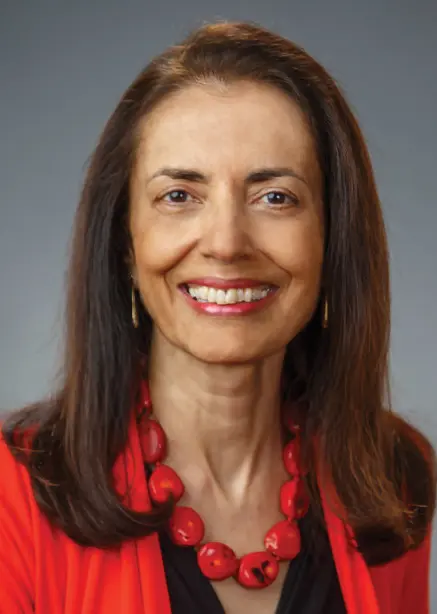
This is the true gift of our Vassar community, and it has been my privilege and honor to have served as your AAVC president for the past four years. Although we find ourselves continually muddling through complicated times, I know that somehow, somewhere, Vassar people are shining the light for all of us.
Thank you for all that you do, and thank you for allowing me to play a small part in serving this amazing community. I am indebted to the AAVC Officers, Brian Farkas ’10, Tyrone Forman ’92, and Alisa Swire ’84, and the entire AAVC Board, for their support, thoughtfulness, and tireless commitment to all things Vassar. In my role I have had a symbiotic relationship with Lisa Tessler, Executive Director of the AAVC, who has been an amazing partner, and will also be stepping down this June. The relationship between the AAVC and the College is critical, and it has been a true pleasure to collaborate with our College President, Betsy Bradley, and Chair of the Board of Trustees, Sharon Chang ’84, in ensuring the vitality of our alum community.
I know that my successor and the AAVC Board will cast their own imprint on our community, in collaboration with Willa Vincitore ’92, our new Associate Vice President and AAVC Executive Director. I look very much forward to being a part of that.
Perhaps I will see some of you at Reunion, and I hope you will always bear in mind that ineffable bond created by Vassar that ties us together forevermore.
Take good care, and see you around,


- Monica Vachher ’77, Illinois
President and AAVC Trustee - Brian Farkas ’10, New York
Vice President and AAVC Trustee - Tyrone Forman ’92, Illinois
Vice President - Alisa Swire ’84, New York
Nominating and Governance Committee Chair - Gail Becker ’64, New Jersey
- Maybelle Taylor Bennett ’70, Washington, DC
AAVC Trustee - Patrick DeYoung ’18, Pennsylvania
AAVC Trustee - Eddie Gamarra ’94, California
Alum Recognition Committee Chair - Stephanie Goldberg ’14, New York
- Anne Green ‘93, New Jersey
AAVC Trustee - Delia Cheung Hom ’00, Massachusetts
AAVC Trustee
Diversity, Equity, and Inclusion
Ad Hoc Committee Chair - Kevin Lee ’14, California
- Peggy Ann Nagae ’73, Oregon
- Patricia Ann Neely ’75, New York
- Michael Neuwirth ’89, New York
- Katherine “Kat” Mills Polys ’93, Virginia
Vassar Fund Committee Chair - Heller An Shapiro ’81, Maryland
- Sheryl Smikle ’81, Georgia
- Andrew Solum ’89, United Kingdom
Clubs Committee Chair - Keith St. John ’81, New York
Alumnae House Committee Chair - Carlos Hernandez Tellez ’14, Brazil
Career Networking Committee Chair - Sam Thypin-Bermeo ’11, New York
- Kerri Tillett ’91, Massachusetts/North Carolina
- Emily Weisgrau ’96, Massachusetts
(on leave) - Lisa Tessler
Executive Director of the AAVC - Patricia Lamark
Assistant Director, AAVC Engagement
In Memoriam
-
1945-44
Waleska Evans James
March 21, 2024 -
1945
Marion Gilman Hoffmann
January 12, 2023 -
1946
Grace McCain Heidt
January 2, 2026 -
1947
Elizabeth Treadwell Wray
December 24, 2025 -
1948
Katherine Smith Camp
November 16, 2025 -
1948
Gloria Steinberg Gerst
December 10, 2025 -
1949
Carol Gabrielson Fine
June 14, 2025 -
1949
Nini Almy
October 28, 2025 -
1950
Louise Tompkins
May 3, 2025 -
1950
Joan Kelley Merritt
July 1, 2025 -
1950
Edith Ann Furst Howell
October 25, 2025 -
1950
Emily Faust Korzenik
December 15, 2025 -
1951
Nancy Brown Snow
September 23, 2025 -
1951
Graydon Smith Vanderbilt
September 28, 2025 -
1951
Jean Geggie Brooks
October 28, 2025 -
1951
Grace Gibson Newcomer
December 16, 2025 -
1951
Janina Barcinska Pikielny
December 20, 2025 -
1952
Barbara Jaffe Ellison
December 28, 2025 -
1952
Helene Cohn Isaac
December 29, 2025 -
1952
Suzanne McWilliams Murray
January 9, 2026 -
1953
Jane Telander Unkles
June 20, 2025 -
1953
Martha Rannells Partin
August 23, 2025 -
1953
Bitsie Thompson Clark
October 10, 2025 -
1953
Barbara Elferink Greenstein
October 16, 2025 -
1953
Joan Bell Crockett
November 18, 2025 -
1953
Harriet Lowry King
December 2, 2025 -
1953
Miriam Gargill Braverman
January 5, 2026 -
1954
Jean Rice Hermann
October 8, 2025 -
1954
Marianne McWilliams Romaine
November 29, 2025 -
1954
Hilda Anderson Jennings
December 8, 2025 -
1954
Susan Carter Harris
January 7, 2026 -
1955
Millicent Maas Dunham
October 31, 2025 -
1955
Eva Seed Auchincloss
November 1, 2025 -
1955
Margaret Aydelotte Mills
November 8, 2025 -
1955
Marilyn McManus Largay Bauch
November 20, 2025 -
1955
Joan Calder Penniman
December 16, 2025 -
1955
Annina Hardenbergh Demmon
December 20, 2025 -
1955
Suzanne Joseph Stephens
January 20, 2026 -
1956
Carol Brooks McCrady
June 24, 2025 -
1956
Hester Hinsdale Nau
October 26, 2025 -
1956
Marlynn Weinsheimer Barnes
November 27, 2025 -
1957
Ellen Brett Bierman
November 2, 2025 -
1957
Nancy Nathan Cole
January 27, 2026 -
1958
Caroline Ramsay Merriam
October 3, 2025 -
1958
Pamela Farrington Clayson
October 31, 2025 -
1958
Virginia Backus Vanocur
December 13, 2025 -
1958
Virginia Sellers Shaw
December 18, 2025 -
1959
Margaret Cowles
September 18, 2025 -
1959
Ann Lawler Dewey
September 19, 2025 -
1959
Charlotte Mendelsohn Mitchell
September 30, 2025 -
1959
Elizabeth Dooling
December 16, 2025 -
1960
Brenda Lesnik LeVine
December 11, 2025 -
1960
Geraldine Dunphy Wind
January 12, 2026 -
1961
Edna Cassinerio Ott
November 7, 2025 -
1962
Amy Robinson Chase
July 1, 2025 -
1962
Rosa Rovira Rogers
October 1, 2025 -
1962
Jonelle Carey Rowe
October 1, 2025 -
1962
Susan Keightley Schweser
October 19, 2025 -
1962
Beatrice Fetherston Slinkard Alexander
November 16, 2025 -
1962
Wendell Miller Steavenson
December 30, 2025 -
1963
Selby Butt Beeler
December 1, 2025 -
1964
Marlene Simon Herbst
January 1, 2025 -
1964
Karen Grant Davis
September 19, 2025 -
1964
Sara Huntington Ohly
January 2, 2026 -
1965
Melda Brandt Newman
September 1, 2025 -
1967
Lois Oyer Friedly
September 29, 2025 -
1967
Sydele Epstein Golston
December 23, 2025 -
1968
Dianne Diebold
October 3, 2025 -
1968
Sandra Wilford Weaver
November 1, 2025 -
1971
Margaret Gephart
September 12, 2025 -
1971
Leslie Griffin Hennessey
January 26, 2026 -
1973
Leslie Safford
November 1, 2025 -
1974
Alan Harold Booth
December 1, 2025 -
1975
Nancy A. Henry
February 17, 2023 -
1976
Robert H. Sherwood
August 1, 2023 -
1976
Michael A. Civitello
October 25, 2025 -
1976
Amy Drake Reeves
November 4, 2025 -
1977
Lucy P. Bernier
February 5, 2025 -
1978
Alison Hambly
April 1, 2024 -
1979
Diane Reddy Jeffery
October 8, 2025 -
1979
Beate Kessler-McDermott
December 24, 2025 -
1981
Roderick Huntress
October 23, 2025 -
1982
G. Campion Overbagh
October 24, 2024 -
1985
Edward Tang
October 4, 2025 -
1986
Sofia Stefania Agras
December 8, 2025 -
1988
Elizabeth Corbett
November 5, 2025 -
1989
Shelley Carter Sullivan
September 3, 2024 -
1991
Jubi Arriola-Headley
October 17, 2025 -
1993
John Z. Grace
September 29, 2025 -
2011
Samuel P. Schrader
September 2, 2025 -
2013
Cassidy R. Hollinger
January 5, 2026 -
Faculty/Staff
Morton Allen Tavel
Professor of Science, Technology and Society, and Political Science
Announcements
-
Apartment Rental, Yellowstone
Cozy modern studio for two on the Yellowstone River, steps from Yellowstone National Park’s North Entrance in Gardiner, Montana. Private river access, covered deck overlooking the river, and incredible mountain views. Living space includes comfortable seating, gas fireplace, work desk, and dining table. Fully furnished kitchen with breakfast bar. A half wall separates the king bed from the living area. Full bath. Available year-round.
-
Cute Cottage Near Santa Barbara
Available year-round! Come relax on the beach, boogie board, and build sand castles with your loves and littles and enjoy some of the world’s most beautiful sunsets! Cute cottage, a block from the beautiful and family-friendly Sandyland Cove Beach and walking distance from restaurants, shops, and ice cream! Carpenteria is a sleepy beach town 20 min. south of Santa Barbara and less than two hours to Los Angeles. Our 2BR/1BA sleeps four comfortably in two separate bedrooms, and there’s a pullout couch in the living room for two more. Full kitchen, washer/dryer, dishwasher, microwave, Internet, Roku, and a fenced-in yard with outdoor eating space and parking. Pet friendly. 30-day minimum rental.
Arcadia Haid Conrad ‘94
actuallyarcadia@gmail.com -
Mountain Rental, Colorado
Stay at our gorgeous, 2BR condo in Summit County, CO; sleeps up to 6. Play in the snow all winter (ski, skin, cross country, fat tire bike, etc.); hike, fish, bike, boat in the summer/fall. Penthouse condo looks out over the Blue River; sunrise/sunset views of Rocky Mountain ranges. Near 7 ski resorts: Keystone (15m), Copper (20m), A-Basin (25m), Loveland (25m), Breckenridge (25m), Vail (35m), Beaver Creek (50m); also, Mary Jane/Winter Park (1h), Steamboat (1.5h). Attached, heated garage. Vassar discount available.
-
Historic House in Greenport Long Island’s North Fork
Charming, historic home in maritime village, 5-minute walk to town with all amenities. 3BR, sleeps 5 (2 queen/1 full), 2 full BA, outdoor shower, cook’s kitchen, gracious dining room, library/study, 2 working fireplaces. Sunroom leads to deck with porch & pergola, water views of Sterling Harbor, large private yard. Internet/cable TV, A/C, all utilities incl. Transportation: LIRR, Hampton Jitney, LIE. Two-week or monthly: June $12k, July $16k, August-Labor Day $18k, September $15k. Special rates for October. Other times, please inquire. Information/photos upon request.
-
Rent/Swap Umbrian Farmhouse
4BR/3.5BA, excellent wifi, full AC and lap pool nestled in 6 acres of olive grove near Orvieto. Sweeping view of the Tiber Valley and surrounding hill towns. Walk up to Guardea for morning coffee and Sunday market, visit hill towns, hike/bike the Borghi dei Silenti trail, or never leave this oasis! Plenty of outdoor space, yoga platform, and pergolas for group workshops, family gatherings, and the digital nomad.
Lisa Brodey ’80 and Lucy Clark ’09
lbrodey@yahoo.com -
Florida and Berkshires Rentals
Fisher Island Club, Florida. Exquisite beachfront condo. 3+ BR/BA, 10 mins. to South Beach. April-December 15th. Also: Spectacular Berkshire home/quick access to 5 ski areas, 4BR/3+BA, heated pool, Jacuzzi, sauna, pond, gym, 7 acres close to Hudson, Lenox. Dec-May.
-
French Provinces: Rent Our Lovely Rustic Farmhouse In Southwestern France
Midway between Dordogne and Lot rivers. Quiet picturesque farming village near Figeac and St. Céré; 45 minutes to Sarlat, capital of the Dordogne Valley; 70km to Cahors and its vineyards. Well located for those interested in pre-history, medieval history, gastronomy, hiking, and canoeing.
Professor Geoffrey Jehle
845-437-5210, or visit the web page at https://Nadal.short.gy -
Career and Job-Search Counseling
Vassar alum and experienced career counselor will guide you to a satisfying career path and successful job search. Can meet with you in person in Westchester or NYC, and/or by phone and email. No situation is too difficult!
-
Opportunity for Volunteer Greatness
Have you stepped down from a rewarding career and are looking for a new challenge? Small 501c3 organization seeks an Executive Director for an exciting VOLUNTEER position. We need a bold, strategic, and values-driven leader at the intersection of mental health, public advocacy, and human dignity. Lead our all-volunteer team to greatness and influence!
Alexandra Roth ’81, LCSW
overroth2@gmail.com -
Vassar Wedgwood (Free)
Free to Vassar grad, 12 Wedgwood Vassar dinner plates. Different building centered on each. Small chip in one. Must pick up in Pittsford, NY.
Elizabeth Farnham ‘64
508-274-7932 (text)
Dazzlingly Ordinary
n the first page of The Very Heart of It, Thomas Mallon, right, is talking with Rachel Kitzinger—both Vassar professors I’d admired—about a mutual friend. I feel a small thrill: They knew each other. By page 50, their friend was dead from AIDS.

It’s hard to overstate how much the specter of AIDS weighed on Professor Mallon during the years represented by this book. As a collection of his diaries in the 1980s and early 1990s, it represents in real time the pleasures, concerns, obsessions, small rivalries, and major triumphs of a writer, professor, and editor. I, too, am all those things, and have been for thirty years now.
I’ve stood in front of students while working for eight years on finishing my first book, sending queries, fielding rejections, basking in small signs of success. (I’ve never felt more in common with Professor Mallon than when he notes with minor delight that, standing in a campus library in Texas, he sees that his first novel has been checked out thirteen times.) I’ve taught through divorce and my mother dying young of lung cancer. The students had no idea. That’s not a failure—that’s the job. You show up. You read their work. You say to them, as Professor Mallon did to me, that I was a pretty good writer but I could be so much better. The rest stays private.
As a student, Vassar wasn’t just where I took classes—it was where I slept, ate, made friends, made and lost relationships, figured out who I wanted to be. As a professor, I know now that working at a college is a job, not an identity. That was especially true for Professor Mallon, who yearned to spend his time in New York City, writing, rather than reading our work, though he was unfailingly kind and incisive in his suggestions about our writing.
The diaries show what I couldn’t see: the literary anxieties (worrying his reviews weren’t good enough, that his novel wouldn’t sell), the romantic disappointments, the ever-present fear of AIDS. They also show him slowly detaching from his Vassar life, ultimately giving up the steady income and status of being a tenured professor to bet his future on making it as a writer.
In 1990, the year that I studied with him, Professor Mallon finally took an HIV test, after avoiding it for years. He waited for the results as he taught us about Joan Didion and Bruce Chatwin, and as he challenged me to write deeper, more meaningful stories—a moment he could not possibly remember but which altered the course of my work. He came home from Vassar to a phone call from his doctor. “You’re negative,” the doctor said. A couple of days later, he wrote in his diary, “Life is dazzlingly ordinary. I walk in disbelief.”
The last time I saw Professor Mallon, several years ago, he was speaking to a packed house at the country’s largest writing conference. The crowd was so big, and the line to sign his new book so long, that all I could do was wave in his direction after the talk and say, “Hi! I was your student at Vassar.” A minder hustled him to the book signing before I could tell whether he recognized me.
Reading his diaries now, it’s not the current Thomas Mallon I want to speak with. It’s the young professor from back then, who so thoughtfully read and commented on my writing, even though he was awash with his own concerns. Don’t worry, I want to say. Life, love, writing—it looks like it all turns out just fine.
Kevin Haworth is the author of five books, including the award-winning novel The Discontinuity of Small Things. He is Giles Writer-in-Residence at Penn State University.
Photo by Karl Rabe

- Publisher
Alumnae/i Association of Vassar College
Monica Vachher ’77, President - Vice President, Communications
Victoria Grantham - Associate Vice President, Editorial and Publications; Editor, VQ
Elizabeth Randolph
elrandolph@vassar.edu - Creative Director
Rob Yasharian - Design
Aidan Gallagher
Daniel Silva - Print Production
Dan Lasecki - Staff Writers
Larry Hertz
Kimberly Schaye - Class Notes
Nada Glick ’61, Coordinator
Joan Giurdanella, Copy Editor - Editorial Assistant
Emilee Busby ’26 - Editorial Offices
124 Raymond Avenue, Box 647
Poughkeepsie, NY 12604
845.437.5447 Fax 845.437.7239 - Postmaster
Send address changes to Central Records, 124 Raymond Avenue, Box 14
Poughkeepsie, NY 12604 - Yearly Subscriptions $15
- Unsolicited Manuscripts
We discourage the submission of unsolicited manuscripts or stories written without prior consultation with the editorial office. However, we do welcome story ideas and pitches. Please email
vq@vassar.edu with your suggestions. - Articles reflect the opinions of the writers and not necessarily those of the magazine, AAVC, or Vassar College. Vassar, the Alumnae/i Quarterly is published in the spring, summer, and fall/winter by the Alumnae/i Association of Vassar College (AAVC).
- Mission
AAVC is a living bridge whose mission is to ignite powerful connections to Vassar, to each other, and the world. - Affirmed 2013.
Copyright © 2026 AAVC - LETTERS TO THE EDITOR
We welcome comments on contents of the magazine. Please send your Letters to the Editor to vq@vassar.edu.