



VOLUME 121 ISSUE 3
THE ALUMNAE/I QUARTERLY
Contents
Departments
Exploring The Global “We”
seismic shift happened about 15 years ago in my scholarly field when public health activities conducted overseas (this typically consists of work on infectious diseases in low-income countries) were rebranded from “international” health to “global” health. It was a momentous shift supported by luminaries in the HIV/AIDS crisis and response, including major donors and the World Health Organization. The shift was more than rhetorical; public health professionals called for more equitable engagement of high-income and low-income partners and pointed out that power dynamics associated with wealth had been working against real progress in human health. Unlike “international health,” which was criticized for taking an “us/them” approach to international engagement, “global health” sought to forge collaborations around our common struggles and our shared humanity. The shift from an “us/them” mindset to an expanded conception of “we” has been life-changing. Study after study in global health provides evidence that collaboration, community-based engagement, and public trust are good for health outcomes, including maternal and child health, vaccination rates, reductions in childhood malnutrition, and the list goes on.
When I came to Vassar in 2017 and heard that nearly half of the students studied in international settings during their four years at Vassar, I was intrigued. What were they experiencing? What were they learning that time on campus could not impart? Students shared inspiring stories with me—stories about experiencing the remarkable museums of Europe, participating in environmental sustainability efforts in Tanzania, and learning about mental health education in Korea, among other experiences. Each story highlighted the differences between here and there—the culture, the weather, the food, and the languages. It all added up to tremendous learning about adapting to new situations and unexpected challenges. Students’ time away was often described as challenging but rewarding, because learning to navigate the differences brought new perspectives, agility, and confidence.
Over my career, I have traveled across the world, but it was when I went to Rwanda with Vassar students to study and teach at the University of Global Health Equity that I gained fresh insight into the nature of global education. We spent the first few days experiencing how different from the U.S. everything seemed. We were preoccupied with all the contrasts, trying to absorb the novel mountain views, the dirt roads filled with animals, the vibrant textiles, the small children carrying heavy containers of water, and so much walking. The many differences were both fascinating and overwhelming.
Yet, as we spent time in the classroom, working and learning together with our Rwandan colleagues as peers, a new sensibility began to emerge. We noted the many ways in which we were more alike than we were different from our partners in Rwanda. We all wanted to engage and learn; we all sought ways to protect human health and the planet’s flourishing. As colleagues, we were curious, caring, funny, scared at times, and lonely at others. We had triumphs about which we were proud, and we experienced disappointments as well; we were all human.
As the journey came to its end, where we once saw differences, we saw commonality. Trepidation had given way to familiarity, and we saw ourselves more fully in each other. For me, this is the magic of international study—to move not only over thousands of miles of air travel, but also from the narrowing and brittle conception of “us/them” to the expansive and resilient “we.”
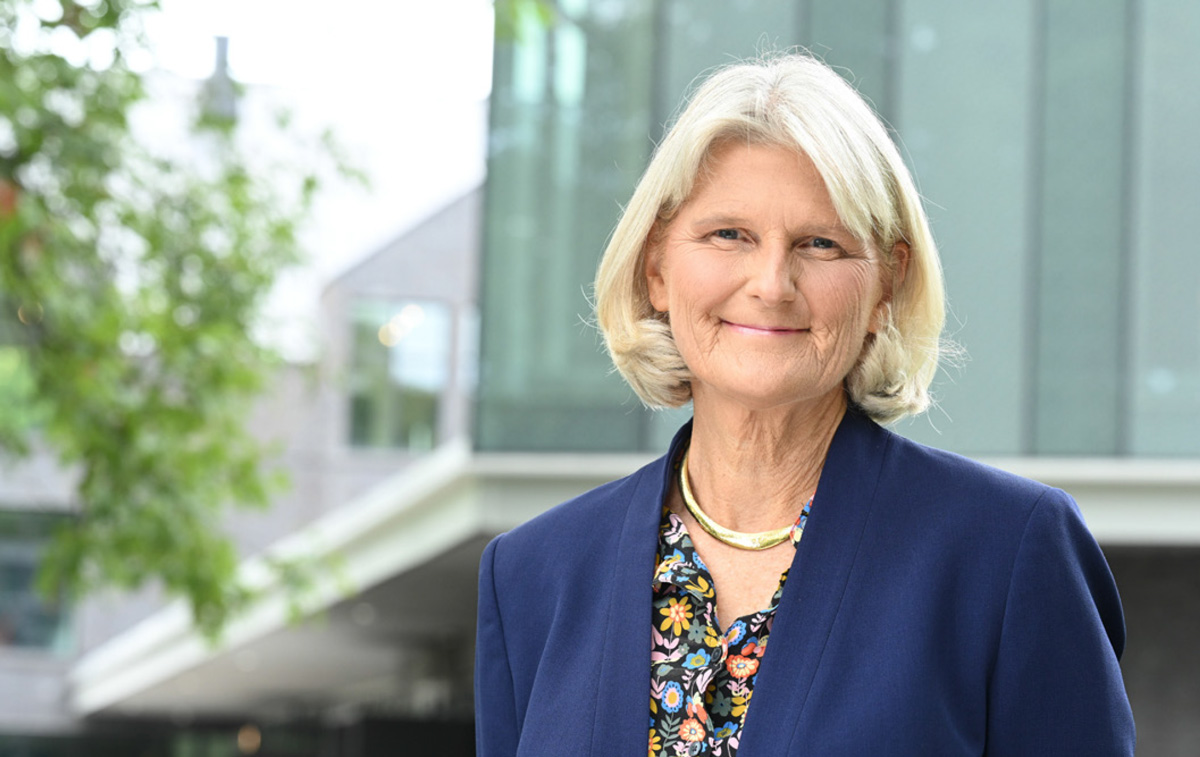

Elizabeth H. Bradley
President
Vassar and SUNY-New Paltz to Offer New 4+1 Accelerated MBA Program
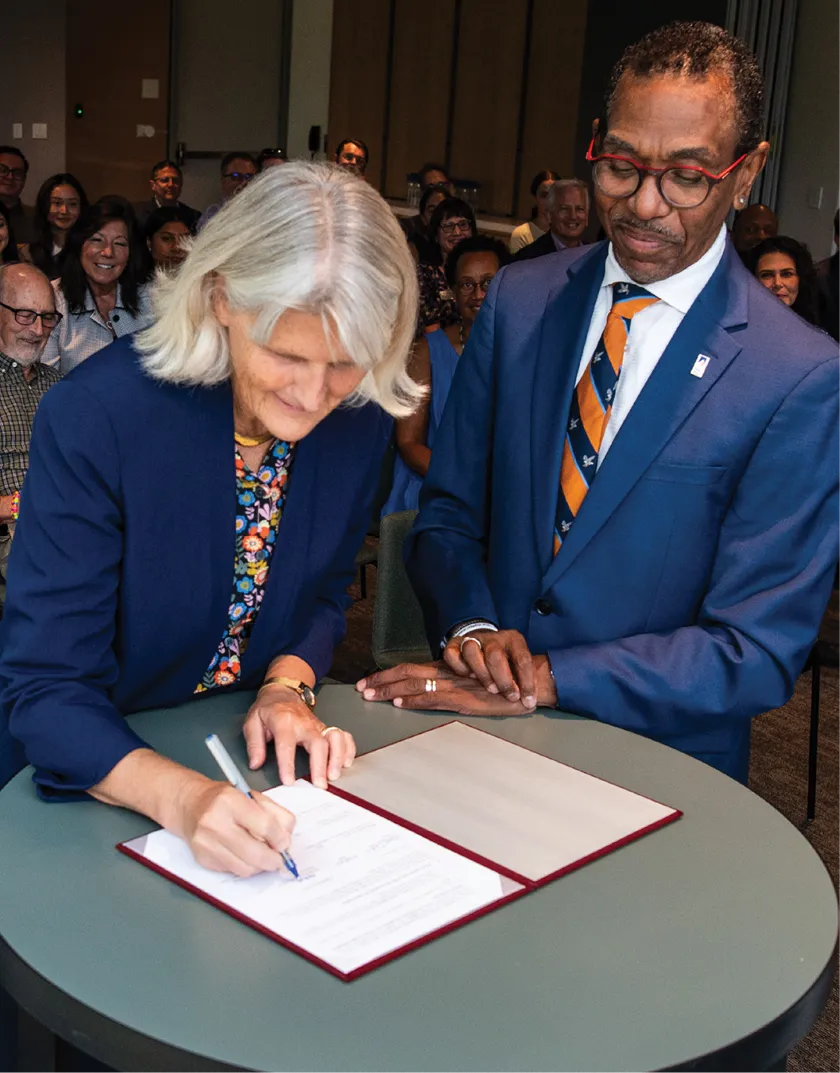
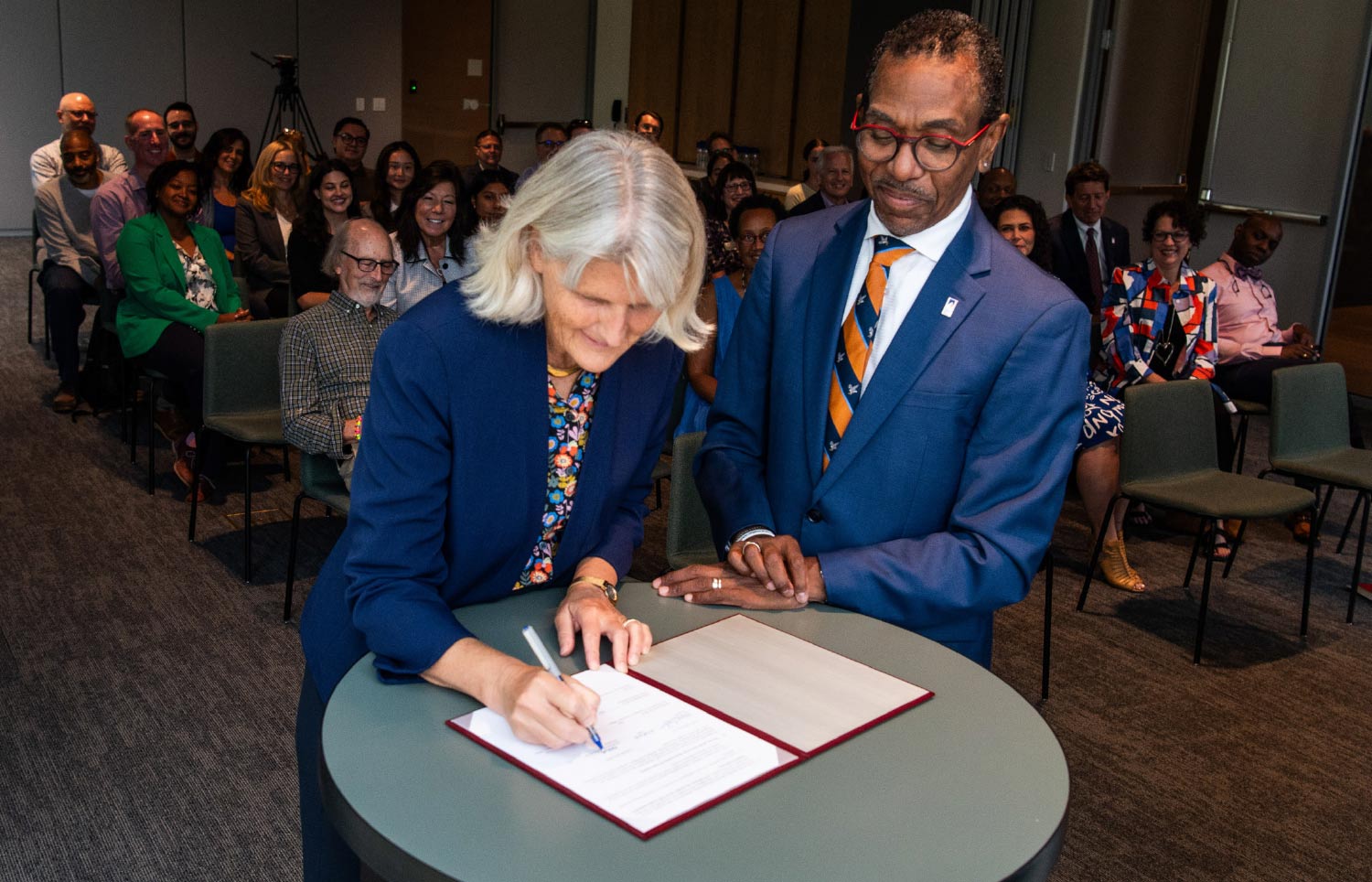
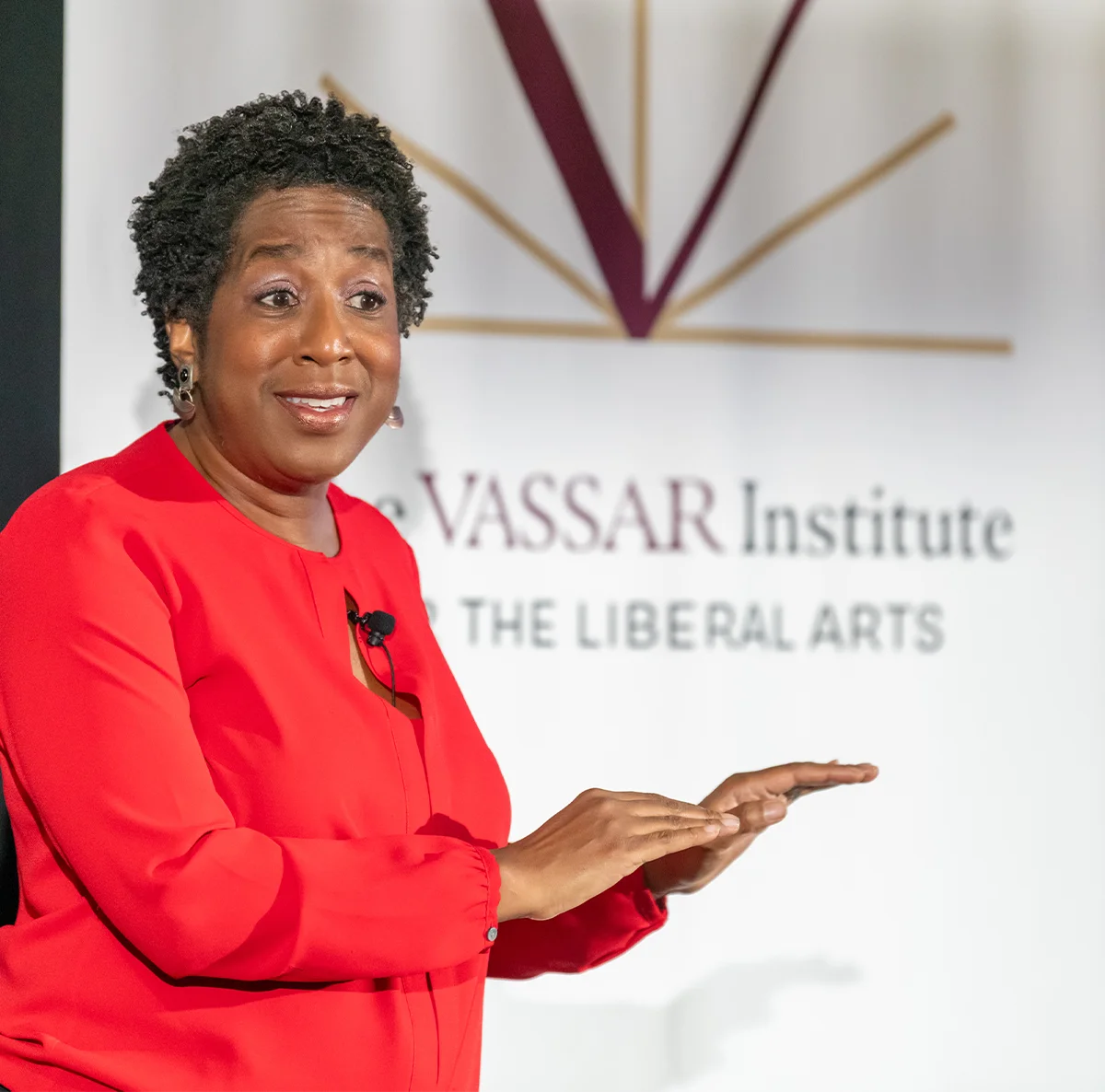
Vassar President Elizabeth H. Bradley (left) and SUNY New Paltz President Darrell P. Wheeler (right) formalized the new MBA program at The Vassar Institute for the Liberal Arts on September 16.
They made a joint announcement, then signed a memorandum of understanding officially creating the new program. “This collaboration with SUNY New Paltz expands opportunities for our students by combining the strengths of a liberal arts education with advanced professional preparation in business,” Bradley said. “The program provides a clear and affordable pathway for students who want to integrate creativity, critical thinking, and entrepreneurship with the practical skills of an MBA.”
Bradley said the idea for the program arose out of conversations she had with Wheeler at dinners she hosts periodically with local college presidents. She described Wheeler as “a person with a lot of ideas to share. I thought there have to be ways we can work together.”
“For decades, the MBA at New Paltz has helped entrepreneurial students across the academic disciplines unlock the full potential of their education and future career prospects,” Wheeler said. “Our dedicated School of Business faculty have worked tirelessly to ensure this program is flexible for busy students and relevant to contemporary market trends.”
SUNY New Paltz’s MBA program is a three-semester, in-person program with hybrid and online learning opportunities for flexibility. The program offers concentrations in Healthcare Management and Business Analytics, as well as a general MBA option. The School of Business also supports social entrepreneurship initiatives and connects students to the Hudson Valley Venture Hub, a vibrant community of entrepreneurs and investors. The MBA program is accredited by AACSB International, the leading global standard for business education.
Two Vassar seniors who plan to enroll in the program at SUNY New Paltz next fall said they were grateful for the opportunity to combine the liberal arts education they are receiving at Vassar with the practical skills they will gain at SUNY New Paltz. “This shows what institutions of higher learning can do to fulfill students’ needs,” said Justin White ’26, a six-year Navy veteran. “We veterans understand the importance of critical-thinking skills combined with technical expertise.”
Cher Mei ’26, who won a top prize at Vassar’s first-ever Entrepreneurship Competition in 2024, called the new partnership with SUNY New Paltz “an amazing example of interdisciplinary education that will add to the liberal arts education we get at Vassar. It’s something many of us in Vassar’s entrepreneurship program can benefit from.”
Aaron Hines, Assistant Dean for Graduate Business Programs at SUNY New Paltz, said he and others in his department were excited about the program. “Students with degrees in the liberal arts benefit from the MBA experience by learning data-informed decision-making, financial analysis, business strategy, and organizational leadership,” Hines said. “Soft skills they have already attained like communication, empathy, ethical reasoning, and teamwork are in high demand in leadership roles. Our MBA program helps the liberal arts graduate expand and accelerate career opportunities with great organizational impact and high potential earnings. Overall, we aim to prepare our MBA students for purpose-driven leadership in today’s workforce.”
Additional benefits include scholarships to bring tuition in line with in-state rates for non–New York State students and preferential consideration for teaching-assistant positions at SUNY New Paltz for those admitted.
The Dede Thompson Bartlett Center for Admission and Career Education Heralds a New Day—and a Better Environment
Deborah OBrien
“I began underwriting internships at Vassar in 2012,” Bartlett recalled recently. “My goal at that time was to encourage more women to focus on high-paying fields that had been previously closed to them. I wanted women to be empowered. But I realized that the internships weren’t enough and that we had to change the paradigm.”
A paradigm shift is exactly what the new center is, according to Stacy Bingham, Associate Dean of the College for Career Education. “The Dede Thompson Bartlett Center represents a truly transformational moment for Vassar and for the Center for Career Education, made possible by Dede’s extraordinary vision and generosity,” said Bingham. “We are incredibly excited to move into this state-of-the-art facility, which is the perfect foundation to build on our excellent outcomes.”
Those outcomes include: nearly 90 percent of seniors participating in an internship by the time they graduate (compared to 50–65 percent nationally); 94 percent of graduates working, participating in a fellowship/year-of-service, or continuing their education within six months of graduation; a law school acceptance rate of 88 percent for applicants over the past three admission cycles (compared to a 70 percent national acceptance rate for the same period); and a medical school acceptance rate of 80 percent for applicants over the past three admission cycles (compared to 48 percent nationally).

Maryann Thompson Architects
Fostering top-notch career development is a deeply personal mission for Bartlett. When she graduated from Vassar with honors, she found few opportunities open to her compared to her male counterparts. Rising to be the highest-ranking woman in two Fortune 25 companies took considerable grit. But her mother had it even worse.
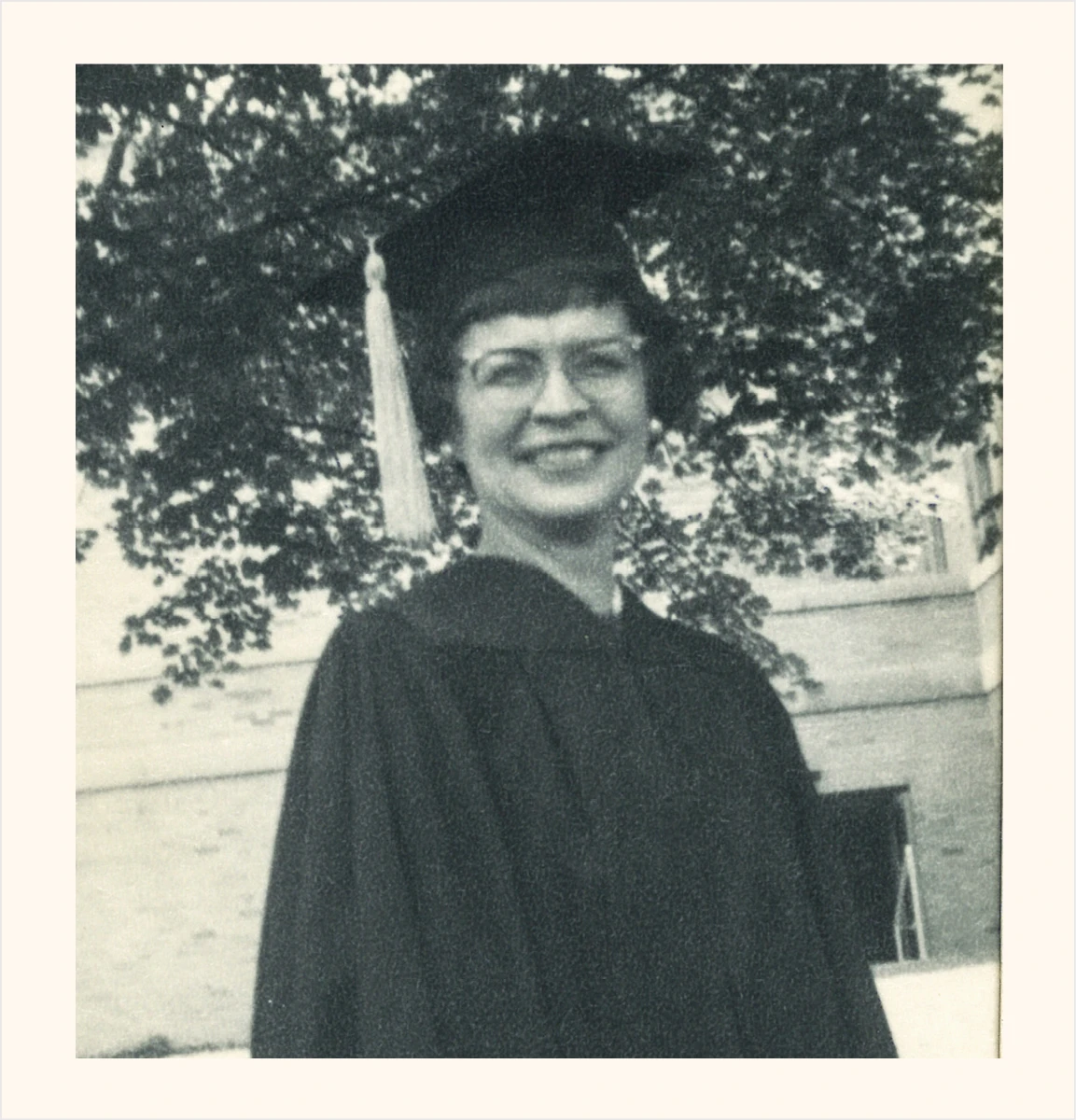
“My mother, Emilie Thompson, graduated from high school in Delaware at age 15 with the highest grades ever recorded in the state,” said Bartlett. “But she was forbidden to go to college by her father, who did not believe in education for women.” Three decades later, Emilie’s husband, George Thompson—a research scientist at the Brooklyn Navy Yard—took an extra job as an instructor in electrical engineering at New York University to fund his wife’s undergraduate education.
Courtesy of Dede Bartlett
In seeking to elevate career education at Vassar, Bartlett said she found the perfect partner in President Elizabeth H. Bradley. “Betsy Bradley was the change agent I’d been looking for,” she said, adding that once they joined forces in 2021, they worked out a plan for the new center in 48 hours. Architect Maryann Thompson P’17 was engaged to design the building and, on a recent morning, Bartlett found herself walking through the manifestation of her vision.
“When I walked through, I felt two things: I felt thrilled, and I felt vindicated,” said Barlett. “This building represents what the women in my class and so many of the women in the previous all-women’s classes had to overcome—women whose superior education was devalued in the workplace, women who were harassed, humiliated, discriminated against, and who had to fight to get into professional graduate schools. Given the current climate in this country, this building is a powerful symbol. Inspired by a woman, designed by a woman, financed by women and the men who care about them—this building will benefit all Vassar students for years to come. And that touches me deeply.”
“To me, admissions and career educations are the bookends. They are part of a continuum,” noted Bartlett. “It starts when the student is introduced to Vassar through the admissions process, bridges to career education, and continues the learning journey for the rest of their life. It puts career education on par with the excellent teaching that Vassar is so renowned for. For 160 years, Vassar’s been in the forefront of liberal arts education, and it puts career education on that same plateau.”
Lucas Pollet
Winton Evans Bridge Dedication Celebrates Family and Love of Music
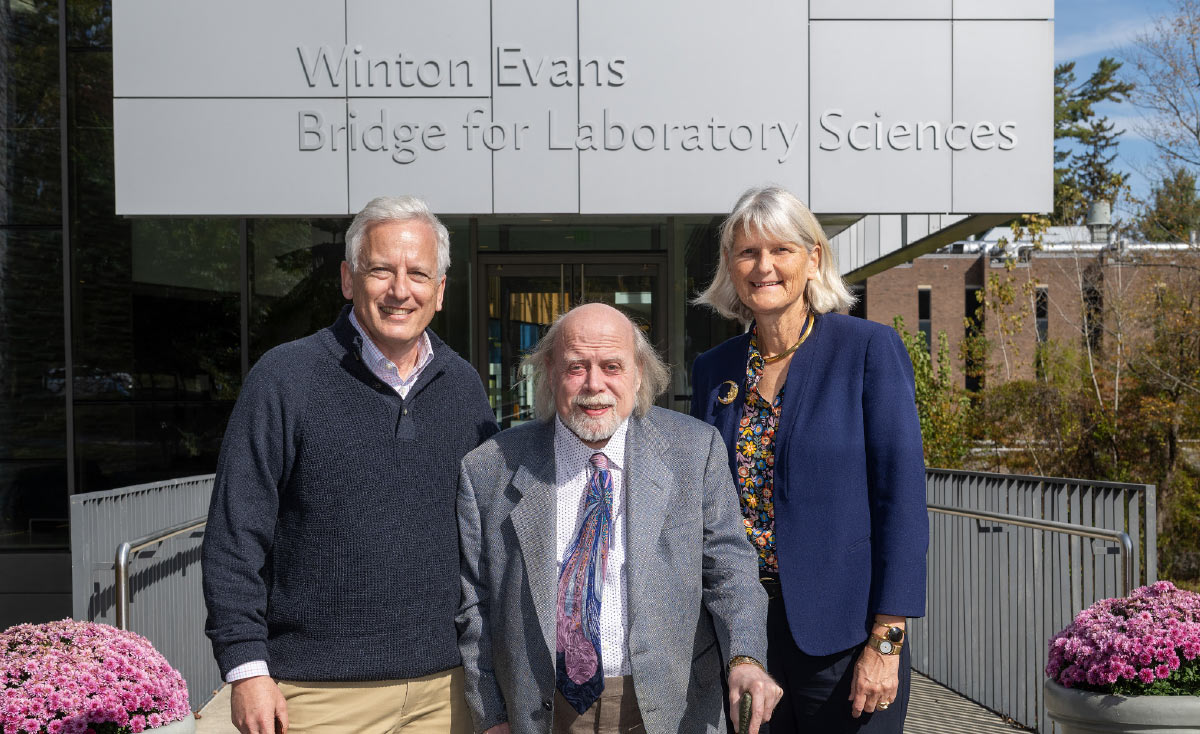
Stockton Photo, Inc.
The naming honors Evans, his mother Katherine “Kay” Winton Evans ’46, P’75, and his grandfather David J. Winton P’46, GP’75, GGP’05, ’10, and their extraordinary generosity to the College.
In June, Evans committed a $28 million gift supporting the Music Department, campus maintenance, faculty scholarship and research, and a scholarship in his mother’s name. Timed with his 50th Reunion, the gift reflects both a personal milestone and a lasting investment in Vassar’s future.
President Elizabeth H. Bradley reflected on the long history behind the gift, acknowledging Evans’s bond with his late mother and the impact their generosity will have on Vassar students. She thanked him for supporting future generations of students “who have a passion for music that echoes your own.”
Although Evans majored in history during his time at Vassar, his true passion was jazz, a program the College did not offer at the time. Still, he found ways to weave music into his academic work, centering his senior thesis on the history of jazz.
Evans’s family’s estate advisor Sonny Miller spoke about how that kind of multidisciplinary approach remains a hallmark of a Vassar education. The College, he said, has long encouraged students to “bring their whole selves” to their studies and “engage in all of those subjects that mean so much to them.” Evans, he added, went on to build a “storied career in jazz music.”
Evans is endowing two funds outright: the Rowland W. Evans ’75 Student Lesson Fund, which subsidizes student music lessons, and the Rowland W. Evans ’75 Concert Fund, which supports annual concert programming. The remainder of his gift, designated through his estate, will create additional funds for building maintenance and faculty research, and contribute $10.5 million to the Katherine Winton Evans ’46 Scholarship Fund, which his mother established and later expanded with her own estate gift.
Justin Patch, Chair of the Music Department, spoke about the passion that students share with Evans. “Most students who come into [Skinner Hall] are not majoring in music,” he noted. “They’re doing this because they love it and they, like us, see music as an integral part of their education.” He added that the gift will make lessons more accessible, giving students from all disciplines the chance to “work with world-class instructors” and broaden their educational experience through music.
“Skinner Hall was really important to a lot of us who weren’t music majors,” said Anne Green ’93, member of the Board of Trustees and AAVC Board. “The first time I stepped into the Bridge Building, and you could see Skinner fully, I was almost in tears. Recognizing that bridge to the music building is really important.”
Kat Mills Polys ’93, P’29, an AAVC Board member, reflected on the multigenerational nature of Vassar legacies. “It’s just a beautiful thing to hear those stories and feel like it’s a real foundational part of the soil here, and the buildings, and the people, and the experience that people have shared throughout their family,” she said.
After the ceremony, attendees enjoyed lunch and a special concert featuring Evans on piano and members of the Vassar Jazz Ensemble.
Before introducing Evans, Class President Pat Neely ’75 reminisced about running out of Josselyn Hall to make the long trek to Skinner Hall and hearing “a solitary piano player” in the hall’s living room. “And this was Rowland Evans.
“Isaac Stern is quoted as saying, ‘What made Carnegie Hall so special was the spirit of Tchaikovsky, Horowitz, Toscanini, and countless others in these walls,’” Neely said. “What makes the Winton Evans Bridge for Laboratory Sciences so special now is that Rowland and his family legacy will forever be embedded within the walls of the building, both in name and in musical spirit.”
Why Multidisciplinary Studies Matter
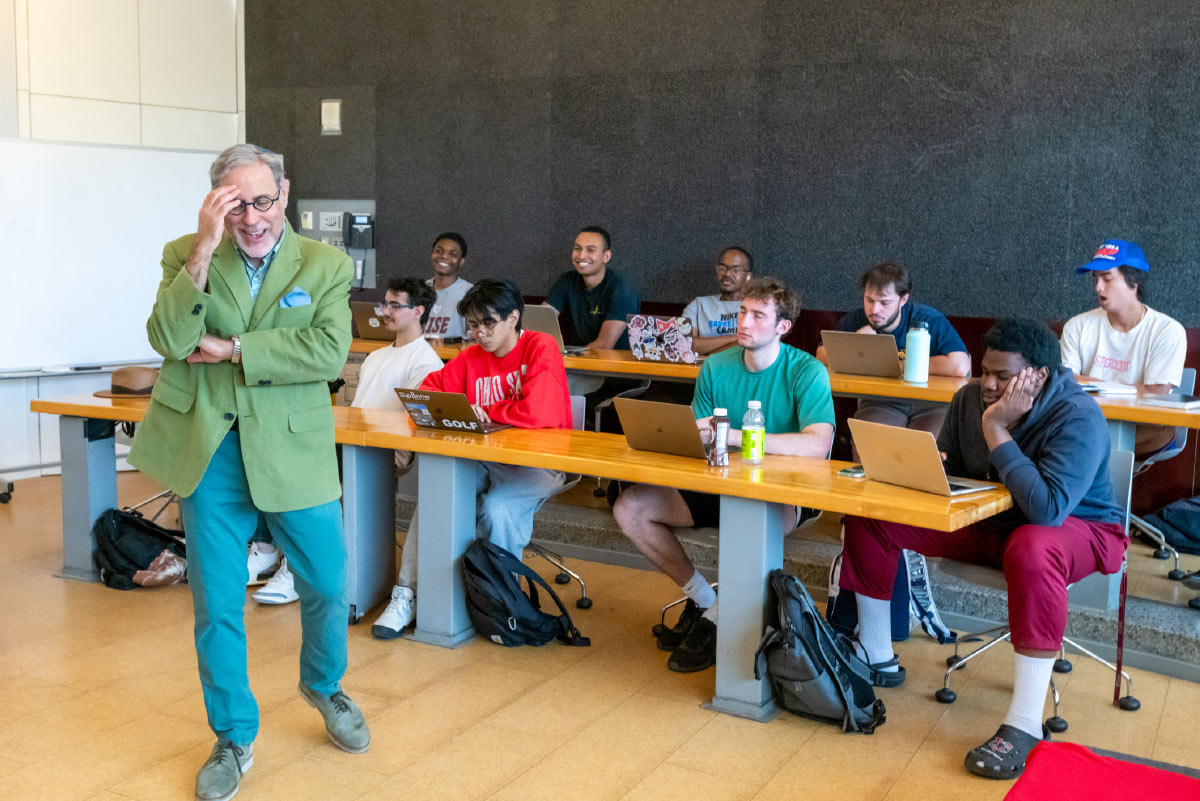
Karl Rabe
This approach to learning continues to shape lives long after graduation. Alums across the generations say the programs have helped them discover not only meaningful work but lasting purpose. Whether in public service, science, activism, entrepreneurship, or the arts, they credit the multidisciplinary programs with giving them the confidence to build careers driven by passion, flexibility, and a deep understanding of the world.
Rising to the Challenge
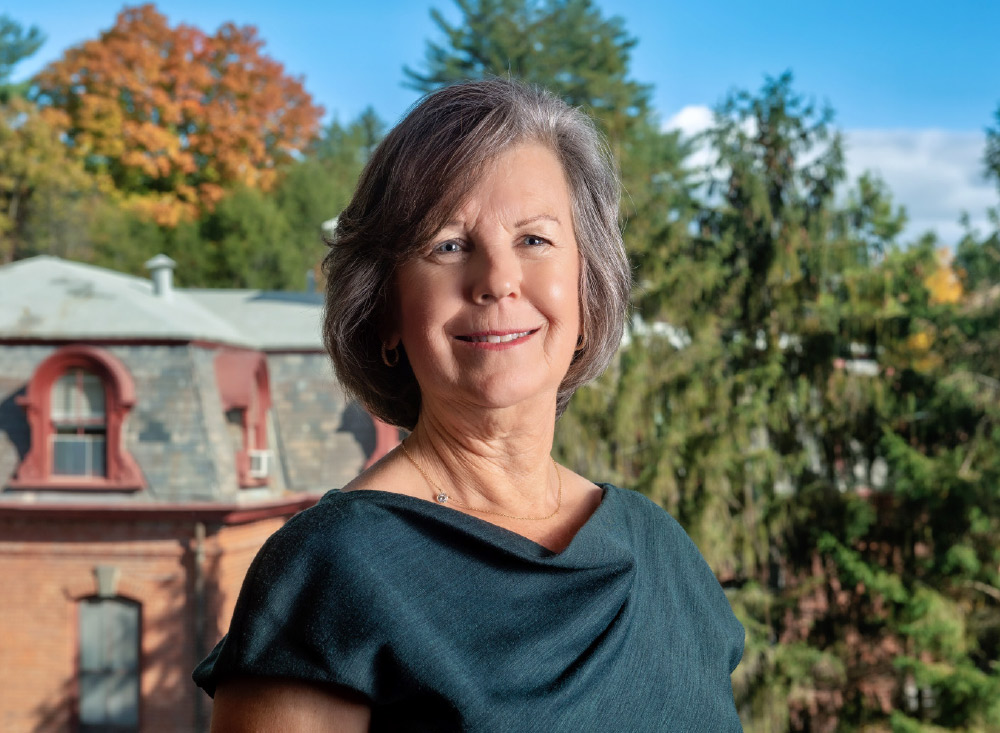
Karl Rabe

When Burnam was at Vassar, STS was split into two concentrations: critical thinking and urban studies. She took a lot of sociology, political science, history, and philosophy classes and chose the critical-thinking path. Her professors challenged her, which was a reason she went into the department in the first place.
The STS seminar course grade was based on participation and a single paper on a technological innovation and its social implications. While many classmates chose to write their papers on major items like cars and phones, Burnam wrote about disposable diapers because of the convenience they offered and the unintended consequence of groundwater pollution by E. coli.
The Multidisciplinary Programs

American Studies
Asian Studies
Environmental Studies
Global Nineteenth-Century Studies
International Studies
Jewish Studies
Latin American and Latinx Studies
Media Studies
Medieval and Renaissance Studies
Neuroscience and Behavior
Science, Technology, and Society (STS)
(the first official multidisciplinary program)
Urban Studies
Women, Feminist, and Queer Studies
Her experiences at Vassar and later at Wharton, where she helped create her own major in management and innovation, contributed to the broad perspective she values in today’s ever-changing world.
“I’m a big believer in the multidisciplinary programs because I don’t think the world is defined in these clear boundaries of a department,” she said. “The multidisciplinary perspective is just the way I see the world. It’s in my thought process all the time. I’m such a believer in the programs that I managed to have both my kids drink the Kool-Aid, and they both majored in multidisciplinary programs.”
Choose Your Own Adventure
“It moved me, opened my mind, and showed me a path to my purpose in life that I will forever be grateful for,” Stone said.
While at the College, Stone interned five times for the Poughkeepsie YWCA’s battered women’s service, answering crisis calls, and going to court as part of her fieldwork assignment. She kept a journal and wrote papers about what was happening in her field placement and earned credit for her fieldwork while getting to know survivors.
Because of the way the multidisciplinary and fieldwork programs were integrated, Stone was “able to sit and analyze all of the realities because I was in the courthouse with survivors and then I came back to campus and did research papers about domestic violence and family law. I was better able to support survivors because of all the rigorous thinking my professors inspired me to do, and my papers were more grounded in reality because of my fieldwork.
“I think that people in more traditional majors had more of a path, and we had more of a ‘choose your own adventure,’” Stone said. “Having had that issue- or problem-focused—but very methodologically broad—lens to my education made it possible for me to follow both the problems and solutions to this work. I got to see gender-based violence the way sociology sees it in one class, the way political science sees it in another class, and the way it shows up in literature in a third. This helped me identify creative solutions that were informed by many academic disciplines but not wedded to any one.”
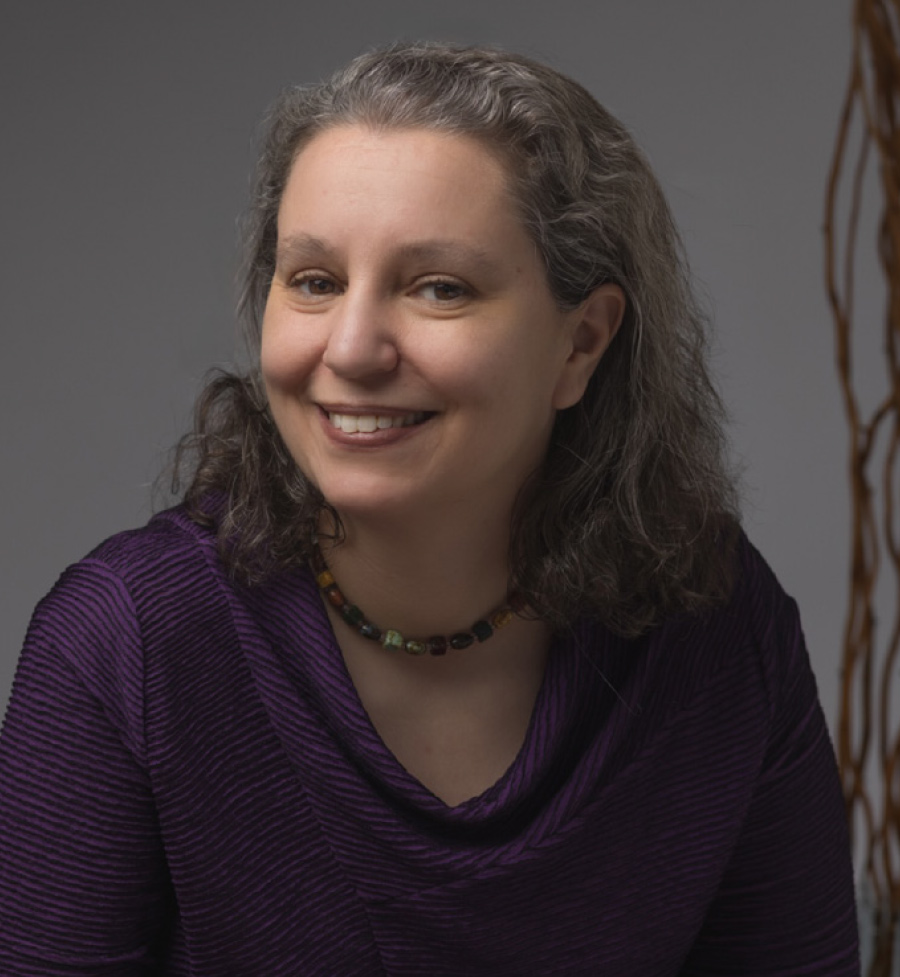
courtesy of the subject
The combination of hands-on fieldwork and the broad, multidisciplinary study Stone experienced at Vassar shaped how she approaches gender-based violence to this day.
Infinite Ways to Solve a Problem
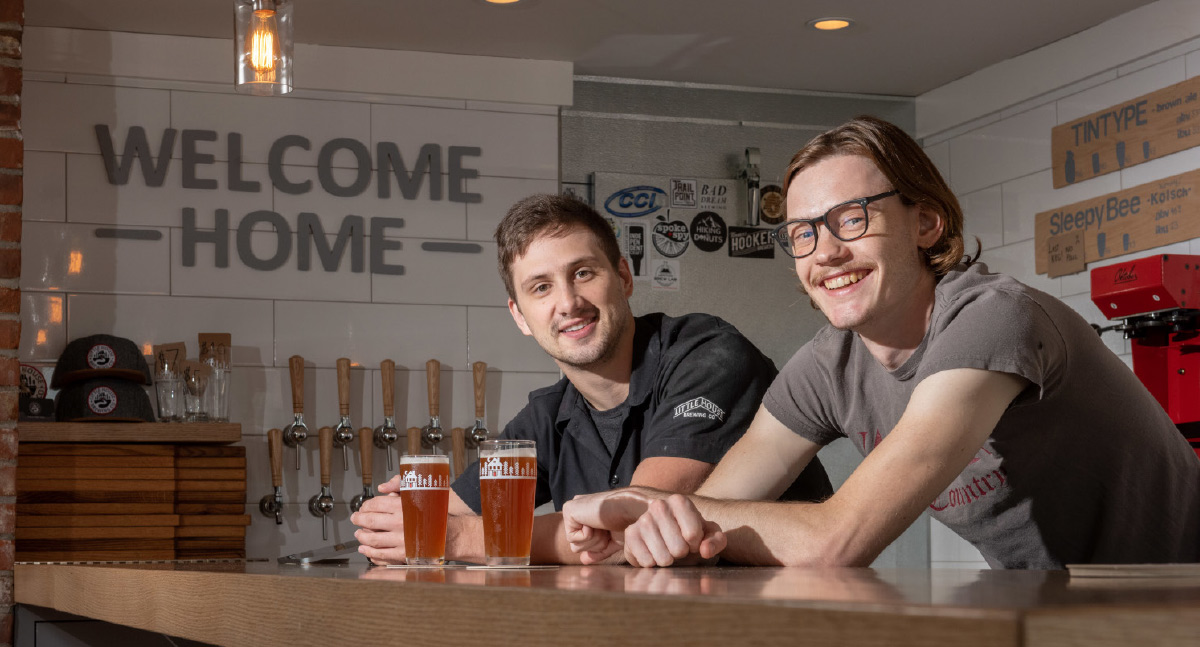
Schaeffer bounced between several different majors, including history and studio art, before deciding to major in STS.
Karl Rabe
Challey became Schaeffer’s advisor and, later, a supporter of Little House Brewing Company. Schaeffer completed an independent study on Matthew Vassar’s brewing career and wrote his thesis on the rise of craft beer in the U.S., examining it through the lens of beer as a socially constructed technology.
“STS taught me that there are a near infinite number of ways to solve a problem, and that it can be very valuable to know not only how something happens, but why it does,” he said. “This has been very useful in commercial brewing, where something is always bound to go wrong, be it an electrical issue, a failing pump, inconsistent raw materials, or uncooperative yeast.”
A Calling
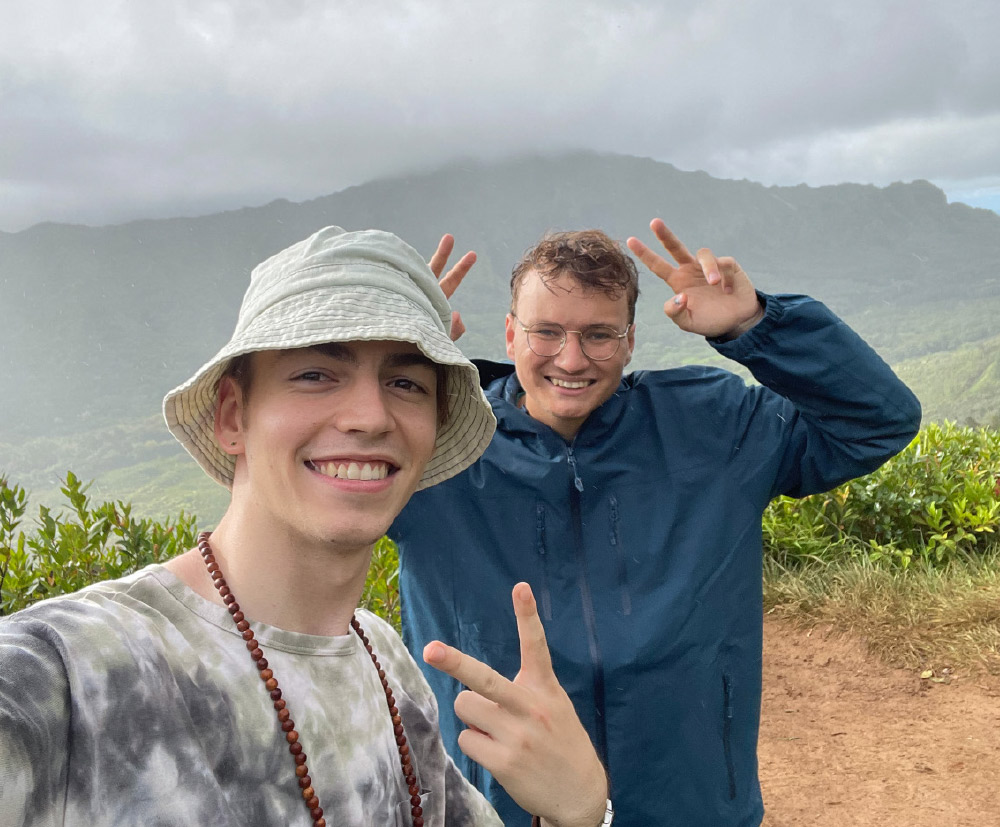
“It felt like a calling and a program that fit my interests well,” Unruh said. “My entire degree was looking at different ways of thinking and viewing the world and its issues. It gave me the flexibility that I felt I really needed and allowed me to create a college experience that worked best for me.”
After graduating, Unruh traveled to Malaysia to participate in the Consortium on Forced Migration, Displacement, and Education, a Mellon Foundation–supported collaboration between Vassar, Bard, Bennington, and Sarah Lawrence colleges and The New School. There, he and other students studied migration issues and worked directly with Southeast Asian migrant communities.
Through it all, International Studies Professor Timothy Koechlin’s words have remained with him: “International doesn’t necessarily mean the other side of the world. International can be the state over from you or even down the street.”
Courtesy of the subject
A Home for the Multidisciplinary Programs
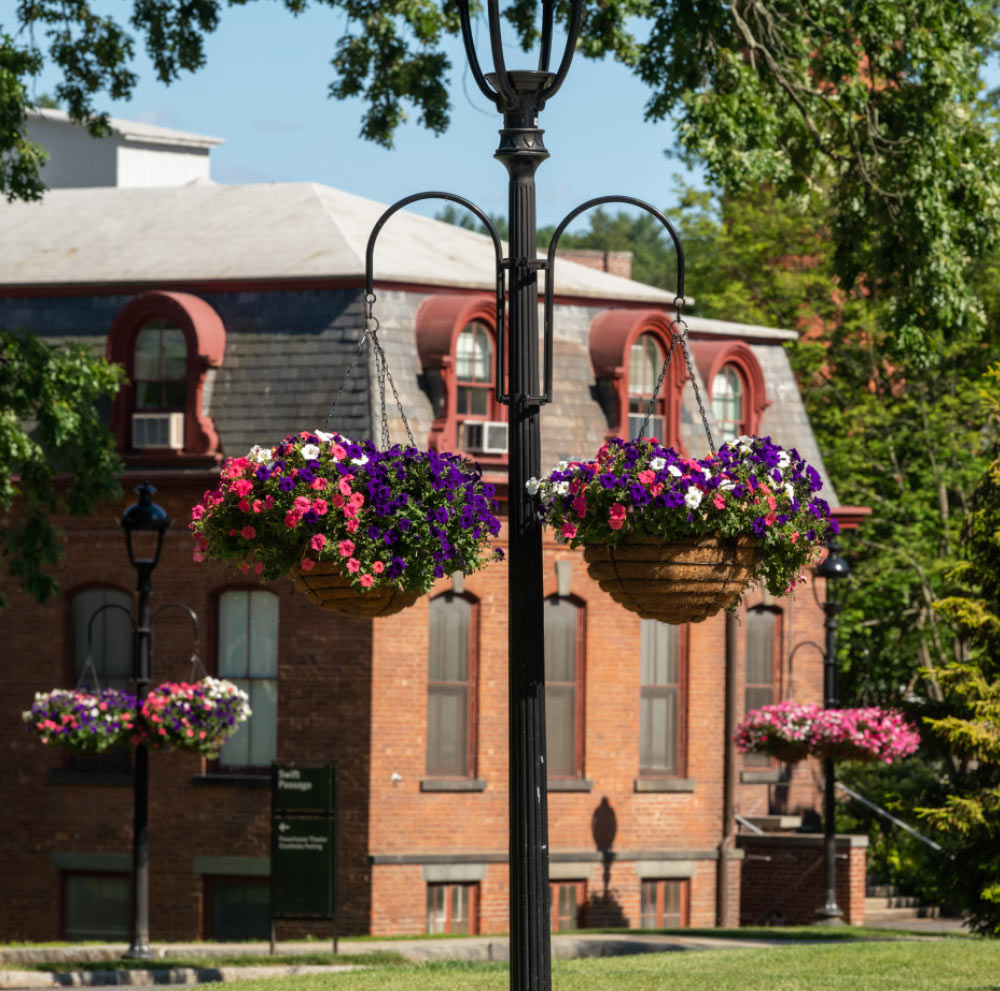
To give the programs a more collaborative and central home base, the College is planning a total renovation of the building that will transform it into the Center for Multidisciplinary Study as a part of the Fearlessly Consequential campaign. The building will be designed with learning and creativity in mind, giving the multidisciplinary programs a home fit for their unique and cooperative learning mission.
To learn more about how you can support the Center for Multidisciplinary Study, visit go.vassar.edu/multisinfo25.
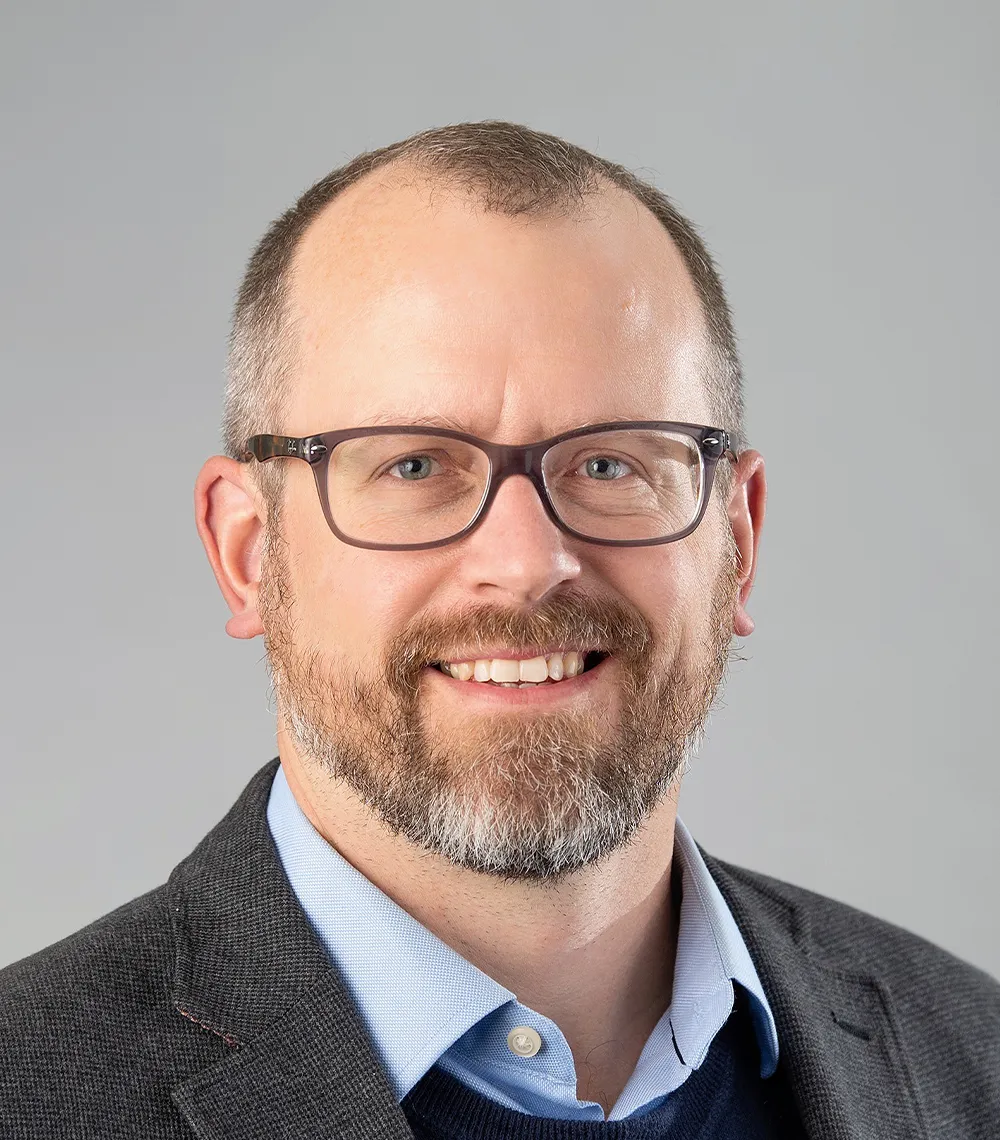
Vassar Welcomes a New Dean of the Faculty, Demetrius Eudell
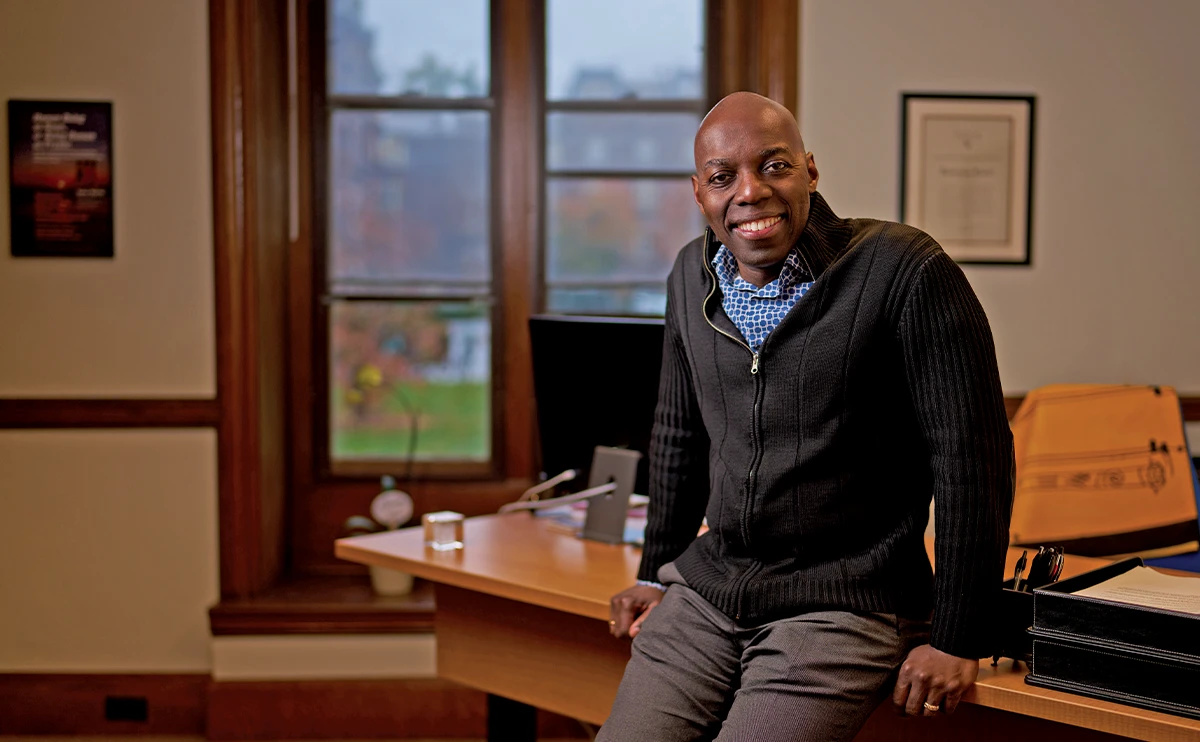
Vassar Welcomes a New Dean of the Faculty, Demetrius Eudell
Eudell comes to Vassar from the Cooper Union for the Advancement of Science and Art, where he served as Vice President for Academic Affairs. He had previously worked at Wesleyan University as Dean of Social Sciences and Professor of History. Eudell graduated from Dartmouth College and earned a PhD in U.S. history from Stanford University. After the start of his tenure in July, Vassar’s top academic officer sat down for a wide-ranging interview.
What attracted you to Vassar?
What would you say to those who question the value of a liberal arts education in today’s world?
Were you a studious child?
How did you decide to major in French as a college student?
How did this lead to a PhD in U.S. history?
What is your academic specialty?
Is there an accomplishment that you’re particularly proud of?

Kelly Marsh
From The Onion to AI
The first Signature Program of the 2025-26 academic year, “Storytelling for Change: Shaping and Sharing Inclusive Narratives in Higher Education, Media, and the Arts” posed the question: “How do we tell impactful stories about the things that matter most, and ultimately, strengthen our relationships to each other?” It was convened by Associate Professor of Psychological Science at Vassar Dara Greenwood and Victoria Grantham, Vassar’s Vice President for Communications.
Preserving our Ability to Live and Learn
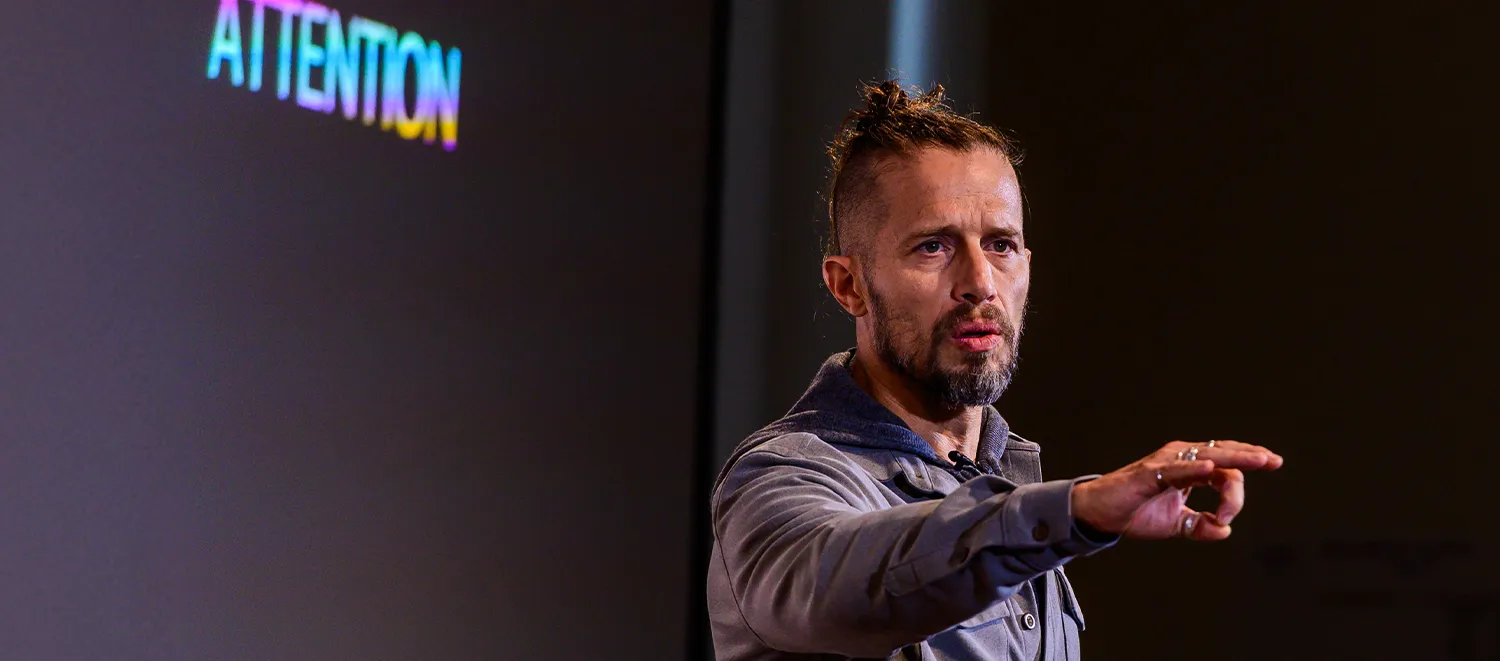
“If we’re going to preserve our humanity and preserve our ability to teach and learn and share stories over the next 20 years, we need to remember how diverse and constitutive of our humanity our attention actually is,” Burnett concluded. “We need to get some new forms of collective action pushing back, and it’s going to take all hands on deck.”
After his speech, he sat down for a conversation with Minerva Tantoco ’86, an early pioneer in AI, holder of four AI patents, and CEO of City Strategies Consulting.
Breaking Down Walls Between Academia and the Public
Panelists included Greenwood, who writes a blog for Psychology Today and whose work has been published in numerous other periodicals; Michele Tugade ’95, Professor of Psychological Science on the William R. Kenan Jr. Endowed Chair, whose research has been published in numerous mainstream outlets; and Robert K. Brigham, Shirley Ecker Boskey Professor of History and International Relations, who has published 11 books.Wes Dixon, Deputy to the President and Secretary of the Board of Trustees, who hosts a Vassar podcast Conversations @ the Salt Line, moderated.
Greenwood made a link to practices that she follows in the classroom—having students make meaningful connections between observations in everyday life and research findings. Brigham said one of his books about his personal history as someone who grew up in the foster care system placed a spotlight on this important national issue. And Tugade talked about applying her work on resilience to real-world problems and audiences, citing her work with astronauts to help them cope with loneliness and stress during trips in small spacecrafts.
Illuminating Critical Stories and Perspectives
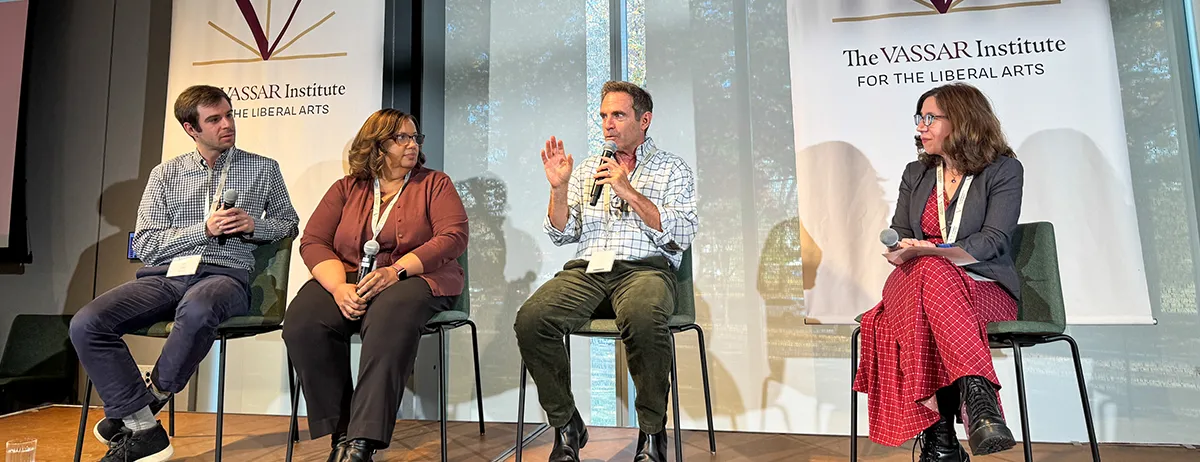
Telling stories has always been a way humans connect with one another, panelists said. Marcus, whose podcast has more than 25,000 listeners and 7 million downloads from people in 200 countries, said, “I love to tell stories—tragic or happy. They help to bring us together and find comfort in each other.”
Telling stories on a public platform can take its toll on the storytellers though, said Clemetson, whose organization provides The Knight-Wallace House—a place for journalists and others to take a break from their demanding and sometimes traumatic work to recharge and focus on meaningful projects.
Gillis said he believed that injecting humor into storytelling can make both mundane and disturbing topics more palatable and relatable.
Carina Cole, a media studies major and Editor-in-Chief of The Miscellany News, said the panel was encouraging. “I think there is a lot of fear surrounding going into this profession right now, understandably, but having examples of people who have succeeded in making careers out of storytelling is invaluable. Just being able to see there are still options for people interested in this career path is important.”
Assorted
Understanding the Current Story of Life After College
In an interactive session titled “Whose Story Is It?” Stacy Bingham, Vassar’s Associate Dean of the College for Career Education, Vassar and Jannette Swanson, Director of External Engagement for Vassar’s Center for Career Education, led attendees in an iterative exercise about the liberal arts and careers.
Courtesy of the subject
Engaging Audiences’ Hearts and Minds Via Live Performances
Building Connection and Community Through Shared Experiences
Greenwood and Grantham were pleased that the varied backgrounds and perspectives of the speakers and attendees had sparked such lively discussions.
“Whether it was from a Poughkeepsie organizer saying that the keynote speaker spoke to her soul, or people tearing up at the theater performances and laughing at Onion headlines, it seemed participants were truly present and engaged,” Grantham said. “I think it’s really important to underscore that stories have the power to move us—in addition to helping us think about things in a different way.”
Greenwood said the ideas sparked at the event would continue to be discussed in other forums. “We saw broad swaths of people connecting with each other and sharing experiences and insights,” she said. “They wanted to keep the conversations going! We plan to follow up with all involved to see where their insights about storytelling and community will take them. Ultimately, the event seemed to tell its own story about how hungry we all are for authentic engagement with each other and with the world around us.”
Kelly Marsh
Student-Faculty Research Is Going Strong at Vassar
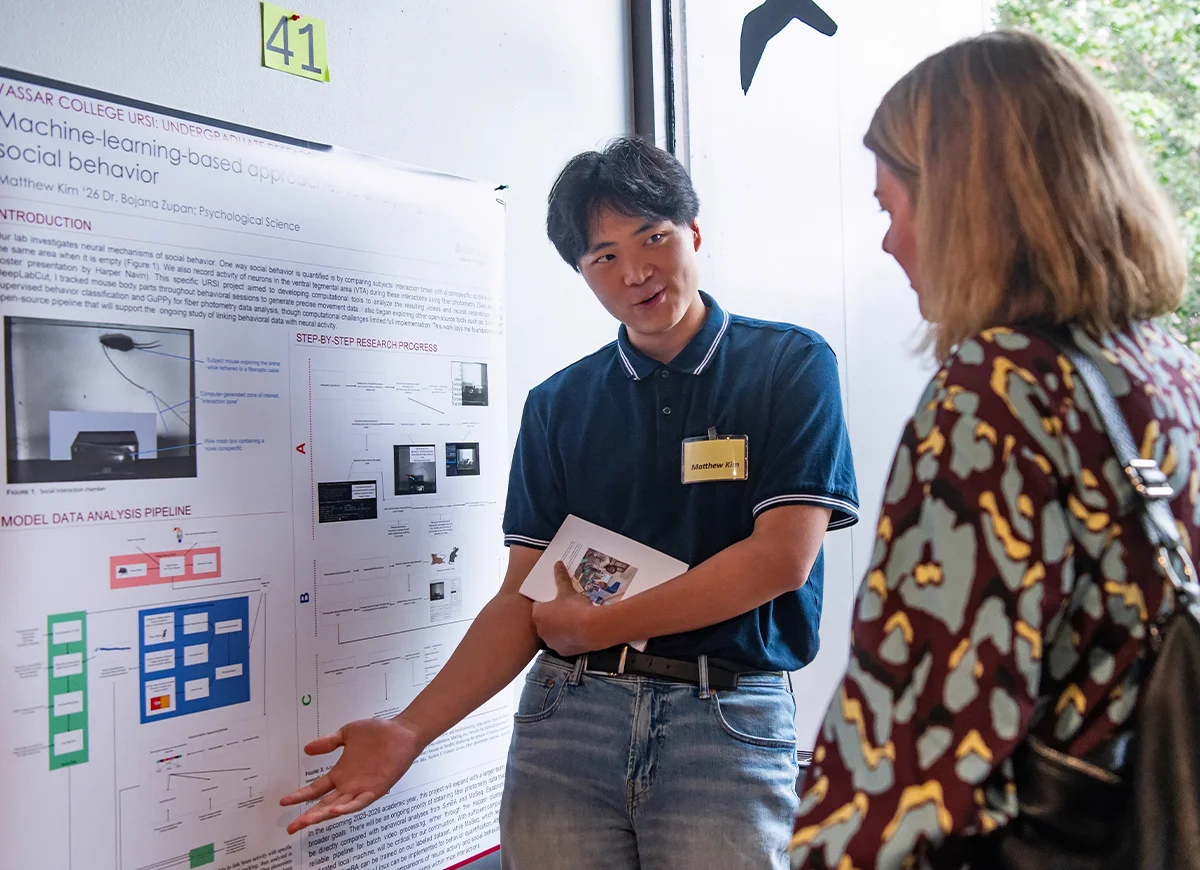
“What we do at Vassar that very few places do is to provide hands-on opportunities for actually touching the data as an undergraduate,” said Abigail Baird ’91, Professor of Psychological Science on the Arnhold Family Chair, herself a former URSI student researcher who went on to earn a PhD at Harvard. “The irony is that a small liberal arts college continues to provide top-tier training and is preparing students to be in the laboratory at a time when so many larger research institutions have been forced to reduce or eliminate student positions.”
Vassar programs remain strong because they are supported by a host of private foundations, endowments from alums, faculty grants, and other independent donations. Read on for a sampling of the projects.
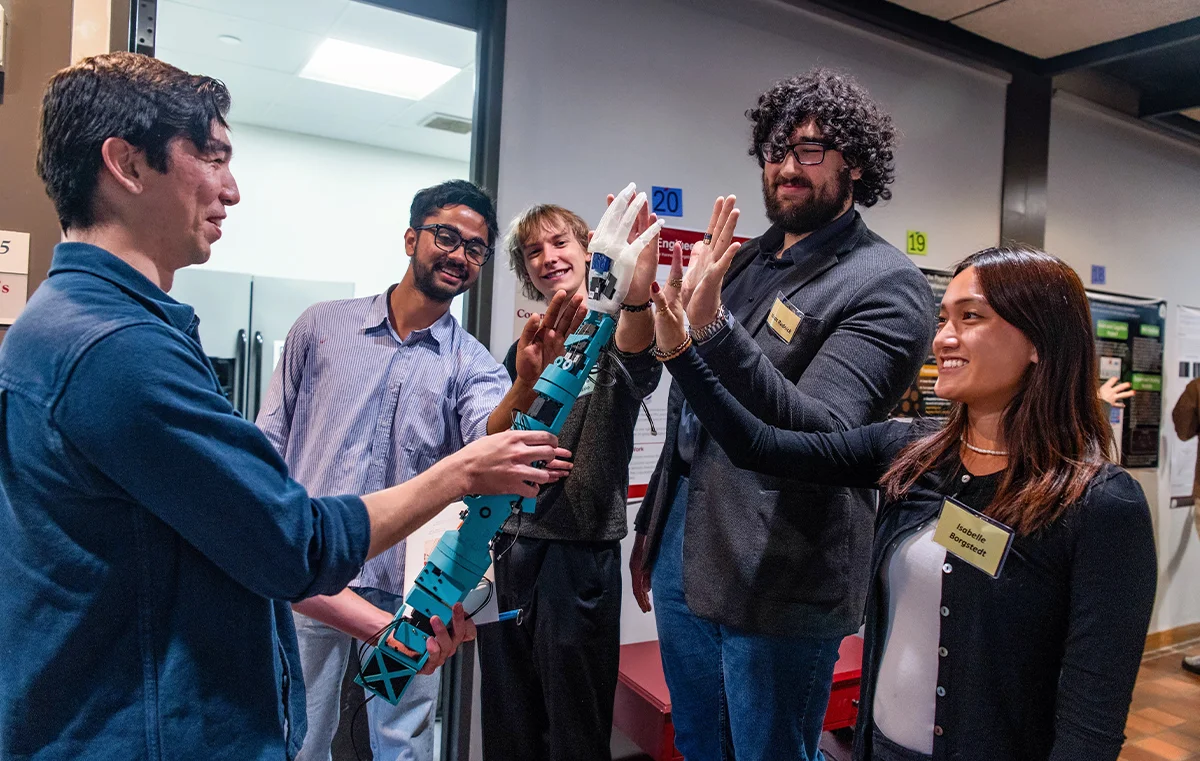
A Robot High-Five
Kelly Marsh
The Oviedo Project: Translating a 500-Year-Old Text About Life in the Americas
La Natural Hystoria de las Indias describes the lives of the colonized people, flora, and fauna of the region. It had never been fully translated into English until Paravisini-Gebert undertook the project in collaboration with Michael Aronna, Associate Professor of Hispanic Studies. “It’s been a challenging project because we are really working with three languages—16th-century Spanish, modern Spanish, and modern English,” said Lilli Palmer ’27, the Ford Scholar who took part in the project this year. The first volume of the translated text will be published later this year—in time to commemorate the 500th anniversary of the completion of Oviedo’s work in 1526.
Assessing Moose Presence and Status in a New Hampshire Forest
URSI student Otis Wildman ’26 and Associate Professor of Biology Lynn Christenson spent the summer evaluating how climate change is affecting the moose population at the Hubbard Brook Experimental Forest, a 7,800-acre northern hardwood forest located in the White Mountains of New Hampshire. On the trip, they monitored cameras that captured the movements of moose and other wildlife. When he returned to Vassar, Wildman used specially designed software to map and analyze the data. “My experience was really useful and let me gain some insight from professionals in the field,” he said.

Natureguy / Adobe Stock
Monitoring Water Quality in the Hudson River and Its Tributaries
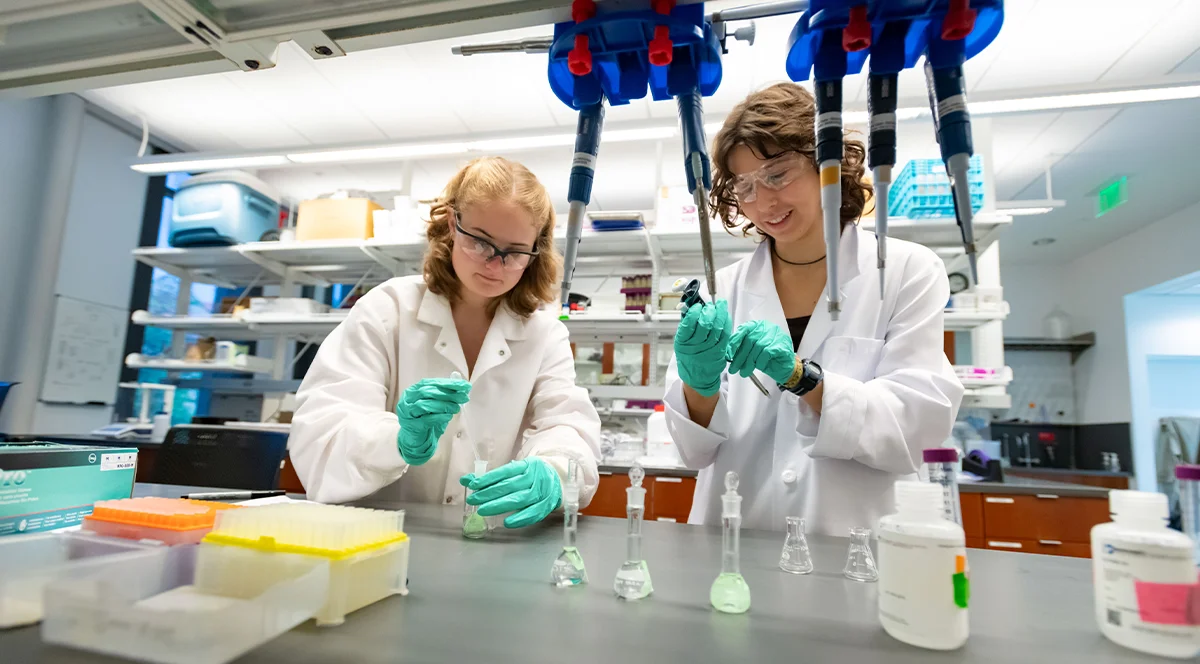
The students analyzed water samples they collected in a lab back at the College, assessing the prevalence of phosphates, which can serve as key indicators of the river’s health. “Phosphates are present in rocks and plants in the water,” Oteiza explained. Too much can indicate the presence of sewage and other pollutants in the river, while too little can also signal other threats to the river’s ecology. The research showed that the levels have not changed significantly since a previous study was conducted about 30 years ago. “I really enjoyed getting out in the community and meeting people who live along the river who are affected by its ecology,” she said. “This summer’s experience was a combination of scientific research and community interaction.”
Faculty mentors for the project were Assistant Professor of Earth Science and Environmental Studies Deon Knights and Associate Professor of Biology Justin Touchon. Both said they had been impressed with their students’ independence in completing the project. “The students were pretty autonomous, and we gathered a lot of good data,” Knights said.
Mitigating Prejudice Development
As an example, team member Asiyah Abbas ’27 said, “All U.S presidents have been men and none have been women. So why is that? Most of it’s because of voter bias and a lot of barriers for women to get into fields like politics. But a child would immediately jump to inborn qualities [of women] and think that this discrepancy is fair, which it obviously is not,” Abbas said.
With the help of a cartoon game-based experiment designed by Peretz-Lange, the students met with hundreds of 5- to 10-year-olds in person and over Zoom to understand their reasoning about fairness. No matter how the research turns out, Peretz-Lange said, the mixed group of student-scientists are already changing the face of the profession for children, who often see science as a male profession—that can discourage girls from wanting to pursue science.
The Costs and Benefits of Empathy
“Basically, we asked ourselves: What psychological resources or strategies can people turn to that would allow them to be more compassionate, especially when they are dealing with many stressors or challenges in their lives?” They asked their URSI students to take that concept and run with it.
Madeline Busam ’26 became intrigued by “self-concept clarity”—the extent to which an individual’s beliefs about themself are clearly and confidently defined. With her professors’ help, Busam designed a survey to measure self-concept clarity and its potential correlation with compassion burnout, recruiting about 300 adult participants through the data site prolific.com.
“We’ve definitely found some stuff that correlates with what I have predicted: That having a higher level of self-concept clarity is going to lead to greater well-being and less compassion fatigue,” said Busam. Baird said she and Morrow will continue to work with Busam, who is one of at least two students in this group likely to be able to publish their studies. “She’s going to see it all the way through with not one but two professors supporting her as an undergraduate, and that’s a wonderfully unusual setup,” Baird said.
“It’s been very helpful and eye-opening for what I want to do after Vassar,” said Busam, who is considering pursuing psychological science in grad school. “I think I’ve been able to get a lot of skills out of it that I wouldn’t have gotten at a big school where your professor might not even know your name. Being able to work on this small a scale, one-on-one, has been really amazing.”
Karl Rabe
Analyzing NBA Player Contracts
Koppolu, who will continue analyzing the actual outcomes of the players’ gambles during the academic year, said collaborating on a single project with a faculty mentor was an enlightening experience. “It was like I was at one end of a maze and he was at the other, and while he tried to guide me, I had to make a lot of decisions on my own because he couldn’t see what I was seeing.”
Said Ge, “This was truly a collaborative effort, and [Koppolu’s] liberal arts training helped him deal with the challenges he faced independently and iron out most issues himself.” These are abilities that will serve Koppolu well in his post-Vassar life, his mentor predicted.
Vassar
Celebrates the Enduring Tradition of
Convocation
with Biology Professor Jodi Schwarz
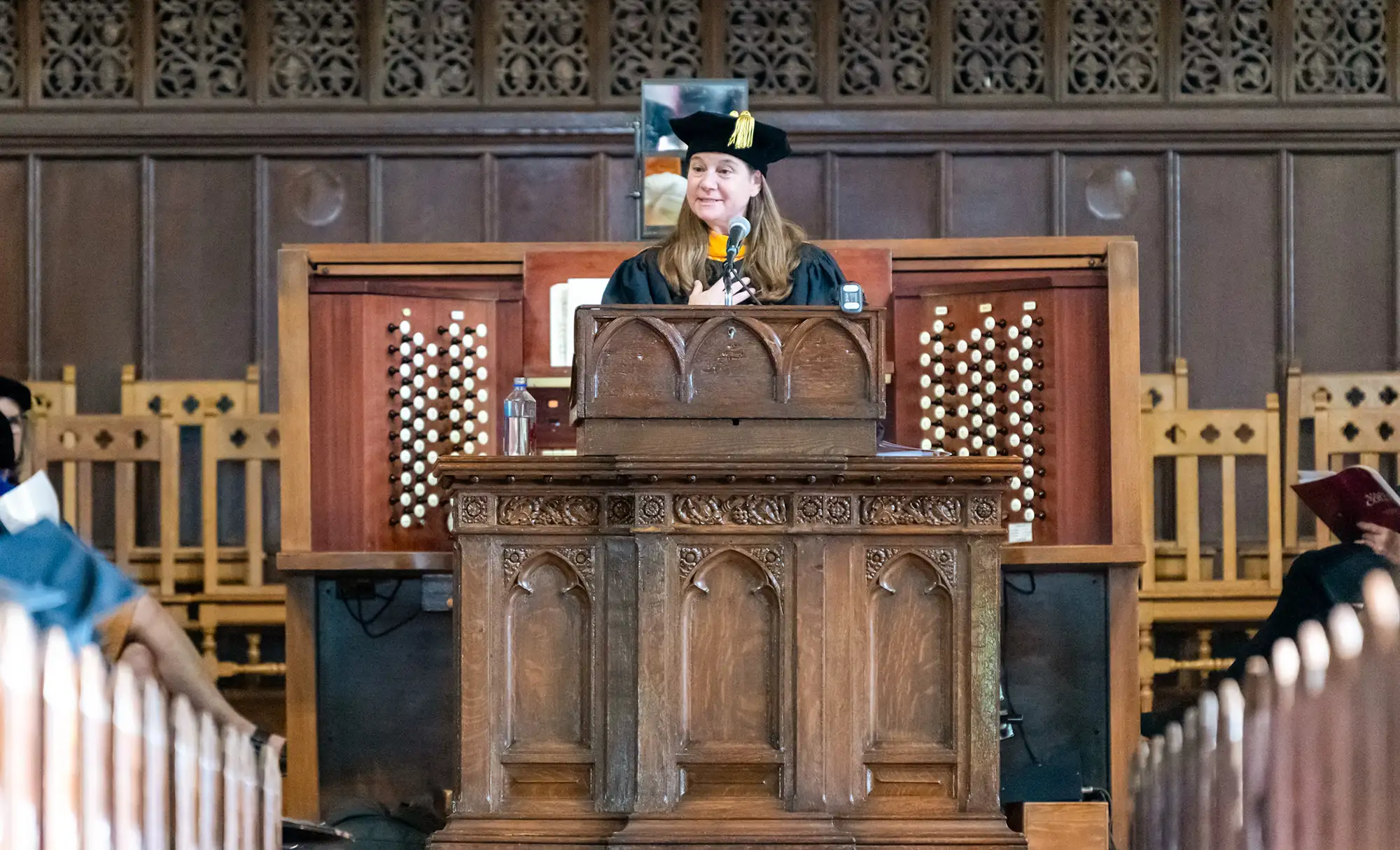
Vassar kicked off the Fall Semester with its 161st Convocation ceremonies in the Chapel by celebrating and acknowledging the changes and challenges that are part of any college career—and life after Vassar.

Karl Rabe
onvocation speaker Jodi Schwarz, Professor of Biology and Founding Director of Vassar’s Grand Challenges program, alluded to her own serpentine academic journey. “I hated science in high school,” she said, noting that she had gone out of her way at her own alma mater, Oberlin College, to avoid science classes.

That voyage eventually led Schwarz to pursue research into the magical symbiosis between algae and coral, a key biochemical interaction that helps to sustain life on the planet. “Corals live in the tropical oceans, which are essentially food deserts. There are not enough basic nutrients in tropical waters for algae, the plants of the sea, to grow,” she said. Yet, “improbably, at some point in the evolutionary past, some algae that needed nutrients and coral that needed food must have made contact and realized in a biological sense that what one needed, the other could provide, and that if they integrated their different ways of being into a new, symbiotic relationship, they could turn this food desert into habitable space.”
Karl Rabe
“If there is anything that we know about a liberal arts education it is that it pushes us all to be collaborative, to pull our perspectives and skills together to tackle challenges,” she said. “The most profound moments of our lives can happen when we place ourselves into a state of dislocation and see things in new ways, learning to recognize what others have to offer and discovering new parts of ourselves.”
Read a transcript of Professor Schwarz’s Convocation Address.
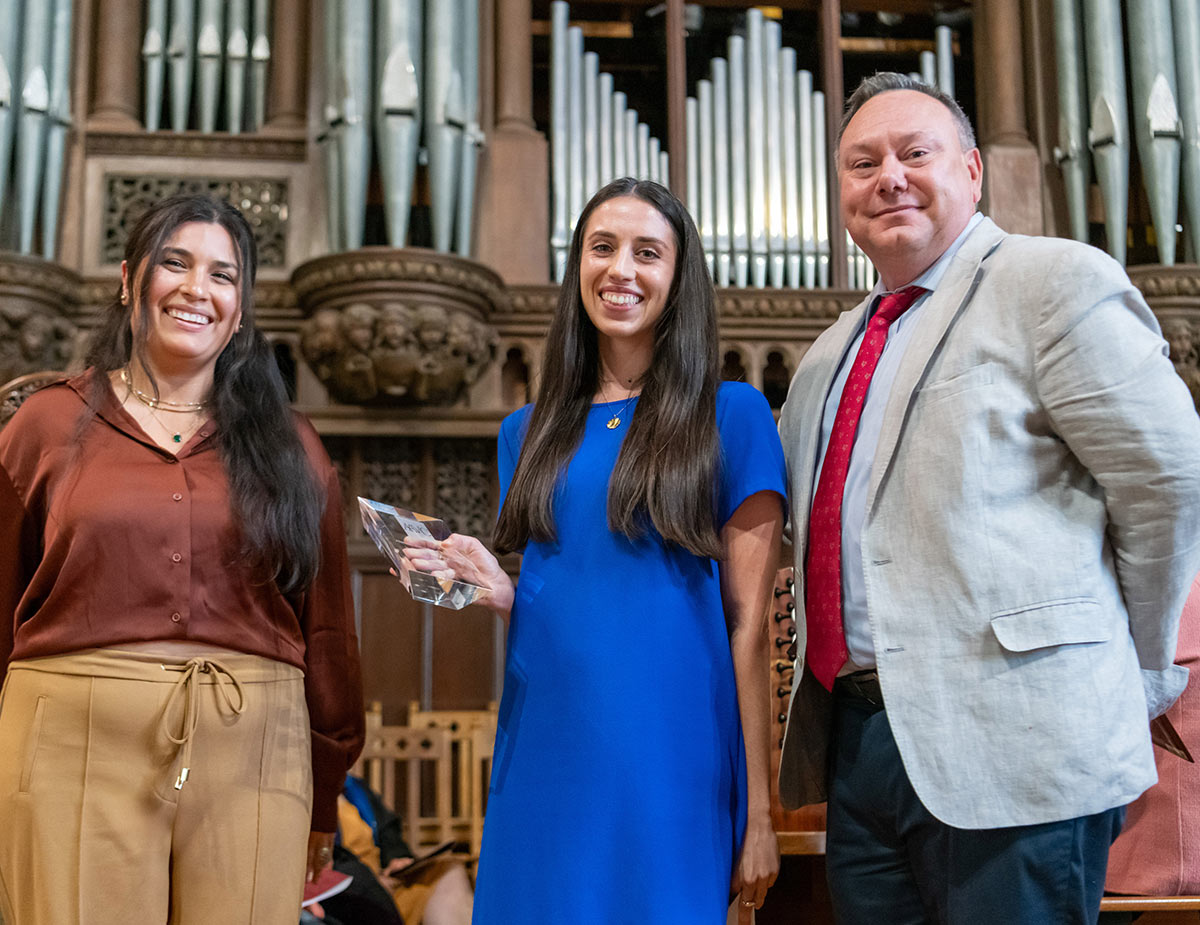
During Convocation, the Alumnae/i Association of Vassar College (AAVC) bestowed its Young Alum Achievement Award upon Elise Shea ’19. Founder of Conversations Unbound, a student-run organization that employs displaced persons from countries throughout the world to provide paid tutoring services to current students at Vassar and other educational institutions. The annual award is given to a Vassar alum of the last decade.
Shea earned her master’s degree in public policy at Oxford University and currently lives in London, where she works as Managing Director at the Global Development Incubator. Gamarra noted that Shea had founded Conversations Unbound as the Syrian civil war was intensifying, “and the media portrayed displaced people as either a burden or a threat. Elise chose to challenge these assumptions by recognizing their invaluable experiences and skills.”
Shea credited her Vassar education with providing the spark for her idea. Classes like Politics of Humanism, she said, “changed my life and had a direct influence on my work founding Conversations Unbound.” And Professor of History Himadeep Muppidi’s Subaltern Studies class, she acknowledged, “helped me to identify and be attentive to the voices that are never heard, and I thought about this class all the time during my work collecting displaced persons’ opinions of humanitarian aid. And I only got the job [at the Global Development Incubator] because I took Candice Lowe Swift’s anthropology class on research methods and because I had some quantitative experience from my econ classes.” Vassar, she noted, has remained a rudder guiding her path.
Stockton Photo, Inc.
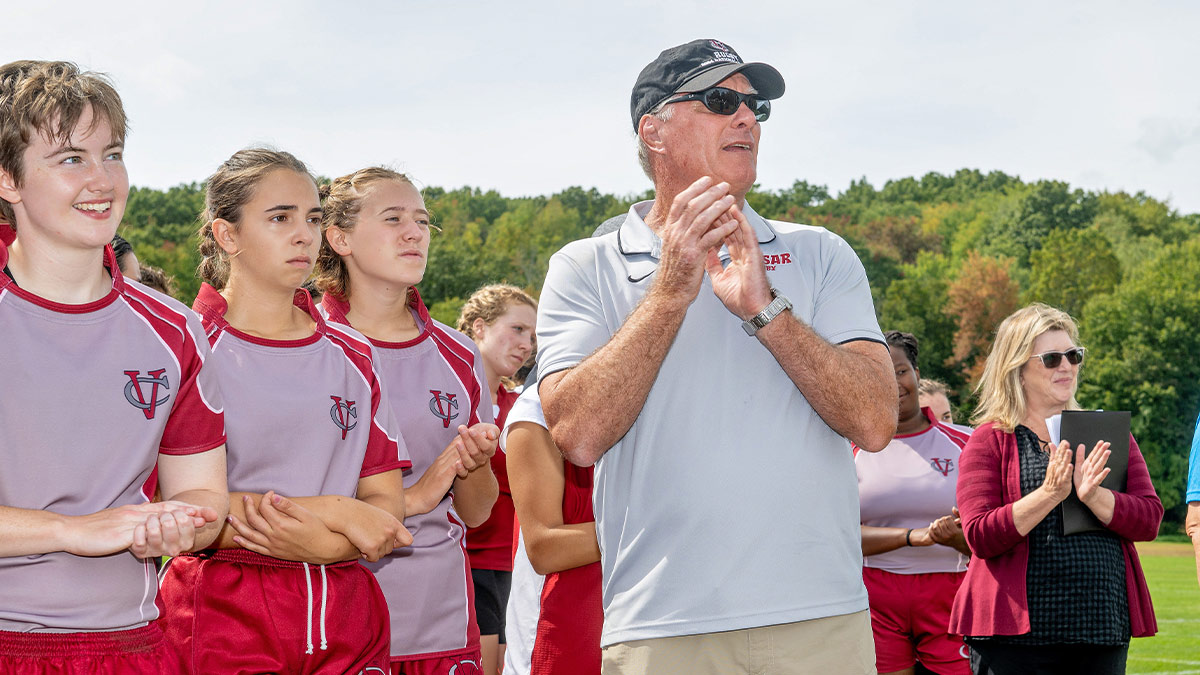
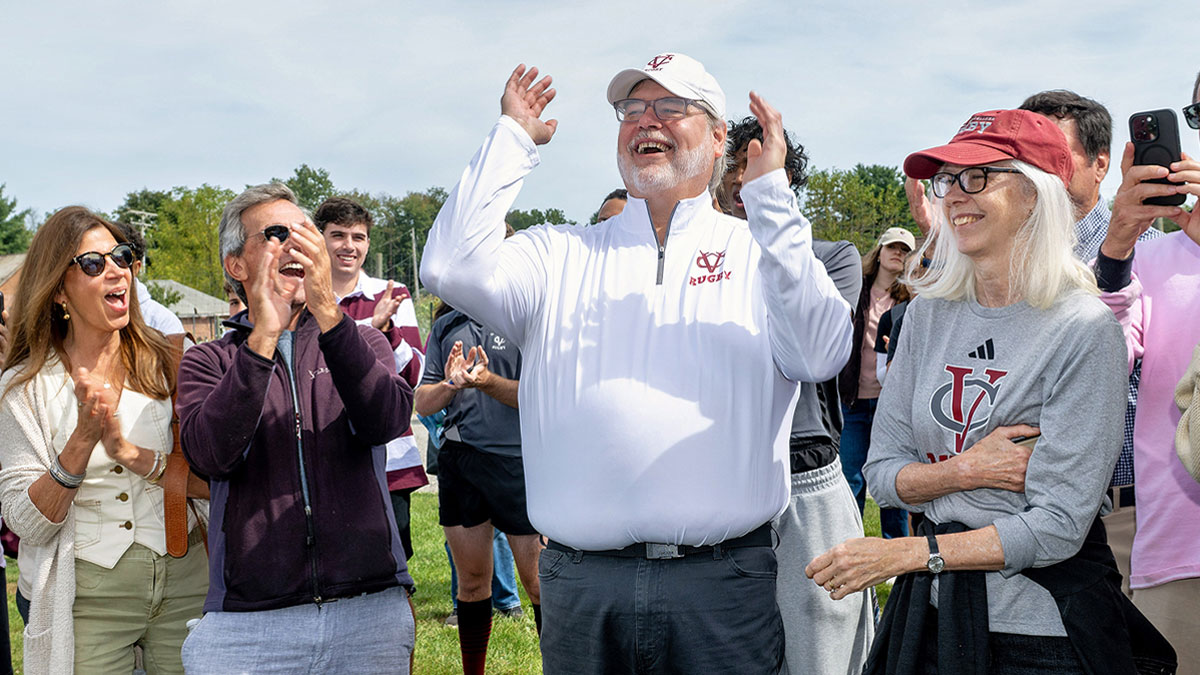
Newly Improved Rugby Fields Dedicated to Beloved Coach and Stalwart Alum Volunteer
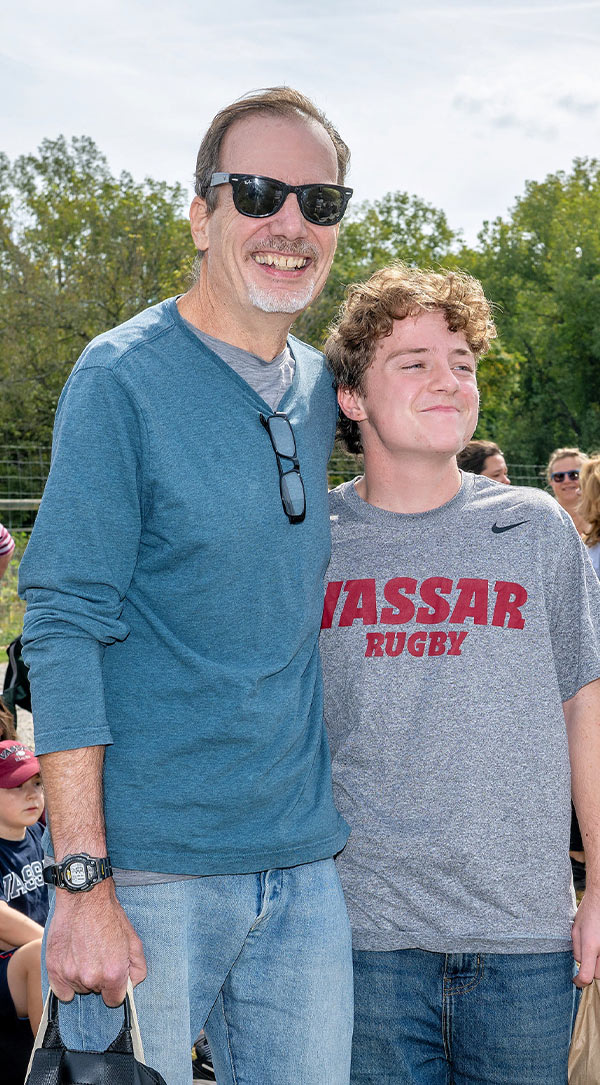
Speakers at the event included Brown and Williams; President Elizabeth Bradley; Michelle Walsh, Director of Athletics and Physical Education; members of the Office of Advancement; and donors Philip and Ann White, parents of rugby alum Danny White ’25—a third-generation Vassar grad whose grandmother, Frances Hamilton White, graduated in 1956.
Stockton Photo, Inc.
Philip White said he first became acquainted with Coach Brown when Danny was injured during the semifinals of the national Final Four in their sophomore year. “Despite all the demands of preparing for the finals the next day, Tony took the time to call us after the game and talk to us about Danny’s injury,” White said. “We were really impressed that he would spare some time to help put our minds at ease and talk to us not only about the injury but tell us how much Danny had added to the team that year. And more importantly, he told us how much more confident and buoyant Danny had become over the course of the season.”
Stockton Photo, Inc.
Later, the Whites approached Brown and asked how they could assist the program, and a plan for renovating the fields was hatched.
Speaking at the dedication ceremony, Ann White said rugby had been a “cornerstone of Danny’s Vassar experience.” She called Brown “the coach I wish I’d had when I was a kid” and described Williams as a volunteer “who won’t let the flame of rugby go out. He’s on the sidelines on weekends and, during the week, he’s mentoring the players for their post-Vassar lives.”
Brown thanked the Whites for their generous gift. “Through your generosity, you have validated this experience, and improved it, and it is a gift that will keep on giving,” he said. “Past, present, and future generations of Vassar rugby players will derive real joy from your gift, be it through pride in such a beautiful venue, the successes of the teams, or a safer student-athlete experience.”
President Bradley presented the Whites with a ball signed by the players. She noted that the women’s team had won the national championship four times and was Vassar’s most successful athletics program. But she added that sports at Vassar are about more than winning championships. “Athletes have to learn how to hustle when they are truly exhausted and to lose gracefully and win gracefully,” she said.
The day concluded with dominant performances by both teams. The men’s squad scored 17 tries and kicked seven conversions to rout Montclair State, 99–10, while the women overwhelmed Fordham, 119–5.
Lessons That Transcend Borders
Director of Fellowships
“The fellowships and internships that support students in pursuing language study and gaining professional experience abroad are invaluable in helping them step outside of the U.S.-centric context and gain new perspectives,” said François Olivier, Director of Fellowships, a position recently created to oversee the many opportunities available to students. “These experiences are central to the goals of a liberal arts education.”
Courtesy of Madeleine Paternot ’95
Art in the Alps
Longing for Japan
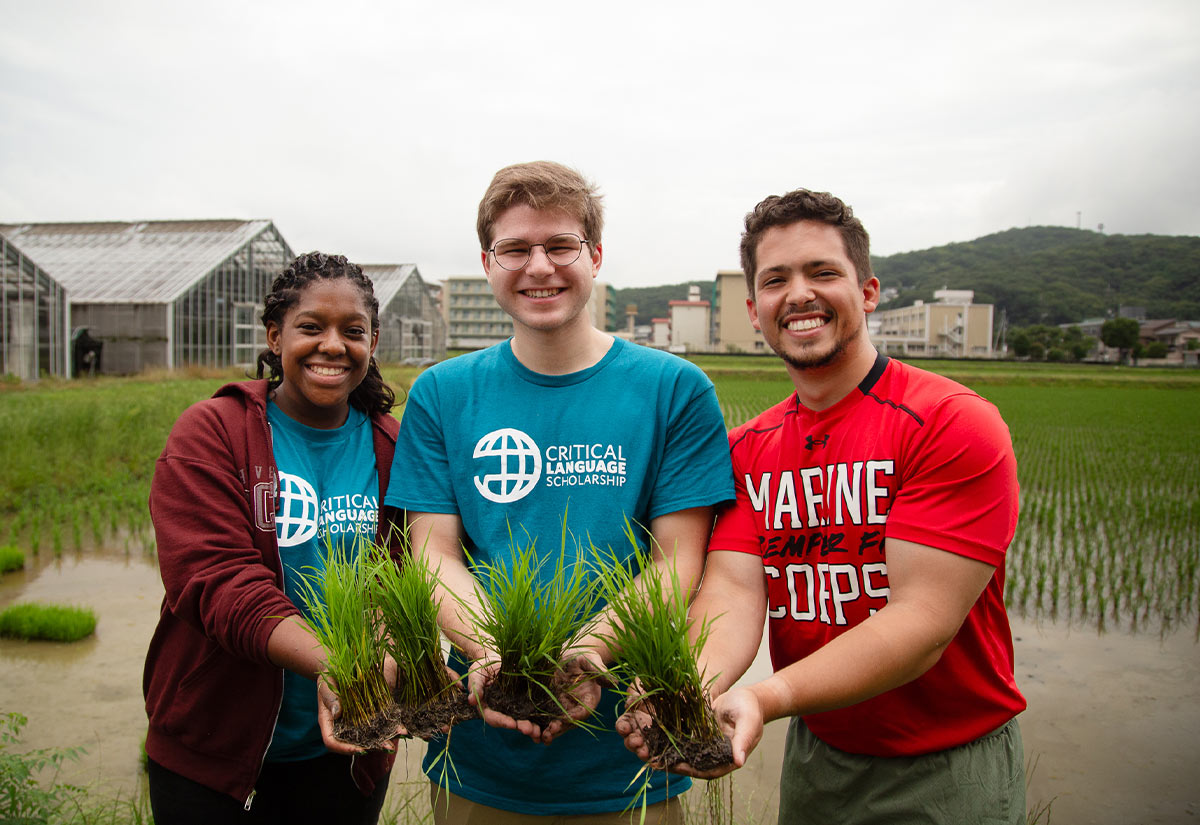
Image courtesy of the subject
As a STEM major, Graber also believes that his interest in biology helped broaden his classmates’ perspectives—through simple acts such as pointing out plants and animals he knew or discussing why Japanese biological research isn’t widely publicized in American journals. He was also able to have fun with his Japanese roommates and language partners, some of whom are training to become English teachers, by sharing Western customs and teaching them English slang.
Spending time in Japan also gave Graber an opportunity to learn how to build and maintain relationships within his diverse cohort of American students who represented a broader cultural and political spectrum than he found at Vassar. “Learning to stay connected to people who don’t always agree was a crucial part of my experience,” he said, explaining that, as a queer man, he found new contexts for having self-respect, despite others’ perceptions.
Although developing the skills to navigate different cultures is a key part of any international experience, recognizing the cultural norms in Japan at times presented challenges. “They were tricky to learn, trickier to implement,” he said. Everything from distinctions in how to address different people depending on their social status to not acknowledging someone who sneezes, took some getting used to, he reported.
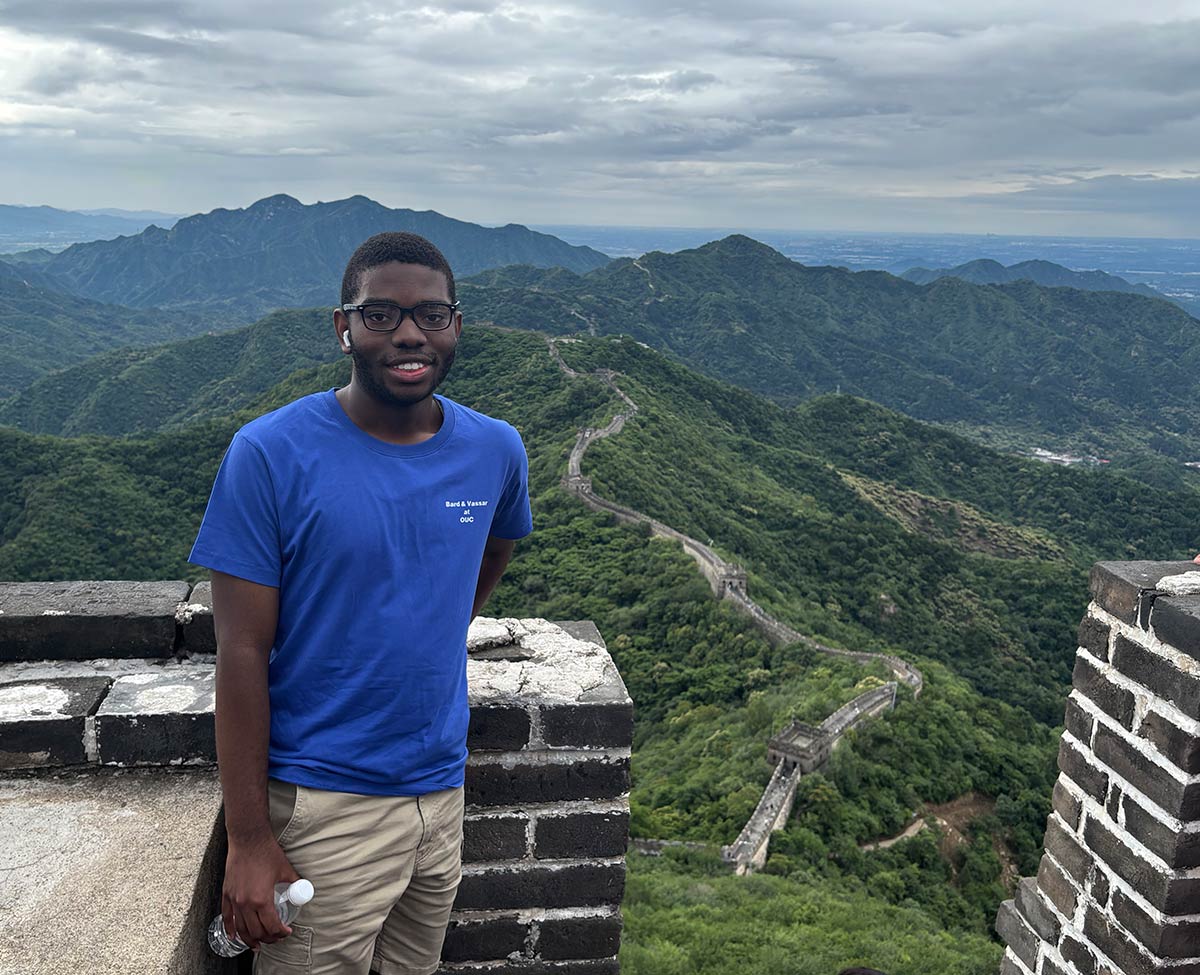
Image courtesy of the subject
Soaking in Chinese Culture
He admits to being surprised by the friendliness of the people he encountered and how easy it was to explore a city with extensive public transportation. He appreciated the weekend trips led by professors from Vassar and Bard College to Jinan, Tai’an, and sections of the Great Wall of China in Beijing. And despite the challenges of studying a new language in such an intensive way, the program whetted his appetite for more travel and study abroad.
“Although I took elementary Chinese last year at Vassar, I struggled with the classes here—it’s such a different language,” he acknowledged. “But the immersion aspect really helped, so I was able to see some improvement. And it helped that the Chinese people were really willing and patient with me.”
Experiencing Brazil
“There was little exposure to any of that where I grew up in suburban Connecticut,” she said, explaining that she is thinking about a career in teaching or in museum education. “I think any career would be helped by having access to different languages and cultures.”
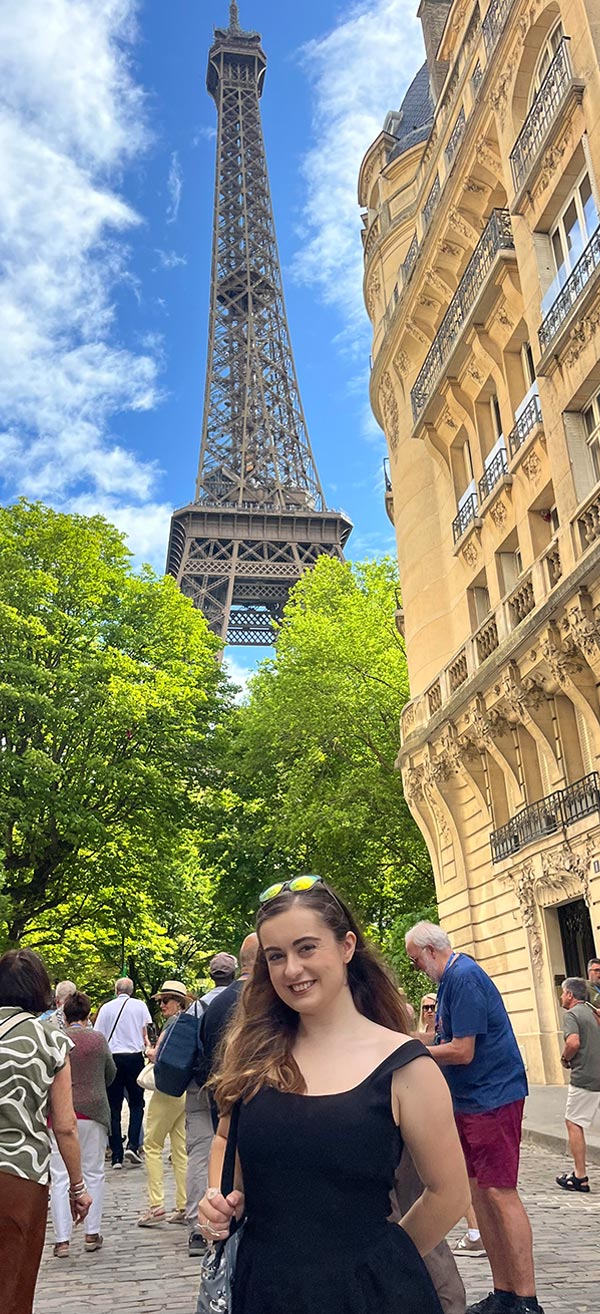
Image courtesy of the subject
Image courtesy of the subject
An Appetite for Travel
“I didn’t want to be away for a semester or an entire year,” she said. “I have campus commitments that I didn’t want to miss out on—work-study, a stipend job, and extracurriculars like a cappella and dance—so this was perfect.”
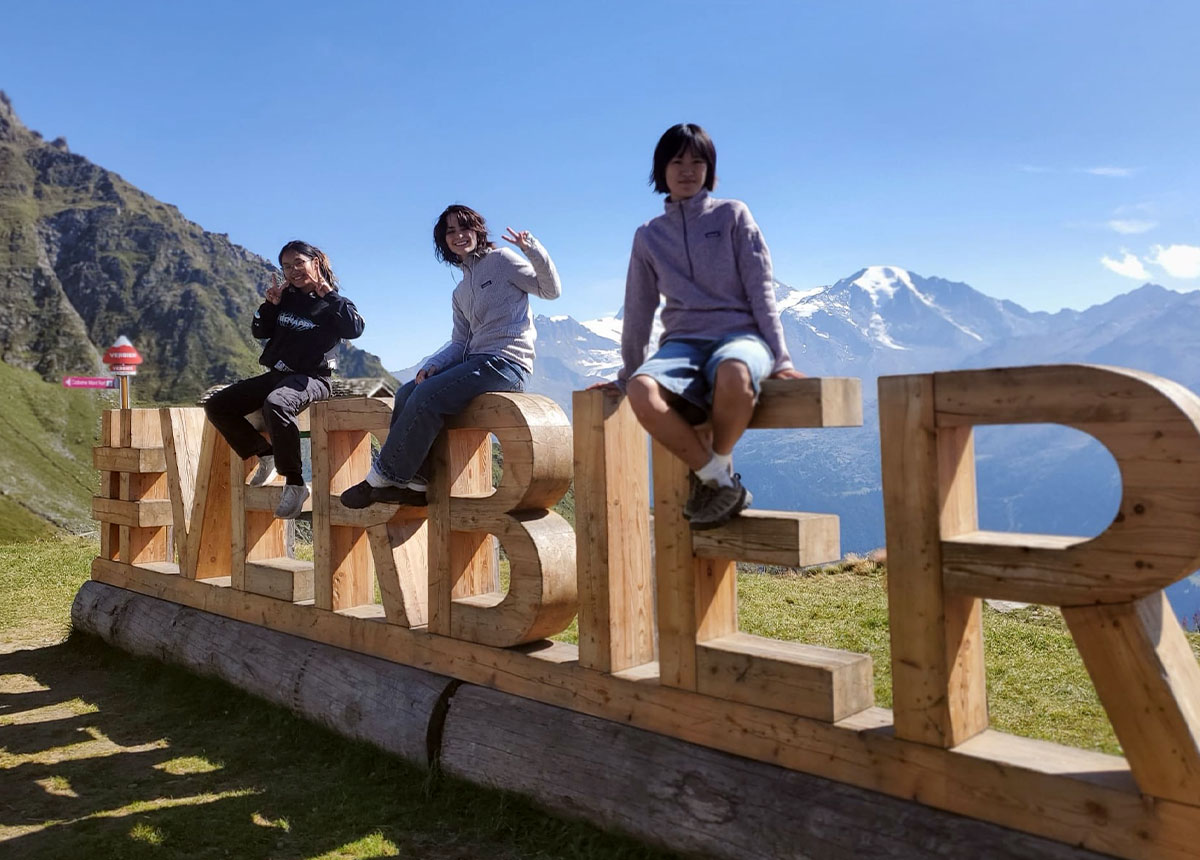
Despite all of her planning, it was a combination of fate, luck, and persistence that led her to Sabaye Sok, a caricature artist whom she met at a Japanese festival near the Arc de Triomphe. The artist’s passion and career became the subject of Arenberg’s final project in the summer program.
Now a self-appointed ambassador for the CCE, Arenberg loves sharing stories about her time abroad as well as the value of the structure and guidance she received from her Vassar advisors.
“I’m really eager to let other students know about my experiences,” she explained. “I don’t think that a lot of students understand all the possible fellowship opportunities, so one of my key goals is to help demystify the process.”
Choosing South America
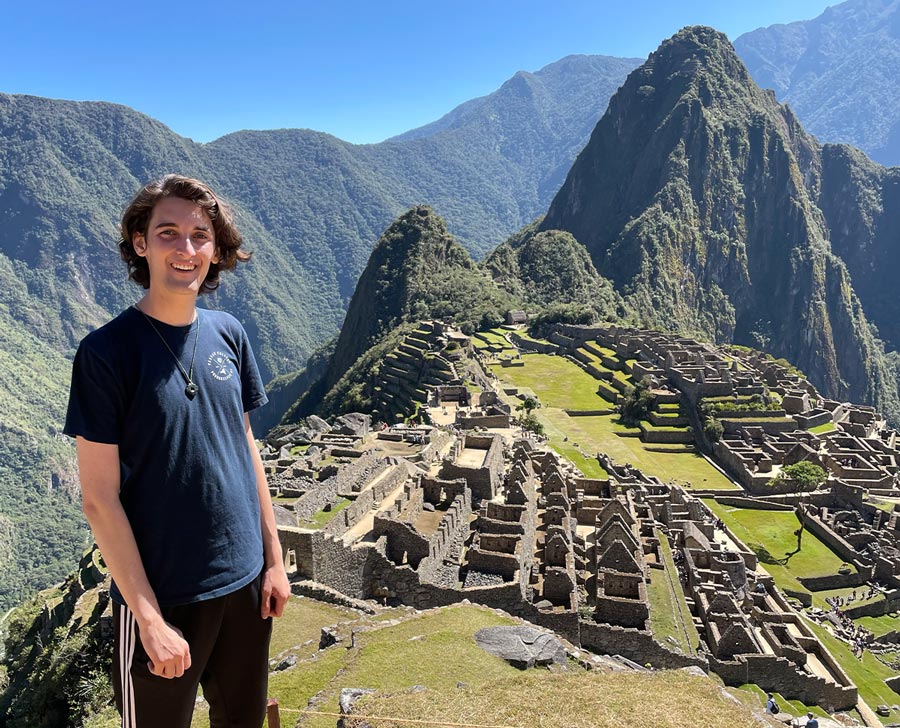
Image courtesy of the subject
Lewis, an international studies major, chose to work in Colombia as an English Teaching Assistant as a way to explore his diverse interests, including migration (Colombian communities have welcomed millions of Venezuelans), as well as the country’s reputation as home to the most diverse bird population in the world.
Lewis’s love of teaching developed during his time at Vassar when he worked with Hispanic and immigrant communities in Poughkeepsie. He teaches English classes at the Universidad Cooperativa de Colombia’s Pereira-Cartago campus and volunteers at museums and public schools.
“At Vassar, my professors helped me explore the implications of what it means to teach English abroad,” he said. “They challenged my thinking about why I would apply for such a prestigious award and helped me understand how to do good in the world and become part of a country and a community outside of school.”
Young Alums Get a Taste of European Art
Image courtesy of Bart Thurber
or three and a half weeks this past June and July, three young Vassar alums who had worked at Vassar’s Frances Lehman Loeb Art Center while they were students traveled to Europe with Bart Thurber, the Anne Hendricks Bass Director at the Loeb, to immerse themselves in the art world.
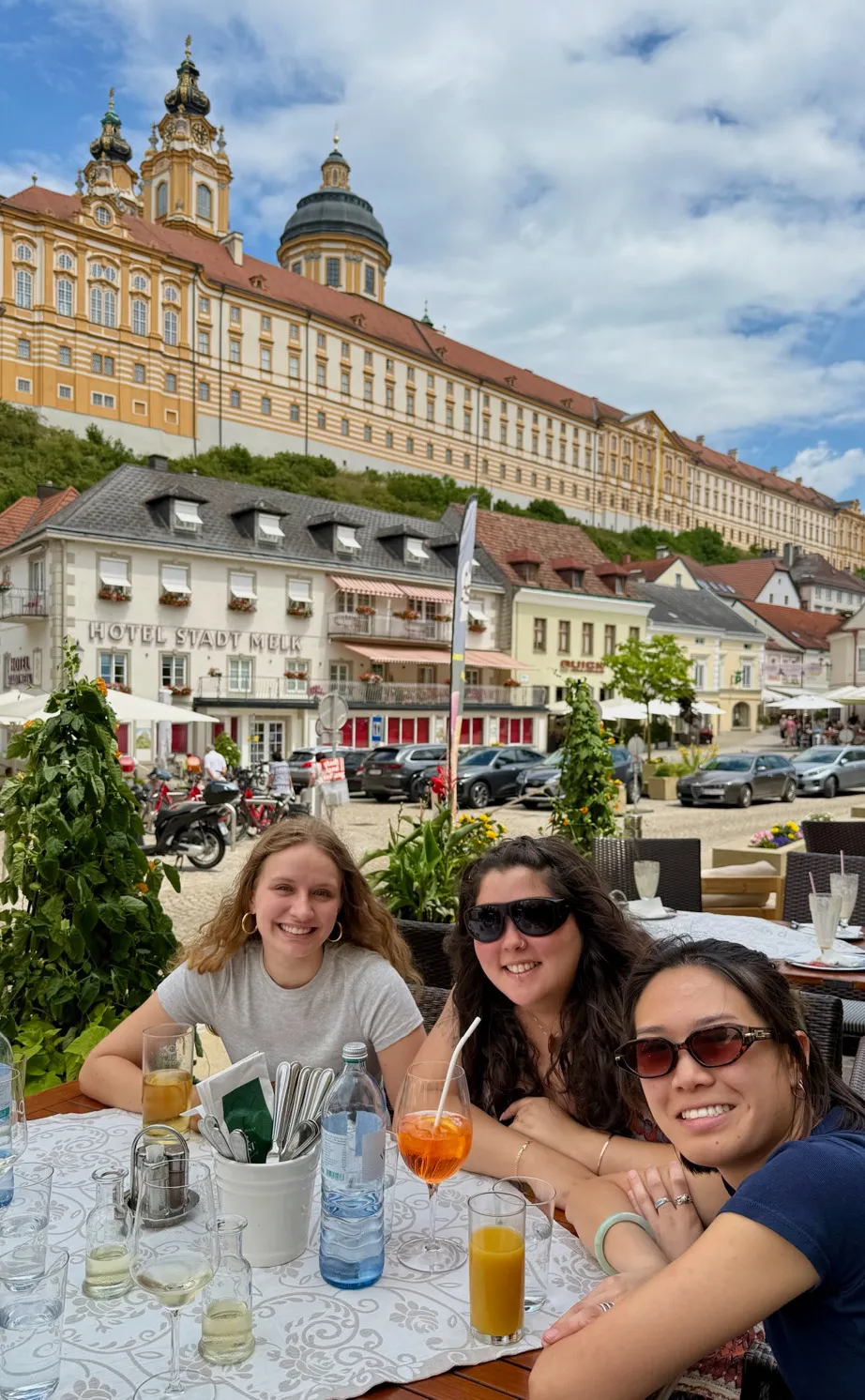
The alums, Betsy Subiros ’25, Emma Larson ’25, and Kathleen Chang ’25, were the first to participate in the Jamee Gregory Summer Research Program, established by Jamee Tucker Gregory ’70 and her spouse, Peter Gregory, both dedicated patrons of the arts. The young alums engaged with curators, conservators, and directors of museums and galleries in the Czech Republic and Austria.
Thurber said Subiros, Larson, and Chang were chosen for the trip because they had worked at the Loeb all four years while at Vassar and had taken his Museum Studies seminar.
“This gift from the Gregorys is giving us the opportunity to have our students or young alums conduct primary research at overseas museums that in many ways are different from ours,” he said.
Jamee Tucker Gregory ’70 said she was thrilled to learn how much the young alums had enjoyed the trip. She had first experienced viewing art in Europe during a summer session sponsored by Sarah Lawrence College while she was a student at Vassar. A French major and art history minor, Gregory spent part of that summer in Paris and visited the Louvre. “Many students don’t have such an opportunity, seeing works of art firsthand, and nothing can compare to that,” she said. “That experience opened my eyes in so many ways, so I see this gift to the Loeb as a way to give back for my Vassar experience, and Bart’s connections in Europe meant he knew which collections ought to be seen.
“The Loebs were friends of my family,” Gregory continued, “so there was a wonderful synergy to all of this.”
Hear what our alums had to say …
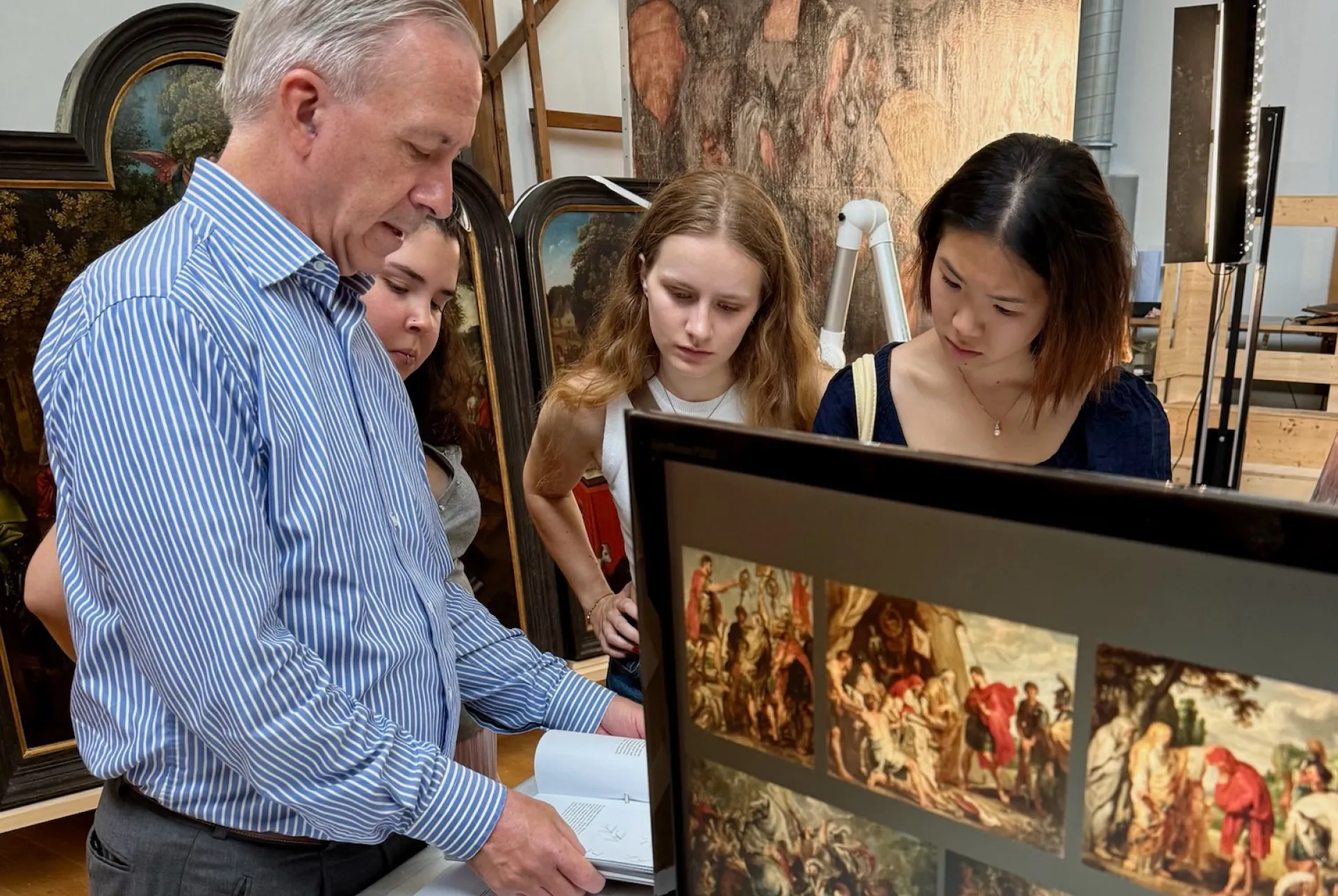
Image courtesy of Bart Thurber
Emma Larson ’25
Registrar
Arcadia Art Consultancy, Charlotte, NC
“I first heard about this opportunity when I was working at the Loeb in the winter of my senior year, and then Kathleen and Betsy and I started having dinners together and talked about our plans for the trip. Bart said we’d be the first of many to go on this trip and that we’d be talking afterward about our experiences to get a good sense of what we liked and perhaps what should be eliminated on the next trip, to make future trips more effective for students and alums. At its core, it was sort of an art history and cultural studies trip, engaging with museum professionals to learn about the culture and the history of the locations we visited and how different museums and cultural institutions work. My current job involves advising clients what to do with the art they have acquired, and I got a chance in Europe to see how public-facing institutions do this. Definitely, a lot of things about the trip helped me in my job, especially [visiting] contemporary museums and art spaces because a lot of what I’m engaged in involves contemporary art.”
Kathleen Chang ’25
Former Docent
Frances Lehman Loeb Art Center
“Being the first group to do this, we got to meet with people at a lot of different museums and collections, seeing the back end of museum operations, or going to shows and talking about what we liked with someone in charge of the show. We also had the opportunity to explore Prague and learn more about the city’s history. And I learned more about how to engage audiences in fun and creative ways. I didn’t have an answer to what I wanted to pursue in my career, but now I realize that what draws me into museums the most is the audience engagement part. What made the trip special for me was that it wasn’t a traditional research trip but rather a time when we all experienced these things together, just talking about art in a bubble for a month alongside people who are also passionate about art.”
Betsy Subiros ’25
Collections and Registrarial Fellow
Frances Lehman Loeb Art Center
“I remember getting an email from Bart about the trip as I was walking back to Ferry House one day during my senior year. I saw it as an opportunity to do something quite different from studying or working at Vassar, to go abroad and get a behind-the-scenes look at museums and how they work over there. I applied to work at the Loeb my very first week on campus, and the next four years there really informed me about what I want to do as a career going forward. My Venice experience [Subiros, Larson, and two Loeb student employees had analyzed exhibits at the renowned Venice Biennale in 2024] and now this one really showed me how many different museums operate. A highlight of the trip for me was meeting Dr. Jonathan Fine, Director of the Kunsthistorisches Museum [Vienna], who had been mentored by Bart when he was a grad student at Princeton and Bart worked at the museum there. I learned so much observing their conversation over dinner one night.”
For Students, Study Abroad Starts With
Letting Go
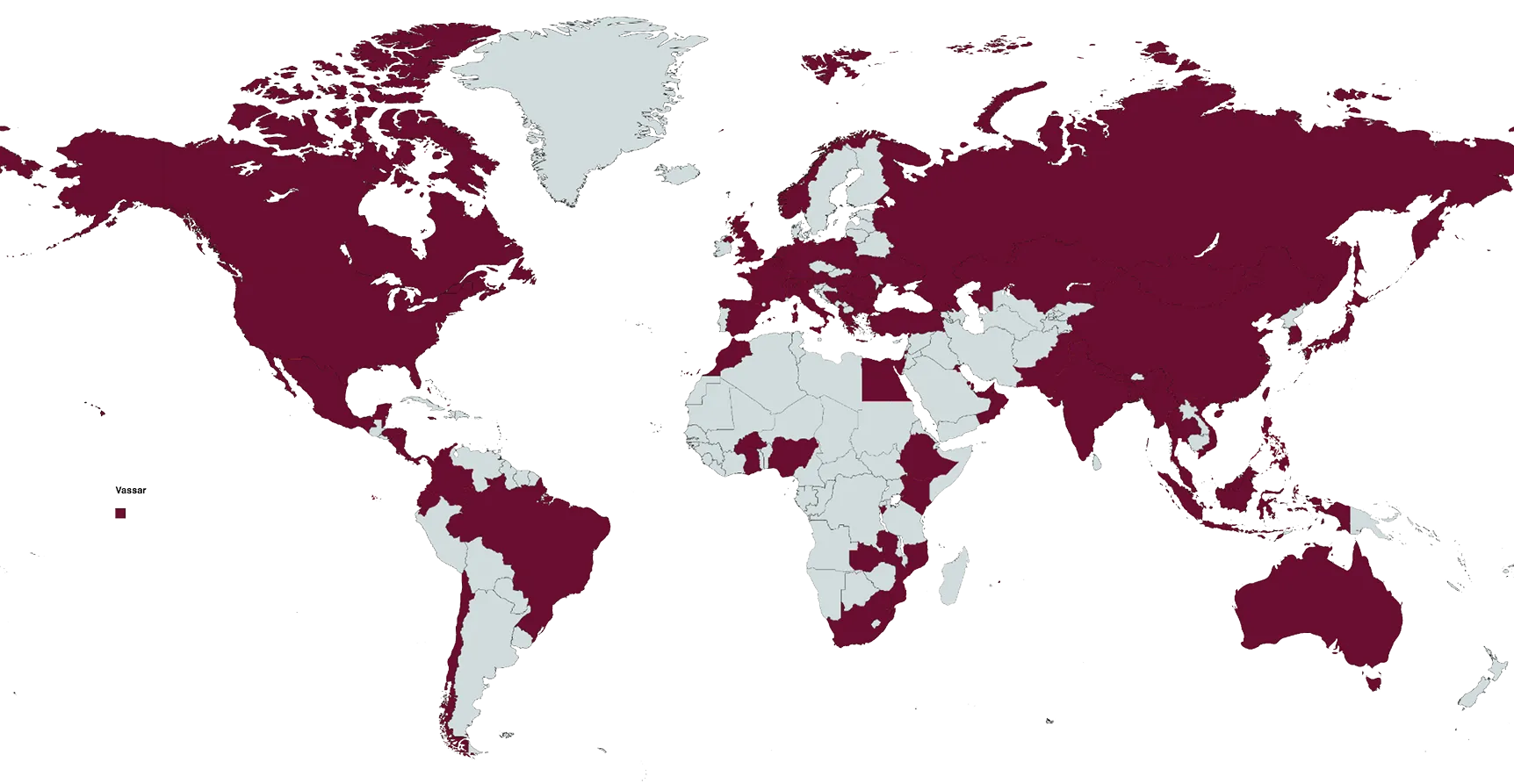
here is little that compares with the heady excitement, anxiety, and anticipation of leaving the familiarity of Vassar’s campus to study in a wholly new environment—a place with a different culture, traditions, and, perhaps, language. But it is exactly what 50 percent of all Vassar students choose to do at some point during the course of their undergraduate education. Each year, Vassar’s Office of International Programs works closely with faculty who play a major role in advising and supporting around 300 students, finding which of the 135 programs in 25–30 countries will help further their individual academic and personal goals. To do so, the College creates and oversees many international programs, often with faculty on the ground, and also works in partnership with other institutions to help increase the range of offerings.
“The College’s investment in study-abroad programs demonstrates our belief in the value of global learning to a liberal arts education,” said Kerry Zuccaro, Assistant Dean for Global Partnerships and International Programs. “The more diverse and meaningful opportunities we create with international institutions, the more innovative opportunities there are for students. And it pays off—half of our students take advantage of these opportunities, compared with 11 or 12 percent from other colleges and universities nationally.”
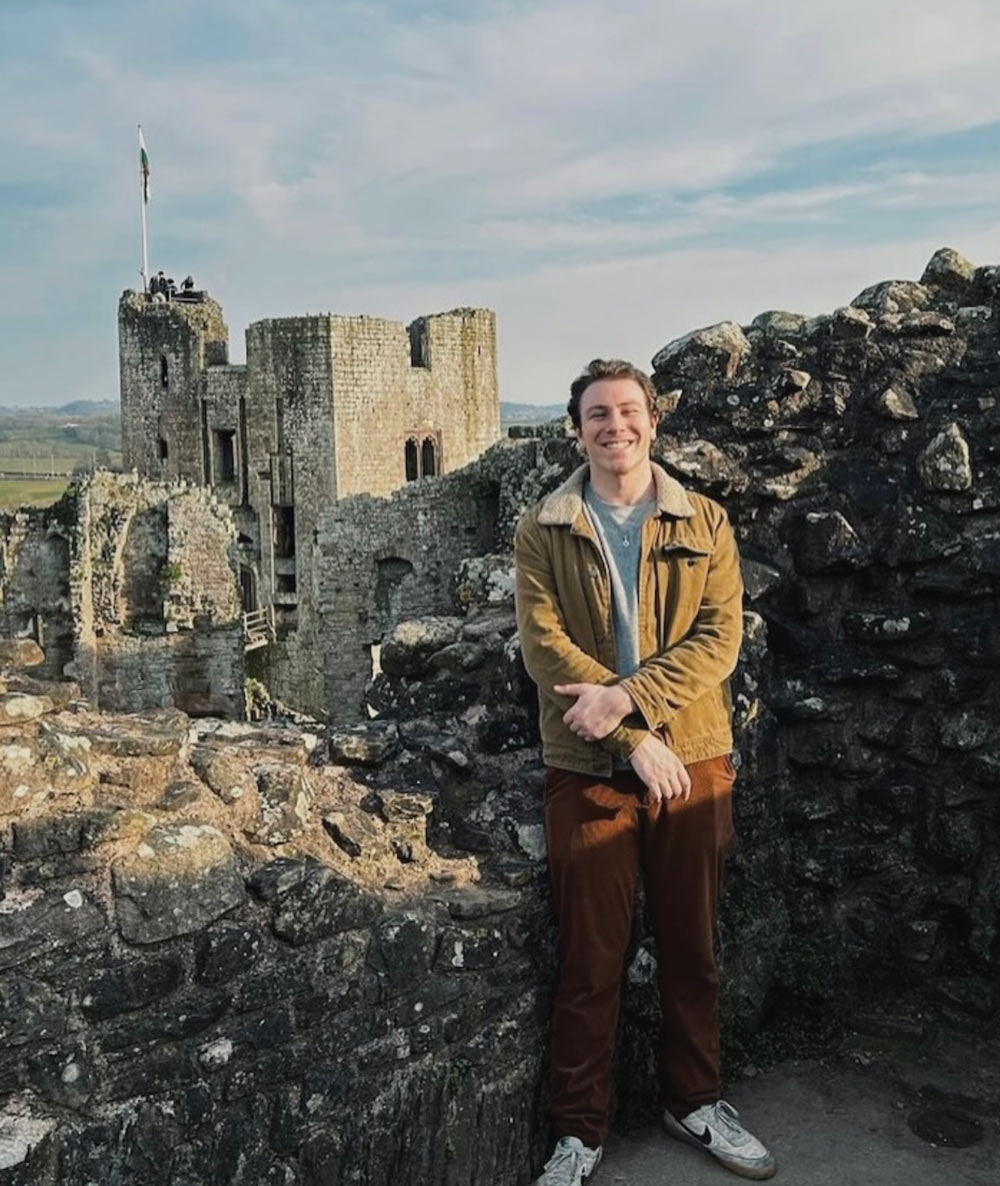
Worcester’s tutorial system came as a bit of a shock to the English major with a minor in film, with students meeting individually with professors who assign readings and discuss students’ weekly essays. Although it took some adjusting, Siegel found he loved the depth of the one-on-one interaction, so much so that he is already thinking about returning to pursue graduate work.“The experience was fully new to me but not as intimidating as I feared,” he said. “It teaches you to get good at arguing, to sell your subject in a persuasive way, to support your own claims. I learned a lot about how to schedule my own time, do my own research. Now I hope to pursue a master’s, hopefully at Oxford or maybe in the U.K., and then maybe work toward a PhD, if I’m lucky, which, coming in, I did not plan on doing.”
The independent nature of the tutorials pushed Siegel to look for ways to connect with other Worcester College students, which he did by joining a rowing team and taking part in a writers’ group. He met other American students through the Institute for Study Abroad, the program’s partner organization, and took the initiative to become familiar with the booksellers and shopkeepers in the city of Oxford, and the easy to access and affordable arts and culture of London, Paris, and Belgium.
“They were awesome, but I was so unsure at the start because they did everything for me,” Butts said. “They made meals, made my bed, cleaned my bathroom, and did my laundry—I’ve been doing my own laundry since middle school!”
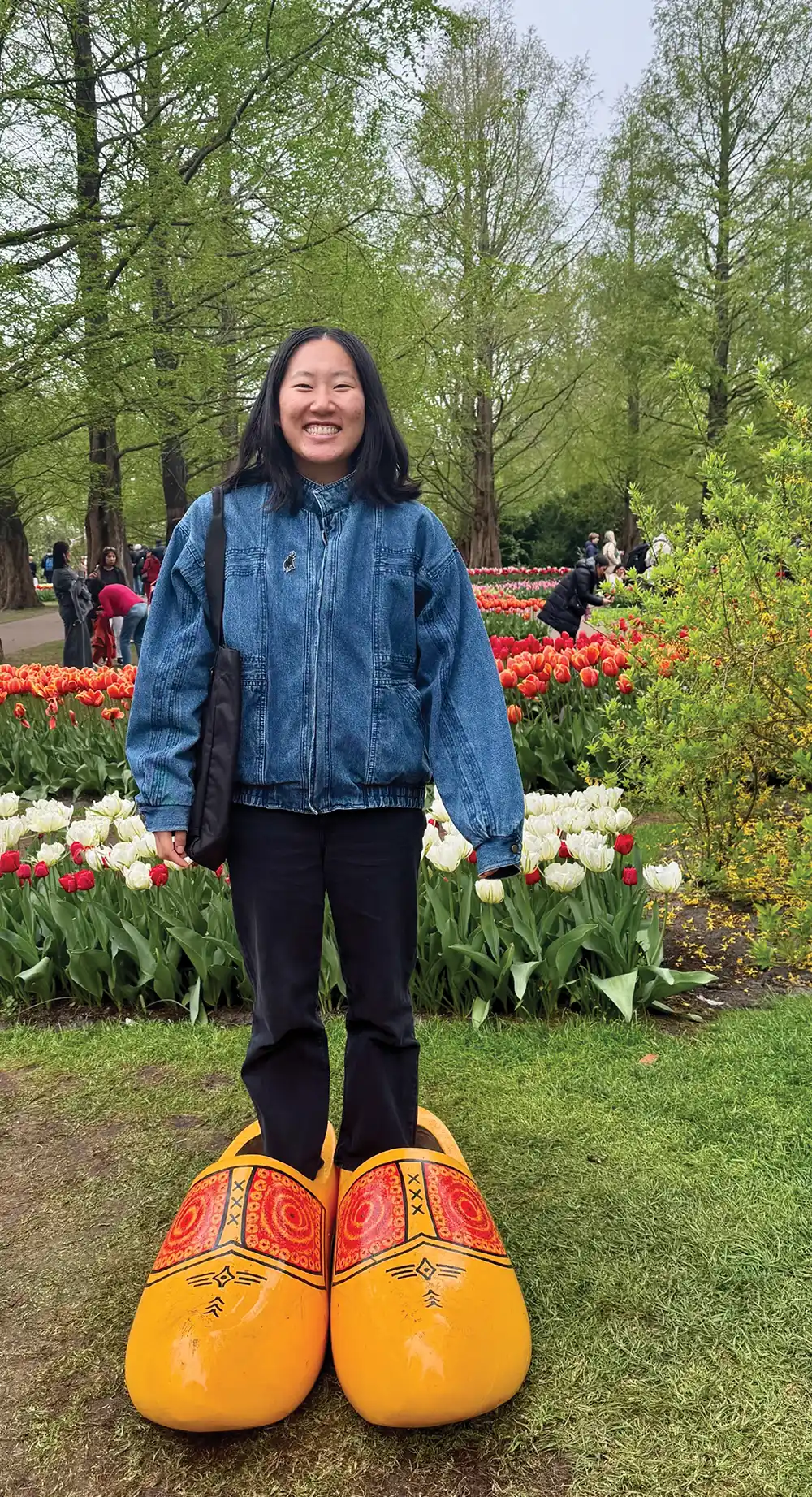
Making her way around a large, diverse university with multiple campuses across the city of Amsterdam and traveling solo on weekends left Lee with an appreciation of public transportation and the appeal of different neighborhoods. It also gave her a taste of the kind of city she’d like to live in after graduation.
“When I went to Paris, it was a big challenge to be alone, to sit undistracted with my own thoughts,” she explained. “Once I got past the discomfort of being alone, I felt I had gained another skill to keep in my back pocket.”
Lee was also surprised by the quality of friendships she made in four short months abroad. “Getting to know people outside of familiar circumstances resulted in some lasting friendships, which was surprising,” she said. “Now it’s exciting to be back home and making plans with people across the United States.”
Trinity College in Dublin spoke to senior Talia Fiore’s love of literature, and she chose to spend both semesters of her junior year there to sink into the experience of living independently, with enough time to travel and explore Ireland.
“I had heard that going for just one semester can really feel cut short, and being there for the year really gave me the chance to settle in,” she said. “It was the little things that got me—grocery shopping and other aspects of daily life, including [hearing] Gaelic—that drove home that I was in a place that wasn’t super different, but just different enough.”
Matthew Leone ’27, who is currently studying in Argentina through the Institute for Study Abroad, opted for an internship with Fundación Éforo in addition to his classes. He is working with high school students from Buenos Aires learning about politics and civic engagement. Improving his Spanish was at the top of Leone’s list of reasons for going to Argentina. But like most of his fellow study-abroad students, Leone continues to be up for the challenge inherent in leaving the familiarity of campus life in exchange for the unanticipated growth and insights that come with being open and curious about living in a new culture.
“Going about life as the one who is the foreigner, not a tourist, has given me a whole new level of appreciation for our shared humanity,” said Leone. “Even after just a short time here, what I see are our similarities more than our differences.”
Students and Professors listening to a guide in Rwanda, standing at a river’s edge.
Collaboration Among Educational Institutions on Three Continents Brings Global Perspectives to Students
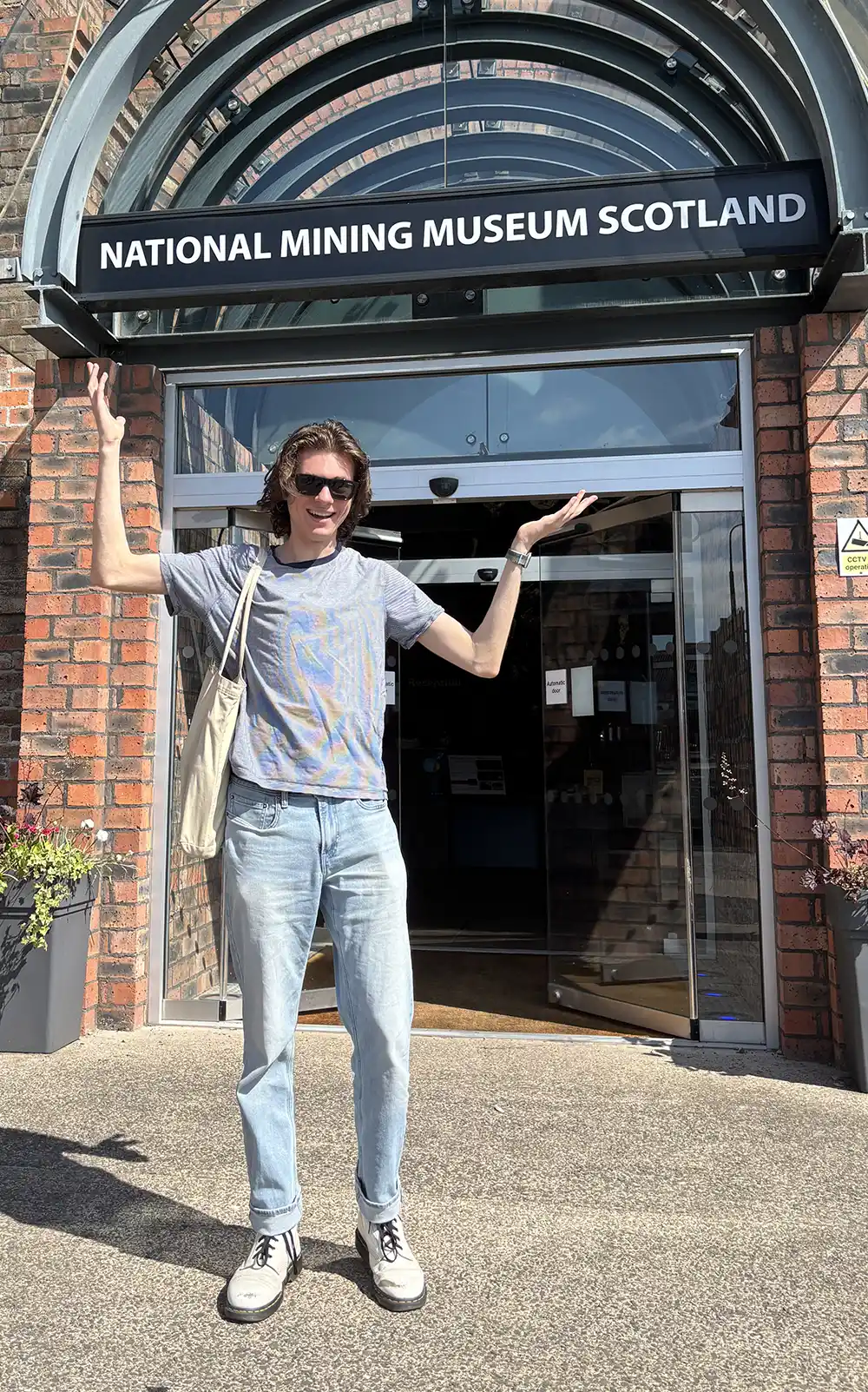
Meanwhile, 4,400 miles northwest of the UGHE campus, a Vassar student spent seven weeks at The University of Edinburgh in Scotland as the first participant in a partnership between the two institutions that will enable him and others to earn a master’s degree in planetary health from The University of Edinburgh.
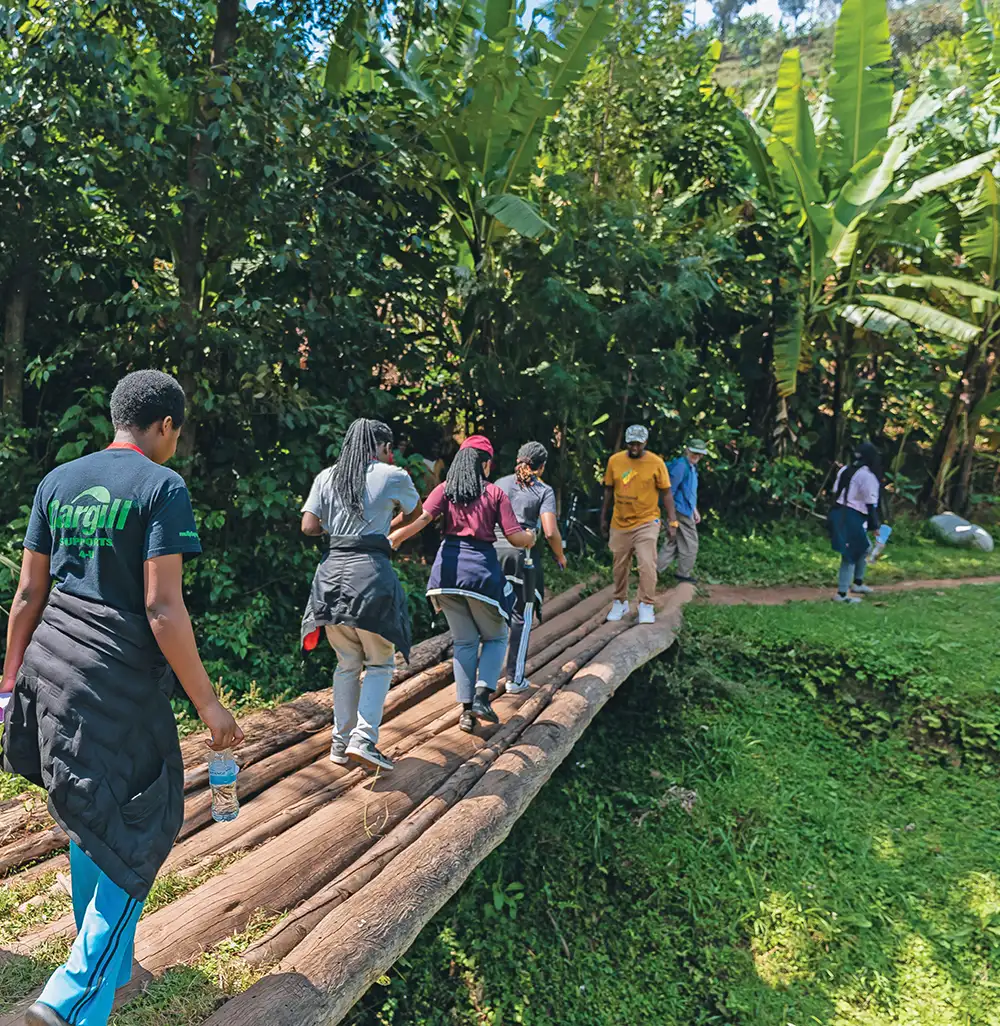
To teach Blue Rwanda, a course on the role water has played in African history and culture, Professor of French and Francophone Studies Thomas Parker collaborated with Dr. Denis Regnier, Lead Faculty for Global Health Equity and Social Medicine and an Associate Professor in Anthropology at UGHE; Dr. Rowan Jackson, Lecturer in Planetary Health and Food Systems and Co-Director of MSc Planetary Health Programme at The University of Edinburgh; and Professor of Geography Mary Ann Cunningham.
Parker, who was making his third trip to Rwanda, taught the first portion of the course on water as an “intensive” offering at Vassar, then completed the course with approximately 30 UGHE students and six of the Vassar students who had enrolled in the intensive.
“We looked at the environmental and religious aspects of water as well as how it is viewed in traditional medicine and how it relates to gender,” he said. Parker also led the group on field trips.

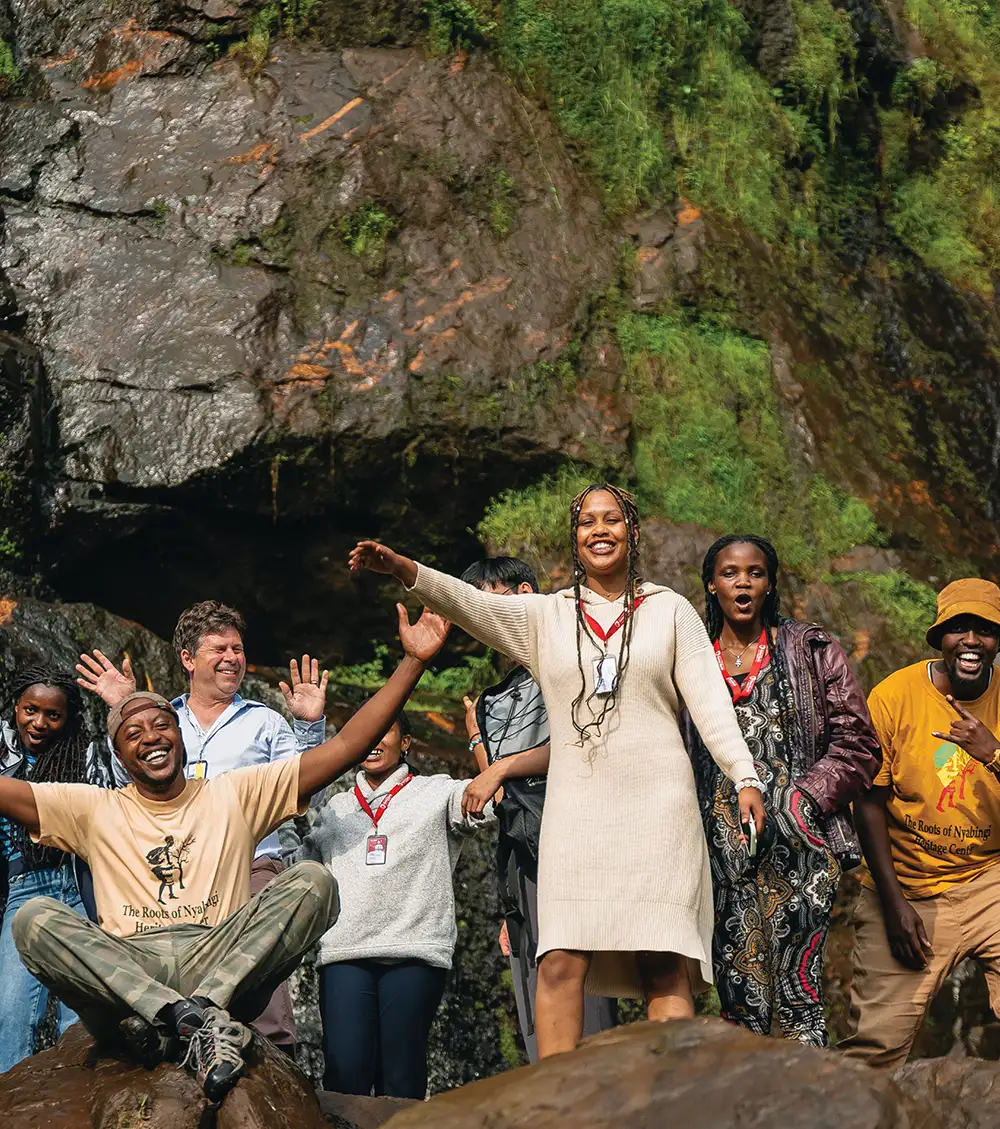
Anne Brancky, Associate Professor of French and Francophone Studies and Faculty Director of the Global Collaborative for the Liberal Arts, made her second trip to Rwanda to facilitate field trips and to teach a module within the course on the relationship between water issues and gender in African nations. “Gender roles vary around the world,” Brancky said, “so we looked at how different cultures view these roles as it pertains to water.”
Brancky noted, for example, that in many African villages, the women are expected to carry water, often from sources far from their homes. And this cultural phenomenon has led to bonds among women in these villages, affecting the culture of those communities.
Cunningham said her experience at UGHE not only benefited the students there but would also benefit her students at Vassar. “It’s good to learn about things outside the USA bubble,” she said. “More of the world is like Rwanda than like the United States. It made me more aware of finding ways to integrate this kind of information into my own classes at Vassar.”
Olivia Yost ’27 said she learned about the opportunity to take the trip to Rwanda from Lisa Pace, Associate Director for Pre-Health and STEM Advising, who has guided her on her pre-med journey at Vassar.
Pace also made the trip to Rwanda. “I wanted the opportunity to expand my knowledge about global public health issues, and water is a big part of health issues in Africa,” Yost said.
Maxwell Mhlanga, UGHE’s Head of the Humanities and Social Sciences Department, said Vassar’s partnership with UGHE had provided students “with a unique opportunity to engage directly with global health education and practice in a low-resource, community-based setting. Through immersive experiences at our campus, [Vassar students] are gaining a deeper understanding of health equity, social determinants of health, and interdisciplinary approaches to problem-solving beyond the traditional classroom context.”
It has been incredibly rewarding to watch Vassar students and faculty engage with UGHE’s students and faculty,” Mhlanga added. “The interactions were marked with genuine curiosity, mutual respect, and a shared commitment to social justice and health equity.” Hear about one student’s summer experience in Rwanda.
Meanwhile, in Scotland, Demetri Sedita ’26 was learning about environmental issues facing local communities near the Edinburgh campus. “I studied how Scottish local governments are planning to address climate change,” Sedita said. “Studying climate change and how to combat it has been a longtime passion of mine.” He now has the opportunity to return to The University of Edinburgh next fall for a year of study to complete his master’s program.
Dr. Rowan Jackson acted as one of Sedita’s advisors during the summer. “It was delightful having Demetri join Edinburgh as a visiting student for the inaugural Edinburgh-Vassar program,” Jackson said. “Demetri worked with academics and practitioners between the Edinburgh Futures Institute and the Edinburgh Climate Change Institute to assess local governments’ progress in enacting climate change targets. The work he produced will help them identify good practices.”
President Bradley noted that Ahmedabad University in India recently joined the group of participating schools. Members of the Global Collaborative will soon meet to discuss what’s next for the three institutions. The partners are making plans to teach a course at their colleges with similar public-health themes, then convene at UGHE in March.

By the Numbers
Vassar students study abroad either for a semester or an academic year annually.
of the current student body is made up of international students and dual citizens.
international faculty members come from approximately 25 countries.
Fires, Floods, and Other Climate-Related Disasters Spur Action
Within days of learning about the wildfires that leveled the Los Angeles communities, Alvin Puentevella ’20 began to assemble a team and seek the funding to launch the nonprofit Building For Neighbors (BFN). His mission: Deliver permanent housing within weeks—not years—to those who lose their homes due to natural or systemic disasters, often in the most vulnerable low-income communities. By reversing traditional recovery inequities and speeding up the process, Puentevella aims to create a model for equitable disaster recovery nationwide.
“Something clicked when the fires happened,” he said, explaining that he could no longer ignore the pull he felt to use his real estate investment and management experience to make a meaningful contribution. “Traditional disaster recovery systems are broken—it takes years to deliver housing. During that time, vulnerable communities dissolve, and low-income families wait the longest for help,” he continued. “We’re building the infrastructure to respond the next day with capacity to build at scale—to preserve communities and restore dignity.”
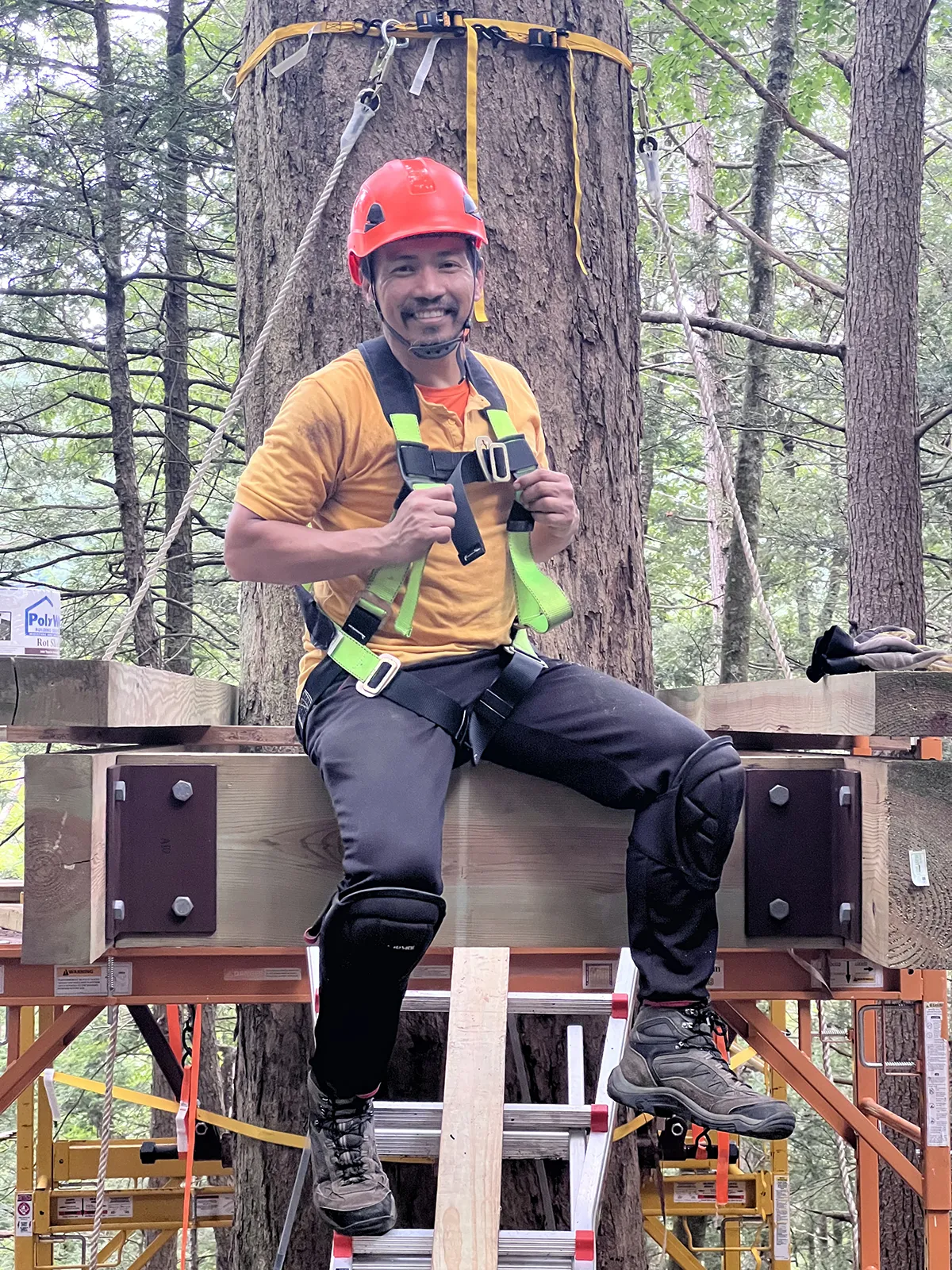
“People are languishing in trailer homes and selling their land to the highest bidder,” Puentevella explained. “There are plenty of people ready to take advantage of those in crisis. We’re the experts in the middle—between government, builders, and insurance companies—to lead the process and ensure people get the help they need.”
One of the first people Puentevella contacted to help launch Building For Neighbors was his former Vassar rugby buddy, Sam Ruben ’04. The two men reconnected in the fall of 2024 at Climate Week NYC, where Ruben, a co-founder of HyWatts, which deploys zero-emission “Power-Plant-in-a-Box” technology, was a speaker on energy resilience. With a background in 3-D printed building panels, community organizing, and housing systems innovation, as well as a dual-graduate degree in public affairs and business, Ruben introduced Puentevella to others who are fundamental to the success of Building For Neighbors, including building partners with expertise in modular and community-centered construction, venture capitalists, and local architects.
“My main role has been as a connector,” Ruben said, “bringing Alvin’s vision of low-cost, resilient rebuilding to the right people in the community so that it’s done right. These events bring out the best and the worst in people—those who are just out to make a quick buck and those who come together to help, regardless of their differences.”
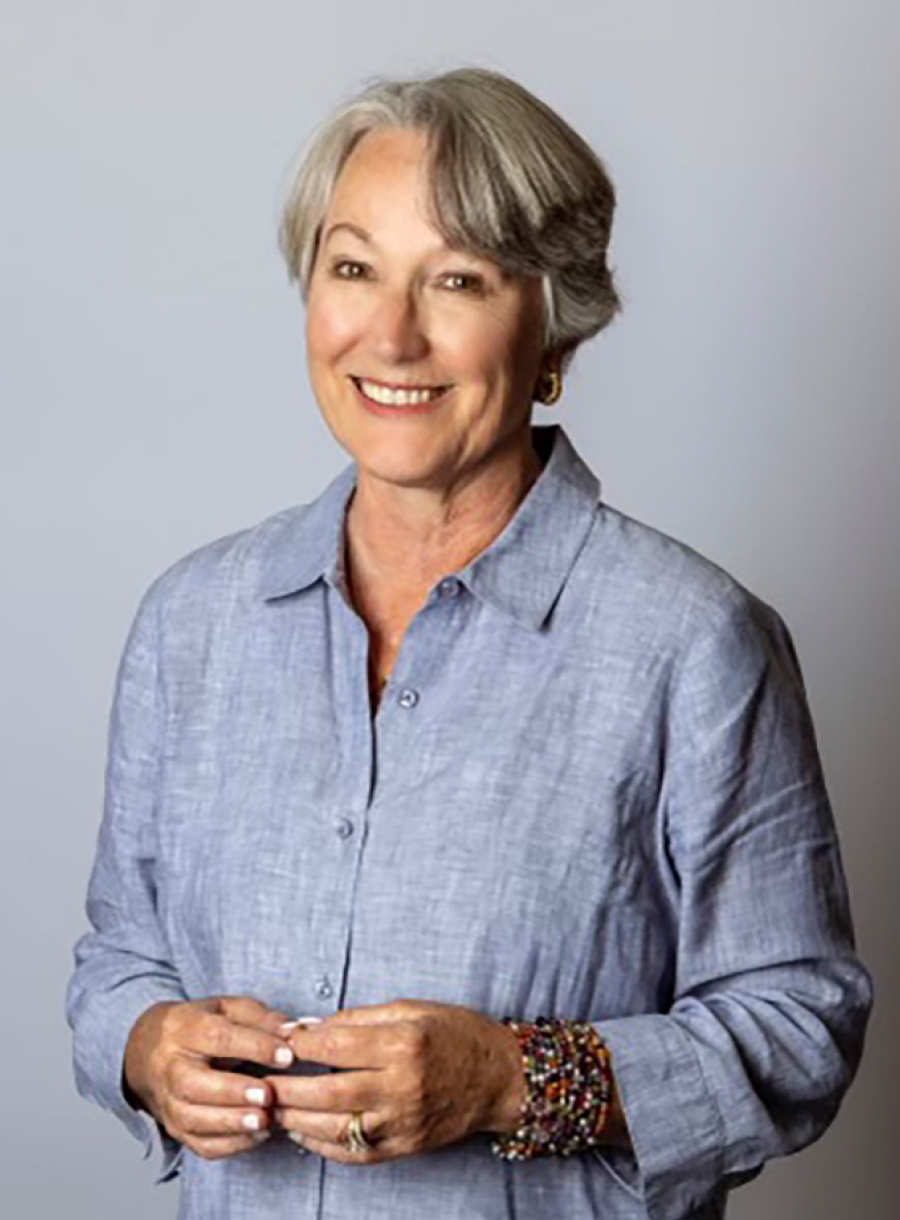
Other alums have joined the effort to mitigate harm. In their work as wildfire safety educators in their Northern and Southern California communities, where wildfire activity continues to increase, both Susanne Lyons ’79 and Beth Burnam ’77 use their roles to cut across cultural and political differences. Lyons, who retired from a career in finance and as chair of the U.S. Olympic & Paralympic Committee, recently joined Vassar’s board as a trustee and moved from Marin County to Sonoma County in Northern California, where wildfires burned 77,758 acres in 2019. Building on her experience as a block disaster coordinator in Marin and the longtime organizational and crisis-management skills gained during her career, she has worked to certify her community in Firewise USA, a national program that provides communities and neighborhoods with a collaborative framework to mitigate wildfire risk.
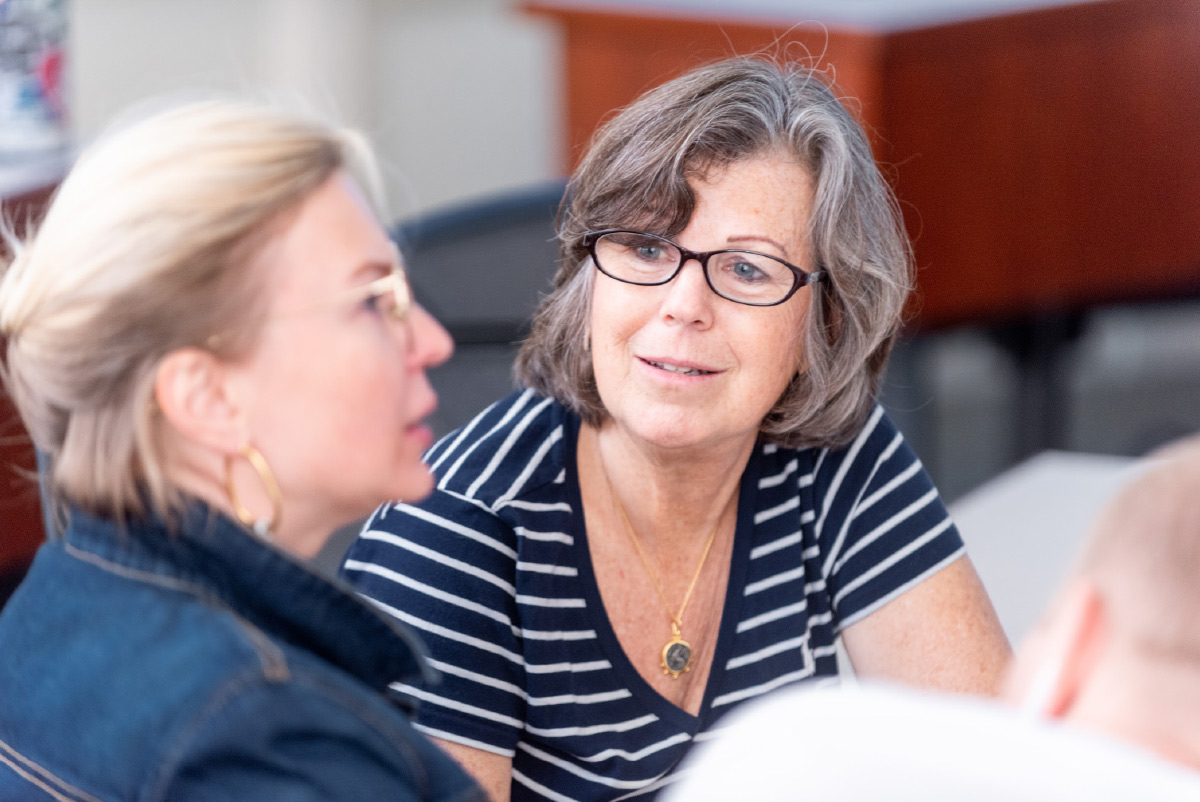

Lyons’s first step was to become involved with Communities Organized to Prepare for Emergencies (COPE), which hosts a summer potluck that features presentations by the local fire chief, a representative from their local PG&E utility, and advice about how to save farm animals in the event of fires or floods. She then brought Firewise into the community, which has since become one of 12 areas certified in Sonoma, with a three-year plan and annual reviews to mitigate risks through the modification of building materials and landscaping.
Courtesy of the subject
“I got to meet everyone and all their cats and their dogs,” she said. “And when half of our road collapsed this winter due to the flooding of the Russian River, we easily organized a letter-writing campaign to our representatives, which has us on track for repairs within the next few months—not years.”
Beth Burnam was a little surprised when, decades after earning an MBA from Wharton and then working in her family business in the Los Angeles area, she realized she was following in her grandmother’s and mother’s (Vassar ’49) footsteps as a “professional volunteer” (her son is a 2010 Vassar graduate). The remote, rural community in Topanga Canyon outside of Los Angeles where she lived for 25 years is populated by fiercely independent, self-reliant individuals—with minimal firefighting resources. She began to address that situation by writing grants for funds through the California Fire Safe Council, raising a total of $365,000, and implemented local programs to educate and help communities organize wildfire prevention. Now, as a regional coordinator for Firewise USA, she is working with 40 communities in the Eastern Sierra, spreading the word by first setting up tables in front of local shops and then giving Zoom presentations to educate and mentor neighborhoods through the six-month process of becoming recognized Firewise communities.
“This is my passion,” Burnam explained. “Seventy-five percent of the worst fires in California have occurred in the last decade, and 90 percent of the homes that ignite in wind-driven wildfires are by embers that land on wood shingle roofs, get in through vents, and are fueled by vegetation that surrounds a house. Homeowners can make a difference. First responders need us. Our homes don’t have to burn down.”
For more information on Building For Neighbors, visit buildingforneighbors.org or email alvin@buildingforneighbors.org.
Georgette Bennett ’67
Lucas Pollet
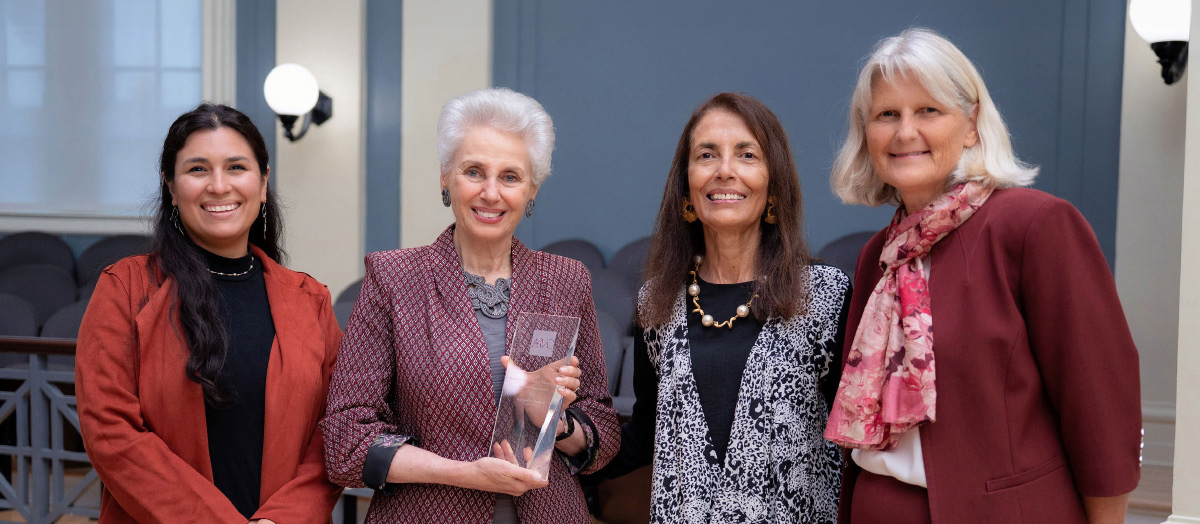
“Having started life as a stateless refugee, Vassar was a milestone along the road to the American dream,” Bennett said in accepting the award. “So it’s deeply meaningful to me to receive this great honor from my alma mater.”
The annual AAVC Spirit of Vassar Award recognizes an alum “who has demonstrated extraordinary and distinguished leadership, contribution, and commitment to serving a community in which they affect positive, transformative societal change.” In Bennett’s case, that “community” is nothing short of the entire world. As founder of both the Tanenbaum Center for Interreligious Understanding and the Multifaith Alliance, Bennett has spent decades mobilizing faith communities to confront global crises, bridge divides, and transform conflicts into opportunities for healing and change. During her talk, titled “Mobilizing Interreligious Relations to Transform Conflicts and Confront Big Issues,” she spoke with Vassar’s new Associate Dean for Religious and Spiritual Life, Reverend Callista Isabelle, about how she goes about that seemingly impossible mission in an ever-more dangerous and polarized world.
Isabelle started by asking Bennett to “share some of the early religious and spiritual roots of your life and how they have informed your work in an ongoing way.” The in-person audience at Rockefeller Hall and viewers online immediately became riveted by Bennett’s description of her early years in Hungary and her family’s escape from the Nazis in the 1940’s.
“I was born into a bombed-out apartment, and there was no food. My mother tells me the only thing she could get hold of was beer and sardines, and that’s what I was fed on as a baby,” said Bennett, who also recalled that her mother suffered seven miscarriages. “I think very much about myself as having had an accidental and unexpected life, because between the Nazis and the miscarriages, the odds of my having been born are practically nil, and so that has left me with a lifelong feeling that I owe a debt to the world; that’s driven a lot of my life’s work.”

At Vassar, Bennett pursued an academic interest in religion but majored in sociology, having become energized by the politics of second-wave feminism, the Civil Rights movement, and President Lyndon B. Johnson’s War on Poverty. After earning a PhD in sociology from New York University, she worked as a criminologist, advising New York City’s police department on issues related to women. Also, she said, “as a criminologist, I became very interested in the links between religion and violence, specifically the way that apocalyptic thinking and believing that one has a monopoly on truth, how that ultimately leads to violence.”
In 1982, she married Rabbi Marc Tanenbaum, one of the most influential religious leaders in America. “He introduced me to a kind of outward-facing Judaism that had an enormous impact on me,” Bennett explained, “and he introduced me to the ways in which religious coalitions could be formed to address conflict, to address serious social problems. For example, he helped organize the international rescue effort for the Vietnamese ‘boat people.’” Tanenbaum also built alliances between Jews and Muslims “at a time when this wasn’t being done,” which prompted Bennett to read the Quran from cover to cover—twice. “That helped me to understand what a deeply misunderstood religion Islam is, and the tremendous similarities between Islam and Judaism,” she said.
After Tanenbaum died in 1992, Bennett founded the Tanenbaum Center to continue his work. In 2013, she founded the Multifaith Alliance (MFA) to aid the millions of Syrian refugees displaced by civil war. “I was stunned by the magnitude of the suffering, and it just reminded me so much of what my own family had gone through during the Holocaust,” Bennett explained. “But it was really being a Jew that drove me to do it, because Leviticus 19:16 [states that] ‘Thou shalt not stand idly by while the blood of your neighbor cries out from the earth.’ And I just felt I could not stand idly by.”
Isabelle noted that through the MFA, Bennett was able to mobilize over $660 million in humanitarian aid to benefit nearly 4 million Syrians affected by war—and that the group had recently been able to provide aid to 100,000 families in Gaza. She then asked Bennett how religion can engender healing rather than conflict. “I’m curious what your thoughts are about how we might go about finding common ground in an especially polarized moment. How might we build bridges and understanding even right here at Vassar?”
“I mentioned earlier apocalyptic thinking,” Bennett replied. “One of the problems with religion is that it tends to divide the world into the children of light and the children of darkness. And the children of light hold a monopoly on truth. The children of darkness get dehumanized.” This type of “binary thinking” can progress quickly from dehumanizing speech to physical violence, Bennett warned.
A perfect example of binary thinking, she said later, is “the whole Israeli-Palestinian thing—that you have to be either pro-Israeli or pro-Palestinian, as if they’re mutually exclusive. They’re not mutually exclusive—you can be pro-both; it’s called being pro-humanity.”
Bennett said that liberal arts colleges such as Vassar, which emphasize the development of critical-thinking skills, have a role to play in exposing the fallacy of binary thinking—for example, “that you are either the oppressed or the oppressor, or you are the colonized or the colonizer,” she said. “That doesn’t leave any room for nuance. It doesn’t leave any room for communication, and it ain’t that simple. … The real world is full of the murky middle, and that’s what people have to learn to live with: the ambiguities of the murky middle.”
That’s just the type of education Bennett said she herself received at Vassar. “My education was nuanced, compassionate, and open,” she said. “My commitment to human rights, interreligious understanding, humanitarian diplomacy—all of that began here, and so did my understanding of democracy. The liberal arts and humanities are crucial for democracy to survive.”
Isabelle’s last question to Bennett was, “What have you seen in the last year that gives you hope?”
Bennett reframed the question: “When confronting an overwhelming problem, and that’s what you’re asking about, where you want to have some impact, where you want to create some change, how do you do that?” she asked. “I have a very simple formula that I have applied in all of the settings where I’ve been a change agent, whether it’s policing, criminal justice, the corporate world, or intergroup relations: Find an entry point. Identify a gap that hasn’t been filled. Find something doable with which to fill that gap—and the operative word here is doable—and then stay tightly focused on that doable thing.”
Elizabeth Randolph / Courtesy of the subject
The Fight for Democratic Values and Civil Rights Will Rely on Younger Generations, Alum Speakers Say
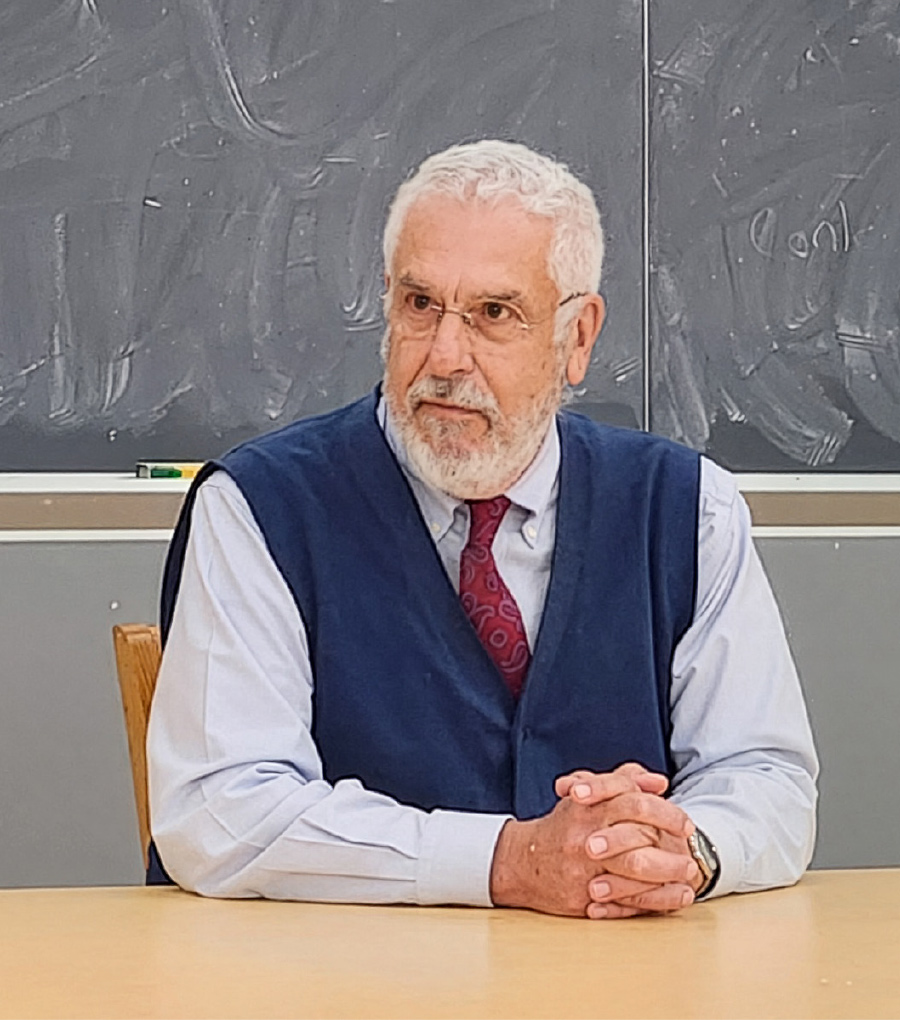
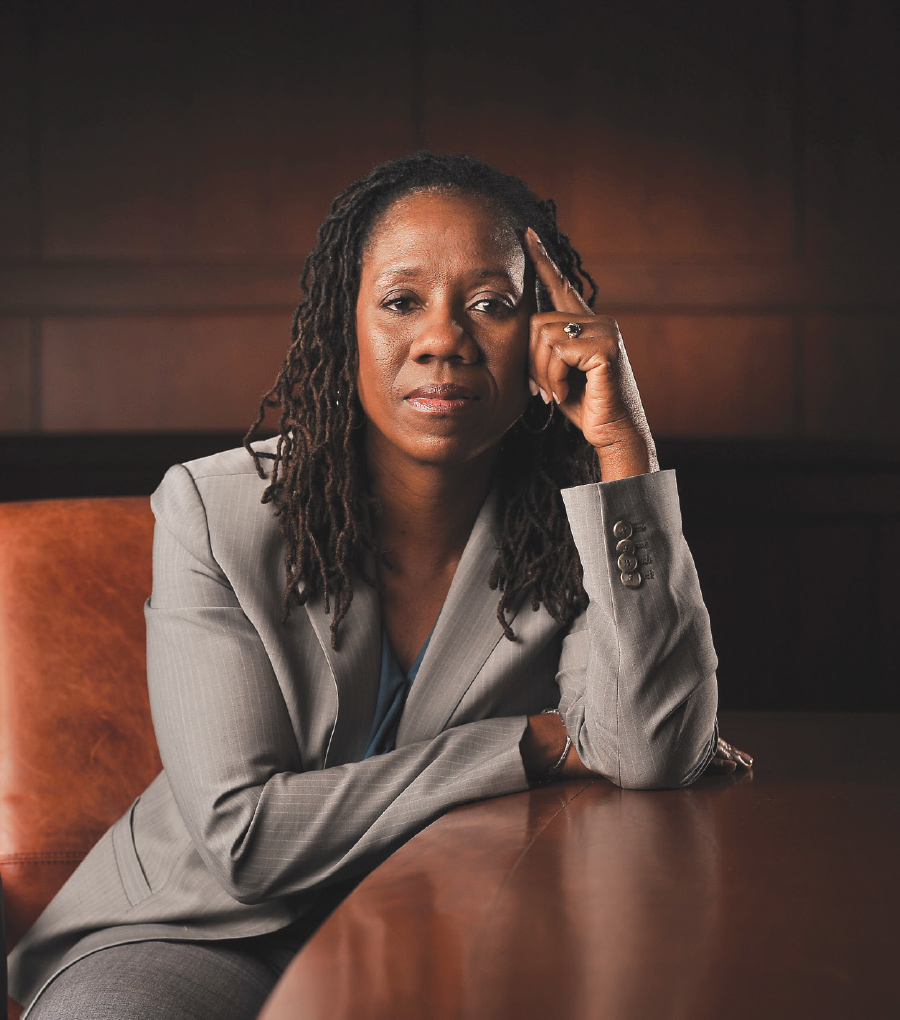
Cash is the Executive Director of The Steady State, a nonprofit advocacy organization whose members are former senior national security officials from across the intelligence, diplomatic, homeland security and defense communities. His career has included stints with the Central Intelligence Agency, the Department of Homeland Security, and the staffing of several congressional committees that oversee and assess national security issues. Ifill is the Vernon Jordan Distinguished Professor in Civil Rights at Howard University School of Law, and formerly served as President and Director-Counsel of the NAACP Legal Defense and Educational Fund.
During a conversation with students and others in Rockefeller Hall, Cash offered a sober assessment of threats to constitutional democracy in the U.S. His conclusion? The country is facing the gravest threat to its constitutional democracy since the Civil War.
His prior roles have often involved tracking what he called “indicators” of emerging autocratic forms of government in countries around the world. “We are seeing all of these indicators here right now,” he explained. They include taking control of the security apparatus, identifying “enemies” within the country, and threatening the media, legal professionals, and business communities, as well as institutions of higher learning. Colleges and universities are targets, Cash said, “because you guys are the Kryptonite of autocracy.” He also expressed concern about voting rights and free and fair elections.
Cash said it will take a sustained effort from young people and others across the country to preserve democracy, and today’s liberal arts students are well positioned to push back. “Use your critical-thinking skills,” he urged. “You are already being trained to collect and analyze data.
“I still have confidence that all is not lost,” Cash concluded, saying it is up to every individual to assess their own level of comfort with risk and their willingness to step forward to counter authoritarianism. One way would be to form coalitions with people from a broad political spectrum, he said, to engage people with whom we disagree and find common ground.
During an October program in the Villard Room, Ifill expressed similar concerns—and optimism. A civil rights leader for more than 30 years, she has been involved in countless civil rights cases across the country. She has seen civil rights expand and contract in her lifetime and throughout history, and said that we are currently in a period of retrenchment.
During a campus interview by Professor of Sociology Diane Harriford, Ifill noted that “Something very ugly has been unleashed in this country. There are days when I am furious, and I can’t imagine not being furious. But I remember the tireless work people before me did to make this work possible.”
Likewise, Ifill said, it is incumbent upon veteran civil rights leaders like herself to make room for the next generation. “There is the harvest. And we have reaped the benefits of the harvest,” she noted, but said we must also “plant the seeds” that bring forth the next cohort of civil rights leaders.
Ifill said the history of the nation had provided her with hope for the future. She praised the men and women who worked tirelessly, often putting themselves in harm’s way, to get the Civil Rights Act passed and said, “I believe we can do it again. We can be founders and incubators of new ideas that translate into a new reality.”
Ifill’s forthcoming book, Is This America?, is an examination of race and the current crisis in American democracy. It will be published in 2026 by Penguin Press.
Empowering Students to Experience the World: June Ross Marks ’49
hen June Ross Marks ’49 talks about her life, Vassar is a key part of the story. She credits her time at the College to her father, who encouraged her to apply. While serving as an assemblyman in Albany, NY, he met a Vassar professor and “decided that I should go to Vassar.”
Though she wasn’t admitted as a first-year student, she transferred from Barnard College for her junior year. She spent her time at Vassar playing tennis behind Josselyn House and meeting new people, both of which supported her career in unexpected ways.
“Vassar really opened doors for me,” Marks said. “When you say you went to Vassar, people are impressed. It’s a great gateway to the world.”
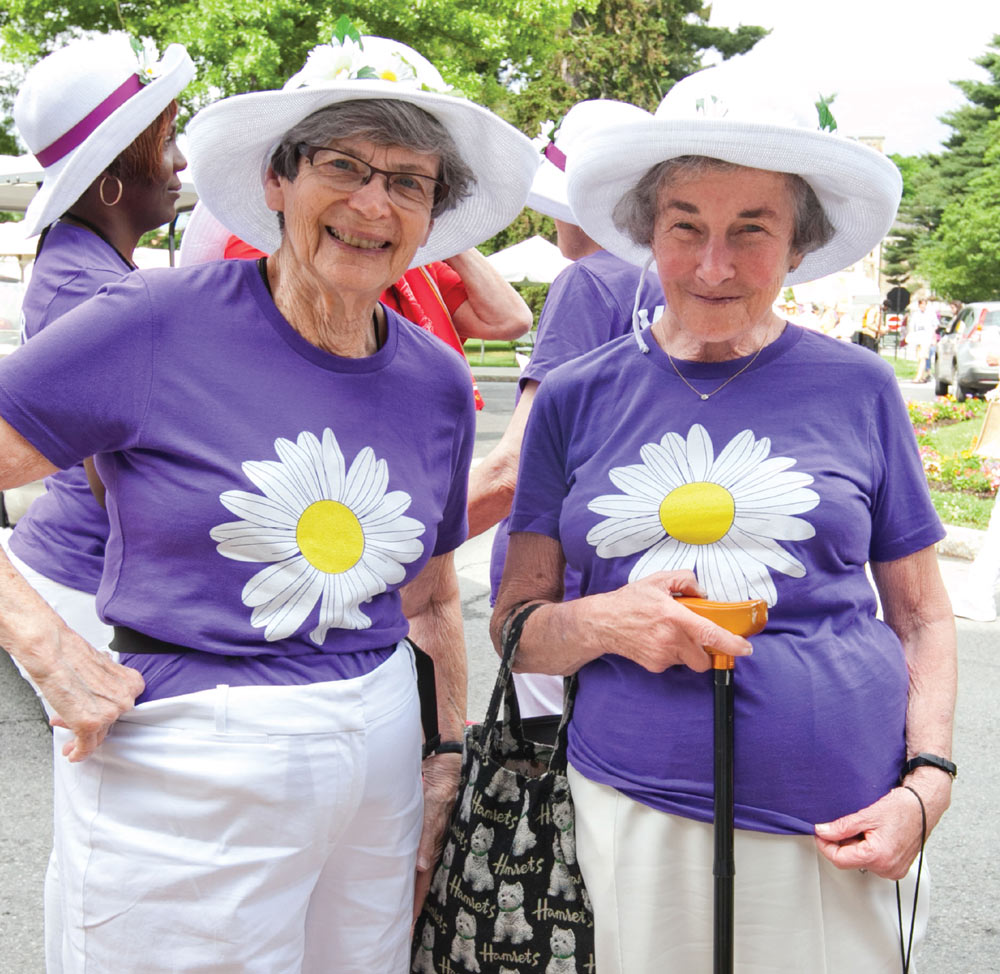
June met her late husband, Alan Marks, on a blind date on the court and soon discovered another love that would shape her career: a passion for tennis wear and a desire to design it for women and children. After purchasing several athletic dresses from designer Helen Bush, Marks asked if she could represent Bush’s business as a seller, and Bush agreed. Not long afterward, Marks launched her own line of women’s and children’s clothing, which became known for its distinctive fabric and craftsmanship.
For 45 years, she managed every aspect of the business, collaborating with “many skilled young homemakers to make the garments” and creating a new line of dresses every year. She also produced her own catalog for many years, with the help of Gretchen Tatge ’55, whom she met at a Vassar luncheon. Throughout it all, Alan, who was in the toy business, remained a steadfast supporter of her endeavors. She only stepped away from the industry after relocating following Alan’s passing.
The Markses were avid world travelers, visiting countries on all seven continents, including Antarctica when June was 80 years old. Their travels included memorable trips to Russia (then the Soviet Union), Israel, and Vietnam, her favorite destination, which she visited again through the Vassar Travel Program.
Today, Marks is living a quieter life, playing bridge and hosting a group of friends on Wednesday afternoons. She has two children, three grandchildren, and a great-grandchild on the way.
“I’ve had a good life,” Marks said.
In celebration of her 60th Reunion, Marks wanted to give back to the College in a meaningful and lasting way. As a devoted Vassar volunteer over the years, she served on the AAVC Alumnae House Committee, attended nearly every reunion (even serving as co-chair of the reunion gift in 1997 and as reunion co-chair in 2004), and represented her class as co-president from 1999 to 2004 before serving as vice president from 2014 to 2018. Wanting to create something more permanent than a one-time scholarship, she established the June Ross Marks ’49 Travel Fund in 2008.
The fund supports student travel, with a preference for trips connected to academic work. Among the projects it has supported: a student from Bangladesh who wanted to photograph fishermen along that country’s coast; a student researching historically vital archives on missing individuals in Germany; a student who accepted an undergraduate research position at a University of Nebraska Medical Center cancer research center; and a student who hiked the Appalachian Trail for the first time, despite never having backpacked before.
Through the June Ross Marks ’49 Travel Fund, she has created a lasting journey for students who, like her, are ready to explore the world.

-
NONFICTION
Horror’s New Wave
by Jason Blum ’00
Simon and Schuster, 2025 - The Body Digital: A Brief History of Humans and Machines from Cuckoo Clocks to ChatGPT
by Vanessa Chang ’03
Melville House, 2025 - Degas at the Gas Station
by Thomas Beller ’87
Duke University Press, 2025 - Industrial Organization Theory and Practice
Co-author, Professor Qi Ge
Routledge Taylor/Francis, 2025 
- Teaching Computers to Read: Effective Best Practices in Building Valuable NLP Solutions
by Rachel Wagner-Kaiser ’10
Taylor & Francis, 2025 - The White Pedestal: How White Nationalists Use Ancient Greece and Rome to Justify Hate
Professor Curtis Dozier
Yale University Press, 2026 - Introduction to U.S. Federal Securities Laws: Guide to the Legislative Process, Regulatory Process, and Judicial Review
by Stuart Kaswell ’76
ABA Publishing, 2025 -
FICTION
Blue Monkeys
by Lois Shapley Bassen ’67
Shy City House, 2025 - One of Them
by Kitty Zeldis ’79
Harper Collins Publishers, 2025 - How She Came to Know
by Lois Shapley Bassen ’67
Shy City House, 2025 
-
CHILDREN
Henrietta, Problem Solver
by Katharine Stanley-Brown Abbott ’49
SDP Publishing, 2025 -
POETRY
Snakeberry Mamas: Words from the Wild
by Mary Alice Dickson ’73
Charlotte Lit Press, 2025 - Whispers of the Wild: Haiku Poetry from the Animal Kingdom
Illustrated by Vicki Cole ’65
BookBaby, 2025 -
MEMOIR
Anna: An Immigrant Story
Rhoda Orme-Johnson ’62
Independently Published, 2025 -
TRANSLATION
Carnaval Fever
by Madeleine Arenivar ’08
Soft Skull Press, 2025 
The “Murrow Boy” Who Went to Vassar!
Breckinridge fled to Britain and began documenting that island nation as it braced itself for WWII. In a letter, she confessed, “. . . It now seems foolish to run away from the most interesting thing I could be doing on Earth right now.” Over dinner, her friend Edward R. Murrow asked her to do a broadcast of her story about an English village preparing for war for Life. Breckinridge was unaware that Murrow had asked CBS executives to tune in. She aced the audition and became the only woman to join the “Murrow Boys.”
Mary Marvin Breckinridge was born on October 2, 1905, in New York City. Her maternal grandfather was tire magnate B. F. Goodrich, and her paternal great-grandfather was John C. Breckinridge, Buchanan’s vice president and the Southern Democrats’ 1860 nominee for president. The second oldest of four and the only girl, she began photographing the sights of her hometown with a Pocket Kodak when she was nine years old.
Breckinridge majored in history and modern languages at Vassar, where she became known as “Bric.” After returning from a meeting of the International Confederation of Students in Copenhagen, she helped found the National Student Federation of America (NSFA), and in 1927 was elected its president. She befriended Edward R. Murrow, who became NSFA president in 1929.
After graduation, Breckinridge considered foreign service but instead chose a more unconventional path. “I enjoyed parties and coming out, but I didn’t want to make a whole life of it.” She went to Appalachia to join her cousin, Mary Carson Breckinridge, who had established the Frontier Nursing Service, dedicated to reducing the mortality of mothers and infants. Mary Marvin learned motion picture photography and lugged her hand-cranked camera through the hills to shoot “The Forgotten Frontier,” a fund-raising film about the service. Gradually, Breckinridge forged a career as a photojournalist.
When Breckinridge began covering the war, Murrow told her to use her full name: “Give the human side of the war, be honest, be neutral, and talk like yourself.” He did not edit her scripts. Cool and self-assured, Breckinridge spoke with a clear, upper-class accent that sounded vaguely British to American listeners. Murrow assigned her to the Netherlands, a neutral country fearing German invasion.
Breckinridge had a dog tag made to identify herself in case of the worst and checked into the Carlton Hotel in Amsterdam. Her broadcasts from Holland were part of the CBS Sunday-night roundup, World News Today. Breckinridge was frustrated by the lack of feedback from America, but cheered by Murrow’s support. “Your stuff so far has been first rate. I am pleased, New York is pleased, and so far as I know, the listeners are pleased. If they aren’t, to hell with them.”
Breckinridge chose most topics herself, but CBS wanted stories to provide the “women’s angle.” She soon grasped that one telling detail could dramatize a scene. She, for example, described the Netherlands’ refusal to plan for military cooperation with the British by analogy. “Holland is wearing her Little Red Riding Hood of neutrality, but she’s a bit scared just the same as she goes through the wood.”
In January 1940, Murrow Boy William Shirer requested leave to visit his family in Switzerland, and Murrow asked Breckinridge to take his place in Berlin. She agreed, and the last leg of her train ride to Berlin was so crowded that Breckinridge stood wedged against a window and found that the arm of her coat froze to the glass. Waiting for her in Berlin was Jefferson Patterson, a Foreign Service Officer at the U.S. Embassy. Patterson, a Yale graduate, had been an artillery officer in World War I. The two had met in Washington, DC, and had begun corresponding. The day she arrived, Breckinridge accompanied Shirer on a long subway ride to a 2:00 p.m. broadcast at the German Radio complex, then back to the Adlon Hotel to dine with Patterson. No cocktails, she explained; she had to attend Hitler’s 9:00 p.m. speech at the Sportspalast, write her script, then return to the studio for a 1:00 a.m. broadcast. Patterson thought, I shall have to move rapidly to keep up with such energy!
Customarily, Breckinridge marked her scripts to indicate delivery speed and emphasis but dropped this practice in Germany to avoid telegraphing her intent to censors. The censors at Völkischer Beobachter, Germany’s most widely read newspaper, which Hitler had purchased in 1920, missed the irony in her conclusion: “The motto of this important official paper is ‘Freedom and Bread.’ There is still bread.”
Breckinridge found time to accompany Patterson on one of his official diplomatic duties, visiting POW camps on behalf of Great Britain and France to ensure compliance with the Geneva Convention. A German officer wondered why new POWs were apprehensive upon arrival. Breckinridge replied they must have heard about the concentration camps at Dachau and Buchenwald.
Before she returned to Amsterdam, Patterson proposed. Breckinridge accepted but requested no announcement. Patterson, fearful she needed time to think it over, visited Amsterdam twice before the German Blitzkrieg plunged west but had to inform his fiancée that marriage would end her broadcast career. State Department rules forbade diplomatic spouses from publishing news or opinions.
Breckinridge’s biggest confrontation with censors occurred on a report about the National Socialist Movement (NSM), the Dutch Nazis. The local censor sent her script to The Hague for approval. When the delay stretched on, Breckinridge threatened to leave the Netherlands if they killed the story. A friend suggested a workaround. She rewrote the piece, prefacing the report with mundane local news. The bombshell came when she summarized her interview with NSM leader Anton Mussert. “I asked him, ‘What would you do if Germany should invade Holland?’ He said he would sit with folded arms.” Although Breckinridge’s story was only broadcast in America, the Dutch government used it to chastise the nine NSM members in the Dutch Parliament.
On May 10, 1940, Germany attacked France and the Low Countries. Breckinridge caught the last train from Amsterdam to Paris, where she joined CBS correspondent Eric Sevareid to report the debacle. Her May 28 broadcast announced Belgium’s surrender, “leaving the … way to Dunkirk open to the German divisions.” Her reports depicted desperate refugees streaming into Paris. “Anxious people waited in the station for train after train, and when their people did not arrive, they’d say to each other, “There’s another train in half an hour. There’s another train in half an hour.” She gave her last broadcast on June 5 and cabled her resignation to CBS. With impeccable timing, she boarded the last train from Paris to Genoa before Italy declared war and closed the border.
Between air raids, Breckinridge caught a train from Genoa to Berlin. On June 20, she and Patterson had two marriage ceremonies, a mandatory civil one beneath a portrait of the Führer at the local registry office and another by a minister at the U.S. Embassy. Attempting to preserve normality despite the war, the couple invited a few friends from the press and diplomatic corps to celebrate, but once people saw the unrationed food Patterson obtained from the U.S. Embassy in Denmark, the wedding party swelled enormously. “At least the champagne held out,” Patterson wrote.
Their brief honeymoon at Lake Eibsee in Bavaria was darkened by news that France had fallen. Patterson returned to the grim task of visiting POW camps. Although Breckinridge was barred from entering and talking to POWs, she still questioned German officers outside. “She was not particularly reticent about interrogating people,” Patterson explained. Breckinridge attempted to restart her career as a photojournalist and wrote a story for Harper’s Bazaar, but the State Department blocked publication.
For the next 18 years, she fulfilled the role of a diplomat’s wife but missed her days as a radio broadcaster. “I liked it more than any job I ever had.”
Letter from the President of the AAVC
I am just back from an invigorating time on campus with the AAVC Board and the Board of Trustees. Some of the trees that we all know so well on the quad and near the Chapel, the ones that catch the sun in just the right way, were resplendent with fall colors. It was lovely to be surrounded by such beauty and camaraderie.
We celebrated the rededication of the Bridge building, now the Winton Evans Bridge for Laboratory Sciences, thanks to an extraordinarily generous gift from Rowland Evans ’75. Among his many talents, Rowland is a gifted jazz pianist and performed with members of several Vassar student jazz ensembles during the dedication ceremony. We also honored Philip Jefferson ’83, Vice Chair of the Federal Reserve, a distinguished and highly esteemed economist and devoted Vassar alum, with the AAVC Distinguished Achievement Award, and Sally Clement ’71, P’09, with the AAVC Outstanding Service to Vassar Award, for her remarkable contributions to the Vassar community. Suffice it to say, it was a very special weekend!
As for the theme of this issue of VQ, I cannot count the number of times someone has described their study-abroad experience as “life-changing.” Whether students have traveled frequently or it is their first experience going overseas, spending extended time immersed in a new culture is life-altering. Alas, the notion of spending an entire year studying abroad is almost a relic, but living and studying overseas for a semester, or even a few weeks, is truly an education—the academic environment, the transportation system, the food, customs and behaviors, the languages, and so many other aspects of daily life are different.
Study abroad is also a personal passion, as it brings together my interests in education and international relations. (Full disclosure: I am a long-standing board member of an independent nonprofit that provides education overseas for U.S. and international students. Vassar is a member of our academic consortium.)
My passion in this regard far predated my involvement with this group, however, as I was effectively a foreign student at Vassar. My family had moved to the U.S. just a year before I came to Vassar. So when many of my friends went overseas for their junior years, I went to Washington, DC, as part of my “international” adventure. Even though I had attended an American school in New Delhi, being in the U.S. and living and studying here was an entirely new experience, one that entailed a great deal of learning in various ways.
I am proud that Vassar is a proponent of international experiences and a supporter of students who wish to study abroad and work around the world as fellows and interns. I am sure many of you have stories from your time overseas, so please share them with your class correspondent for the next issue of VQ!
Until then, I send you all good wishes for a healthy and happy winter season!


- Monica Vachher ’77, Illinois
President and AAVC Trustee - Brian Farkas ’10, New York
Vice President and AAVC Trustee - Tyrone Forman ’92, Illinois
Vice President - Alisa Swire ’84, New York
Nominating and Governance Committee Chair - Gail Becker ’64, New Jersey
- Maybelle Taylor Bennett ’70, Washington, DC
AAVC Trustee - Patrick DeYoung ’18, Pennsylvania
AAVC Trustee - Eddie Gamarra ’94, California
Alum Recognition Committee Chair - Stephanie Goldberg ’14, New York
- Anne Green ‘93, New Jersey
AAVC Trustee - Delia Cheung Hom ’00, Massachusetts
AAVC Trustee
Diversity, Equity, and Inclusion
Ad Hoc Committee Chair - Kevin Lee ’14, California
- Peggy Ann Nagae ’73, Oregon
- Patricia Ann Neely ’75, New York
- Michael Neuwirth ’89, New York
- Katherine “Kat” Mills Polys ’93, Virginia
Vassar Fund Committee Chair - Heller An Shapiro ’81, Maryland
- Sheryl Smikle ’81, Georgia
- Andrew Solum ’89, United Kingdom
Clubs Committee Chair - Keith St. John ’81, New York
Alumnae House Committee Chair - Carlos Hernandez Tellez ’14, Brazil
Career Networking Committee Chair - Sam Thypin-Bermeo ’11, New York
- Kerri Tillett ’91, Massachusetts/North Carolina
- Emily Weisgrau ’96, Massachusetts
(on leave) - Lisa Tessler
Executive Director of the AAVC - Patricia Lamark
Associate Director, AAVC Engagement
In Memoriam
-
1941
Margaret Porch Lounsbury
March 28, 2024 -
1943
Natalie Devine Kittredge
July 31, 2021 -
1945-4
Elizabeth Rohland Hanson
June 14, 2025 -
1945
Barbara McElroy Reichert
April 18, 2025 -
1945
Mallory Messner Semple
July 16, 2025 -
1946
Mary Menhinick White
May 13, 2023 -
1947
Brunhilda Wallach Diel
December 14, 2024 -
1947
Nancy Platt Rayfield
June 5, 2025 -
1947
Phyllis Murray McDowell
September 12, 2025 -
1948
Jean Sheppard Rowe
June 22, 2025 -
1948
Elsie Norman Dunklin
July 25, 2025 -
1949
Margaret Cochley Powell
September 8, 2025 -
1949
Joan Havelock Wheeler-Bennett
September 9, 2025 -
1950
Eloise Sydenstricker Morton
July 15, 2025 -
1951
Keren Ellington Widmann
February 10, 2024 -
1951
Marilyn Senn Moll
June 29, 2025 -
1951
Catherine Holman Johnson
August 30, 2025 -
1953
Joan R. Brennan
January 22, 2025 -
1953
Carolyn Young
April 14, 2025 -
1953
Carolyn Peck Farris
August 10, 2025 -
1953
Janet Carter Christie
August 16, 2025 -
1953
Jane Whittlesey North
August 31, 2025 -
1953
Patricia Pulling Sands
September 20, 2025 -
1954
Nancy Fletcher Harrington
June 22, 2025 -
1954
Joyce Klar
July 14, 2025 -
1955
Nina Gibbon Nyhart
July 27, 2025 -
1955
Sabra Gilcreast Upjohn
August 26, 2025 -
1956
Christine Braddock Kellstrom
July 24, 2024 -
1956
Maureen Lefcort Blitman
January 26, 2025 -
1956
Margaret Bush Brooks
June 14, 2025 -
1956
Katrina Kanzler Maxtone-Graham
June 17, 2025 -
1956
Joan Singer Schiele
June 23, 2025 -
1956
Barbara Porter Schofield
July 29, 2025 -
1956
Gail Brisco Schaefer
August 23, 2025 -
1956
Susan Gans Krinsk
September 11, 2025 -
1957
Barbara Donahue Stratton
July 14, 2025 -
1957
Betty Ann Hickey McGeehan
August 18, 2025 -
1957
Dawn Ide Ansty
August 27, 2025 -
1959
Elizabeth Covington Smith
January 13, 2021 -
1959
Gina Hicks Royalty
June 23, 2025 -
1959
Suzanne Sokoloff Bomze
June 24, 2025 -
1961
Frances O’Neill Mosle
June 29, 2025 -
1961
Virginia Anderson Nash
August 18, 2025 -
1962
Barbara Rosof Harris
May 22, 2025 -
1962
Pamela Millikin Richards
June 9, 2025 -
1962
Elizabeth Henry Caldwell
September 7, 2025 -
1963
Molly Macon McHenry
June 27, 2025 -
1963
Martita Rice Seeligson
August 26, 2025 -
1965
Jill Weber Dean
January 19, 2024 -
1965
Noriko Goto Palmer
September 6, 2024 -
1966
Katharine Kaynor Turpie
September 3, 2025 -
1967
Cornelia Ferber Potter
June 20, 2025 -
1967
Karen Borack
August 29, 2025 -
1969
Sara Lee Newell
June 25, 2025 -
1969
Constance Miller
July 13, 2025 -
1969
Diana Greene
August 17, 2025 -
1969
Mary Anderso
August 24, 2025 -
1969
Margaret McCray-Worrall
August 28, 2025 -
1970
Gita Storch Morris
August 10, 2025 -
1970
Sheila Canby Voss
August 17, 2025 -
1971
Mary Davidson
June 29, 2024 -
1971
Anita Cotter
July 9, 2025 -
1972
Elizabeth Corker
July 13, 2025 -
1973
Al-lyce Eloise James
May 7, 2025 -
1974
Sara L. Augenbraun
August 6, 2025 -
1974
Clyde Perham Weed
August 17, 2025 -
1976
Andrea Hellering Weidman
June 3, 2025 -
1977
Lisa Niven
July 6, 2025 -
1977
Michele Korob Norris
July 8, 2025 -
1979
C. Morgan McNeish
July 13, 2025 -
1980
Cynthia Cobb
June 29, 2025 -
1982
Carol Rosenberg Berluti
August 8, 2025 -
1984
Ronald M. Eppinger
September 12, 2025 -
1989
Benedict Horsbrugh
February 1, 2025 -
1990
Raymond J. Freda
August 19, 2025 -
2002
Daniel C. Rufer
August 1, 2025 -
2004
Marwan F. Sehwail
September 13, 2025 -
2024
Matthew Peeples
July 24, 2025 -
Faculty/Staff
Colton Johnson
English Department, Dean of Studies, Dean of the College, and Vassar Historian
September 1, 2025M Mark
English Department
June, 2025
Announcements
-
Apartment Rental, Yellowstone
Cozy modern studio for two on the Yellowstone River, steps from Yellowstone National Park’s North Entrance in Gardiner, Montana. Private river access, covered deck overlooking the river, and incredible mountain views. Living space includes comfortable seating, gas fireplace, work desk, and dining table. Fully furnished kitchen with breakfast bar. A half wall separates the king bed from the living area. Full bath. Available year-round.
-
Cute Cottage Near Santa Barbara
Available year round! Come relax on the beach, boogie board, and build sand castles with your loves and littles and enjoy some of the world’s most beautiful sunsets! Cute cottage, a block from the beautiful and family-friendly Sandyland Cove Beach and walking distance from restaurants, shops, and ice cream! Carpenteria is a sleepy beach town 20 min. south of Santa Barbara and less than two hours to Los Angeles. Our 2/1 sleeps four comfortably in two separate bedrooms, and there’s a pullout couch in the living room for two more. Full kitchen, washer/dryer, dishwasher, microwave, Internet, Roku, and a fenced-in yard with outdoor eating space and parking. Pet friendly. 30-day minimum rental.
Arcadia Haid Conrad ‘94
actuallyarcadia@gmail.com -
Mountain Rental, Colorado
Stay at our gorgeous, 2-BD condo in Summit County, CO; sleeps up to 6. Play in the snow all winter (ski, skin, cross country, fat tire bike, etc.); hike, fish, bike, boat in the summer/fall. Penthouse condo looks out over the Blue River; sunrise/sunset views of Rocky Mountain ranges. Near 7 ski resorts: Keystone (15m), Copper (20m), A-Basin (25m), Loveland (25m), Breckenridge (25m), Vail (35m) Beaver Creek (50m); also, Mary Jane/Winter Park (1hr), Steamboat (1.5h). Attached, heated garage. Vassar discount available.
-
Historic House in Greenport Long Island’s North Fork
Charming, historic home in maritime village, 5-minute walk to town with all amenities. 3 BR, sleeps 5 (2 queen/1 full), 2 full BA, outdoor shower, cook’s kitchen, gracious dining room, library/study, 2 working fireplaces. Sunroom leads to deck with porch & pergola, water views of Sterling Harbor, large private yard. Internet/cable TV, A/C, all utilities incl. Transportation (LIRR, Hampton Jitney, LIE). Two-week or monthly: June $12k, July $16k, August-Labor Day $18k, September $15k. Special rates for October. Other times, please inquire. Information/photos upon request.
-
Rent/Swap Umbrian Farmhouse
4 BR/3.5 BA, excellent wifi, full AC and lap pool nestled in 6 acres of olive grove near Orvieto.d Sweeping view of the Tiber Valley and surrounding hill towns. Walk up to Guardea for morning coffee and Sunday market, visit hill towns, hike/bike the Borghi dei Silenti trail, or never leave this oasis! Plenty of outdoor space, yoga platform, and pergolas for group workshops, family gatherings, and the digital nomad.
Lisa Brodey ’80 and Lucy Clark ’09
lbrodey@yahoo.com -
You’ve Got Great Stories! Let FamilyLore Record Them!
At FamilyLore.com, we believe every life is brimming with unique stories to be expressed, recorded, and shared. I’m Adam Phillips ‘77, a multi-award-winning radio journalist with 35+ years of experience interviewing world-famous luminaries as well as everyday folks with their own fascinating tales to tell. Together, let’s unearth the “gold” in your life’s journey for present and future generations to enjoy. (We also work with organizations and conduct workshops.)
Adam Phillips ‘77
www.FamilyLore.com -
Career and Job-Search Counseling
Vassar alum and experienced career counselor will guide you to a satisfying career path and successful job search. Can meet with you in person in Westchester or NYC, and/or by phone and email. No situation is too difficult!
-
Opportunity for Volunteer Greatness
Have you stepped down from a rewarding career and are looking for a new challenge? Small 501c3 organization seeks an Executive Director for an exciting VOLUNTEER position. We need a bold, strategic, and values-driven leader at the intersection of mental health, public advocacy, and human dignity. Lead our all-volunteer team to greatness and influence!
Alexandra Roth ’81, LCSW
overroth2@gmail.com -
Florida and Bershires Rentals
Fisher Island Club, Florida. Exquisite beachfront condo. 3+ BR’s/baths,10 mins to South Beach. April-December 15th.
Also: Spectacular Berkshire home/quick access to 5 ski areas 4BR, 3+baths,heated pool, Jacuzzi, sauna,pond, gym, 7 acres close to Hudson, Lenox. Dec-May.
-
Home In Catskills For Sale
139 acres in Catskill Mountains which may be used as a private estate. Minutes from Windham and Windham Mountain Club.
Searching for Mom in the Pages of the Vassarion
The Vassarion
Sarah survived Vassar and even learned from the experience. When her mother sent a homemade dress to wear to a party, Sarah borrowed her roommate’s dress instead. She studied hard, aware that she was less well prepared than her friends from private schools. Sarah knew she was at one of the best colleges in the country and was proud to have gotten in. She would make the most of it. Yet, when all the families came up for graduation at the end of her fourth year, it was hard to be one of the two girls in her group who were not invited to a dinner party given by the parents of Ellen Bacon Endicott of Beacon Hill.
One hundred years ago, my mother, Beatrice Chinnock, a senior at Montclair High in New Jersey, decided to apply to Vassar. To increase her chances of admission, Mom spent an extra semester at a private prep school in Summit, NJ. She was the first member of our family to attend college, so getting into Vassar must have been quite a big deal. There were only 273 women in her graduating class because 71 dropped out, probably due to the stock market crash in 1929.
In sorting through her possessions, I found a copy of the 1932 yearbook. She surely treasured the Vassarion as a representation of what she had accomplished. The handsome black cover features an embossed profile of a female warrior from ancient Greece. Turning pages, the theme becomes even more apparent, with Greek-inspired images of vases, dancers, chariots (driven by women, of course), and this statement as a foreword: “The belief of the Greeks in a well-rounded development of the individual is implied in the traditions of Vassar College.”
I couldn’t find her name among those listed in any of the clubs, although there’s evidence that her rooming group was active. Their extracurriculars ranged from Class President to head of the Glee Club. I know Mom felt inferior to these new friends, who had all attended private schools. I’d like to think she spent her free time at the library researching Greece, for instance, because her name is mentioned on a page dedicated to the Vassar Travel Bureau. Indeed, for two years, she organized “The Odyssey Cruise,” which allowed her to enjoy a free summer trip to Europe. That cruise remained among her fondest memories. It must have taken courage for her to shepherd her fellow students across the ocean to a foreign land. During my childhood and adolescence, she never told me about this extracurricular activity of hers. It was in old age that she confided highlights, like her midnight swim in the Aegean.
The 1932 yearbook didn’t reveal any clues to Mom’s character, but it did confirm how thoroughly she enjoyed Vassar. By junior year, she fit right in, overcoming her feeling of alienation. I find her standing in the third row at prom, happily holding the arm of a tall, good-looking date.
After graduation, Mom used the Vassarion to keep track of classmates. She left a squiggle in black ink beside class photos of women to whom she had “sent Xmas cards, 1934.” To some captions, she added married names and recent addresses. To others, she jotted down professions.
Vassar remained a significant influence throughout her life. She corresponded with classmates, and upon retirement moved to Cape Cod, where former roommate Nancy Macdonald maintained a summer house on Slough Pond and classmate Margaret Campbell spent July in Hyannisport. The most precious thing Vassar gave my mother must have been the opportunity to forge friendships with a group of amazing women. She was very proud when I chose to follow in her footsteps and attend the College. How she would have loved the fact that I Zoom twice a month with my own classmates, including one former roommate!

- Publisher
Alumnae/i Association of Vassar College
Monica Vachher ’77, President - Vice President, Communications
Victoria Grantham - Associate Vice President, Editorial and Publications; Editor, VQ
Elizabeth Randolph
elrandolph@vassar.edu - Creative Director
Rob Yasharian - Design
Aidan Gallagher
Daniel Silva - Print Production
Dan Lasecki - Staff Writers
Larry Hertz
Kimberly Schaye - Class Notes
Nada Glick ’61, Coordinator
Joan Giurdanella, Copy Editor - Editorial Assistant
Emilee Busby ’26 - Editorial Offices
124 Raymond Avenue, Box 647
Poughkeepsie, NY 12604
845.437.5447 Fax 845.437.7239 - Postmaster
Send address changes to Central Records, 124 Raymond Avenue, Box 14
Poughkeepsie, NY 12604 - Yearly Subscriptions $15
- Unsolicited Manuscripts
We discourage the submission of unsolicited manuscripts or stories written without prior consultation with the editorial office. However, we do welcome story ideas and pitches. Please email
vq@vassar.edu with your suggestions. - Articles reflect the opinions of the writers and not necessarily those of the magazine, AAVC, or Vassar College. Vassar, the Alumnae/i Quarterly is published in the spring, summer, and fall/winter by the Alumnae/i Association of Vassar College (AAVC).
- Mission
AAVC is a living bridge whose mission is to ignite powerful connections to Vassar, to each other, and the world. - Affirmed 2013.
Copyright © 2025 AAVC - LETTERS TO THE EDITOR
We welcome comments on contents of the magazine. Please send your Letters to the Editor to vq@vassar.edu.